🚀 أصبحت CloudSek أول شركة للأمن السيبراني من أصل هندي تتلقى استثمارات منها
اقرأ المزيد


Application security (AppSec) is the practice of finding, fixing, and preventing vulnerabilities in software across every stage of the development lifecycle and into production. Application security treats the application layer itself as the defended asset: the code, the dependencies bundled with it, the interfaces it exposes, and the data it handles.
Attackers concentrate on this layer for a plain reason. Applications sit directly between users and data, hold the business logic worth abusing, and change with every release, which keeps fresh mistakes arriving faster than old ones get fixed.
Scope runs wider than a single codebase. One program covers custom code, open-source components, build pipelines, cloud configuration, and the running workload, with different controls guarding each piece.
Four types of application security line up with the platforms applications run on, and each type carries its own failure modes.
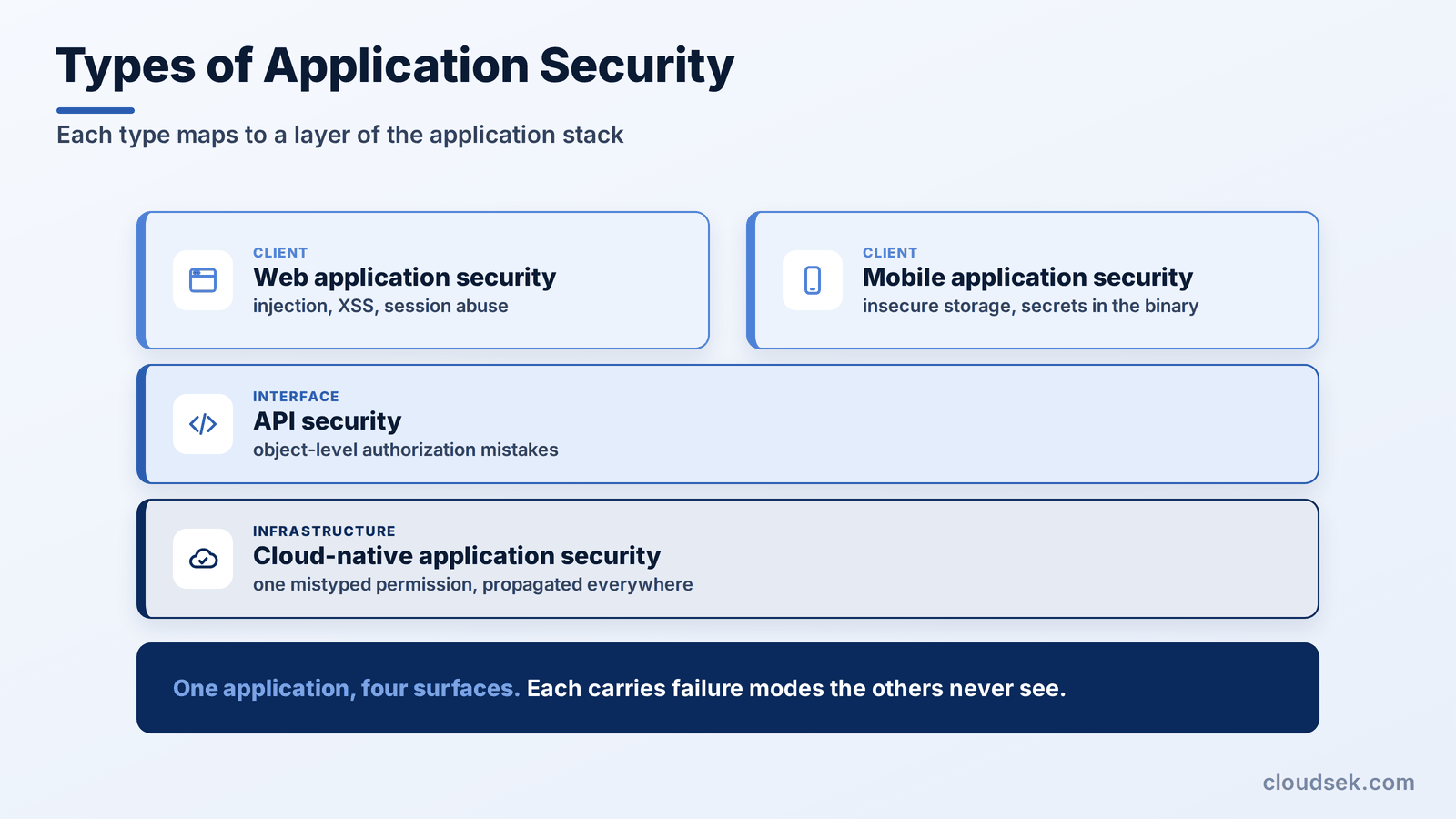
It guards browser-facing software against injection, cross-site scripting, and session abuse, the classes that dominate breach reports year after year. Single-page frameworks and heavy client-side logic moved a large share of this risk into JavaScript running on the visitor’s machine.
Mobile application security handles the Android and iOS packages an organization ships, where insecure local storage, weak certificate validation, and secrets compiled into the binary create risks no server-side control reaches.
API Security protects the machine-to-machine interfaces behind web and mobile frontends. Authorization mistakes dominate here, since every new endpoint multiplies the places where object-level access gets checked wrongly.
It covers containers, serverless functions, and the infrastructure-as-code templates that deploy them, where one mistyped permission propagates across every environment built from the same template.
Threat prioritization in application security starts with one document. OWASP published the Top 10:2025 in November 2025, the first refresh of its risk ranking since 2021, rebuilt from analysis of more than 175,000 CVE records alongside practitioner surveys.
Structure shifted along with the data. Server-side request forgery folded into the first category, security misconfiguration climbed 3 places, and 2 categories entered the list for the first time. Both newcomers reflect risk that lives in how software is assembled and operated rather than in any single line of code. MITRE’s CWE Top 25 catalogs the same terrain at the individual weakness level, pairing with OWASP’s category view.
Testing methods split by what they inspect and when they run, and the spread below explains why working programs stack several rather than picking one:
Trade-offs decide the mix. Static scanning arrives first and drowns teams in findings; dynamic scanning reports real behavior, but late, and human testing reaches what no automation touches at a price that limits its frequency.
A web application firewall (WAF) stands at the network edge and filters HTTP traffic before requests reach the application, blocking known attack patterns such as injection payloads and cross-site scripting probes. Rule upkeep is the tax: signatures need tuning per application, and each new microservice arrives unprotected until someone writes its rules.
Runtime application self-protection (RASP) takes the opposite position, operating inside the application process and judging each call with full context of what the code is about to execute. Instrumentation overhead and language support set its practical limits.
Shifting left means moving security work toward the start of the software development lifecycle (SDLC), where a flaw costs minutes instead of an incident. NIST formalizes the approach in its Secure Software Development Framework (SSDF), Special Publication 800-218, which groups practices into four areas: preparing the organization, protecting the software, producing well-secured software, and responding to vulnerabilities. In day-to-day development, that intent plays out across six stages:
DevSecOps names the arrangement, with security work distributed across development and operations rather than parked at the end of the cycle. AI-assisted development raises the stakes on every gate. Generated code ships in volumes no manual review absorbs, and the models reproduce the insecure patterns present in their training data, so the same automated scanning applies with thinner human margin for error.
Modern applications assemble more borrowed code than written code: direct dependencies pull transitive ones, build tools and registries sit inside the trust chain. One compromised package upstream lands in thousands of products downstream, the mechanics behind a supply chain attack.
Fresh proof arrived in August 2026. A self-propagating worm tore through the npm registry after a single maintainer account takeover, publishing malicious versions of more than 400 packages. Payloads executed through preinstall hooks, harvesting credentials from developer machines and build pipelines, per Microsoft’s analysis of the ChainDrop campaign. Every application that pulled an infected version inherited the compromise without a line of its own code changing.
CloudSEK research put numbers on the blast radius of the same pattern. In March 2026, the TeamPCP threat group reached the LiteLLM AI gateway indirectly, through a poisoned build of the Trivy scanner that LiteLLM’s own pipeline installed automatically. CloudSEK’s analysis maps potential exposure across more than 2,500 organizations and roughly 434,000 CI/CD (continuous integration and delivery) pipelines, from packages that stayed live on PyPI for about 40 minutes.
Defenses begin with visibility. A software bill of materials (SBOM) lists every component a build contains, composition scanning maps those components to known flaws, and pinned versions with verified signatures shrink the window for tampered updates.
AI dependencies need the same scrutiny. CloudSEK AIVigil inspects AI packages and model files for malicious code before they reach production, and its AI bill of materials maps the models and libraries an application depends on.
Cloud platforms redraw the boundary of what counts as the application. Shared responsibility puts the provider in charge of the infrastructure and the customer in charge of everything deployed on it, and misconfiguration on the customer side now produces more cloud exposure than any exotic exploit.
Secrets sprawl compounds the problem. Access keys, tokens, and connection strings scatter across environment variables, configuration files, and storage buckets, and one exposed credential grants the access that once took months of patient exploitation. It’s the same lifecycle that turns leaked credentials into initial access.
Leaked secrets often surface in public places first. In one CloudSEK case study, XVigil found a public GitHub repository linked to a major Indian fintech company that exposed usernames, passwords, and database credentials, which the company then revoked and rotated. External monitoring of code repositories and paste sites catches these exposures before an attacker uses them.
Everything above assumes the defender knows what runs where. Attackers skip that assumption and enumerate: forgotten subdomains, staging builds left public, retired app versions still resolving, and mobile packages on public stores carrying compiled-in keys, none of which appear in the pipeline’s inventory.
CloudSEK’s BeVigil approaches applications the same way. The platform fingerprints an organization’s internet-facing footprint, scans web applications for exploitable classes including SQL injection and cross-site scripting, inspects published mobile packages for embedded secrets and weak configurations, and probes exposed APIs. Applications account for 3 of the 8 external surfaces the platform watches.
Neither side replaces the other. External scanning maps what the internet already sees and feeds a continuous attack surface management loop that keeps inventories honest, while static analysis, pipeline gates, and source-level fixes stay with development tooling, where they belong.
Seven habits separate programs that reduce risk from programs that generate reports, and CloudSEK’s guide to application security best practices expands each into implementation detail.
Measurement holds the program together. Counts of findings per release, remediation time, and defects escaping to production show whether the 7 habits reduce risk or merely document it.
Software security builds protection into code as it is written, while application security spans the full lifecycle, adding runtime defense, configuration, and monitoring after release. In practice, the first works as a subset of the second.
Application security defends the software layer, meaning code, dependencies, and interfaces, while network security defends the transport layer through firewalls, segmentation, and traffic inspection. Attacks riding legitimate HTTPS sessions often pass through network controls unchallenged, which is why the application itself must defend against them.
ASPM (application security posture management) is a tool category that aggregates findings from scanners, pipelines, and cloud platforms into one prioritized view. It emerged as a category in 2023 to answer the sprawl created by disconnected testing tools.
No, a WAF alone is not enough for application security. Edge filtering blocks known attack patterns but never repairs the underlying flaw, misses business logic abuse, and lags behind novel payloads, so code-level remediation stays essential.
Applications need penetration testing at least once per year, plus a fresh round after major releases, architecture changes, or security incidents. High-risk applications in finance and healthcare commonly run 2 to 4 assessments per year.
Yes, application security is part of cybersecurity. Cybersecurity spans networks, endpoints, identities, data, and applications, and the application layer forms the slice where code-level flaws meet business logic.
