🚀 A CloudSEK se torna a primeira empresa de segurança cibernética de origem indiana a receber investimentos da
Leia mais
.avif)

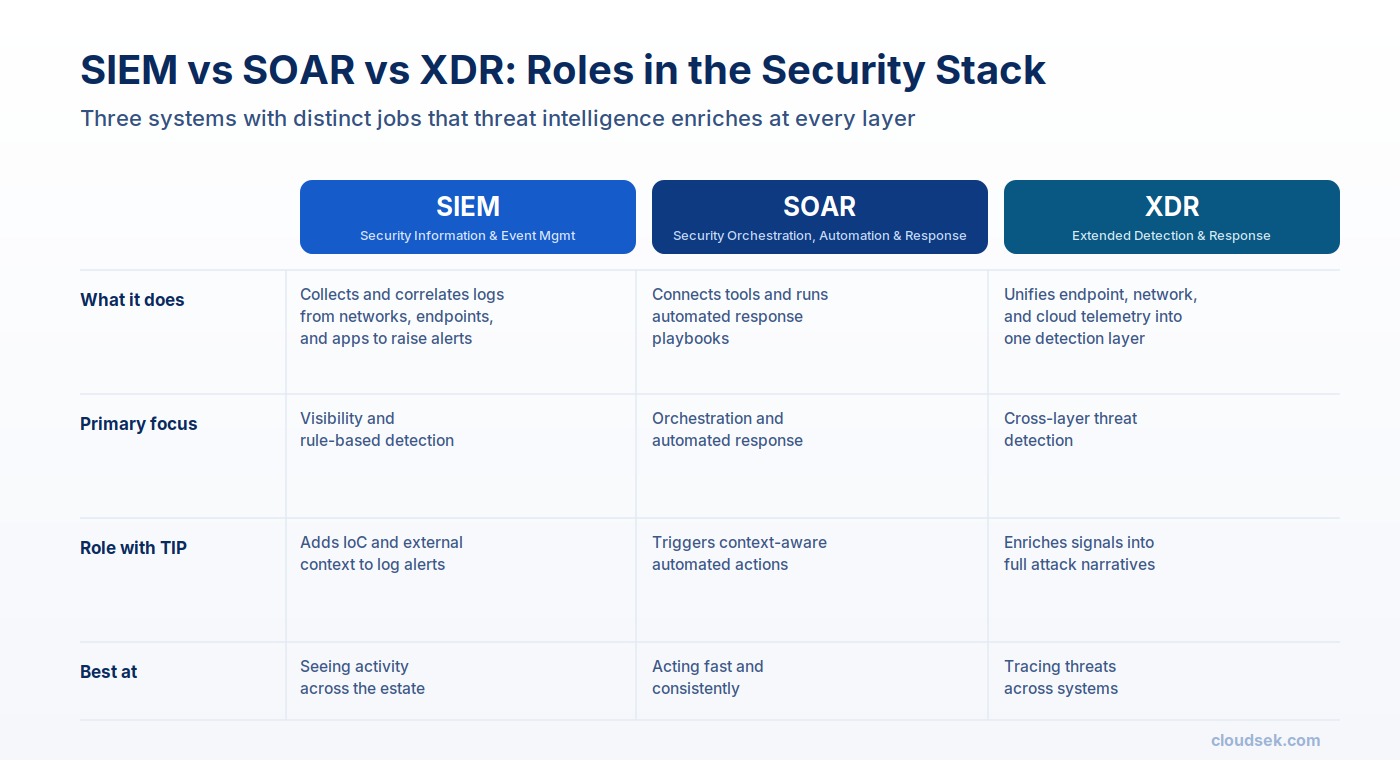
SIEM (Security Information and Event Management) is a cybersecurity system that collects, stores, and analyzes log data from networks, endpoints, servers, and applications. It detects suspicious behavior by correlating events and generating alerts based on defined rules and patterns.
Security teams use SIEM to gain visibility into system activity and identify potential threats across the infrastructure. Integration with Threat Intelligence Platforms enhances these alerts by adding context through Indicators of Compromise and external intelligence.
SOAR (Security Orchestration, Automation, and Response) is a cybersecurity platform that connects multiple security tools and automates incident response workflows. Predefined playbooks execute actions such as blocking threats, enriching alerts, and initiating investigations without manual intervention.
Security operations become faster and more consistent through orchestration across tools like SIEM and endpoint systems. Integration with threat intelligence sources improves decision-making by enabling context-aware and automated responses.
XDR (Extended Detection and Response) is a security approach that combines data from endpoints, networks, cloud systems, and applications into a single detection layer. Multiple telemetry streams are analyzed together to uncover attack patterns that remain hidden in isolated tools.
Threat activity becomes easier to trace across systems instead of appearing as disconnected alerts. Context from integrated intelligence sources connects events into complete attack narratives and supports faster response decisions.
Threat Intelligence Platforms integrate with SIEM systems by feeding contextual threat data into log analysis workflows, allowing security teams to detect and understand threats with higher accuracy.
Threat intelligence platforms continuously supply Indicators of Compromise, including suspicious network indicators, flagged domains, and known malicious file signatures. These inputs expand SIEM visibility beyond internally generated data.
Raw indicators are enriched with additional context like threat actors, attack techniques, and historical activity. Enriched data provides meaning that basic logs cannot deliver.
SIEM systems match enriched intelligence with incoming log data from endpoints and networks. Correlation reveals patterns that indicate potential security incidents.
Threat intelligence updates detection rules within SIEM to align with current threat landscapes. Updated rules improve the system’s ability to identify evolving attack methods.
Generated alerts include intelligence-backed context rather than isolated signals. Analysts can quickly understand why an alert was triggered and what it represents.
Context-rich alerts are ranked based on risk and relevance. High-priority threats surface faster, reducing time spent on low-impact events.
Detection outcomes are sent back to the intelligence platform to refine future data. Continuous feedback strengthens both intelligence quality and SIEM performance.
Automation within security operations becomes more effective as enriched intelligence flows into response systems, where Threat Intelligence Platforms integrate with SOAR platforms to enable faster and more informed actions.
Structured threat data is delivered into SOAR systems as actionable input for decision-making. Clean and contextual intelligence ensures workflows start with accurate information.
Predefined response playbooks are triggered based on specific threat signals. Automated initiation removes delays caused by manual validation.
Response actions such as blocking suspicious activity or isolating assets are carried out automatically. Consistent execution reduces errors across repeated incidents.
Different security tools are orchestrated together to respond simultaneously. Coordinated actions improve efficiency across the entire security environment.
Each response action is supported by intelligence that explains the nature of the threat. Analysts gain clarity without needing to investigate from scratch.
Results from automated actions are fed back into the intelligence system for refinement. Ongoing updates improve both future responses and threat accuracy.
Integration with XDR combines external threat intelligence with internal telemetry to enrich signals, detect patterns, and identify coordinated attacks across systems.
Telemetry from endpoints, networks, and cloud systems is combined with external threat intelligence. Merged data creates a broader view of potential threats.
Multiple signals are analyzed together to identify complex attack patterns. Correlation reduces the chances of missing multi-stage threats.
External intelligence adds context to detected activities within XDR. Enriched insights help distinguish between normal behavior and real threats.
Threats moving across different environments are identified more effectively. Visibility across layers prevents attackers from exploiting isolated gaps.
Related events are connected into a single incident view. Linked insights make investigations faster and more accurate.
Findings from XDR detections are fed back into the intelligence platform. Continuous updates improve future detection and overall threat awareness.
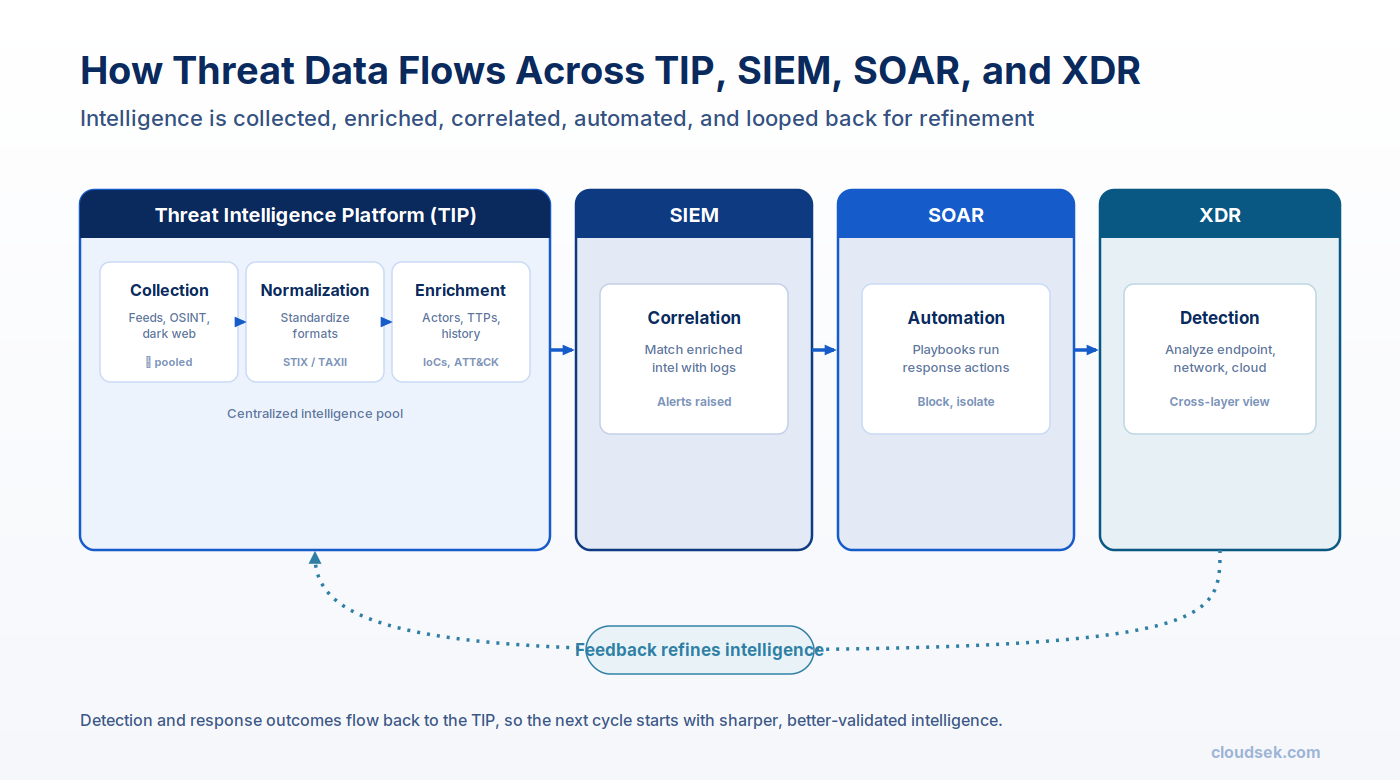
Threat intelligence moves through a structured pipeline where data is collected, enriched, correlated, automated, and continuously refined across integrated systems.
Integration across these systems turns isolated security operations into a connected workflow where intelligence directly drives detection and response.
Threat intelligence enables systems to identify risks as they appear within logs and telemetry. Faster detection limits the time attackers have to move across environments.
Enriched intelligence adds background, such as attacker behavior and intent, to each alert. Better context allows quicker and more confident decision-making.
Correlation between internal data and external intelligence filters out irrelevant alerts. Fewer false positives help teams focus on real threats.
Automated workflows triggered by intelligence reduce delays in handling incidents. Immediate actions improve overall response efficiency.
Manual investigation and repetitive tasks are minimized through integration and automation. Security teams can allocate time to complex threat analysis.
Data flowing across SIEM, SOAR, and XDR provides a unified view of threats. Visibility across layers prevents gaps in detection.
Feedback from detection and response cycles strengthens intelligence over time. Systems evolve to become more accurate and resilient against emerging threats.
Connecting multiple security systems introduces technical and operational challenges that can impact performance and detection quality if not managed carefully.
Large volumes of incoming threat intelligence can overwhelm detection systems. Excessive data often leads to noise instead of actionable insights.
Different tools operate on varied architectures and data formats, making alignment difficult. Proper configuration requires planning and skilled implementation.
Inconsistent support for standards like STIX and TAXII can disrupt data exchange. Lack of uniform structure reduces efficiency across systems.
Poorly tuned integrations may generate alerts that do not represent real threats. Increased noise slows down investigation and impacts decision-making.
Continuous tuning, updates, and monitoring are required to keep integrations effective. Ongoing effort is necessary to adapt to evolving threats and system changes.
CloudSEK enables integration by delivering real-time threat intelligence through APIs that connect directly with SIEM and SOAR platforms. Enriched alerts are streamed into systems like IBM QRadar, Wazuh, and LogRhythm to improve detection accuracy and log correlation.
Threat intelligence from CloudSEK is used within SOAR platforms such as Cortex XSOAR to trigger automated response workflows. Automated playbooks execute actions like blocking threats and initiating investigations without manual intervention.
Security alerts are also integrated into ticketing and communication tools like ServiceNow, Jira, and Slack for streamlined incident management. Scalable integration across 50+ applications ensures continuous intelligence flow and coordinated response across security operations.
