🚀 A CloudSEK se torna a primeira empresa de segurança cibernética de origem indiana a receber investimentos da
Leia mais


Operational security (OPSEC) is a five-step process for identifying critical information, analyzing the threats and vulnerabilities around it, and applying countermeasures that deny adversaries an actionable picture of operations. OPSEC protects patterns, behaviors, and small operational details rather than systems, which sets it apart from most security disciplines.
In March 2026, a single leaked automation token cascaded through the software supply chain. CloudSEK's investigation of the resulting LiteLLM compromise identified more than 2,500 organizations and roughly 434,000 CI/CD pipelines potentially exposed, a chain that began with one small piece of unprotected information.
OPSEC treats information as an asset an adversary collects, correlates, and acts on. NIST describes OPSEC as a systematic process to deny adversaries information about capabilities and intentions by identifying, controlling, and protecting unclassified indicators tied to sensitive activities.
Scope separates OPSEC from information security. Information security guards data at rest and in transit, while OPSEC guards the exhaust around operations: schedules, procedures, supplier relationships, staffing changes, and the routine behaviors that reveal intent. Protected categories include user roles, system dependencies, supply chain processes, and implementation details.
OPSEC exists because adversaries assemble intelligence from fragments, not from single secrets. An indicator is a discrete, often harmless data point that gains meaning when combined with others, the way puzzle pieces resolve into an image.
A worked example shows the mechanic. An employee's public profile reveals a role, a job posting reveals the technology stack that role supports, a conference talk reveals the architecture, and a geotagged photo reveals a facility. None of these is sensitive alone, yet together they hand an attacker a targeting map, which is why cybersecurity reconnaissance leans on exactly this aggregation.
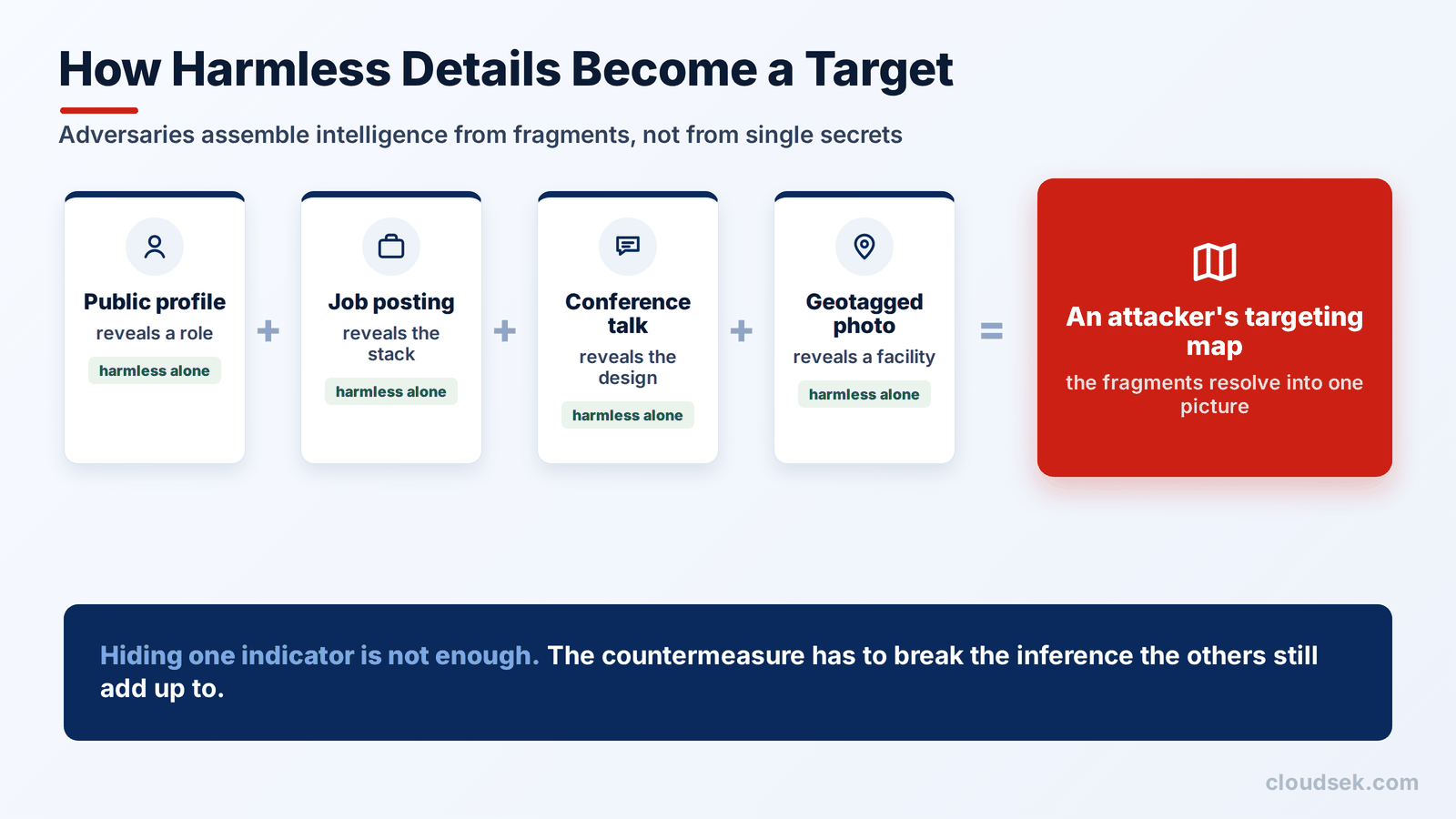
Aggregation is why OPSEC resists a checklist mindset. A control that hides one indicator fails if three others still combine into the same conclusion, so OPSEC evaluates exposure as a whole rather than field by field. The discipline asks what an adversary infers from everything visible, then closes the smallest set of gaps that breaks the inference.
OPSEC began in the Vietnam War. Rolling Thunder bombing missions kept failing to surprise their targets, and a 1966 Joint Chiefs of Staff survey code-named Purple Dragon traced the losses to predictable US patterns. The adversary read those patterns in advance, from stereotyped takeoff times to fixed refueling routes.
Purple Dragon proved that protecting classified secrets was not enough while unclassified routines gave the game away. The survey became a permanent capability, and in 1988 National Security Decision Directive 298 established national OPSEC policy, codifying the five-step process still used today. The discipline moved from military doctrine into government, critical infrastructure, and enterprise security over the decades that followed.
The OPSEC process runs as five sequential steps, repeated as conditions change. Each step feeds the next, and the cycle restarts whenever missions, technologies, or threats shift.
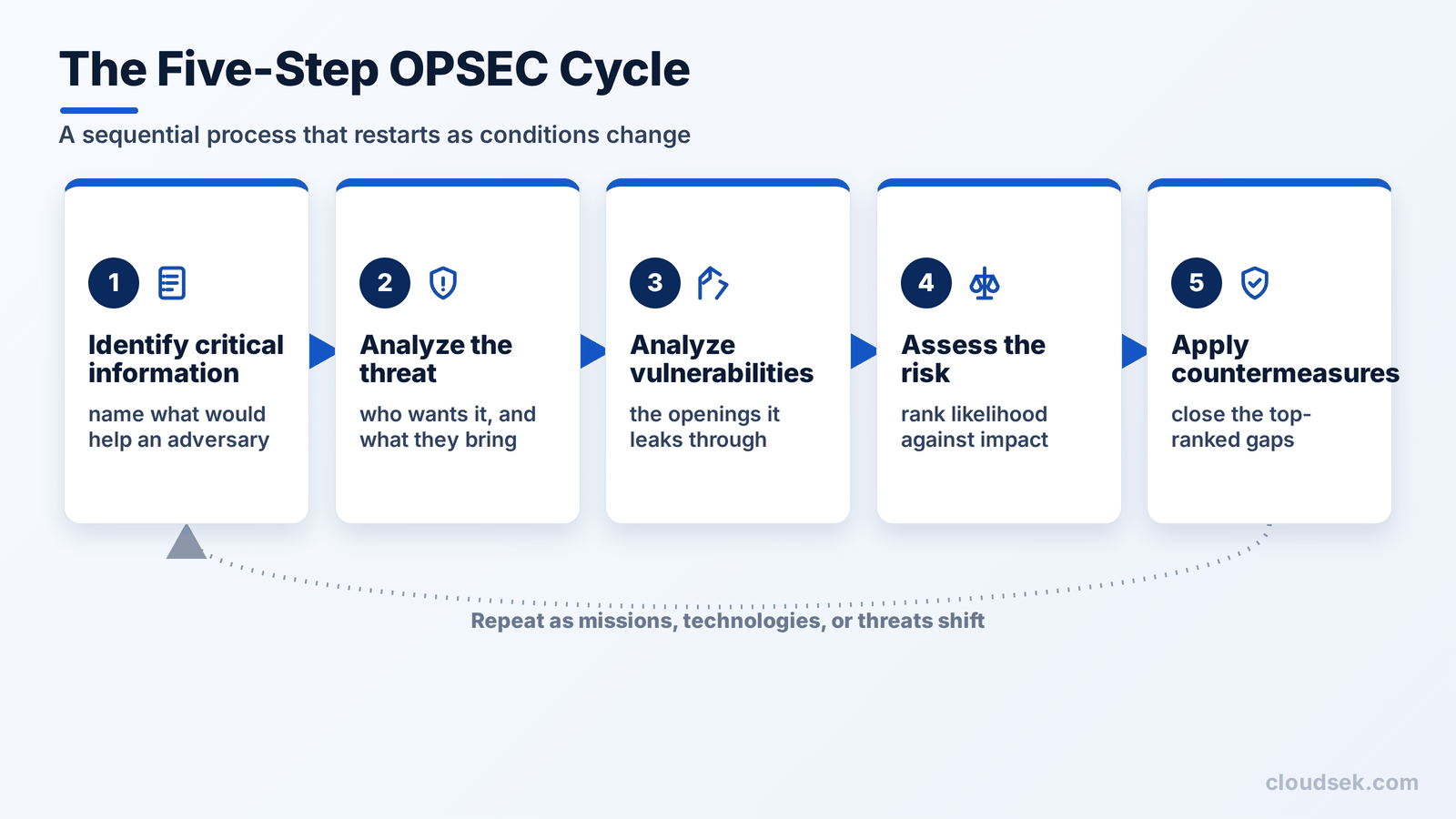
Identification starts by naming the information that would help an adversary if exposed: plans, capabilities, staffing, logistics, and the indicators that reveal them. Teams record this in a critical information list, documenting each item's owner, priority, and handling rules, and review it as operations evolve.
Threat analysis identifies who wants the information and what they bring to the effort. It rates adversaries on intent, their motivation to act, and capability, the tools and access available to them, drawing on intelligence reporting and historical patterns. Analysts weigh threat shifting too, the way adversaries adapt once safeguards appear, by delaying, changing targets, or switching techniques.
Vulnerability analysis finds the openings through which critical information leaks. These range from geotagged social posts and predictable schedules to misconfigured systems and third-party exposure, and each vulnerability is a path an adversary walks toward the critical information list.
Risk assessment pairs each threat with each vulnerability and weighs likelihood against impact. High-likelihood, high-impact combinations rise to the top, and this ranking justifies where limited countermeasure budget goes through a cost-benefit lens rather than treating every exposure equally.
Countermeasures close the prioritized risks through policy, process, technology, or behavior change. Examples include tightening need-to-know access, varying predictable patterns, stripping metadata, and training staff, and effective programs fold these controls into daily operations rather than bolting them on.
OPSEC overlaps with adjacent disciplines yet protects something distinct. The comparison clarifies where each one operates.
The 2026 LiteLLM breach reads as an OPSEC failure at machine speed. It shows how one unprotected indicator, a leaked automation token, cascaded into potential credential exposure across thousands of organizations, and how modern operations expose secrets far faster than the Vietnam-era pattern that named the discipline.
Trust carried the attack. Attackers first compromised Trivy, a widely used open-source security scanner. LiteLLM’s CI pipeline installed Trivy without pinning it to a verified version, which let the attackers publish two poisoned LiteLLM releases (1.82.7 and 1.82.8) to the Python Package Index. The releases were live for only about 40 minutes. A malicious file executed the moment Python started, so any environment that merely installed the package ran the payload.
What the payload swept maps directly onto a critical information list nobody had written. It harvested cloud keys, source-control tokens, SSH keys, Kubernetes secrets, and AI provider keys from continuous-integration runners, reading credentials straight from process memory and metadata services. In some cases, the malware used stolen credentials to create repositories in the victim’s own GitHub organization, turning an organization into the unwitting host of its own critical information.
CloudSEK's research draws the OPSEC lesson plainly. AI gateways and agent runtimes now sit as junctions between data, identity, compute, and autonomous action, which concentrates exactly the credentials an adversary needs, and traditional tooling built for endpoints and ports is not designed to see that AI-layer exposure. Removing the package ended nothing, since copied credentials stayed usable until rotation, the countermeasure step that containment depends on.
OPSEC applies wherever exposed information carries consequences, and the critical information changes with the setting. Security teams run it as a continuous program alongside threat intelligence and attack surface management, not as a one-time review.
Corporate OPSEC protects mergers, product launches, layoffs, executive travel, and supply chain relationships. Indicators leak through job postings that reveal a pivot, vendor announcements that expose partnerships, and public code repositories that expose architecture and secrets, each a fragment competitors and attackers collect.
Individual OPSEC governs what a person reveals through social media, location sharing, and routine. Geotagged photos expose a home or workplace, check-ins expose patterns, and oversharing about travel exposes absence, which is why practicing OPSEC protects individuals as directly as organizations.
Distributed work widened the OPSEC surface past the office perimeter. Home networks, personal devices, video-call backgrounds that reveal documents, and public-space screen exposure each leak indicators that a controlled office once contained.
Six failures recur across most preventable exposure.
Six best practices turn the process into routine defense.
Modern OPSEC has an external half that no policy controls: the information already exposed on the open, deep, and dark web, waiting for an adversary to collect it. Seeing that exposure first, before reconnaissance turns it into an attack, is the monitoring function OPSEC has always needed and rarely had.
CloudSEK XVigil provides that outside-in view, surfacing leaked credentials, exposed data and code in public repositories, impersonation, and sensitive data traded across underground channels. BeVigil adds the asset side, discovering forgotten and shadow internet-facing systems before reconnaissance does. For the AI layer the LiteLLM breach targeted, AIVigil finds and validates leaked AI API keys, monitors exposed model endpoints, agents and MCP servers, and inspects AI packages and model files for malicious code before deployment. SVigil extends the view to vendors and their dependencies, and CloudSEK Threat Intelligence supplies the adversary context around all of them.
Placement stays honest. These tools reveal what an adversary already sees and feed the countermeasure step; they complement the internal OPSEC process of classification, need-to-know, and pattern discipline rather than replacing it.
OPSEC protects the indicators and patterns that reveal operations, while information security protects the confidentiality, integrity, and availability of the data itself. OPSEC asks what adversaries infer; information security asks how data stays safe.
No, OPSEC is not only for the military. It began as military doctrine in the Vietnam War, and enterprises, governments, and individuals now apply the same five-step process to protect sensitive operational information.
A critical information list is a documented inventory of the specific information an adversary could exploit, recording each item's owner, priority, and handling rules, and reviewed regularly as operations change.
An OPSEC indicator is a discrete, often harmless detail that reveals critical information when combined with others, such as a job posting, a geotagged photo, or a predictable schedule.
Responsibility for OPSEC in an organization is shared: leadership owns the critical information list, security teams run analysis and countermeasures, and every employee controls the indicators they expose.
Yes, individuals can practice OPSEC. Limiting location sharing, stripping photo metadata, varying routines, and reviewing a public footprint apply the same principles that protect organizations.
