What Is Cybersecurity Reconnaissance? Types and Risks
Cybersecurity reconnaissance is the first attack stage where attackers gather information about systems, users, and assets to identify attack paths before exploitation.
Cyberattacks do not begin with exploitation. They begin with deliberate information gathering focused on systems, users, and exposed assets to identify defensive gaps. This initial phase, known as cybersecurity reconnaissance, determines attack precision, stealth, and success well before malware execution.
Breach investigations consistently confirm that most successful intrusions involve reconnaissance activity days or weeks before access. As organizations expand cloud usage and internet-facing services, reducing reconnaissance opportunities and detecting them early defines effective modern security strategy.
What Is Cybersecurity Reconnaissance?
Cybersecurity reconnaissance is the process of gathering information about systems, networks, users, and defenses to identify potential attack paths. It is the first stage of most cyberattacks and occurs before exploitation, intrusion, or malware deployment.
In a cybersecurity reconnaissance attack, attackers identify targets, map exposed assets, enumerate services, and study human and technical weaknesses. The quality of reconnaissance directly determines how targeted, stealthy, and effective later attack stages become, because informed attackers make fewer mistakes and generate less detectable noise.
How Cybersecurity Reconnaissance Works?
Cybersecurity reconnaissance works through 4 connected steps that turn unknown targets into mapped attack paths.
Identify targets Attackers select what to study, such as domains, IP ranges, cloud accounts, or specific employees. This step narrows the scope and focuses the effort on high-value systems.
Collect technical data Attackers gather details about exposed infrastructure, such as open ports, running services, software versions, and cloud assets. This data reveals what is reachable from the internet and what technologies are in use.
Collect human data Attackers gather employee and organizational information, such as email formats, job roles, public profiles, and vendor relationships. This data increases phishing accuracy and supports credential-focused attacks.
Analyze weaknesses and plan next actions Attackers connect the findings to likely entry points, misconfigurations, and weak controls. This analysis determines the next stage, such as exploitation, password attacks, or social engineering.
Types of Cybersecurity Reconnaissance
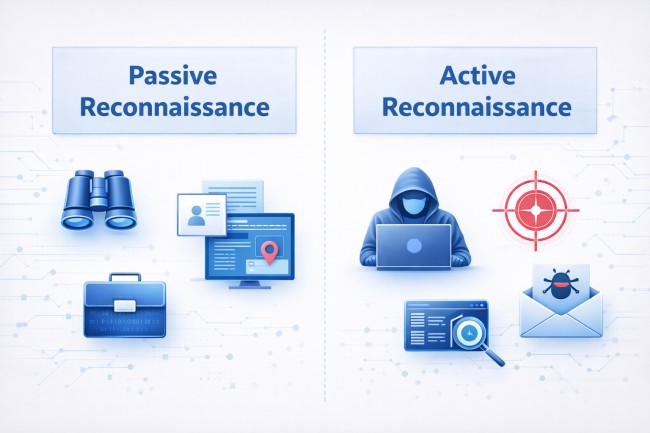
Cybersecurity reconnaissance occurs in two primary types, based on whether the attacker directly interacts with the target environment.
Passive Reconnaissance
Passive reconnaissance focuses on collecting information without touching the target systems. Attackers rely on public, third-party, and historical data sources that do not generate alerts or logs on the victim’s infrastructure.
This type includes reviewing public websites, domain records, code repositories, breach data, and employee information shared on professional networks. Passive reconnaissance is low risk for attackers because it leaves no direct trace, but it still reveals valuable details about technologies, users, and exposed assets.
Active Reconnaissance
Active reconnaissance involves direct interaction with systems and networks to gather information. Attackers send probes, scans, or requests to identify live hosts, open ports, running services, and security controls.
This type includes network scanning, service enumeration, and vulnerability probing. Active reconnaissance increases accuracy and detail but carries higher detection risk because it produces network traffic, log entries, and behavioral signals that defenders can monitor and block.
The key difference between passive and active reconnaissance is visibility. Passive methods prioritize stealth, while active methods prioritize accuracy and real-time validation of targets.
Passive Reconnaissance vs Active Reconnaissance: Comparison Table
Aspect
Passive Reconnaissance
Active Reconnaissance
Target Interaction
No direct interaction
Direct interaction with systems
Data Sources
Public and third-party sources
Live systems and networks
Detection Risk
Very low
Moderate to high
Accuracy of Data
Indirect and contextual
Direct and real-time
Typical Techniques
OSINT, breach data, DNS records
Port scans, service probes
Defensive Visibility
Little to none
Network logs and alerts
Attack Phase Use
Early intelligence gathering
Pre-exploitation validation
Common Cybersecurity Reconnaissance Techniques
Attackers use multiple reconnaissance techniques to understand how a target organization is built and where it is most exposed. Each technique reveals a different type of weakness.
Open-Source Intelligence (OSINT) Publicly available information is collected from company websites, job postings, social media platforms, forums, and breach repositories. This data reveals technologies in use, employee roles, email formats, and external relationships.
DNS and Domain Enumeration Domain records are analyzed to identify subdomains, mail servers, and name servers. This process exposes hidden systems, test environments, and misconfigured services that are not visible through the main website.
Network Scanning IP ranges are scanned to determine which systems are active and reachable. Live hosts become priority targets, while inactive addresses are filtered out.
Port and Service Discovery Open ports and associated services are identified on exposed systems. Service discovery reveals running applications and, in some cases, software versions linked to known weaknesses.
Email and Employee Profiling Employee names, roles, and contact details are gathered from public sources. This information increases the success rate of phishing and impersonation attempts.
Technology Stack Fingerprinting Underlying platforms and software frameworks are identified, such as web servers, databases, and content management systems. Technology awareness guides exploit and attack method selection.
Cloud Asset Discovery Exposed cloud resources, including storage buckets, APIs, and virtual machines, are located. Misconfigured cloud assets often provide direct access without advanced exploitation.
Together, these techniques allow attackers to build a detailed map of the target before attempting any intrusion.
Real-World Examples of Cybersecurity Reconnaissance
Cybersecurity reconnaissance appears in multiple real-world attack scenarios:
Equifax breach (2017) Before exploiting the vulnerable Apache Struts application, attackers performed reconnaissance to identify exposed web applications and unpatched services. Public-facing system enumeration allowed attackers to target a known vulnerability, leading to the exposure of data belonging to approximately 147 million individuals. The breach demonstrated how reconnaissance shortens time to exploitation when patch visibility is poor.
Target data breach (2013) Attackers first conducted reconnaissance on Target’s third-party vendors and identified a less-secure HVAC contractor. Employee and vendor profiling enabled credential compromise, which attackers then used to move laterally into Target’s internal network. The breach resulted in over 40 million payment card records being stolen, showing how human and vendor reconnaissance enables indirect access.
Colonial Pipeline attack (2021) Reconnaissance activity focused on identifying exposed remote access systems and unused VPN credentials. Attackers leveraged a single compromised account discovered through credential exposure rather than exploitation. The resulting ransomware attack disrupted fuel supply across the U.S. East Coast, highlighting how reconnaissance-driven access can bypass technical defenses entirely.
Attacker vs Defender Reconnaissance
Cybersecurity reconnaissance is used by both attackers and defenders, but the intent and authorization differ completely.
Attacker reconnaissance focuses on discovering weaknesses that enable unauthorized access. It prioritizes exposed assets, misconfigurations, weak credentials, and human targets that reduce effort and detection risk. The goal is to gather enough intelligence to execute precise, low-noise attacks.
Defender reconnaissance focuses on identifying exposure before attackers do. Security teams actively scan their own environments to discover unknown assets, misconfigurations, leaked credentials, and shadow IT. The goal is to reduce the attack surface and close entry points proactively.
Risk
How It Increases Security Risk
Expanded Attack Surface Visibility
Exposed systems, services, and users become fully mapped. Clear visibility allows attackers to choose the weakest entry points instead of guessing.
Higher Likelihood of Targeted Attacks
Detailed reconnaissance enables highly targeted phishing, exploitation, and credential attacks. Targeted attacks succeed more often than generic campaigns.
Faster Exploitation Timelines
Well-prepared attackers move quickly from reconnaissance to intrusion. Reduced time between discovery and exploitation limits defensive response windows.
Increased Breach Success Rates
When reconnaissance goes unnoticed, attackers avoid errors and detection. Precise planning increases the probability of successful compromise and persistence.
Detection Technique
What to Look For
Why It Indicates Reconnaissance
Unusual Scanning Activity
Repeated requests across multiple ports, services, hosts, or IP ranges, including sequential port checks and probes from unfamiliar sources.
Attackers scan systems to identify open ports, exposed services, and potential entry points.
Abnormal DNS Queries
High volumes of subdomain requests, repeated lookups, or spikes in NXDOMAIN responses for names such as dev, vpn, api, or staging.
DNS enumeration helps attackers discover hidden services, infrastructure, and domain structure.
Repeated Failed Connection Attempts
Repeated failed logins, TLS handshakes, or service requests across VPNs, admin panels, remote access gateways, or multiple accounts.
High failure rates can indicate probing to determine valid accounts, services, or system capabilities.
Enumeration Across Multiple Assets
One source accessing multiple web apps, APIs, file services, cloud endpoints, admin paths, metadata URLs, or predictable directories.
Cross-asset activity helps attackers map the environment and understand how systems and services are connected.
How Organizations Can Protect Themselves From Cyber Reconnaissance?
Organizations can protect themselves from cybersecurity reconnaissance by limiting what attackers can see and detecting discovery activity early. Protection focuses on exposure control, visibility, and response.
Here is what organizations can do to protect from Cybersecurity Reconnaissance:
Reduce the External Attack Surface Public-facing assets should be minimized and reviewed regularly. Unused domains, test environments, old APIs, and exposed services increase what attackers can map. Removing or restricting these assets reduces reconnaissance value.
Maintain an Accurate Asset Inventory Security teams must know what systems exist across on-premises, cloud, and third-party environments. Unknown or unmanaged assets are easy reconnaissance targets because they lack monitoring and controls.
Harden Identity and Access Points Remote access portals, VPNs, email systems, and admin interfaces attract reconnaissance. Strong authentication, limited access scopes, and account monitoring reduce the usefulness of credential and login probing.
Monitor for Enumeration and Scanning Behavior Network traffic, DNS activity, and authentication logs should be continuously monitored for discovery patterns. Early alerts allow teams to block sources and investigate before exploitation begins.
Apply Rate Limiting and Access Controls Rate limits restrict how quickly systems respond to repeated requests. Slowing down enumeration makes reconnaissance noisy and less effective while increasing detection opportunities.
Use Threat Intelligence and External Monitoring Threat intelligence identifies scanning infrastructure, malicious IP ranges, and reconnaissance tools. External monitoring of exposed assets helps organizations see themselves as attackers do.
Effective protection weakens attacker preparation and disrupts the attack chain before intrusion occurs.
How CloudSEK Helps Prevent Cybersecurity Reconnaissance?
CloudSEK helps organizations disrupt cybersecurity reconnaissance by giving continuous visibility into their external digital footprint. Its Attack Surface Intelligence identifies internet-exposed assets, shadow IT, misconfigured cloud resources, and forgotten subdomains that attackers typically discover during reconnaissance.
CloudSEK’s Threat Intelligence and Digital Risk Protection services monitor open web, deep web, and dark web sources to detect leaked credentials, exposed employee data, and early chatter related to asset discovery. By surfacing these signals early, CloudSEK enables security teams to reduce exposure and close entry points before reconnaissance evolves into targeted exploitation.
Frequently Asked Questions
What is the goal of cybersecurity reconnaissance?
The goal is to identify weaknesses, entry points, and attack paths before exploitation.
Is cybersecurity reconnaissance illegal?
Reconnaissance is legal with authorization. Unauthorized reconnaissance can violate cybercrime laws.
Can reconnaissance occur without touching systems?
Yes. Passive reconnaissance relies on public and third-party data.
How early can reconnaissance be detected?
Reconnaissance can be detected early through scanning, DNS anomalies, and enumeration behavior.
Do defenders perform reconnaissance?
Yes. Defensive reconnaissance identifies exposed assets and reduces attack surface.
Cybersecurity risk management is the process of identifying, assessing, and treating cyber risk. Explore its steps, frameworks, quantification, and best practices.
A keylogger secretly records every keystroke to steal passwords and data. Learn its types, how it works, its infostealer evolution, and how to detect and remove it.
Smishing is phishing by text message, using fake SMS to steal data and money. Learn how it works, its scam types, red flags, and how to spot and prevent it.
.avif)