🚀 CloudSEK featured in the 2026 Frost Radar™!
Read more
.avif)

Identity threat is a cybersecurity risk that targets digital identities to gain unauthorized access to systems or data. It focuses on exploiting login processes and access permissions rather than attacking infrastructure directly.
Attackers abuse compromised accounts, stolen credentials, or manipulated sessions to appear as legitimate users. Once access is granted, activities often blend with normal behavior and become harder to detect.
Modern environments increase exposure because identity now controls entry to cloud platforms, applications, and internal resources. Control over identity often means control over the organization’s most critical assets.
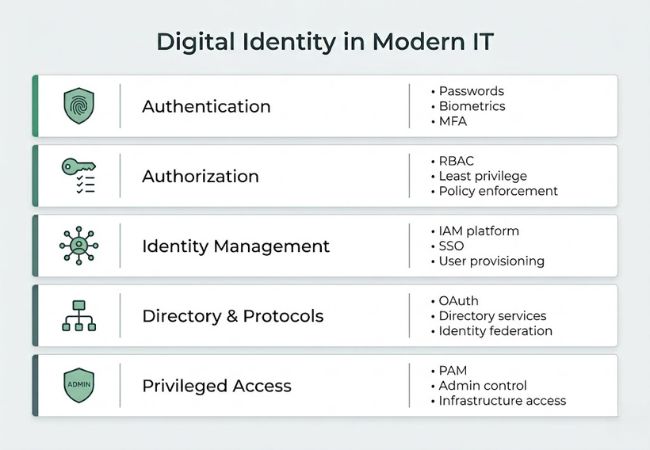
Digital identity systems determine who can access what within an organization. They rely on authentication to verify identity and authorization to define permissions.
Authentication confirms a user’s identity using passwords, biometrics, or Multi-Factor Authentication (MFA). Strong authentication reduces unauthorized access but does not eliminate identity abuse entirely.
Authorization determines what authenticated users can access based on predefined policies. Role-Based Access Control (RBAC) and least privilege principles help minimize exposure.
Identity and Access Management (IAM) platforms centralize user provisioning, access policies, and Single Sign-On (SSO). Technologies like OAuth and directory services such as Active Directory manage identity relationships across systems.
Privileged Access Management (PAM) secures administrative accounts and elevated permissions. Since privileged identities control critical infrastructure, they are high-value targets for attackers.
Identity determines access across modern IT systems where network location no longer defines trust.
Identity-based attacks exploit authentication systems, access permissions, and identity trust relationships to gain unauthorized control.
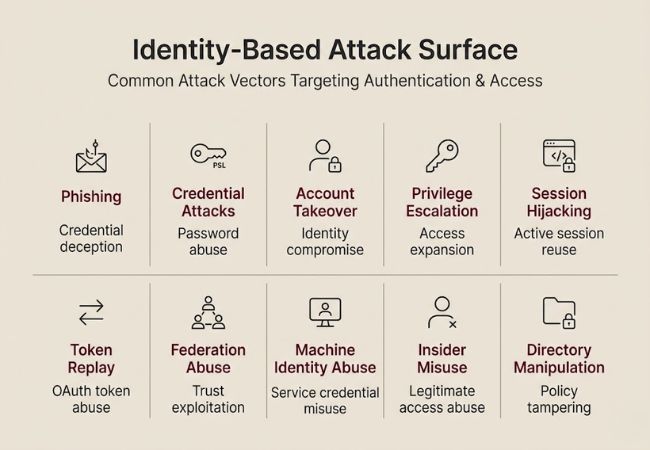
Phishing attacks manipulate users into disclosing authentication credentials through deceptive emails, fake login portals, or impersonated communications. Stolen usernames and passwords allow attackers to bypass access controls without exploiting software flaws.
Spear phishing increases precision by targeting specific employees with context-aware messages. Successful phishing often leads to account compromise within enterprise identity systems.
Credential attacks rely on stolen or reused passwords obtained from data breaches or malware infections. Techniques such as credential stuffing and password spraying attempt large-scale login attempts against authentication portals.
Weak password hygiene and lack of Multi-Factor Authentication increase exposure. Once valid credentials are identified, attackers gain legitimate access to applications and cloud services.
Account attacks occur when adversaries assume control of valid user identities within a system. Account takeover enables unauthorized access to email, SaaS platforms, and internal applications.
MFA fatigue and identity impersonation tactics help bypass secondary verification mechanisms. Activity under a compromised account often appears legitimate in audit logs.
Privilege attacks focus on expanding access rights after initial entry. Privilege escalation enables attackers to move from standard user roles to administrative control.
Misconfigured role assignments and excessive permissions increase the likelihood of abuse. Elevated privileges provide access to configuration settings, sensitive databases, and security controls.
Session attacks exploit active authenticated sessions rather than credentials themselves. Session hijacking and cookie theft allow attackers to reuse valid session identifiers.
Compromised sessions maintain access without triggering password resets. This method bypasses traditional login verification steps.
Token attacks target authentication tokens issued during modern login processes. OAuth tokens and refresh tokens can be replayed to sustain unauthorized API access.
Improper token storage or validation increases exposure risk. Stolen tokens often provide direct access to connected services without additional verification.
Federation attacks exploit trust relationships between identity providers and service providers. Manipulated SAML assertions or compromised federation configurations enable cross-platform access.
Federated identity systems extend authentication beyond a single domain. Weak validation within these trust chains expands the attack surface.
Machine attacks target non-human identities such as service accounts and application credentials. API keys, certificates, and workload identities often carry persistent access privileges.
Machine identities frequently lack the monitoring applied to human users. Compromised service accounts can automate unauthorized actions at scale.
Insider attacks involve authorized users misusing legitimate access privileges. Malicious insiders may extract sensitive data or modify system configurations.
Detection is challenging because actions originate from valid accounts. Excessive permissions increase the potential impact of insider abuse.
Directory attacks manipulate centralized identity stores and access structures. Changes to directory objects or group policies can alter permissions across the environment.
Compromised directory services affect authentication across connected systems. Control over identity infrastructure can disrupt entire enterprise operations.
Identity-based attacks move through distinct stages that expand access and control over time.
Attackers identify valid user accounts, exposed authentication endpoints, and accessible identity services. Leaked credentials and public-facing login portals often provide initial targeting data.
Stolen passwords, phishing results, or compromised tokens are used to authenticate successfully. Gaining valid access allows attackers to operate under a trusted identity.
Misconfigured roles and excessive permissions enable escalation beyond initial access. Elevated privileges increase control over administrative functions and sensitive resources.
Compromised accounts are leveraged to access connected systems through trust relationships. Single Sign-On and federated identity models can extend reach across multiple applications.
Attackers execute objectives such as data exfiltration, financial fraud, or ransomware deployment. Impact typically occurs after identity misuse remains undetected across systems.
Identity threats and identity theft are often confused, but they differ significantly in scope, target, and impact.
Identity threats create operational, financial, and regulatory consequences that extend beyond technical systems.
Preventing identity-based attacks requires layered controls that secure authentication, access permissions, and identity monitoring.
Multi-Factor Authentication reduces reliance on passwords alone and blocks many credential-based attempts. Adaptive verification strengthens protection by evaluating device, location, and behavior.
Access rights should be limited to only what users and services require to perform defined roles. Regular access reviews prevent permission drift and reduce excessive privilege exposure.
Privileged Access Management restricts administrative accounts and monitors elevated sessions. Time-bound access minimizes long-term risk from high-level permissions.
Secure storage and strict validation of OAuth tokens and session identifiers reduce replay and misuse risks. Token expiration policies limit persistent unauthorized access.
Service accounts, API keys, and certificates must be inventoried and monitored continuously. Automated rotation and scoped permissions reduce machine identity abuse.
Behavioral analytics identify unusual login patterns and access anomalies in real time. Identity Threat Detection and Response enables rapid containment of compromised identities.
An effective identity threat protection solution must provide visibility, detection, and response across the entire identity ecosystem.
The platform should provide centralized visibility across users, privileged accounts, service accounts, and federated identities. Unified monitoring reduces blind spots across cloud and on-prem environments.
Advanced analytics should detect abnormal login behavior, privilege misuse, and token anomalies. Context-based risk scoring improves early threat detection.
The solution must continuously track administrative activity and access changes. Real-time alerts reduce response time to privilege abuse.
Token usage patterns should be monitored for replay attempts and unusual API calls. Strong validation prevents long-lived token misuse.
Non-human identities such as APIs and workload accounts require continuous oversight. Automated key rotation and certificate tracking strengthen protection.
Integrated response workflows should allow rapid account suspension and session termination. Automated containment limits the impact of identity compromise.
Identity threats have shifted cybersecurity from protecting network boundaries to protecting authentication systems and access control mechanisms. Compromised credentials, tokens, and privileges now provide attackers with direct pathways into critical infrastructure.
Microsoft reports more than 600 million identity attacks per day, and over 99 percent target user passwords, demonstrating the scale of credential-focused threats. Identity threats now dominate cybersecurity risk, making clear knowledge of their definition, attack categories, and progression critical for protecting authentication and authorization systems.
Strong identity governance, continuous monitoring, and least privilege enforcement reduce the risk of unauthorized access. Securing human and machine identities equally is essential for maintaining control in modern cloud-driven environments.
Yes, identity-based attacks are increasing as organizations rely more on cloud services and remote authentication. Attackers prioritize identity systems because valid login access often bypasses traditional security controls.
Machine identities often have persistent credentials and broad permissions. Limited monitoring of service accounts increases the risk of unnoticed compromise.
Multi-Factor Authentication significantly reduces password-based attacks. However, token abuse, session hijacking, and privilege misuse require additional monitoring controls.
Finance, healthcare, government, and technology sectors face elevated exposure due to sensitive data and complex identity infrastructures. High-value digital assets make these industries attractive targets.
Zero Trust requires continuous verification of identity and access context. This model minimizes implicit trust and reduces the impact of compromised credentials.
