🚀 CloudSEK featured in the 2026 Frost Radar™!
Read more
.avif)

Ransomware attacks can encrypt business-critical systems within minutes, halting operations and demanding payment for data restoration. Organizations without structured security controls often experience prolonged downtime and significant financial disruption.
Most ransomware breaches originate from phishing campaigns, compromised credentials, or unpatched software vulnerabilities. Weak identity management and unrestricted network access allow attackers to escalate privileges and spread encryption across systems.
Effective prevention requires layered cybersecurity controls that block initial entry and restrict lateral movement. Implementing MFA, proactive patch management, network segmentation, and resilient backups significantly reduces overall compromise risk.
Ransomware is malicious software designed to encrypt files or lock digital systems to deny access. Attackers typically demand cryptocurrency in exchange for a decryption key.
Modern ransomware operations frequently use double extortion techniques by exfiltrating sensitive data before encryption. Threat actors then pressure victims with the risk of public data exposure.
Beyond encryption, ransomware incidents can compromise confidential information and trigger regulatory consequences. Clear knowledge of how ransomware operates strengthens strategic prevention planning.
Ransomware attacks typically begin with unauthorized access gained through technical vulnerabilities or human error.
Phishing emails trick users into clicking malicious links or opening infected attachments disguised as legitimate communication. Executing these files silently installs ransomware or opens a backdoor for later deployment.
Attackers use stolen usernames and passwords to log into systems without triggering immediate alarms. Privileged access allows rapid escalation and lateral movement across the network.
Unpatched software and outdated systems expose vulnerabilities that attackers actively scan and exploit. Automated tools deploy ransomware immediately after identifying a weakness.
Unauthorized software, pirated applications, or unsafe browser downloads may contain hidden ransomware payloads. Malware often activates after installation or during system reboot cycles.
Compromised vendors or infected software updates distribute ransomware through trusted channels. Indirect delivery makes detection more difficult during the early stages of compromise.
Strong ransomware prevention depends on layered security controls that reduce entry points and restrict damage if a breach occurs.
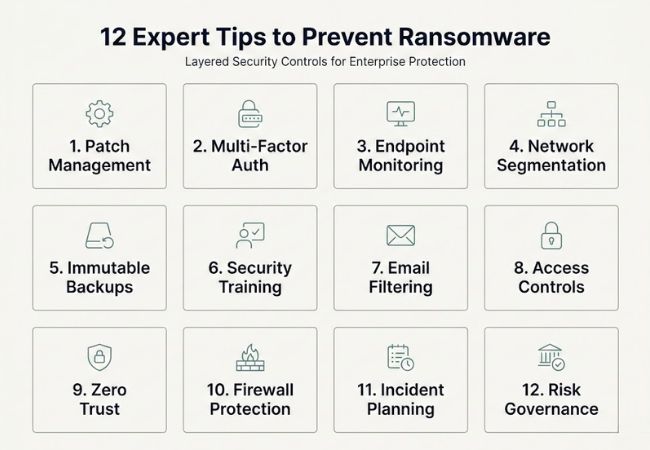
Unpatched software remains one of the most exploited entry points for ransomware attacks. Regular updates close known vulnerabilities and reduce the attacker’s opportunity window.
Centralized patch management ensures consistent updates across servers, endpoints, and third-party applications. Automated scheduling and vulnerability scanning further minimize exposure gaps.
Stolen credentials lose value when Multi-Factor Authentication (MFA) is enforced across systems. Additional verification layers prevent unauthorized logins even after password compromise.
MFA should be mandatory for remote access, administrative accounts, and cloud services. Hardware tokens, authentication apps, or biometric factors provide stronger protection than SMS-based codes.
Behavior-based endpoint detection tools identify suspicious encryption activity early. Rapid device isolation prevents ransomware from spreading across the network.
Modern Endpoint Detection and Response (EDR) platforms analyze anomalies such as mass file modifications or unusual privilege escalation. Early alerts allow security teams to contain threats before system-wide encryption begins.
Flat networks allow attackers to move laterally without restriction. Segmented infrastructure limits blast radius and protects critical systems from widespread encryption.
Critical databases, backup servers, and administrative systems should operate in isolated zones. Controlled access between segments reduces cross-environment infection risk.
Secure, offline, or immutable backups ensure encrypted data can be restored safely. Following the 3-2-1 backup strategy removes financial pressure to pay ransom demands.
Backup copies should be stored across separate environments, including offline or air-gapped storage. Routine restoration testing confirms data integrity and recovery reliability.
Human error remains a primary ransomware entry point. Ongoing employee education reduces phishing clicks and unsafe credential practices.
Simulated phishing exercises reinforce recognition of suspicious emails and social engineering tactics. Consistent reinforcement builds a stronger security culture across the organization.
Advanced email security systems scan attachments and embedded links before delivery. Suspicious files are sandboxed to block malicious execution.
AI-driven filtering tools analyze sender reputation, URL behavior, and attachment signatures. Early filtering significantly reduces ransomware exposure at the inbox level.
Excessive permissions increase the potential scope of compromise. Applying least privilege principles restricts internal ransomware propagation.
Role-based access control ensures users only access systems required for their responsibilities. Privileged account monitoring further limits misuse of administrative credentials.
Implicit trust within networks creates unnecessary risk exposure. Zero Trust architecture continuously verifies users and devices before granting access.
Authentication checks, device health validation, and behavioral monitoring strengthen internal defenses. Continuous verification reduces both insider and credential-based threats.
Next-generation firewalls inspect traffic patterns for malicious behavior. Intrusion detection capabilities block unauthorized communication attempts.
Properly configured firewall rules restrict suspicious outbound connections often used to communicate with command-and-control servers. Traffic logging also supports forensic investigation if an incident occurs.
Prepared organizations respond faster during active ransomware incidents. Documented response procedures reduce downtime and confusion under pressure.
Incident playbooks should define containment steps, communication protocols, and recovery priorities. Regular tabletop exercises improve coordination between IT, legal, and executive teams.
Long-term resilience requires structured oversight and periodic risk assessments. Governance frameworks ensure continuous security improvement against evolving ransomware threats.
Security policies should align with regulatory requirements and internal risk tolerance levels. Executive accountability ensures cybersecurity remains a strategic priority rather than a reactive measure.
Comprehensive protection requires coordinated safeguards across access management, infrastructure design, data protection, and oversight practices.
Access to systems should require layered verification and strict credential governance. Limiting authentication risks significantly reduces unauthorized entry points.
Workstations and servers must be continuously analyzed for abnormal file changes or suspicious processes. Immediate containment of compromised devices limits escalation.
Dividing environments into controlled zones restricts cross-system exposure. Isolated architecture prevents widespread disruption during compromise events.
Protected backup copies stored separately from production systems enable safe restoration. Recovery validation ensures operational continuity without reliance on extortion payments.
Aggregated event logs and behavioral analytics help detect anomalies early. Faster identification shortens attacker dwell time inside digital environments.
Defined policies and executive accountability strengthen long-term cyber maturity. Structured evaluation cycles maintain alignment with evolving threat landscapes.
Ransomware can be prevented by reducing entry points, enforcing strong access controls, and maintaining secure recovery systems. Consistent patching, MFA enforcement, endpoint monitoring, and segmented infrastructure significantly lower compromise risk.
Technical defenses alone are not enough without disciplined operational practices. Employee awareness, tested backups, and documented response procedures strengthen overall protection.
Sustained prevention depends on continuous improvement and regular security evaluation. Organizations that apply layered controls and adapt to evolving threats maintain stronger long-term resilience against ransomware attacks.
The most effective way to prevent ransomware is by combining MFA, regular patching, endpoint monitoring, network segmentation, and secure backups. Layered controls block entry points and limit damage if a breach attempt occurs.
Small businesses should prioritize strong authentication, automatic software updates, email filtering, and offline backups. Basic layered defenses significantly reduce exposure even without large security budgets.
Yes, behavioral detection tools can identify suspicious file activity before full encryption spreads. Early isolation of affected devices prevents system-wide compromise.
Backups do not stop infection but ensure safe recovery without paying ransom demands. Immutable and regularly tested copies provide reliable restoration capability.
Security controls should be reviewed continuously and formally assessed at least annually. Threat tactics evolve rapidly, making regular updates essential for effective prevention.
