🚀 CloudSEK featured in the 2026 Frost Radar™!
Read more
.avif)

Zero Trust Security is a model that verifies every access request based on identity, device health, and context, rather than granting trust based on the request's origin. A user inside the corporate network receives no more implicit trust than a user connecting from a hotel lobby, and every request to access an application is evaluated on its own merits before access is granted.
Forrester analyst John Kindervag introduced the term in 2010 under the maxim "never trust, always verify," arguing that risk exists inside a network as much as outside it. Fifteen years later, the model underpins US federal security policy and most enterprise access architecture, though the gap between adopting the language and implementing the architecture remains wide.
Corporate networks once had a defensible edge. Employees worked from offices, applications ran in owned data centers, and a firewall separated a trusted inside from an untrusted outside. Anyone who cleared the perimeter was treated as legitimate for the remainder of their session.
Three shifts dismantled that arrangement. Applications moved to SaaS platforms and public cloud, where no enterprise firewall sits in front of them. Workforces became distributed, so the majority of connections now originate outside any owned network. Attackers, meanwhile, stopped breaking through perimeters and started logging in with stolen credentials bought from criminal marketplaces.
That last change matters most. A perimeter model has no answer to an attacker holding valid credentials, because the architecture was built to distinguish inside from outside rather than legitimate from illegitimate. Once inside, lateral movement across a flat network faces almost no resistance.
Practitioners describe Zero Trust through three operating principles, and each one replaces an assumption the perimeter model depended on. They originate in industry practice rather than in any single standard, and they translate the model into decisions a security team can act on.
No request earns trust from its origin. A connection from a corporate subnet, a managed laptop, or an authenticated session already in progress carries no standing entitlement, and identity, device state, and context are checked again each time a resource is requested. Kindervag built the original formulation around this idea, arguing that internal traffic had never deserved the trust the perimeter model extended to it.
Granting the narrowest access that lets someone do their job limits what a compromised account can reach. Entitlements map to specific resources rather than to network segments, and just-in-time provisioning removes the standing permissions that accumulate quietly as people change roles. An account with access to one application is worth far less to an attacker than one holding broad domain rights.
Designing as though an attacker already holds valid credentials changes what the architecture optimizes for. Detection, containment, and blast-radius reduction take priority over keeping intruders out, because the model treats prevention as certain to fail eventually. Segmentation, session monitoring, and rapid revocation all follow from accepting that premise rather than resisting it.
Formal specification of those principles arrived in August 2020, when NIST published Special Publication 800-207, still the definitive technical reference. The standard sets out seven tenets rather than three principles, and each one states a requirement an architecture has to satisfy rather than an intent it expresses.
Of the seven, tenet three is the one organizations claim most readily and implement least. Per-session authorization means a user authenticated into an email client holds no standing entitlement to a file share, and most environments still issue broad access at login rather than evaluating each resource request separately.
A contractor opens a laptop in an airport lounge and requests the payroll application. Between that request and the application sit three logical components defined in SP 800-207, and together they decide whether the connection happens at all.
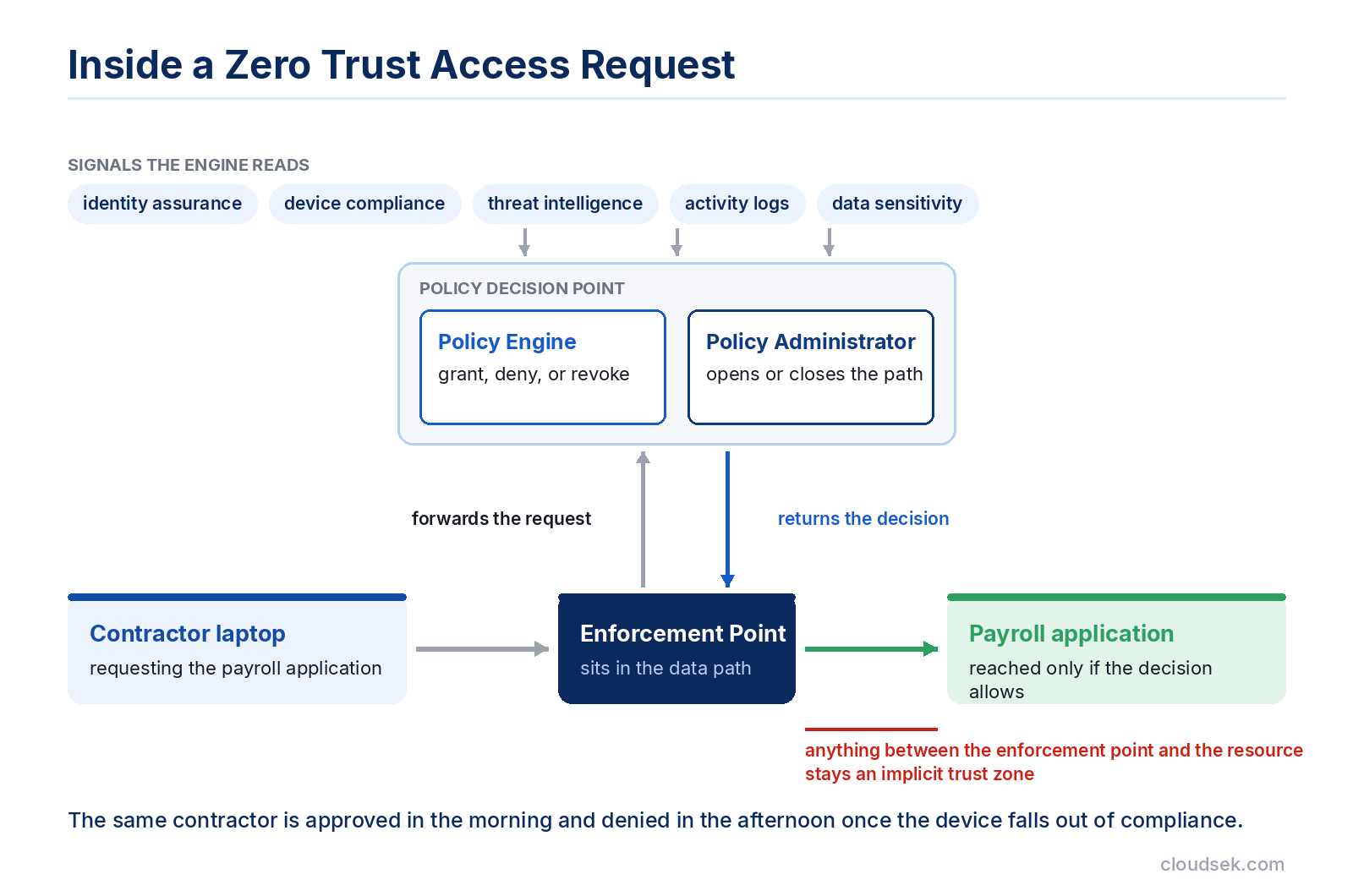
Deciding whether to grant, deny, or revoke access falls to the Policy Engine. It weighs the access policy against inputs that include identity assurance, device compliance status, threat intelligence feeds, activity logs, and data sensitivity classification. The decision is a computed outcome rather than a static rule lookup, which is what allows the same user to be approved in the morning and denied in the afternoon after their device falls out of compliance.
Executing that decision is the Policy Administrator’s job. It establishes or terminates the communication path between subject and resource, issuing the session credentials or authentication tokens the connection requires. The Policy Engine and Policy Administrator together form what the standard calls the Policy Decision Point.
Sitting directly in the data path, the Policy Enforcement Point is the gateway every request passes through. It intercepts the request, forwards it for evaluation, and enforces whatever comes back, monitoring and terminating the connection as instructed. Enforcement points are placed as close to the protected resource as the architecture allows, because anything between the enforcement point and the resource remains an implicit trust zone.
Identity management answers the question every access decision starts with: who is asking. The controls below turn the architecture into something enforceable in a real environment.
CISA published version 2.0 of its Zero Trust Maturity Model in April 2023, and it remains the reference federal agencies measure against. The model organizes capability into five pillars supported by three cross-cutting capabilities, and scores each pillar independently across four stages, since pillars mature at different rates inside the same organization.
Version 2.0 added the Initial stage between Traditional and Optimal, an acknowledgement that the original three-stage model asked organizations to cross too much ground in one move. Visibility and Analytics, Automation and Orchestration, and Governance run across all five pillars, and weakness in any of the three caps how far the pillars themselves can mature.
Where traditional network security drew a boundary and trusted what sat inside it, Zero Trust makes no such concession, and the difference shows up in five places.
Attacks that depend on reaching a second system after compromising a first are the ones this model disrupts most directly.
Valid credentials stop being sufficient when device posture and behavioral context have to check out as well. An attacker holding a working password from an infostealer log still faces device validation and per-resource authorization, and the attack path from that credential to anything valuable gets considerably longer.
Encrypting an enterprise requires reaching file servers, backup infrastructure, and virtualization hosts from wherever the intrusion started. Microsegmentation breaks that traversal, which is why ransomware-as-a-service affiliates working through a well-segmented environment take longer, generate more detectable activity, and settle for a smaller blast radius than the operation intended.
Vendor accounts have historically carried standing, broad access that nobody revisits after onboarding. Scoping those connections to named applications with expiry dates removes the conditions that make supply chain attacks effective, since a compromised integrator reaches only what its access explicitly permitted.
No architecture eliminates risk, and NIST devotes a section of SP 800-207 to the threats that persist under Zero Trust. Programs run into the same obstacles repeatedly.
Zero Trust does not arrive as a product purchase. Organizations that make progress treat it as a sequence of architectural changes, each depending on the one before it.
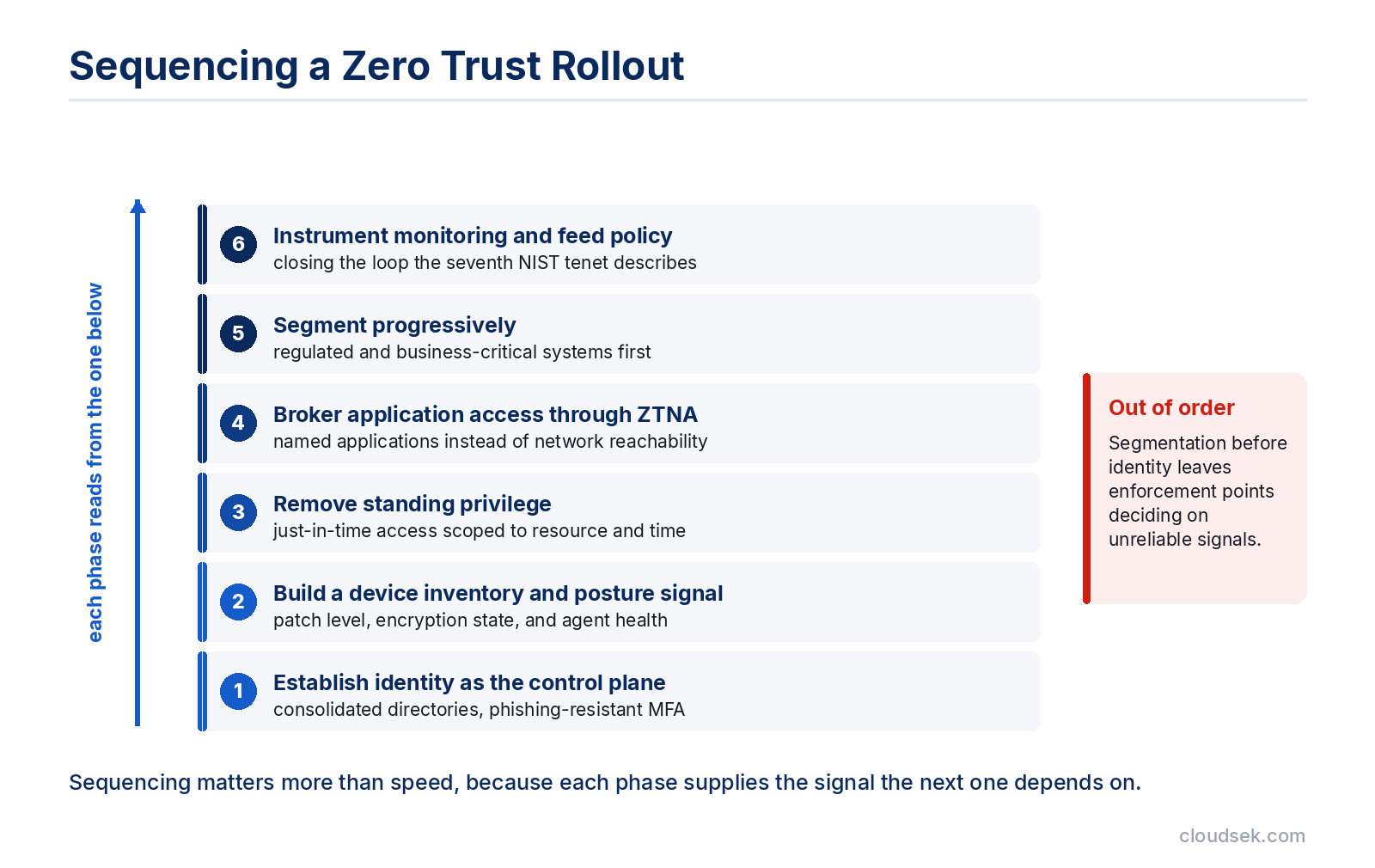
Sequencing matters more than speed here. Segmentation deployed before identity consolidation produces enforcement points making decisions on unreliable signals, and organizations that start with network controls end up rebuilding them once identity catches up.
Access decisions depend on signals the organization controls, and on exposure it does not. A Zero Trust policy engine evaluates the credential presented to it, and has no way to know that the same credential appeared in a criminal marketplace three weeks earlier. CloudSEK XVigil covers that external layer, monitoring deep and dark web sources, leaked-data marketplaces, and paste sites for credentials, exposed assets, and brand abuse tied to a specific organization.
Exposure intelligence changes what the assume-breach tenet means in practice. Knowing which accounts appear in recent infostealer logs converts a general assumption into a specific list of identities to force through re-authentication, credential rotation, or additional verification. BeVigil extends the same outside-in view to internet-facing assets that access policy has never accounted for.
None of this enforces access. Policy engines, enforcement points, identity providers, and segmentation remain the architecture, and external intelligence supplies context that those components cannot generate from inside the perimeter they no longer rely on.
Treating Zero Trust as a destination produces the most common failure in these programs: a set of tools purchased, a maturity assessment filed, and implicit trust still running through legacy exceptions nobody revisited. The model describes an operating assumption rather than an end state, and the assumption is that any credential, device, or session in the environment already belongs to someone else until proven otherwise.
Organizations making real progress tend to share one habit. They measure maturity per pillar rather than declaring the program complete, they treat every exception as a documented, expiring decision instead of a permanent accommodation, and they keep asking which implicit trust relationships remain, because the answer is never none.
No. Zero Trust is a security model. SASE and SSE are delivery architectures that bundle network and security services in the cloud, and both are common vehicles for implementing Zero Trust principles.
No. Firewalls continue handling egress filtering, network hygiene, and segmentation enforcement. Their role narrows from defining the trust boundary to enforcing policy alongside identity-based controls.
Machine identities receive the same treatment as human ones: unique credentials, scoped permissions, short-lived tokens, and behavioral monitoring. They outnumber human accounts by a wide margin in most environments.
Yes. Identity consolidation, MFA, and application-level access are available in standard cloud productivity suites, and smaller estates need fewer exceptions than large legacy environments.
Partly. Identity and segmentation principles transfer, while continuous re-authentication and agent-based posture checks are unsuited to controllers that cannot be interrupted or instrumented.
No. NIST SP 800-207 is guidance rather than a certifiable standard, and CISA maturity scoring is a self-assessment. No accredited body certifies Zero Trust compliance.
