🚀 A CloudSEK se torna a primeira empresa de segurança cibernética de origem indiana a receber investimentos da
Leia mais
.avif)

Shadow AI has become one of the fastest-growing security gaps in enterprise environments. Employees adopt AI tools faster than security teams can govern them, and each unapproved tool introduces data exposure, compliance risk, and unmonitored attack surface that traditional security tools cannot see.
This guide explains what shadow AI is, why it creates security risks, how to detect it, and how to control it before it becomes an exploitable attack path.
Shadow AI refers to the unauthorized use of AI tools, AI applications, or generative AI platforms inside an organization without IT approval, security oversight, or governance controls.
Shadow AI develops when employees use AI tools independently to improve productivity, automate tasks, generate content, analyze data, or write code. These tools operate outside official IT policies and security monitoring. Employees often upload documents, source code, customer information, prompts, or internal business data into these systems without understanding the security and compliance risks involved.
Common examples include public AI chatbots, AI writing assistants, browser-based AI extensions, AI coding tools, and third-party AI automation platforms. Each one represents an unmonitored connection between enterprise data and an external AI system.
Shadow AI is now a measurable enterprise security problem, not an emerging one. The clearest evidence comes from IBM's 2025 Cost of a Data Breach Report, based on 600 organizations studied by the Ponemon Institute.
Shadow IT and shadow AI are related, but shadow AI is the more dangerous subset. Shadow IT is the unsanctioned use of any software, hardware, or cloud service without IT approval. Shadow AI narrows that to AI specifically: unapproved AI tools, models, AI coding assistants, browser AI extensions, and AI features quietly added to software the organization already uses.
Shadow AI rarely starts as a deliberate policy violation. It starts with one employee finding a tool that makes a task faster, then spreads department by department until it is embedded in workflows that no security team has reviewed.
Employees use public AI platforms, browser extensions, AI chatbots, and AI productivity tools to complete tasks faster. These tools are easy to access and require no approval process. In most cases, employees adopt them without informing IT or security teams, creating AI activity outside approved enterprise systems.
Once employees begin using AI tools, they upload prompts, documents, source code, spreadsheets, customer records, or internal business information to get better responses. Sensitive data moves into external AI platforms without proper review. Employees often do not realize that confidential information is leaving enterprise-controlled environments.
External AI systems process uploaded data to generate responses, automate workflows, or perform analysis. Some AI providers temporarily store prompts, files, or interaction history inside their own infrastructure. Organizations lose visibility into how that data is handled, where it is stored, and who can access it.
Traditional monitoring tools may not detect unauthorized AI usage. Security teams cannot apply standard access controls, logging, or data protection policies to tools they do not know exist. This creates blind spots unmanaged AI tools operating entirely outside enterprise governance and security controls.
Shadow AI appears in different forms depending on how employees use unauthorized AI tools inside the organization.
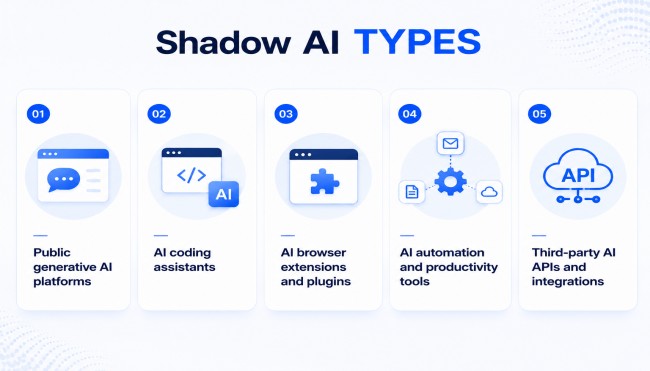
Public generative AI tools help employees create content, summarize information, and automate daily tasks. Employees paste prompts, documents, or business data into these platforms without approval, which increases the risk of sensitive information moving to external systems the organization does not control.
AI coding assistants help developers generate code, debug applications, and suggest fixes in real time. Developers may share source code, API credentials, internal application logic, or authentication tokens with external AI systems, creating intellectual property and security risks.
Browser-based AI extensions integrate into websites, emails, documents, and online workflows. These tools may access browsing activity, copied text, login sessions, or enterprise applications without centralized monitoring. Because they install at the browser level, they often bypass network-level controls entirely.
AI automation tools help employees automate workflows, generate reports, and process information. Many connect with enterprise systems such as email, cloud storage, and collaboration tools. Unmanaged integrations create hidden access paths into core business systems.
Development teams often connect external AI APIs and services into applications or internal systems without security approval. Unapproved integrations introduce weak authentication, insecure access paths, and hidden dependencies that expand the organization's attack surface.
Shadow AI is not a problem with AI itself. The risk comes from the absence of approval, governance, and oversight. The difference between managed AI adoption and shadow AI is the difference between AI the organization can account for and AI it cannot.
Organizations with managed AI adoption maintain an AI Bill of Materials, a current inventory of every AI tool, model, and integration in use. Organizations with shadow AI have a growing set of AI connections they cannot see, inventory, or protect. Closing that gap is less about banning tools and more about bringing every AI asset into an inventory the security team can govern.
Shadow AI creates hidden security gaps because organizations lose visibility and control over how employees use external AI tools and services.
Employees upload confidential files, customer information, source code, financial records, or internal documents into AI platforms to get faster responses. External AI tools may process or store this data outside enterprise-controlled environments, increasing the risk of data leakage and unauthorized access. Once data enters an external AI system, the organization has no guarantee of where it goes or how long it is retained.
Most shadow AI tools operate outside approved enterprise security systems. Security teams cannot apply access controls, monitoring, logging, or data protection policies to unauthorized AI applications. The tool exists, is being used, and is moving data but security has no view of any of it.
Organizations handling regulated data must follow GDPR, HIPAA, PCI-DSS, and other privacy regulations. Sharing sensitive information with unapproved AI platforms may violate these requirements. The organization becomes liable for data handling it did not authorize and cannot document.
External AI tools rely on third-party vendors, plugins, APIs, and cloud infrastructure. Organizations have limited visibility into how these providers secure data and manage access. A compromised AI vendor or insecure third-party integration can expose enterprise systems through a connection the security team did not know existed.
Every unauthorized AI tool, browser extension, API connection, or AI integration increases the external AI attack surface. Attackers scan for exposed AI applications and unmanaged integrations to identify weak access points. Shadow AI is now one of the primary initial access vectors in AI-layer attacks, the same category as prompt injection, tool poisoning, and agentic workflow abuse.
Shadow AI risk has already played out in named enterprises:
Shadow AI is not only a security gap. It is a compliance gap. The major AI governance frameworks all assume an organization can see and account for the AI it uses, which is exactly what shadow AI prevents.
These sit alongside the data-protection regulations the organization already answers to, including GDPR, HIPAA, and PCI-DSS. The common requirement across all of them is visibility: an organization cannot govern, audit, or prove compliance for AI it cannot see. Bringing every AI asset into a documented inventory is the foundation each of these frameworks depends on.
Organizations need continuous visibility across users, devices, cloud services, and AI applications to find unauthorized AI usage before it becomes an exploitable attack path.
Track which AI tools employees access across enterprise devices and networks. Monitoring identifies unapproved AI platforms, browser-based AI tools, and external AI services operating outside official policies.
Network and cloud traffic analysis detects communication with external AI platforms and APIs. Unusual outbound connections, unknown AI domains, or unapproved API requests indicate shadow AI activity. Many shadow AI tools use standard HTTPS traffic that blends in with normal browsing look for patterns, not individual requests.
Monitor what type of data employees upload into AI systems. Tracking file transfers, prompts, and data-sharing behavior identifies situations where sensitive business information moves into unauthorized AI platforms.
Employees and development teams connect external AI APIs, plugins, and automation tools without security approval. Continuous discovery identifies risky integrations that create hidden access paths and unmanaged dependencies across the organization's AI ecosystem.
Different teams use AI tools differently based on operational needs. Analyzing usage patterns helps identify high-risk AI adoption, unusual activity spikes, and unmanaged AI expansion. Marketing, development, finance, and customer support teams all have different shadow AI patterns they need to be monitored separately.
Preventing shadow AI requires governance, continuous visibility, controlled AI access, and employee awareness working together. No single control is sufficient on its own.
Define which AI tools are approved, what data can be shared, and what the approval process is for new AI tools. Employees use shadow AI partly because the approved alternative is unclear or inconvenient a clear policy removes the ambiguity.
Security and IT teams should offer approved AI platforms that meet enterprise security and compliance requirements. When employees have a sanctioned tool that does what they need, the pressure to use unauthorized alternatives drops significantly.
Implement controls that block or limit access to risky AI tools, unauthorized browser extensions, and unapproved AI integrations. Network-level controls, browser extension policies, and application allowlists reduce the available shadow AI surface.
Data Loss Prevention (DLP) controls identify and block sensitive information from being uploaded into unauthorized AI platforms. DLP monitors file transfers, prompts, and data uploads to catch accidental or intentional data leakage before it leaves the organization.
Continuous monitoring detects unauthorized AI usage, suspicious integrations, and risky AI behavior across users and devices. Real-time visibility finds shadow AI activity before it creates a security incident.
Identify and classify sensitive data before employees interact with AI platforms. Data classification restricts confidential information customer records, financial data, source code, credentials from entering any AI system, approved or not.
External AI vendors require ongoing security and compliance reviews. Assess how vendors process data, manage access, and store information. Vendor review is not a one-time onboarding step the vendor's security posture changes, and so does the risk.
Os funcionários usam ferramentas de IA externas sem entender as consequências de segurança e conformidade. O treinamento regular ajuda as equipes a reconhecer práticas de IA inseguras, entender quais dados não podem ser compartilhados e seguir consistentemente as diretrizes aprovadas de uso de IA.
Sim. Os funcionários frequentemente colam arquivos confidenciais, credenciais ou código-fonte em ferramentas de IA externas. Uma vez que esses dados entram no modelo, a organização perde o controle sobre como são armazenados, retidos ou reutilizados para treinamento, às vezes sob regras de privacidade diferentes das suas próprias.
É generalizado. No Relatório de Custo de Violação de Dados de 2025 da IBM, uma em cada cinco organizações relatou uma violação ligada à IA sombra, e altos níveis de IA sombra adicionaram aproximadamente US$ 670.000 ao custo médio da violação.
Não. As proibições empurram o uso de IA para dispositivos e contas pessoais onde as equipes de segurança têm ainda menos visibilidade, e os recursos de IA incorporados em ferramentas SaaS aprovadas tornam uma proibição real impraticável. Ferramentas sancionadas mais um caminho de revisão leve funcionam melhor.
Cada ferramenta de IA, API ou extensão não sancionada é uma conexão não monitorada entre os sistemas corporativos e um ambiente de IA externo. Atacantes procuram por estes como vetores de acesso inicial, e como a IA sombra funciona sem autenticação ou revisão de segurança, é um alvo fácil.
A IA sombra expande a superfície de ataque de IA de maneiras invisíveis para as ferramentas de segurança tradicionais. A CloudSEK aborda isso através do AIVigil, a plataforma de monitoramento e gerenciamento da superfície de ataque de IA construída especificamente para encontrar ativos de IA que não deveriam estar lá.
O AIVigil descobre continuamente ferramentas de IA não autorizadas, agentes de IA não gerenciados, servidores MCP não aprovados e integrações de IA sombra executando sem o conhecimento da equipe de segurança. A descoberta abrange ambientes de nuvem, on-premise e SaaS, incluindo ferramentas de IA que os funcionários conectaram a sistemas corporativos sem qualquer aprovação ou revisão. Cada descoberta alimenta uma Lista de Materiais de IA (AI BOM) continuamente atualizada, dando às equipes de segurança um inventário atual de cada ativo de IA no ambiente, incluindo aqueles que nunca deveriam estar lá.
O AIVigil então avalia cada implantação de IA sombra quanto à explorabilidade. Ele pontua cada descoberta usando agência de agente, estado de autenticação e raio de explosão para que as equipes de segurança saibam quais ativos de IA sombra representam caminhos de ataque reais e quais são de menor prioridade. Servidores MCP não aprovados com acesso público, ferramentas de IA conectadas ao armazenamento em nuvem com autenticação fraca e extensões de navegador com acesso a aplicativos corporativos são todos pontuados e priorizados para ação.
