🚀 A CloudSEK se torna a primeira empresa de segurança cibernética de origem indiana a receber investimentos da
Leia mais
.avif)

A DNS misconfiguration is an error or insecure setting in a domain's DNS records or server that exposes it to disruption, spoofing, or takeover. Common examples include open resolvers, exposed zone transfers, and missing email-authentication records.
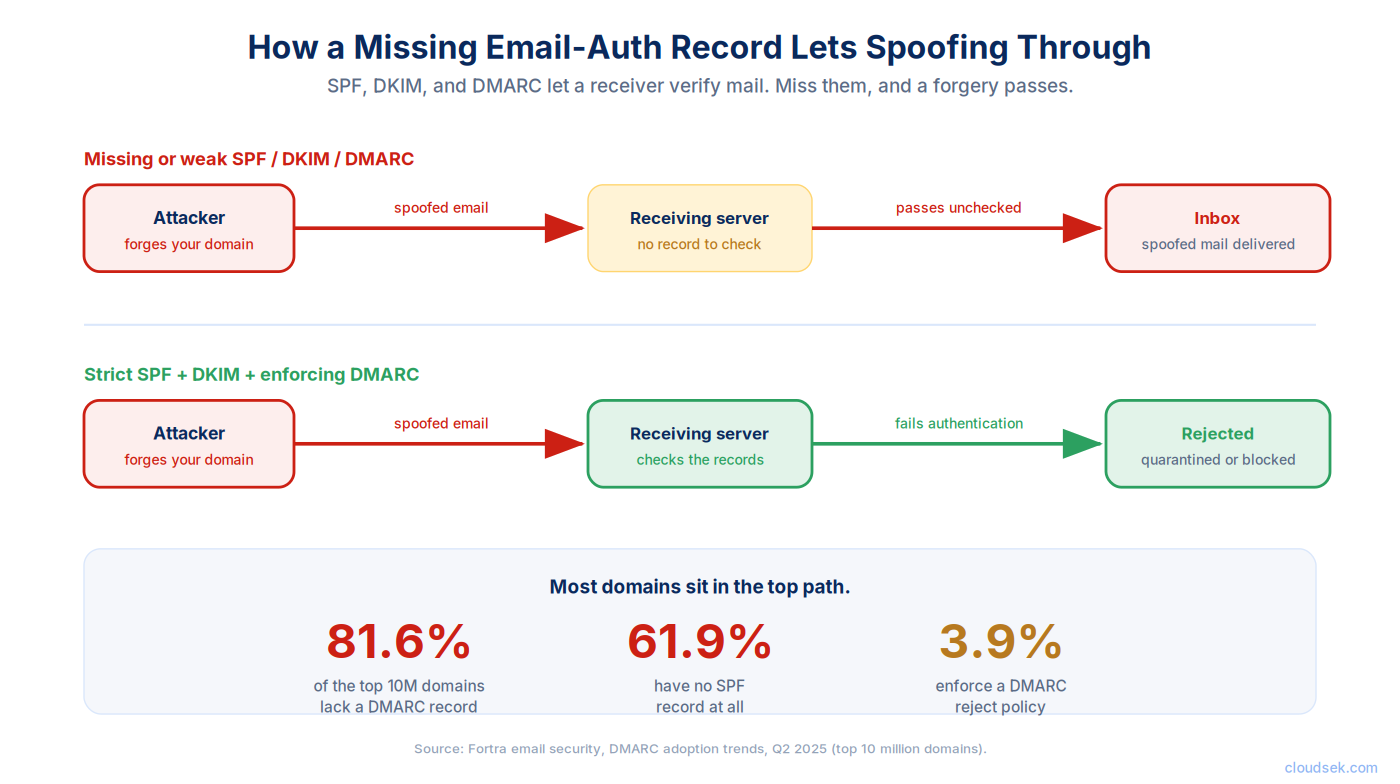
These errors are widespread: an analysis of the top 10 million domains found that 81.6 percent lacked a DMARC record entirely and only 3.9 percent enforced a reject policy, leaving most domains open to email spoofing.
DNS misconfigurations come in several common types, each carrying its own security and availability risks. This guide breaks down what they are, the risks they create, how to detect them, and how to prevent and fix them.
A DNS misconfiguration is any incorrect, weak, or outdated setting in the Domain Name System that creates a security or availability problem. DNS translates domain names into the addresses systems use to reach each other, so an error in a record or server setting can send traffic to the wrong place, leak information, or break a service entirely.
Most misconfigurations trace back to a handful of causes: human error during record changes, weak change management, records left behind when a service is retired, absent security extensions, and poor coordination between the teams that manage DNS and the teams that own the services it points to.
The consequences fall into two groups. Availability problems include outages, undeliverable email, and unreachable sites caused by broken records. Security problems include email spoofing, traffic redirection, subdomain takeover, and the exposure of internal infrastructure. Any domain owner can be affected, and the risk grows with the size of the estate and the use of cloud services.
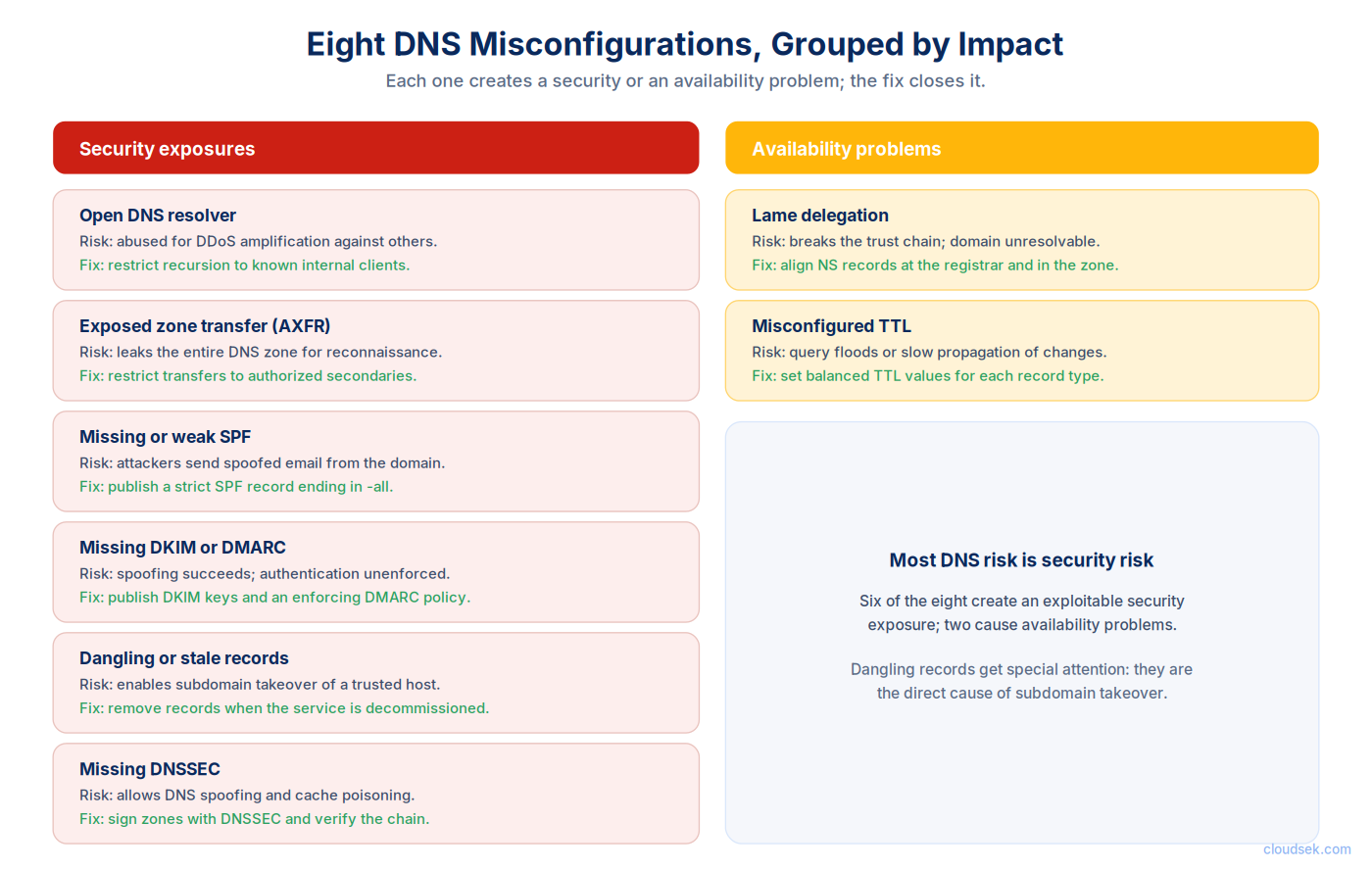
The following eight DNS misconfigurations account for most real-world risk. The table below pairs each one with the risk it creates and the fix that closes it.
Dangling records deserve particular attention because they are the direct cause of subdomain takeover, where an attacker claims the deprovisioned service a record still points to and serves their own content from a trusted subdomain.
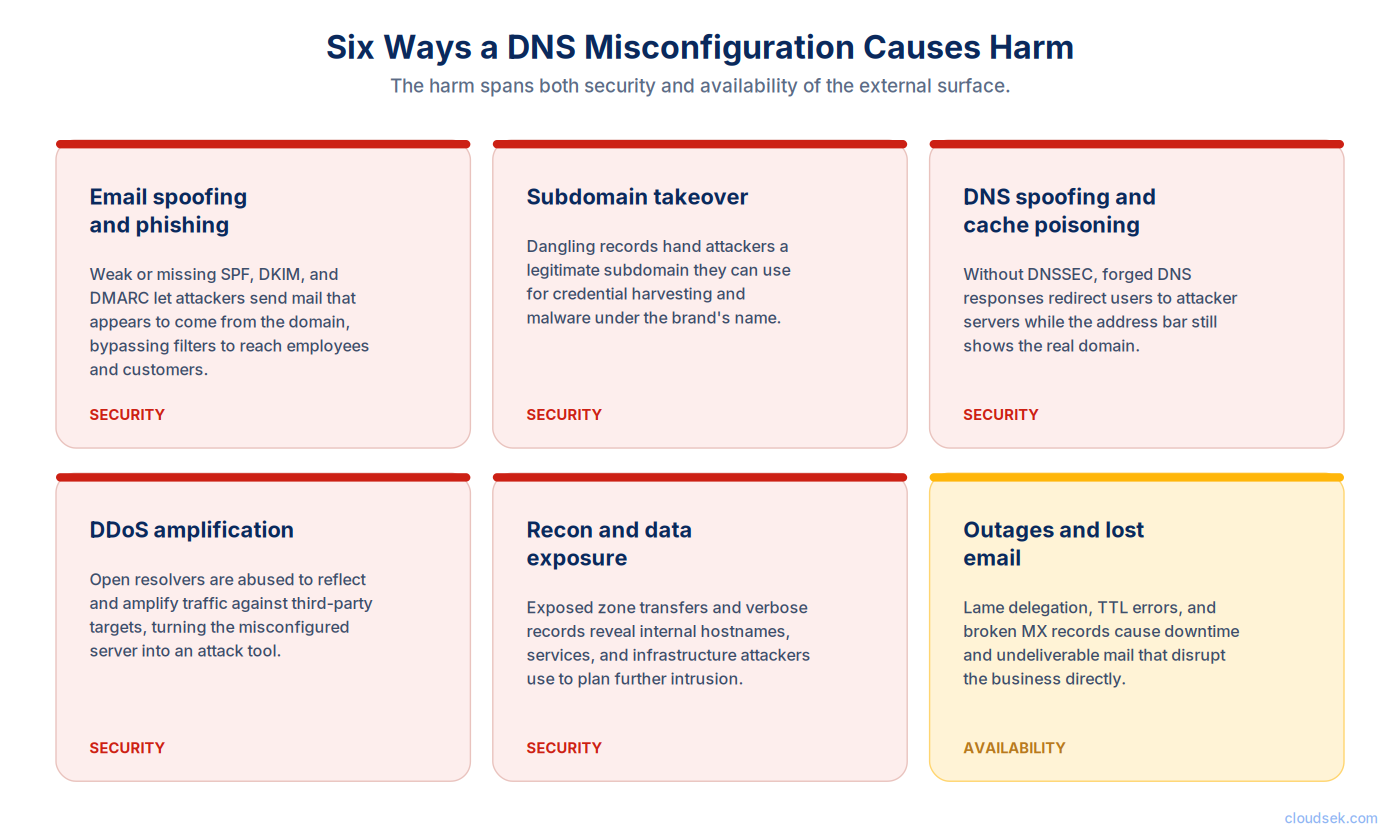
DNS misconfigurations create six main forms of harm, spanning both security and availability.
Detecting DNS misconfigurations combines manual record checks with continuous automated scanning. A four-step approach surfaces the errors that matter.
Build a complete list of every A, CNAME, MX, TXT, and NS record and the service each one points to, because an unknown record cannot be checked or corrected.
Use dig and nslookup to confirm resolver behavior, test whether zone transfers are exposed, and verify that records resolve to the resources they should.
Run SPF, DKIM, and DMARC through validation tools to confirm correct syntax, a strict SPF terminator, and an enforcing DMARC policy.
Deploy external attack surface monitoring that flags misconfigurations as records change, since one-time checks miss errors introduced afterward.
Preventing DNS misconfigurations is a matter of disciplined configuration and ongoing hygiene. Six measures close the gaps that attackers exploit.
Limit AXFR to authorized secondary nameservers and disable open recursion so the server answers only the clients it should.
Publish a strict SPF record, valid DKIM keys, and a DMARC policy set to quarantine or reject rather than monitor-only.
Sign zones and verify the full chain of trust, keeping in mind that a broken DNSSEC setup is itself a misconfiguration that can make a domain unreachable.
Remove stale and dangling records as soon as a service is retired, and keep the record inventory current as infrastructure changes.
Restrict who can change DNS records, separate responsibilities, and log every change so errors are traceable.
Use automated detection that catches new misconfigurations as they appear instead of relying on periodic manual review.
DNS misconfiguration is the broad category that several specific exposures fall under, and understanding the relationship clarifies where each fits.
DNS misconfiguration is an external attack surface problem that the category CloudSEK BeVigil is built to address. The platform fingerprints an organization's internet-facing assets, discovering domains, subdomains, and DNS records, then its DNS scanner flags misconfigurations including SPF and DMARC issues, the dangling records that enable subdomain takeover, and private IP disclosures. It surfaces the same exposures an attacker would find by enumerating the domain.
Running that discovery continuously is what makes the difference. DNS records change as teams add and retire services, so a misconfiguration introduced by a single change is caught as it emerges rather than at the next audit. Treating DNS health as part of ongoing attack surface management closes the gap between when an error appears and when an attacker finds it.
Missing or weak email-authentication records are the most common. Analysis of the top 10 million domains found 61.9 percent had no SPF record and 81.6 percent had no DMARC record, leaving most domains open to email spoofing.
Use dig or nslookup to inspect records and test for exposed zone transfers, run SPF, DKIM, and DMARC validators to check email authentication, and use an external attack surface scanner to detect misconfigurations continuously rather than once.
Yes. A lame delegation where nameserver records do not match can make a domain unresolvable, and broken or misconfigured records can route traffic to the wrong place or stop a site from loading entirely.
A DNS misconfiguration is an accidental error in DNS settings. DNS hijacking is a deliberate attack that alters DNS responses or records to redirect traffic. Misconfigurations such as missing DNSSEC make hijacking easier to carry out.
No. DNSSEC protects against DNS spoofing and cache poisoning by authenticating responses, but it does not address email authentication, zone transfer exposure, or dangling records. A broken DNSSEC setup is itself a misconfiguration.
When SPF, DKIM, or DMARC records are missing or weak, receiving mail servers cannot verify that a message genuinely came from the domain. Attackers exploit this gap to send convincing phishing emails that appear authentic.
