🚀 CloudSEK featured in the 2026 Frost Radar™!
Read more
.avif)

Future digital risk protection will rely on AI-driven threat detection, Zero Trust frameworks, behavioral analytics, and real-time monitoring to stop cyber threats before disruption occurs. Modern protection strategies are shifting from reactive defense models to predictive risk prevention across cloud platforms, digital identities, endpoints, APIs, and connected networks.
Businesses now depend on remote environments, third-party services, mobile devices, and expanding cloud infrastructure that increase digital exposure. Rising threats like ransomware, deepfake fraud, credential theft, and AI-powered phishing are forcing organizations to improve visibility, identity verification, and access control across digital ecosystems.
Machine learning systems, identity protection tools, threat intelligence platforms, and automated response technologies are shaping the future of digital risk protection. Organizations adopting adaptive frameworks are strengthening cyber resilience, reducing financial losses, and protecting critical digital assets more effectively.
Digital risk protection is expanding beyond traditional monitoring as cloud computing, artificial intelligence, remote work, connected devices, and third-party ecosystems create new layers of exposure across modern environments.
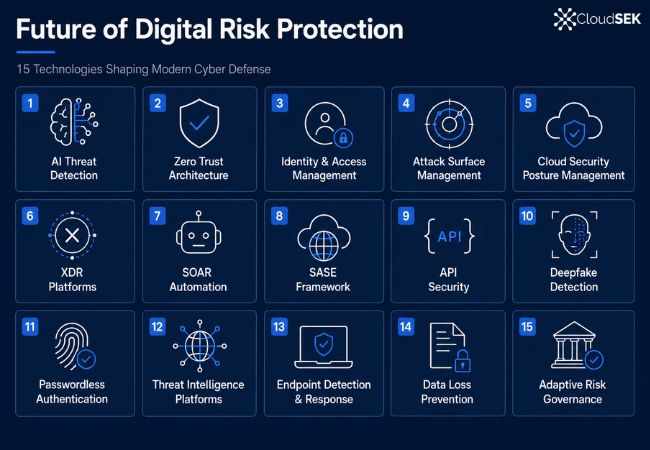
AI Threat Detection brings greater visibility into behavioral anomalies, suspicious interactions, and hidden patterns across users, devices, and applications. Digital environments now generate enormous amounts of activity that are difficult to evaluate through manual analysis alone.
Zero Trust Architecture places identity validation, contextual awareness, and device integrity at the center of access decisions. Trust based solely on network location has become increasingly difficult to justify across decentralized environments.
Identity and Access Management strengthens control over authentication, permissions, user roles, and privileged accounts. Credential theft continues creating opportunities for unauthorized entry across cloud services and connected applications.
New domains, cloud resources, APIs, and internet-facing services often appear faster than inventories can document them. Attack Surface Management helps uncover visibility gaps that frequently remain unnoticed until an incident exposes them.
Configuration complexity increases with every workload, storage environment, integration, and service deployed across multiple providers. Cloud Security Posture Management helps identify weaknesses hidden within permission structures and deployment settings.
XDR platforms combine endpoint activity, identity signals, email telemetry, network behavior, and cloud events into a unified investigation view. Fragmented alerts rarely provide enough context when critical decisions depend on speed and accuracy.
SOAR Automation coordinates containment workflows, alert prioritization, and investigative actions through predefined response playbooks. High-volume incidents often overwhelm manual processes during time-sensitive situations.
The SASE Framework aligns secure connectivity with environments where users, applications, and resources operate across multiple locations. Remote access requirements continue expanding beyond traditional office networks and centralized infrastructure.
Applications exchange information continuously through APIs connecting platforms, cloud services, payment systems, and third-party integrations. API security reduces exposure created by weak authentication controls, unsecured endpoints, and abnormal request behavior.
Synthetic media continues influencing digital trust through cloned voices, manipulated videos, and AI-generated visual content. Deepfake detection technologies help verify authenticity during sensitive communications and approval processes.
Passwordless authentication reduces dependence on credentials frequently exposed through phishing campaigns and credential reuse. Traditional passwords continue creating unnecessary risk across connected digital environments.
Threat Intelligence Platforms transform external indicators into actionable context that supports informed decision-making. Emerging risks often leave traces across phishing infrastructure, leaked credentials, and malicious domains before broader exposure occurs.
Endpoint Detection and Response provides detailed visibility into suspicious processes, unusual device behavior, and unauthorized activity. Laptops, smartphones, servers, and remote hardware remain common entry points across distributed environments.
Data Loss Prevention helps reduce accidental exposure through contextual monitoring, classification policies, and transfer controls. Sensitive information moves constantly between cloud storage, collaboration tools, messaging platforms, and external applications.
Adaptive Risk Governance connects compliance requirements, business priorities, risk oversight, and decision-making through flexible control structures. Rapid technological change continues challenging static policies and rigid governance models.
CloudSEK is advancing digital risk protection through AI-powered intelligence, external threat visibility, automated response capabilities, and continuous monitoring across modern digital ecosystems.
Cloud environments, remote access models, mobile connectivity, and interconnected business ecosystems continue expanding across industries, creating broader exposure points that contribute to a growing volume of digital risks.
Digital risk protection is entering a new phase where visibility, identity validation, and intelligent threat analysis matter more than traditional perimeter-based defenses. Expanding cloud environments, connected devices, third-party ecosystems, and AI-driven attacks are changing how digital risks emerge and spread across modern infrastructure.
Future-ready protection strategies rely on technologies such as AI threat detection, Zero Trust Architecture, Identity and Access Management, Attack Surface Management, and Threat Intelligence Platforms to address evolving challenges. Rather than reacting after an incident occurs, many organizations are shifting toward earlier detection, stronger verification, and automated response capabilities that reduce exposure before disruption escalates.
Long-term resilience depends on understanding how digital ecosystems continue to evolve alongside increasingly sophisticated threats. Organizations that prioritize proactive risk management, continuous visibility, and adaptive governance frameworks will be better positioned to protect critical assets, maintain trust, and navigate an increasingly connected digital landscape.
Book a demo today to see how XVigil can help protect your organization.
Protect your organization from external threats like data leaks, brand threats, dark web originated threats and more. Schedule a demo today!
Schedule a Demo
.png)