🚀 CloudSEK featured in the 2026 Frost Radar™!
Read more
.avif)

Financial markets now depend heavily on cloud platforms, online trading systems, APIs, and connected digital services that process large volumes of sensitive customer and transaction data every second. Expanding digital infrastructure has increased exposure to ransomware attacks, phishing campaigns, credential theft, and service disruption across India’s financial ecosystem.
The Securities and Exchange Board of India introduced the Cybersecurity and Cyber Resilience Framework (CSCRF) to strengthen cyber resilience and improve security preparedness across regulated financial organizations operating critical securities market infrastructure.
According to the IBM Cost of a Data Breach Report 2024, the average global cost of a data breach reached $4.88 million, with financial organizations remaining one of the most targeted sectors for ransomware attacks, credential theft, and operational disruption. The growing financial impact of cyber incidents has increased the importance of continuous cyber resilience and security governance across regulated financial environments.
Securities and Exchange Board of India Cybersecurity and Cyber Resilience Framework (CSCRF) is a regulatory cybersecurity framework designed to strengthen cyber resilience, operational continuity, security governance, and cyber risk management across India’s securities market ecosystem.
The framework establishes standardized cybersecurity controls, continuous monitoring requirements, cyber risk assessment practices, incident response measures, and resilience planning requirements for SEBI-regulated entities operating digital financial infrastructure.
SEBI introduced CSCRF to strengthen cybersecurity readiness, improve operational resilience, and reduce cyber risks targeting financial institutions, market infrastructure, and digital financial services across India’s financial market ecosystem.
Here are the main reasons why SEBI introduced CSCRF:
Financial institutions increasingly face ransomware attacks, phishing campaigns, credential theft, financial fraud, and data breaches targeting trading platforms, customer accounts, digital transactions, and critical market infrastructure.
Online trading systems, cloud environments, APIs, internet-facing applications, and digital financial services have significantly expanded operational exposure across interconnected financial ecosystems.
Financial entities often operate across complex digital environments with varying security practices, which increases the need for standardized cybersecurity controls, governance processes, and continuous monitoring requirements.
Cyber incidents affecting financial systems may disrupt trading operations, digital transactions, customer services, and critical infrastructure, making operational resilience and recovery preparedness increasingly important across regulated environments.
Rapidly evolving cyber threats require regulated entities to maintain continuous cyber risk visibility, ongoing exposure assessment, real-time monitoring, and proactive identification of security gaps across digital infrastructure.
SEBI CSCRF establishes multiple cybersecurity, monitoring, governance, and resilience requirements that regulated financial entities must implement to reduce cyber risks and strengthen operational security.
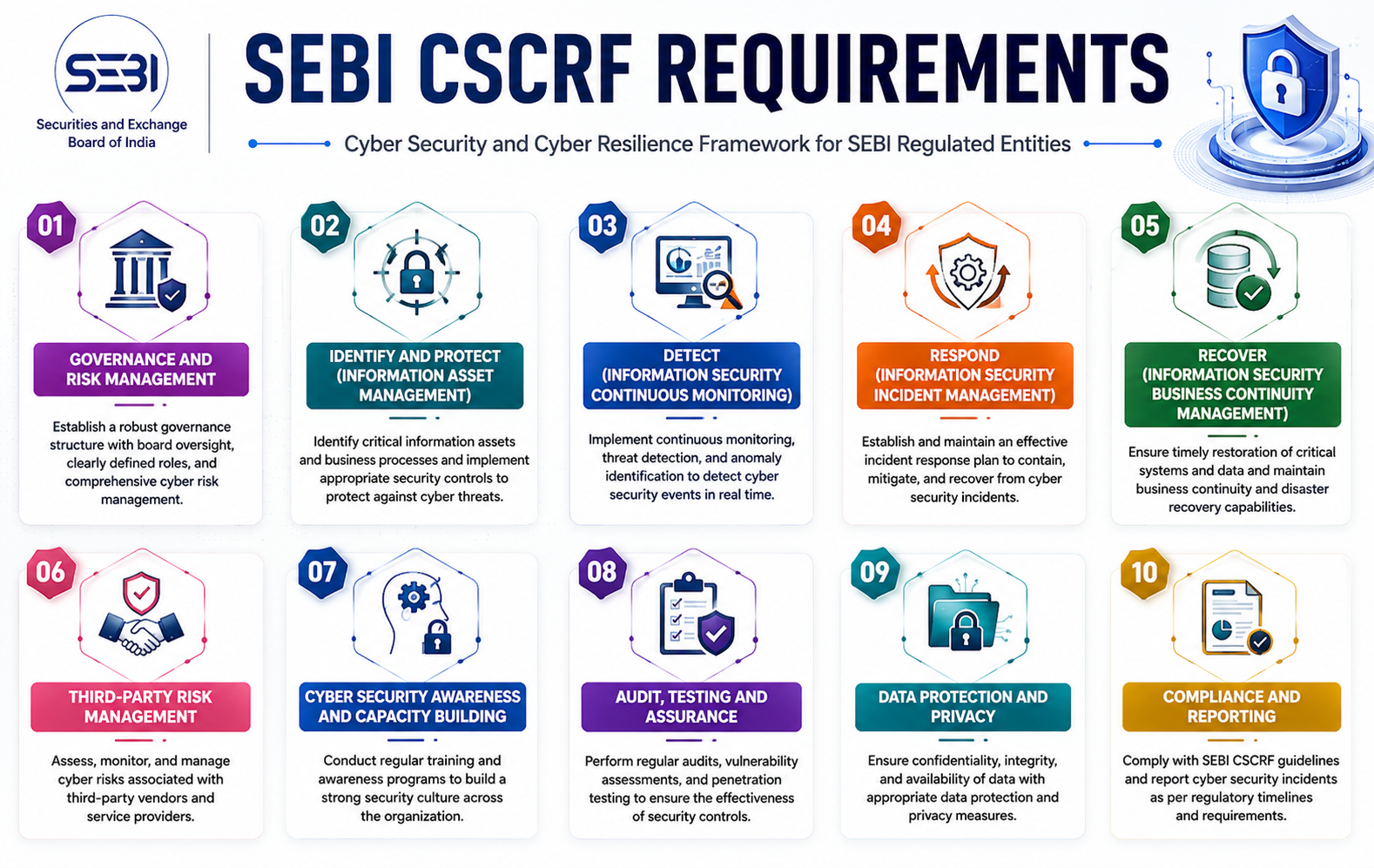
SEBI CSCRF requires organizations to establish clear cybersecurity governance structures with defined accountability, board-level oversight, internal security policies, and continuous cyber risk management processes. Strong governance helps financial entities improve decision-making, strengthen security ownership, and maintain consistent cybersecurity practices across digital operations.
Accurate asset inventory management helps regulated entities identify exposed systems, unmanaged applications, cloud assets, APIs, and internet-facing services connected to securities market operations. Continuous exposure tracking improves detection of security gaps, unauthorized assets, and operational risks across connected digital environments.
Continuous threat monitoring improves early detection of suspicious behavior, unauthorized access attempts, malicious activity, and security incidents targeting critical financial systems. Real-time analysis of networks, applications, user activity, and security events strengthens operational awareness and reduces response delays during cyber incidents.
Ongoing vulnerability assessment and exposure management help financial entities identify weak security configurations, exposed services, outdated applications, and exploitable systems across digital environments. Prioritized remediation and regular patching reduce opportunities for attackers targeting internet-facing assets and critical financial applications.
Strong identity security controls, such as multi-factor authentication, privileged access management, and continuous authentication monitoring, help reduce unauthorized access risks across trading platforms, cloud environments, and connected financial systems. Centralized access governance improves the protection of sensitive operational and customer data.
Organizations must establish incident response workflows, cyber resilience strategies, operational recovery plans, and security response procedures to manage cyber incidents effectively. Preparedness planning helps financial entities reduce operational disruption and maintain business continuity during ransomware attacks, data breaches, or system compromise.
SEBI CSCRF highlights the importance of monitoring vendors, service providers, external integrations, and third-party digital dependencies that may introduce cyber risks into financial ecosystems. Third-party security oversight helps organizations identify supply chain exposure and strengthen protection across interconnected operational environments.
The framework requires organizations to maintain security logs, monitoring records, audit trails, and investigation data that support incident analysis, compliance validation, and regulatory reporting requirements. Effective logging practices improve threat investigation, operational visibility, and cybersecurity audit preparedness across regulated financial systems.
SEBI CSCRF applies to regulated financial entities operating across India’s securities market ecosystem and introduces phased cybersecurity implementation requirements based on operational roles, infrastructure exposure, and regulatory obligations.
The framework applies to stock exchanges, depositories, clearing corporations, asset management companies, market intermediaries, KYC registration agencies, and other SEBI-regulated financial entities managing digital financial operations and sensitive market infrastructure.
SEBI introduced phased implementation timelines to help regulated organizations gradually align cybersecurity controls, governance processes, monitoring capabilities, and resilience measures with CSCRF requirements across operational environments.
Regulated entities must maintain continuous visibility into cyber threats, internet-facing exposure, security events, suspicious activity, and operational risks affecting financial systems and digital infrastructure across connected environments.
Organizations must conduct ongoing cyber risk assessments to identify vulnerabilities, evaluate operational exposure, assess potential security impacts, and prioritize remediation activities across digital infrastructure and financial services.
SEBI CSCRF requires organizations to maintain security documentation, audit records, monitoring evidence, incident reporting data, and compliance-related information that support regulatory assessments and cybersecurity oversight activities.
SEBI CSCRF introduces a broader and more structured cybersecurity framework compared to earlier SEBI cybersecurity circulars that mainly focused on baseline security practices and incident handling requirements. The framework places stronger emphasis on continuous monitoring, cyber resilience, operational continuity, internet-facing risk visibility, cyber risk assessment, and centralized governance across regulated financial environments. Expanded focus on third-party security, asset visibility, identity protection, and resilience planning reflects the growing complexity of modern financial infrastructure and evolving cyber threats targeting digital financial ecosystems.
Unlike earlier guidelines that primarily addressed cybersecurity controls individually, CSCRF establishes a more integrated approach that connects governance, operational resilience, threat detection, continuous assessment, incident response, and recovery preparedness into a unified cybersecurity framework. The framework strengthens accountability across financial organizations by introducing standardized implementation expectations, ongoing monitoring obligations, audit readiness requirements, and stronger oversight of digital infrastructure, external dependencies, and operational cyber risks.
SEBI CSCRF strengthens cybersecurity preparedness, operational resilience, risk visibility, and governance practices across regulated financial environments, handling critical digital infrastructure and sensitive financial data.
The following are the main advantages of SEBI CSCRF:
Continuous monitoring, asset visibility, and ongoing cyber risk assessment help organizations identify exposed systems, operational vulnerabilities, internet-facing risks, and suspicious activity affecting financial infrastructure more effectively.
Structured incident response workflows, resilience planning, and operational recovery processes improve organizational readiness to manage ransomware attacks, phishing incidents, data breaches, and other cybersecurity events with reduced operational disruption.
Cyber resilience measures and continuity planning help financial entities maintain stable operations, protect trading systems, reduce service interruptions, and strengthen recovery capabilities during cyber incidents affecting digital financial environments.
Standardized cybersecurity controls, monitoring requirements, audit readiness practices, and governance processes help regulated organizations maintain stronger alignment with SEBI cybersecurity expectations and compliance obligations.
Continuous assessment of vendors, external integrations, service providers, and connected digital dependencies improves visibility into third-party exposure risks that may affect operational security and financial systems.
Identity protection, access controls, vulnerability management, and continuous monitoring practices improve security around sensitive customer information, transaction records, operational data, and financial infrastructure.
Defined accountability structures, board-level oversight, cyber risk management processes, and centralized security governance strengthen cybersecurity decision-making and improve operational security management across financial organizations.
Organizations often face operational, technical, and governance-related challenges while implementing SEBI CSCRF requirements across complex financial infrastructure and interconnected digital environments.
The following are the common challenges organizations face during CSCRF implementation:
Many financial organizations continue operating legacy systems, outdated applications, and older infrastructure that may lack modern security controls, continuous monitoring capabilities, and compatibility with evolving cybersecurity requirements under CSCRF.
Large financial ecosystems often contain unmanaged assets, exposed services, cloud environments, APIs, and external systems that reduce visibility into operational exposure and increase the difficulty of maintaining accurate asset inventory.
Financial institutions frequently depend on vendors, SaaS providers, external integrations, and service partners that may introduce security gaps, operational dependencies, and supply chain risks affecting cybersecurity resilience across interconnected environments.
Large financial environments generate massive volumes of security events, exposure data, user activity logs, and threat indicators across distributed systems. Managing continuous monitoring across cloud services, applications, APIs, and operational infrastructure often requires advanced detection capabilities and centralized security operations.
Many organizations face challenges related to limited cybersecurity expertise, a shortage of skilled security professionals, and resource constraints that affect implementation speed, operational monitoring, and ongoing compliance management.
Financial entities often operate across multiple locations, cloud platforms, applications, third-party integrations, and interconnected systems that complicate centralized governance, audit readiness, and consistent security implementation.
Continuous cyber risk assessment across large financial ecosystems requires organizations to evaluate vulnerabilities, exposure risks, operational dependencies, and evolving threat activity across rapidly changing digital environments.
CSCRF supports financial cybersecurity by strengthening cyber resilience, improving continuous threat monitoring, reducing operational risks, securing digital financial infrastructure, and improving preparedness against ransomware attacks, phishing campaigns, credential theft, and data breaches.
Yes. CSCRF is mandatory for financial entities regulated under the Securities and Exchange Board of India that fall within the framework’s applicability requirements.
Yes. Organizations using cloud infrastructure, cloud applications, APIs, and internet-facing digital services must maintain visibility, security controls, and continuous monitoring across those environments.
Yes. CSCRF emphasizes continuous monitoring of cyber threats, operational exposure, vulnerabilities, suspicious activity, and internet-facing systems across financial infrastructure.
Asset inventory helps organizations identify critical systems, exposed assets, unmanaged infrastructure, cloud environments, and operational dependencies connected to financial operations.
Yes. The framework requires organizations to assess cybersecurity risks related to vendors, external integrations, service providers, and supply chain dependencies operating within financial ecosystems.
CSCRF improves operational resilience through incident response planning, recovery preparedness, continuous monitoring, cyber risk assessment, and stronger cybersecurity governance across regulated financial environments.