The Hidden Backdoor to 200 Airports: A Supply Chain Failure in Aviation
A single leaked credential from a fourth-party vendor recently exposed the digital infrastructure of 200 global airports. This security failure highlights how a lack of Multi-Factor Authentication can jeopardize critical systems, including baggage reconciliation and passenger kiosks. Discover how SVigil identified this backdoor before it cost the industry billions.
Get the latest industry news, threats and resources.
Amruth Pothula
Security Researcher at CloudSEK
Hansika Saxena
Product Manager at CloudSEK with a background in cyber threat intelligence and a focus on user experience. She bridges research with product design to shape solutions that are intuitive and impactful.
Airports depend on a network of common-use operational systems to manage passenger movement, baggage reconciliation, check-in devices, kiosks, and terminal workflows. These platforms — run by specialised technology vendors — serve as shared digital infrastructure across continents. For operational efficiency, vendors and contractors are often given direct system access, creating a distributed trust model that is only as strong as its weakest participant.
It was within this model that a single leaked credential became a global incident waiting to happen.
The Discovery: A Password That Opened 200 Doors
While routinely monitoring for threats, SVigil identified that login credentials for a European fourth-party airport service portal were being circulated on underground forums. These credentials unlocked operational dashboards used at airports around the world.
Here’s the breakdown:
The Airport hires a Primary Aviation IT Vendor to manage its core operations.
This Primary Vendor then sub-contracts parts of its IT operations and maintenance to a different Third-Party Maintenance Firm.
This makes the maintenance firm a 4th-party to the original airport.
The breach itself was dangerously simple:
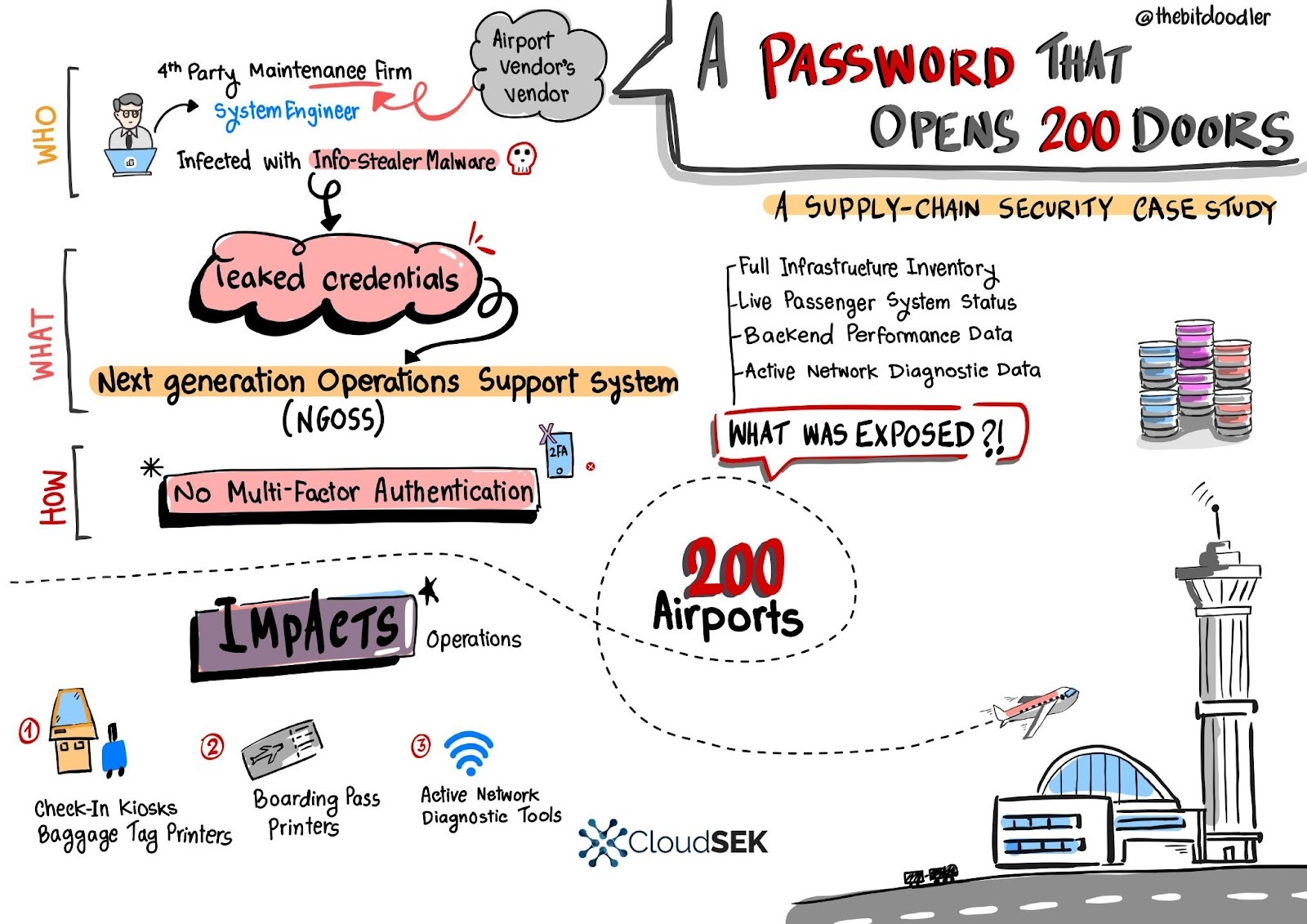
The "Who": A system engineer at this 4th-party maintenance firm had their credentials (a simple username and password) leaked and posted on a dark web forum.
The "What": These credentials (a simple username and password) were the only keys needed to access the primary vendor's main Next Generation Operations Support System (NGOSS) portal.
The "How": The portal, which served as the central control panel for over 200 client airports, lacked Multi-Factor Authentication (MFA).
No breach occurred — but the potential for one was immediate and severe.
Technical Analysis: What Was Exposed?
This wasn't just a view into a single server. It was a complete, real-time map of the entire operational ecosystem for hundreds of airports. Access was leaked to:
Full Infrastructure Inventory: Every server, switch, and core manager, complete with internal IP addresses, hostnames, and device roles (e.g., BHS-SVR-02 for Baggage Handling).
Live Passenger System Status: Real-time dashboards showing the online/offline/error status of every single check-in kiosk, boarding pass printer, and baggage tag printer.
Backend Performance Data: Live CPU, memory, and disk usage for critical servers. This even included performance metrics for the MSSQL and PostgreSQL databases running the passenger service applications.
Active Network Diagnostic Tools: The portal allowed the user to run live "Ping" and "Trace Route" commands from inside the trusted airport network—a perfect tool for launching internal Denial-of-Service (DoS) attacks.
How Attackers Could Weaponise Such Access?
With no malware, ransomware, or phishing required, an attacker holding operational credentials could weaponize the environment in multiple, high-impact ways. Below are the realistic attack scenarios, the immediate operational outcomes, and conservative financial loss estimates (with the assumptions used).
Attack Scenario
Operational Outcome
Cyber Risk Quantification
Targeted Kiosk / Terminal DoS
Attackers use live dashboards to identify
busiest self-service kiosks
at a terminal during peak hours and
repeatedly trigger diagnostics / flood
connectivity, rendering kiosks and associated CUSS/CUPPS stations
unavailable for 6 hours.
Approximately
$3.5M to $10M
Baggage Reconciliation System (BRS) Outage
Attackers identify and disrupt the BRS servers (via inventory data),
preventing verification of bag-to-flight mappings. Regulatory requirements
prevent departures without verification → widespread flight groundings.
Approximately
$12M to $30M+
Coordinated Multi-Hub Attack
Using the same leaked credentials and inventory mapping, attackers coordinate
simultaneous internal network DoS attacks against central managers at multiple
major hubs (e.g., 5–10 global hubs), causing system-wide outages and
a global travel ripple.
Hundreds of millions to over $1B
Business Impact: Where Operations and Revenue Collide
Aviation is an industry where minutes equal money, and availability equals safety. If exploited, the leaked access could have triggered a chain of failures cutting across core airport business KPIs:
Operational Disruption
Slowed or stalled check-ins, boarding, and baggage handling
Terminal throughput collapse due to kiosk and workstation outages
Increased MBR (Mishandled Baggage Rate) from reconciliation failures
Revenue & SLA Impact
Breach of OTP (On-Time Performance) metrics → airline penalty payouts
Loss of aeronautical and non-aeronautical revenue (retail, E-gates, lounges)
Compensation obligations due to passenger delays and baggage incidents
Regulatory & Safety Escalation
Non-compliance with aviation cybersecurity mandates (ICAO, regional regulators)
Mandatory audits, financial penalties, or grounding of affected systems
Reputational Damage
Headlines about “airport systems compromised” — even if only via a vendor
Loss of public confidence in digital aviation systems
Recommendations
This incident was a wake-up call. Immediate mitigation involved revoking the credentials, enforcing an emergency MFA rollout, and auditing all third-party accounts.
But the strategic lessons are what matter most for every business:
MFA is Non-Negotiable: Any partner, vendor, or internal system with administrative access to critical operations must be protected by Multi-Factor Authentication. The potential cost of an outage (tens of millions) dwarfs the cost of MFA implementation.
Enforce Vendor Zero Trust: Never trust, always verify. Third-party access should be granular, temporary (Just-in-Time), and limited only to the specific systems they need to service.
Credential Audit: Initiate a full audit and forced password rotation for all third-party and vendor accounts with privileged access.
Audit Your Supply Chain: You cannot simply trust a vendor's security claims. You must conduct active risk assessments of your critical suppliers and the platforms they provide.
This breach wasn't just about a password. It was about a failure of trust and a lack of basic security controls that nearly cost the aviation industry billions
The SVigil Advantage: Securing the Runway Before Disruption Takes Flight
This incident reinforces a critical truth about modern aviation: airports are only as secure as the third-party systems that keep them running. The exposure of a single credential tied to nearly 200 airports shows how the industry’s greatest vulnerability is not technology itself, but trust without verification.
Modern aviation cannot be protected airport by airport. It must be protected chain by chain, link by link — because when the supply chain weakens, the whole runway shakes. By identifying this exposure before it was weaponized, SVigil helped avert the potential for check-in paralysis, baggage system failures, financial losses, and cascading disruptions across global hubs.
In an industry where minutes cost millions and availability is the product, early detection is the difference between resilience and chaos.
Prevention isn’t just better — in aviation, it’s priceless.
About CloudSEK
CloudSEK is a unified digital risk management platform that leverages AI and machine learning to deliver real-time threat intelligence, attack surface monitoring, and supply chain security across enterprises globally.
Subscribe to CloudSEK Resources
Get the latest industry news, threats and resources.
.avif)







.jpg)