🚀 A CloudSEK se torna a primeira empresa de segurança cibernética de origem indiana a receber investimentos da
Leia mais
.avif)

Point-in-time vendor risk assessments leave you exposed because they capture a vendor's security posture on a single day, while that posture keeps changing between assessment cycles. The annual questionnaire is accurate the moment it is signed and a little more stale every day after.
The gap is not theoretical: SecurityScorecard found that 35.5 percent of breaches in 2024 were third-party related, and attackers move in the months that a static assessment cannot see.
This article explains what a point-in-time vendor risk assessment is, why it leaves you exposed, what changes in a vendor between assessments, how it compares to continuous monitoring, the role it still plays, the cost of the gap, and how to close it.
A point-in-time vendor risk assessment is a periodic evaluation of a vendor's security and compliance posture conducted at a fixed moment, usually at onboarding and then on an annual or quarterly cycle. It typically relies on questionnaires, document reviews, and audits to record how a vendor's controls stood on the day the assessment was completed.
The approach captures certain things well: declared security controls, certifications such as SOC 2 and ISO 27001, governance maturity, and contractual posture. Organizations rely on it because it is structured, thorough, cost-efficient, and familiar to auditors and regulators. The defining trait is in the name. A point-in-time assessment is a snapshot, accurate for the moment it is taken and nothing after.
The exposure comes from a simple mismatch: vendor risk is dynamic, but a point-in-time assessment is static. Six mechanisms turn that mismatch into real risk.
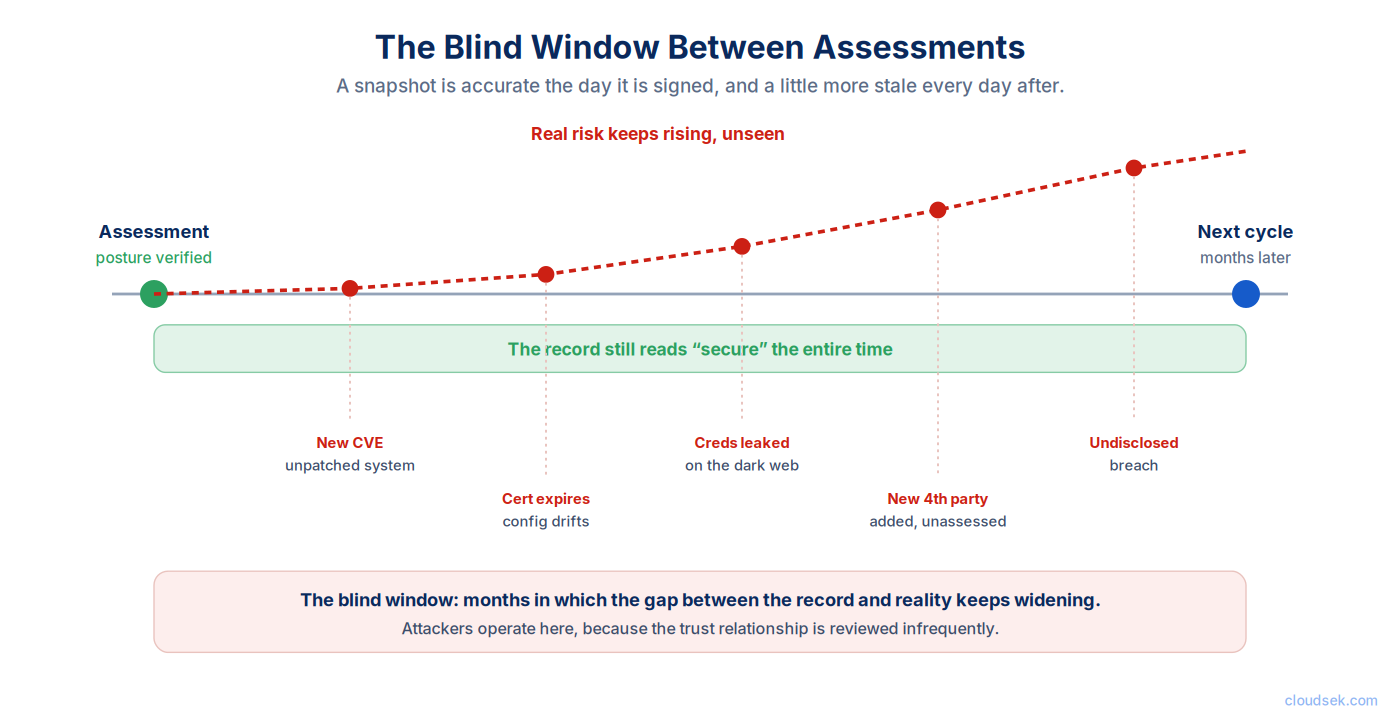
New vulnerabilities, infrastructure changes, expired certificates, and configuration drift appear in the weeks and months after the assessment is filed.
A SOC 2 attestation describes a vendor's controls at attestation time, and says nothing about what changed between then and today.
Annual or quarterly cycles leave multi-month gaps during which a vendor can be compromised while its record still reads secure.
Vendors adopt new fourth-party services and sub-processors between reviews, extending the chain in ways the last assessment never examined.
A vendor breached the day after its assessment looks green in the records until the next scheduled cycle uncovers it.
Adversaries target vendors precisely because the trust relationship is reviewed infrequently, giving them room to operate unnoticed.
The phrase changing posture stays abstract until it is made concrete. Six specific things commonly shift in a vendor during the months between assessments.
Continuous monitoring addresses the timing problem that a point-in-time assessment cannot. The table below compares the two across the dimensions that matter.
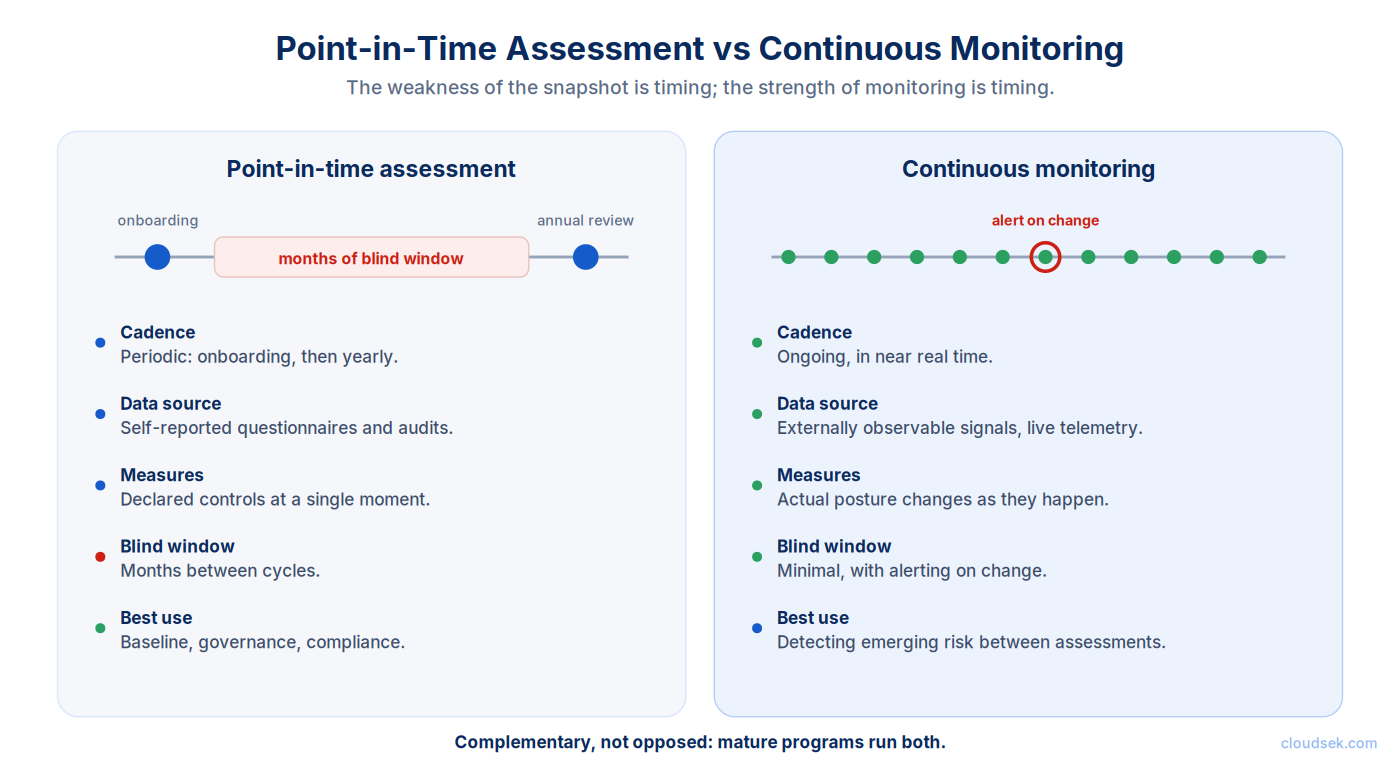
The two are complementary, not opposed. The weakness of the snapshot is timing, and the strength of monitoring is timing, which is why mature programs run both.
Point-in-time assessment is not obsolete, and treating it as worthless overcorrects. It still does the necessary work that monitoring alone does not.
The gap between assessments carries a measurable price. Gartner research cited by Recorded Future found that third-party breaches cost roughly 40 percent more to remediate than internal incidents, because they span multiple entities, jurisdictions, and data environments. The same analysis notes that only 4 percent of organizations have high confidence that their vendor questionnaires reflect real-world risk.
Closing the gap does not mean discarding assessments. It means adding continuous visibility around them through five steps.
The exposure this article describes is a timing problem, and CloudSEK SVigil is built to close it. SVigil monitors vendors and their fourth-party dependencies continuously, fingerprinting each vendor's external attack surface and surfacing exposed credentials, new vulnerabilities, and posture changes as they emerge rather than at the next scheduled review. It maps not only direct suppliers but the hidden dependencies behind them, the layers a point-in-time questionnaire rarely reaches.
The result is vendor risk that reads as a live signal instead of an annual snapshot. In one case, SVigil detected exposed credentials at a third-party communication provider serving major banks and surfaced the access before it could be used, the kind of change that would sit invisible in the months between assessments. Pairing continuous monitoring with periodic assessment is what turns a stale snapshot into a defense that keeps pace with the threat.
A vendor risk assessment is a periodic, questionnaire-based evaluation of a vendor's posture at a point in time. Continuous monitoring is an ongoing feed of external signals about what is actually happening to a vendor between those assessments.
Traditional practice was annual, but the current threat landscape makes that insufficient on its own. Assessments still belong at onboarding and on a defined cycle, paired with continuous monitoring, so risk changes are caught between assessments rather than months later.
Yes. Questionnaires capture declared controls, certifications, and governance maturity, and they satisfy compliance needs. Their limitation is timing: they describe a single moment, so they work best as a baseline that continuous monitoring keeps current.
The blind window. A point-in-time assessment is accurate only on the day it is completed, leaving months between cycles during which a vendor can be compromised while its record still shows it as secure.
No. Continuous monitoring detects when a vendor's posture changes, but it does not replace the depth of a full assessment. The two work together: assessments set the baseline, and monitoring flags when that baseline shifts.
Frameworks such as DORA, NIS2, and NYDFS Part 500 require organizations to detect and respond to material changes in third-party risk as they occur. A continuous obligation cannot be met by an assessment conducted only once a year.
