🚀 A CloudSEK se torna a primeira empresa de segurança cibernética de origem indiana a receber investimentos da
Leia mais
.avif)

Modern AI environments operate across cloud systems, APIs, external services, and connected data pipelines. While these environments improve automation and operational efficiency, they expand the attack surface significantly. Exposed APIs, insecure integrations, misconfigured cloud resources, and weak access controls create direct security risks across enterprise infrastructure.
According to the ThreatLabz 2026 AI Security Report, enterprise AI and ML activity increased by 83.3% YoY in 2025. Data transfer volumes increased by 92.6% in that same time period. AI infrastructure security helps organizations protect AI systems, models, data pipelines, cloud workloads, and connected services from unauthorized access, data exposure, and operational disruption. In this article, we will discuss the core components of AI infrastructure, major security risks, best practices, monitoring methods, and future security challenges affecting enterprise AI environments.
AI infrastructure security protects the systems, models, data pipelines, compute resources, APIs, and connected services that support AI operations from cyber threats, unauthorized access, and operational disruption.
AI infrastructure differs from traditional IT infrastructure because AI systems rely heavily on large-scale data processing, external integrations, and automated decision-making. AI environments constantly exchange prompts, training data, model outputs, and API requests across connected systems. This creates a larger and more dynamic attack surface.
AI infrastructure security focuses on protecting every layer of this ecosystem. This includes securing AI compute environments, controlling access to models and APIs, protecting sensitive training data, monitoring AI activity, and reducing exposure from external integrations. Strong security controls help organizations prevent unauthorized access, data leakage, model theft, and infrastructure misuse.
AI infrastructure consists of interconnected systems that support AI model training, deployment, data processing, storage, and real-time operations.
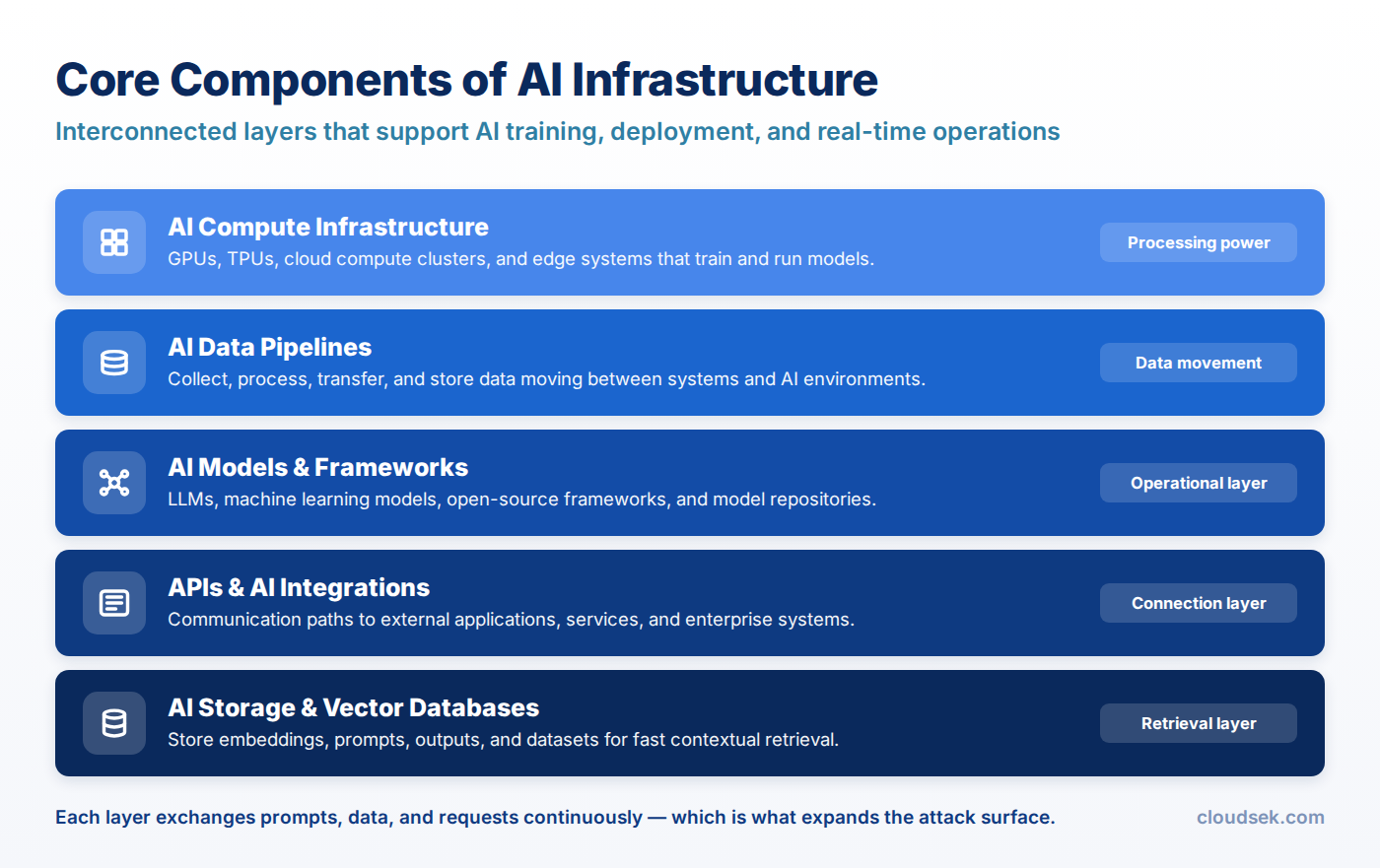
AI compute infrastructure provides the processing power required to train and run AI models. This includes GPUs, TPUs, cloud compute clusters, and edge AI systems that handle large-scale AI workloads and complex calculations.
AI data pipelines collect, process, transfer, and store data used for training and operating AI models. These pipelines move information between databases, storage systems, applications, and AI environments.
AI models and frameworks form the operational layer of AI systems. This includes large language models (LLMs), machine learning models, open-source AI frameworks, and model repositories used for development and deployment.
AI systems use APIs and integrations to communicate with external applications, services, and tools. APIs allow AI models to retrieve information, automate workflows, and interact with enterprise systems.
AI storage systems and vector databases store embeddings, prompts, model outputs, datasets, and retrieved information used during AI operations. Vector databases help AI systems search and retrieve contextual information efficiently.
AI infrastructure security matters because AI environments process sensitive data, connect with critical enterprise systems, and introduce new attack surfaces that attackers actively target.
AI systems continuously process training data, prompts, customer records, operational information, and intellectual property. Weak security controls increase the risk of data leakage, unauthorized access, and exposure of confidential business information across connected environments.
AI infrastructure often includes APIs, cloud services, model repositories, and external integrations that require controlled access. Poor authentication and excessive permissions allow attackers or unauthorized users to access AI systems, manipulate workflows, or misuse enterprise resources.
AI environments rely on internet-facing APIs, external integrations, cloud infrastructure, and connected tools to support real-time operations. Every exposed service or insecure integration increases the attack surface and creates additional entry points for cyber threats.
Organizations use third-party models, datasets, frameworks, and open-source components to accelerate AI development. Compromised vendors, insecure dependencies, or manipulated datasets introduce supply chain risks that may affect the entire AI environment.
Many enterprises depend on AI systems for automation, analytics, customer support, and operational decision-making. Security incidents affecting AI infrastructure may disrupt critical services, interrupt workflows, and impact overall business operations.
Here are the most common AI infrastructure security risks that organizations must not overlook:
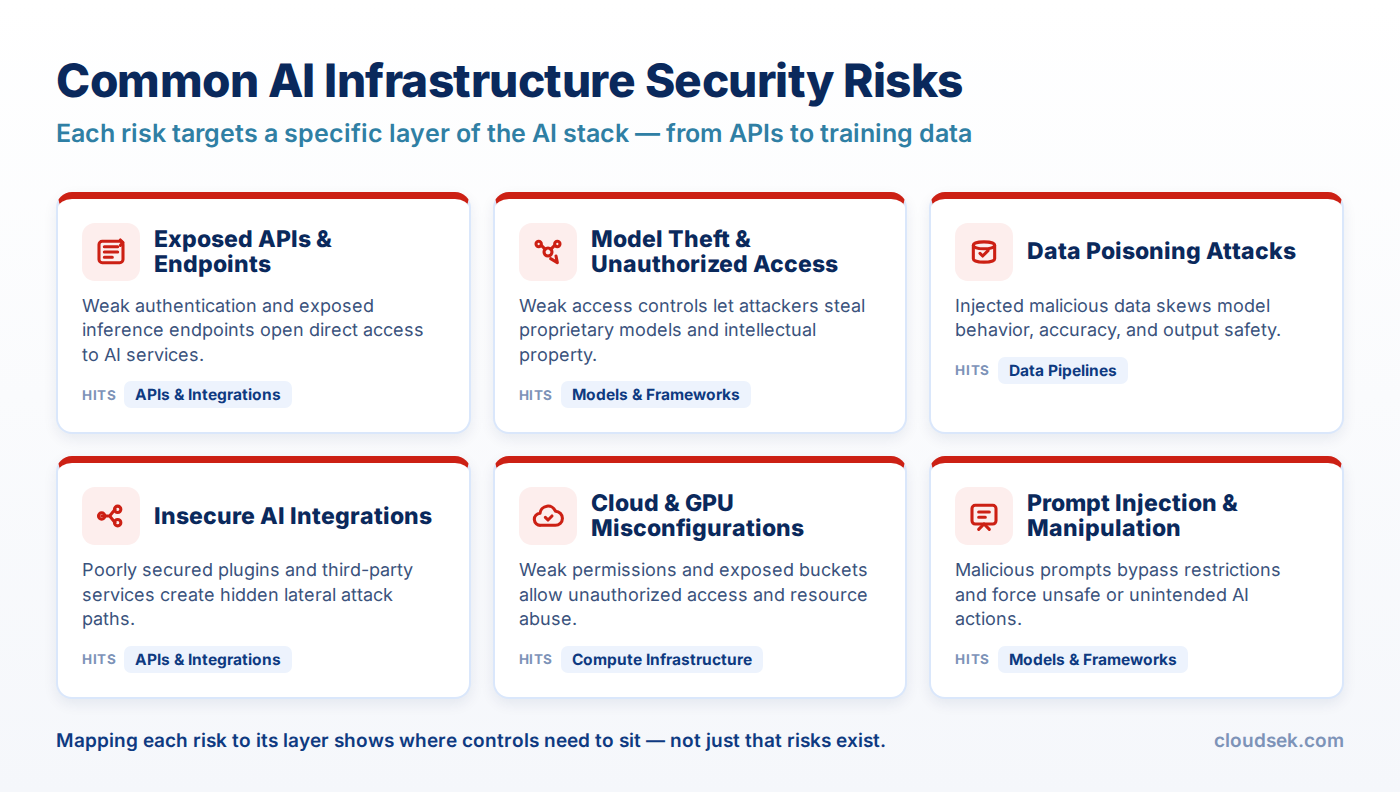
AI systems rely heavily on APIs and public endpoints to process requests, exchange data, and interact with applications. Weak authentication, exposed inference endpoints, or insecure API configurations create direct access points that attackers may exploit to access sensitive AI services and enterprise systems.
Organizations invest significant resources into developing proprietary AI models and training environments. Weak access controls, exposed repositories, or insecure storage systems increase the risk of attackers stealing models, copying intellectual property, or manipulating AI operations without authorization.
AI systems depend on accurate training and operational data to generate reliable outputs. Attackers may inject manipulated, false, or malicious data into AI pipelines to influence model behavior, reduce accuracy, or trigger unsafe responses during operations.
AI environments often connect with external APIs, plugins, cloud platforms, and third-party services to improve automation and functionality. Poorly secured integrations create hidden attack paths that attackers may use to move across connected systems or gain unauthorized access.
AI workloads commonly run on cloud infrastructure, GPU clusters, and distributed compute environments. Misconfigured permissions, exposed storage buckets, and weak identity controls increase the risk of unauthorized access, resource abuse, and infrastructure compromise.
Attackers use malicious prompts and manipulated input to influence AI behavior and bypass operational restrictions. Unsafe prompt handling may force AI systems to expose sensitive information, execute unintended actions, or interact with restricted resources inside the environment.
To secure AI infrastructure, organizations must implement the following strong security practices, which help reduce AI-related risks, protect sensitive systems, and maintain visibility across AI infrastructure environments.
AI infrastructure requires strict authentication and authorization controls to protect models, APIs, storage systems, and compute resources from unauthorized access. Role-based access control, least privilege policies, and multi-factor authentication help reduce unnecessary exposure across AI environments.
AI systems continuously process and transfer sensitive data across cloud services, APIs, and storage environments. Encryption protects prompts, datasets, model outputs, credentials, and operational traffic from interception, leakage, and unauthorized access during storage and transmission.
Continuous monitoring improves visibility into AI infrastructure activity, API usage, access patterns, and operational behavior. Real-time monitoring helps organizations detect suspicious activity, exposed assets, abnormal traffic, and potential attacks before systems become compromised.
AI APIs and external integrations create direct communication paths between AI systems and connected services. Strong authentication, secure API gateways, input validation, and controlled third-party integrations reduce the risk of exposed endpoints and unauthorized interactions.
AI workloads should operate in isolated environments that separate sensitive systems, datasets, and compute infrastructure from unnecessary access. Segmentation and workload isolation reduce lateral movement opportunities if attackers compromise one part of the AI environment.
AI infrastructure changes rapidly due to scaling, integrations, and model deployment updates. Regular security audits help organizations identify misconfigured cloud resources, exposed storage systems, weak permissions, and insecure integrations before attackers exploit them.
Organizations can monitor AI infrastructure security by continuously tracking AI assets, APIs, cloud environments, access activity, and infrastructure behavior across connected systems.
AI systems depend heavily on APIs and network communication to process requests and exchange data. Continuous API and traffic monitoring helps organizations identify abnormal requests, unauthorized access attempts, exposed endpoints, and suspicious communication patterns before attackers exploit them.
AI infrastructure often includes internet-facing models, cloud services, storage systems, inference endpoints, and development environments. Continuous asset discovery helps organizations identify exposed AI components, unmanaged services, and risky configurations that increase external attack surface exposure.
Cloud environments, GPU clusters, storage systems, and AI workloads require constant configuration updates. Monitoring helps security teams detect weak permissions, exposed storage buckets, insecure access controls, and other misconfigurations that attackers commonly target.
Organizations need visibility into how users, applications, and AI systems interact with infrastructure resources. Behavioral analysis helps identify unusual access activity, excessive permissions, suspicious API usage, and abnormal operational patterns that may indicate misuse or compromise.
AI infrastructure operates across cloud platforms, APIs, models, integrations, and external services simultaneously. Correlating threat signals from multiple environments helps organizations identify larger attack patterns, connected security events, and AI-related attack paths more accurately.
AI infrastructure security challenges will increase as organizations expand AI systems, cloud environments, and connected services across enterprise operations.
AI environments continuously grow through APIs, cloud workloads, external integrations, and internet-facing services. Every new AI component creates additional exposure points that attackers may target.
Organizations rely heavily on open-source AI models, frameworks, and datasets for development and deployment. Unverified dependencies, compromised repositories, and insecure packages increase supply chain risks inside AI environments.
Large AI environments operate across multiple cloud platforms, distributed systems, and connected services simultaneously. Maintaining visibility, access control, and consistent security policies becomes more difficult as AI operations expand.
AI workloads require high-speed processing, scalable infrastructure, and real-time access to data and services. Strict security controls may affect operational efficiency if they are not designed properly for dynamic AI environments.
Attackers continue developing new techniques that target AI models, prompts, APIs, training data, and inference systems. Threats such as prompt injection, model manipulation, data poisoning, and AI-assisted attacks increase security complexity across AI infrastructure.
CloudSEK’s AIVigil continuously discovers, monitors, and secures exposed AI infrastructure, MCP servers, leaked AI credentials, vector databases, agentic workflows, and shadow AI.
By tracking down every AI tool in use - even those deployed outside approved workflows - AIVigil ensures complete visibility across the organization. It monitors these assets around the clock, flagging new threats the moment they emerge. By providing clear remediation steps and automated audit reports, it gives leaders the confidence to scale AI safely.
Features include AI infrastructure fingerprinting, finding leaked AI API keys, MCP scanning to uncover unauthorized access, AI red teaming, agentic workflow analysis, AI threat intelligence, AI triage and remediation, SDK & mobile artifact discovery and supply chain & model scanning.
AI infrastructure security protects sensitive data, AI operations, and connected enterprise systems from compromise.
Exposed APIs, model theft, data poisoning, and cloud misconfigurations are major AI infrastructure risks.
Organizations secure AI infrastructure through monitoring, access control, encryption, and continuous risk assessment.
AI infrastructure includes compute systems, data pipelines, AI models, APIs, storage systems, and connected services.
