🚀 CloudSEK featured in the 2026 Frost Radar™!
Read more
.avif)

Security threat intelligence converts raw data into actionable insights to detect, prevent, and respond to cyber threats. Correlating logs with external feeds reveals attacker behaviors and techniques that remain hidden within isolated alerts.
Effective intelligence categorizes threats into strategic and operational levels to support both technical teams and executive decision-makers. This structured approach improves threat prioritization and aligns defenses with an organization’s technology stack and risk profile.
Integration with the MITRE ATT&CK framework and SIEM platforms enables proactive threat hunting and automated event correlation. These combined capabilities allow security teams to recognize attack patterns early and neutralize complex threats before escalation.
Security threat intelligence workflows connect intelligence outputs with real-time detection and response systems across enterprise environments.
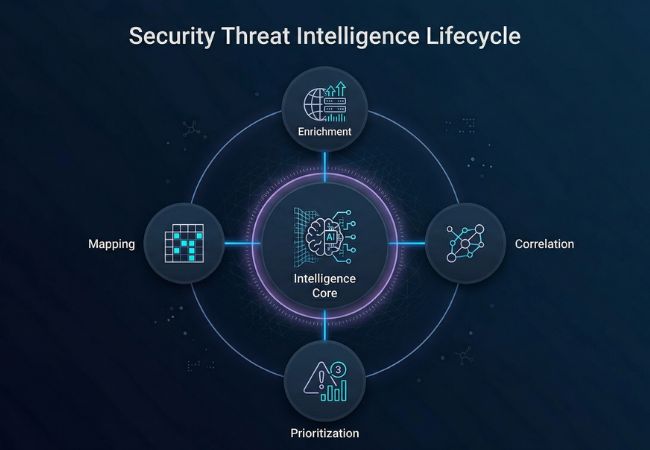
Different intelligence types build on these workflows by supporting decisions at multiple levels of security operations.
Threat intelligence is categorized into distinct types based on how it supports decision-making across different levels of security operations.
While these types define how intelligence is used, predictive capabilities take this further by enabling forward-looking threat anticipation.
Predictive threat intelligence is an advanced approach that anticipates future cyber threats using historical data, behavioral patterns, and evolving threat signals. Analytical models and machine learning techniques identify trends that indicate how attacks are likely to develop.
Analysis of attacker behavior reveals potential next steps such as lateral movement, privilege escalation, or targeted exploitation. Visibility into these patterns allows organizations to prepare defenses before threats fully materialize.
Integration of predictive models with threat intelligence platforms and security operations improves proactive decision-making. Security teams apply these insights to strengthen controls, reduce exposure, and limit the impact of emerging threats.
Security threat intelligence depends on multiple systems working together because no single source provides a complete view of threats. Gaps between data sources, tools, and analysis often create blind spots that attackers exploit.
Threat visibility starts with data spread across logs, endpoints, network traffic, and external feeds. Fragmentation across these sources makes it difficult to see attack patterns unless information is brought together and analyzed collectively.
Scattered threat data quickly becomes unmanageable without a central system to organize it. TIPs consolidate and enrich intelligence, connecting indicators with known campaigns, threat actors, and historical activity.
Security events generate large volumes of alerts that lack context when viewed individually. SIEM platforms correlate these events across systems, turning disconnected signals into a clearer view of ongoing threats.
Understanding attacker behavior requires more than raw data or alerts. Frameworks provide structure by mapping activity to known techniques, helping teams recognize how attacks progress.
Individual indicators such as IP addresses or file hashes often appear insignificant on their own. When tracked and correlated over time, they reveal patterns that confirm whether systems have been targeted or compromised.
Manual investigation slows response when alert volumes increase beyond what teams can handle. Automation reduces this pressure by handling enrichment, prioritization, and response actions at scale.
Threat landscapes change rapidly, making static data outdated within short periods. Continuous updates from external feeds ensure intelligence reflects current threats, vulnerabilities, and attack activity.
Modern environments generate large volumes of security data, yet most of it lacks context when viewed in isolation. Without intelligence, teams struggle to distinguish real threats from noise, leading to delayed response and missed risks.
Security alerts often appear without clear indicators of severity or intent. Intelligence adds context, allowing teams to understand which threats require immediate attention and which can be deprioritized.
Standalone alerts frequently lead to false positives that consume time and resources. Correlated intelligence reduces this noise by linking related signals and highlighting genuine threats.
Delays in identifying and understanding threats increase the potential impact of an attack. Clear visibility into attacker behavior enables faster containment and more precise response actions.
Technical data alone does not support strategic security decisions. Intelligence provides a broader view of risks, helping organizations align defenses with business priorities and threat exposure.
Reactive security models allow threats to progress before action is taken. Intelligence-driven approaches identify risks earlier, allowing teams to prevent incidents instead of only responding to them.
Growing infrastructure increases the volume and complexity of alerts. Intelligence and automation help manage this scale by reducing manual effort and improving operational efficiency.
Security threat intelligence improves visibility, decision-making, and response across complex environments, but it also introduces operational and technical challenges that organizations must manage effectively.
Successful implementation depends on how well intelligence fits into existing systems and supports real operational needs. Poor alignment often leads to unused insights, delayed response, and limited impact.
Clarity at the start prevents unnecessary data collection and scattered efforts. Focus should remain on critical assets, likely threats, and areas where visibility gaps already exist.
Intelligence becomes meaningful only when it feeds directly into detection and response systems. SIEM platforms, endpoint tools, and network monitoring need to work together so insights translate into action.
Disruptions in data flow often create blind spots that attackers take advantage of. Consistent ingestion from internal systems and external feeds ensures analysis reflects what is actually happening across environments.
Isolated indicators rarely explain the full scope of an attack. Connecting them to campaigns, behaviors, and threat actors provides clarity during investigation and reduces guesswork.
Rising alert volumes make manual handling impractical over time. Automated prioritization and response workflows help maintain speed without overwhelming teams.
Even well-integrated systems fail when teams lack clarity on how to use them. Shared processes and regular training ensure intelligence leads to consistent and effective action.
Initial setup rarely delivers optimal results without adjustment. Continuous evaluation of detection accuracy, response time, and operational gaps helps improve effectiveness over time.
CloudSEK strengthens security threat intelligence through AI-driven predictive insights and continuous monitoring across the surface, deep, and dark web. Platforms such as CloudSEK XVigil and BeVigil automate the collection and analysis of external threat data, enabling early identification of risks before they escalate into active incidents.
Coverage across hundreds of external sources, including underground forums, encrypted channels, and social platforms, provides visibility into threats like credential leaks, data breaches, and brand impersonation. Machine learning models correlate this data to generate contextual risk scoring and concise incident summaries, reducing noise and improving analysis efficiency.
Mapping of an organization’s external attack surface reveals exposed assets such as API keys, vulnerable applications, and cloud misconfigurations. Integration with SIEM and SOAR systems enables automated response actions, allowing security teams to act quickly on intelligence and strengthen overall threat detection and prevention workflows.
