🚀 CloudSEK featured in the 2026 Frost Radar™!
Read more
.avif)

Cookie logging is a cyberattack technique that collects and stores browser session cookies to gain unauthorized access to online accounts without a password. Instead of stealing login credentials, attackers copy authentication cookies, which act as proof of login, allowing them to hijack active sessions and bypass authentication systems.
When a session cookie is stolen, the attacker can import it into their own browser and replay the session. The website then treats the attacker as the legitimate user. This method allows account takeover without triggering a password prompt. Because the login process has already been completed, traditional protections such as password complexity do not prevent access.
Cookie logging is considered a form of credential theft because session cookies function as temporary login keys. If those keys are exposed, attackers can access email accounts, cloud platforms, financial services, and internal business tools. The attack focuses on session control rather than password discovery, which makes it especially effective against modern web-based applications.
Browser session cookies are small pieces of data stored by websites to keep users logged in after authentication. When you enter your username and password, the website creates a session cookie and stores it in your browser. This cookie tells the server that you have already verified your identity.
Session cookies usually expire when you log out or close the browser. Persistent cookies, on the other hand, remain stored for a longer period to remember preferences or login states. Authentication tokens are a special type of session cookie that confirms access to secure areas such as email, cloud dashboards, or banking portals.
Websites rely on these cookies to avoid asking for credentials on every page visit. Without them, users would need to log in repeatedly. Because session cookies represent an active login status, anyone who gains access to them can appear as the legitimate user without entering a password again.
Cookie logging works by extracting stored browser session cookies and using them to replay an authenticated session.
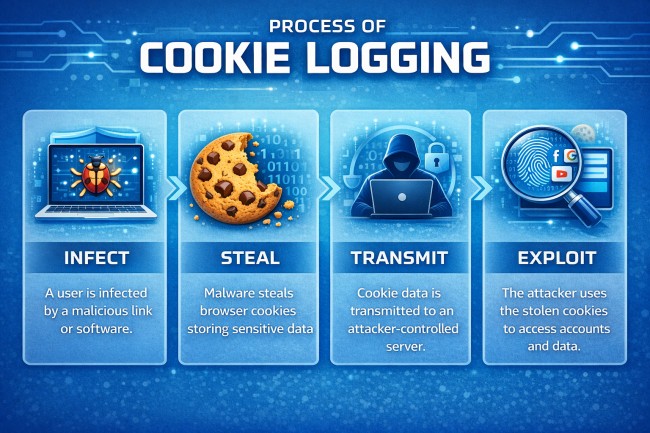
Here is the step-by-step attack flow of Cookie logging:
The attack usually begins when the device is infected with infostealer malware such as RedLine, Raccoon, or Vidar. These programs are designed to silently collect browser data.
In some cases, attackers use browser data extraction scripts, malicious browser extensions, or phishing frameworks that specifically target session tokens instead of passwords. Once installed, these tools gain access to locally stored browser information.
The malware scans browser storage locations where cookies are saved. Modern browsers store session data in protected files. The attacker copies this data from the infected device.
Not all cookies are useful. The attacker filters for authentication or session cookies linked to high-value websites such as email, cloud platforms, or financial services. These tokens confirm logged-in status.
The stolen cookie data is sent to an external server controlled by the attacker. This transfer happens quietly without user awareness. The attacker now possesses the session tokens.
The attacker imports the stolen cookies into their own browser. The target website recognizes the session as valid. Access is granted without requiring a password or additional login steps.
Cookie logging is increasing because modern authentication relies heavily on browser-based session tokens instead of repeated password entry. As organizations shift toward cloud platforms and single sign-on systems, session cookies have become a primary access mechanism.
Businesses now use SaaS platforms for email, collaboration, storage, and finance. These services depend on session tokens to maintain the login state. More cloud usage means more valuable cookies stored in browsers.
Multi-factor authentication protects passwords but does not always protect active sessions. Attackers have shifted from stealing passwords to stealing session tokens. Token theft bypasses the login step entirely.
Infostealer malware is widely sold in underground markets. Tools such as RedLine, Vidar, and Raccoon automate browser cookie extraction. Easy access to these tools increases attack volume.
Stolen session cookies are bought and sold on dark web marketplaces. Buyers can purchase access to verified email or cloud accounts. This resale model increases financial incentive.
Web browsers now act as gateways to corporate systems. Employees access internal tools through web dashboards instead of local applications. When browser sessions become the access layer, stealing cookies becomes a direct path to account control.
In 2022, multiple YouTube content creators were targeted by attackers distributing fake sponsorship offers that delivered infostealer malware such as RedLine. After the victims installed the malicious file, the malware extracted browser session cookies and authentication tokens. Attackers reused the stolen cookies to access YouTube Studio accounts without passwords or MFA prompts. Hundreds of creator channels were hijacked, rebranded for cryptocurrency scams, and temporarily locked by the platform. The campaign caused revenue loss, subscriber confusion, and reputational damage for affected creators.
In 2023, threat actors used phishing emails to deploy browser data-stealing malware against corporate employees. The malware collected Microsoft 365 session cookies from infected devices. Attackers imported those cookies into their own browsers and accessed business email accounts without triggering login alerts. Several mid-sized organizations experienced unauthorized invoice manipulation and wire fraud attempts. Financial losses ranged from thousands to millions of dollars, depending on transaction size.
In 2021, attackers breached a technology company after infecting an administrator’s laptop with an infostealer variant. The malware extracted session cookies associated with a cloud infrastructure dashboard. Using the stolen tokens, attackers accessed the admin panel and modified system configurations. The breach exposed internal data and disrupted service availability for customers. Recovery required full session revocation, credential resets, and infrastructure audits across affected systems.
Cookie logging creates serious security risks because stolen session cookies provide direct access to active accounts. It affects both individuals and organizations, as attackers can exploit hijacked sessions to compromise personal data or infiltrate business systems.
For individuals, the main risks include account takeover—such as email compromise, financial fraud, and identity misuse. A stolen session can expose private conversations, saved payment methods, and personal documents. In many cases, victims remain unaware of the breach until suspicious activity is detected.
For businesses, the impact is broader. Compromised employee sessions can expose internal systems, cloud dashboards, and collaboration platforms. Attackers may move laterally across SaaS applications, extract sensitive data, or prepare ransomware deployment. The longer a stolen session remains active, the greater the operational and financial damage
Here are some best methods to detect cookie logging attacks:
Monitor login sessions that originate from unfamiliar locations or new devices. A session that suddenly shifts to a different country or IP range signals possible token misuse. Device fingerprint changes strengthen suspicion.
Check whether a session remains active even after the user changes their password. Legitimate sessions should be invalidated after credential updates. Persistent access indicates stolen session cookies.
Use endpoint detection tools to identify processes accessing browser storage files. Infostealer malware often reads local cookie databases. Alerts for unauthorized browser data access indicate possible compromise.
Track session tokens reused across different devices simultaneously. One token appearing active in multiple environments suggests replay activity. Token duplication rarely occurs during normal usage.
Review cloud platform logs for abnormal administrative actions or rapid data downloads. Unexpected configuration changes from active sessions may signal unauthorized access. Audit logs provide early visibility into session abuse.
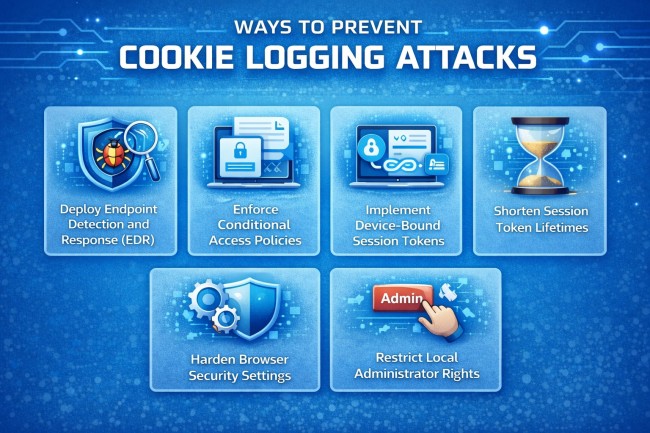
Since attackers target session tokens stored in browsers, protection must focus on both device security and authentication policies. Here are the best strategies to prevent cookie logging attacks:
Install EDR solutions on all user devices. EDR monitors suspicious processes that attempt to access browser storage files. Early detection blocks infostealer malware before cookies are extracted.
Use conditional access rules to verify device health, location, and user behavior before granting access. Even if a token is stolen, abnormal device conditions can block login. Risk-based access reduces session abuse.
Enable device binding so session tokens work only on the original device. A stolen cookie becomes unusable on another system. Device-bound authentication limits replay attacks.
Reduce how long session cookies remain valid. Short-lived tokens decrease the window of exploitation. Expiring sessions force reauthentication sooner.
Disable unnecessary browser extensions and restrict installation permissions. Keep browsers updated with the latest security patches. Secure configuration reduces data exposure.
Limit administrative privileges on endpoints. Malware often requires elevated rights to access sensitive browser data. Least-privilege policies reduce extraction risk.
Invalidate all active sessions immediately after detecting suspicious activity. Force users to reauthenticate across devices. Session revocation stops ongoing unauthorized access.
Yes, cookie logging can bypass multi-factor authentication in certain situations. MFA protects the login process by requiring an extra verification step, such as a code or biometric scan. However, once the login is completed, the website issues a session cookie that confirms the user is authenticated. If that session cookie is stolen, the attacker can reuse it without going through MFA again.
The bypass works because MFA verifies identity only at the time of login, not during every page request. A valid session token tells the server that authentication has already happened. If the session is not tied to a specific device or location, the stolen cookie can grant access from another system.
MFA still reduces overall risk because it blocks password-only attacks. Strong protection requires additional controls such as device binding, short session lifetimes, and conditional access policies. Without session protection, MFA alone does not prevent cookie-based account takeover.
Cybersecurity professionals use cookie logging in controlled environments to test session security, detect weaknesses, and strengthen authentication controls. Ethical use focuses on improving defenses, not exploiting accounts.
Here are some scenarios in which cybersecurity professionals use cookie logging:
Security teams simulate real-world attacks during authorized penetration tests. They extract session cookies in a lab setting to evaluate whether accounts can be accessed without passwords. This testing reveals weaknesses in session handling.
Professionals analyze how long session tokens remain valid and whether they are properly invalidated after logout. Weak session expiration policies increase exposure. Testing confirms whether token lifetimes are secure.
Security engineers test whether stolen cookies allow access even when multi-factor authentication is enabled. This assessment helps organizations understand gaps between login protection and session protection.
During breach investigations, analysts examine whether attackers used stolen cookies for account takeover. Cookie logging techniques help confirm how access was gained. This analysis supports accurate root cause identification.
Professionals verify that endpoint detection tools and browser protections block unauthorized cookie extraction. Controlled testing confirms whether security tools generate alerts. Validation ensures defensive controls operate as expected.
Yes, cookie logging is illegal when performed without authorization. Stealing session cookies to access someone’s account violates computer misuse and privacy laws in many countries.
No, HTTPS does not prevent cookie logging. HTTPS encrypts data during transmission, but it does not stop malware from stealing cookies stored on a local device.
Session cookies may be encrypted in transit, but they are stored on the user’s device in a readable format for the browser. Malware can extract them if the device is compromised.
Yes, attackers use stolen session cookies to gain initial access to cloud accounts before deploying ransomware or stealing data.
Yes, modern antivirus and endpoint detection tools can detect many infostealer programs. However, detection depends on updated signatures and behavioral monitoring.
