🚀 CloudSEK featured in the 2026 Frost Radar™!
Read more
.avif)

RedLine Stealer is a .NET-based information-stealing malware that harvests saved passwords, browser cookies, payment-card data, and cryptocurrency wallets from infected Windows devices, then packages the theft into stealer logs sold through a Malware-as-a-Service model.
RedLine and the related META stealer accounted for 64% of infostealer-infected devices in 2024 and exposed more than 451 million unique credentials, figures that ranked RedLine as a leading infostealer before its 2024 disruption.
A coordinated law-enforcement takedown named Operation Magnus disrupted RedLine's infrastructure in October 2024, yet RedLine samples still surface in active campaigns. This guide explains what RedLine Stealer is, how it works, what it steals, how to recognize and remove an infection, and how to prevent one.
RedLine Stealer is an information-stealing Trojan first observed in March 2020, when attackers spread it through a COVID-19-themed email campaign. RedLine operates as Malware-as-a-Service: criminals rent it through subscriptions that run from roughly $100 per week to $800 for a lifetime license, then sell the harvested data on dark-web markets and Telegram channels.
The malware ships as an encrypted .NET assembly and hollows into a legitimate process to evade antivirus. Threat groups, including LAPSUS$, have deployed RedLine against high-profile targets.
RedLine Stealer works in six stages, from delivery to data exfiltration:
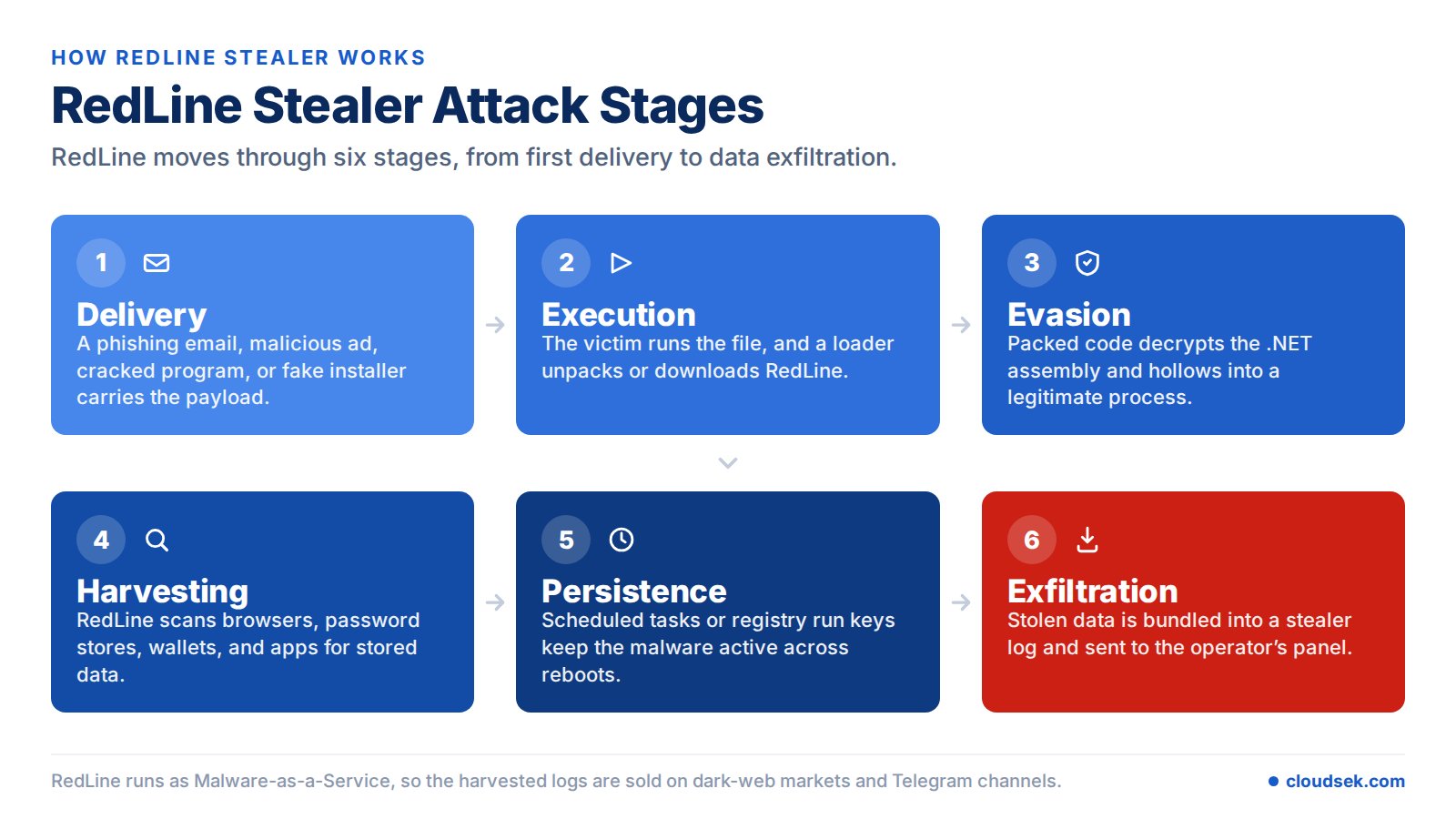
CloudSEK's technical analysis of RedLine documented the loader hollowing the malware into the legitimate Regsvcs.exe process, then decoding its configuration through a layered base64-and-XOR scheme before contacting its command-and-control server. The same research recorded a region check that halts execution on devices in several CIS countries.
RedLine Stealer steals data across four categories: browser secrets, cryptocurrency assets, application credentials, and system details.
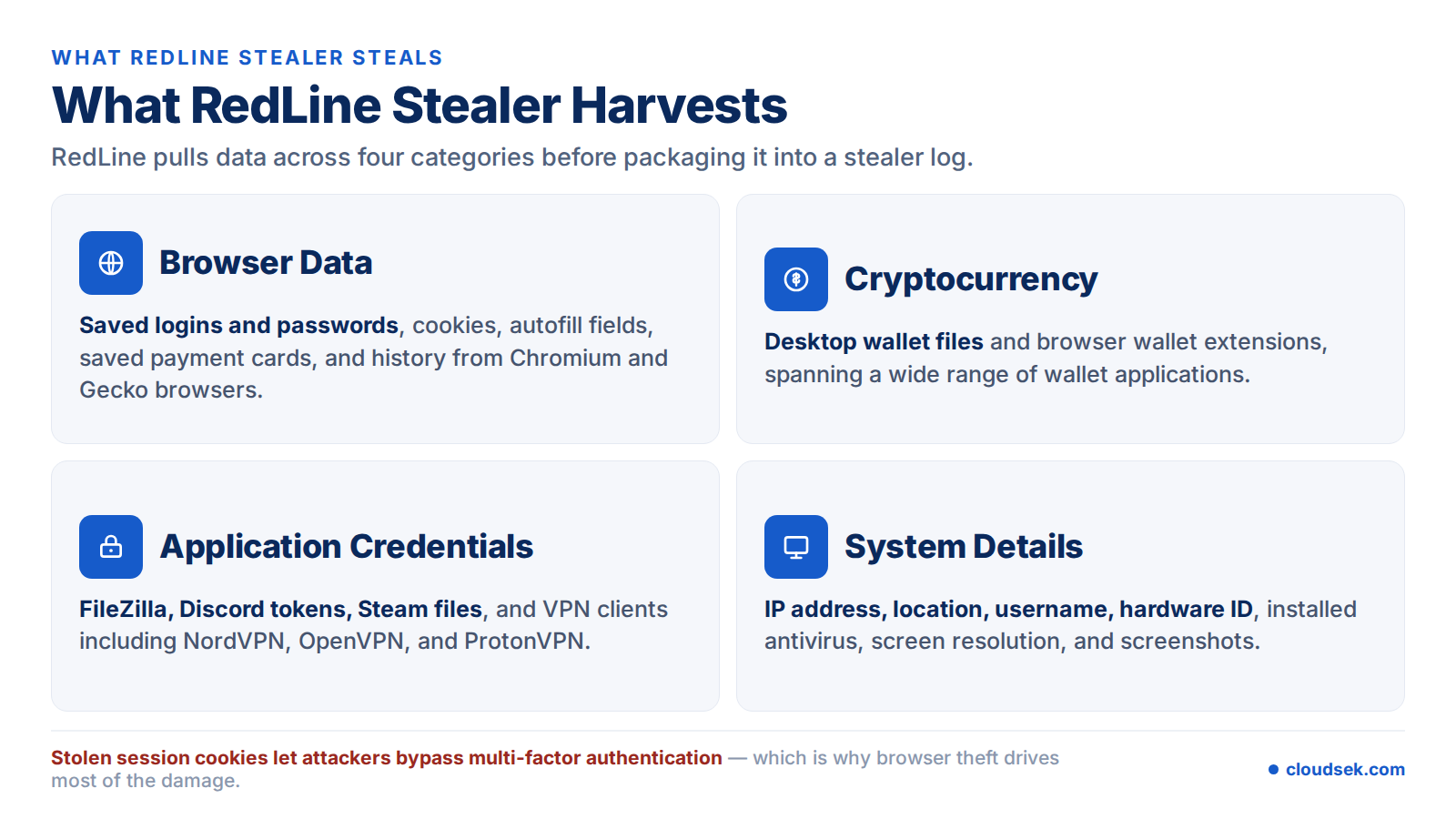
Stolen session cookies let attackers bypass multi-factor authentication by hijacking authenticated sessions, which is why browser theft drives most of the damage in a RedLine infection.
RedLine Stealer spreads through social-engineering channels that trick users into running the payload:
Browser exploitation forms another RedLine route. CloudSEK's Threat Research Team found RedLine exploiting CVE-2022-1096, a Chromium browser zero-day rated 9.1, to compromise around half a million users. The resulting stealer logs exposed credentials from organizations including Axis Bank, Cisco, Samsung, and Zoom.
RedLine remains in circulation, though law enforcement disrupted its core operations. On 28 October 2024, the Dutch National Police, the FBI, and partners coordinated by Eurojust ran Operation Magnus, seizing servers in the Netherlands, two domains, source code, license servers, and Telegram channels tied to RedLine and META. The US Department of Justice charged Maxim Rudometov, a Russian national identified as a RedLine developer and administrator, with access-device fraud, conspiracy to commit computer intrusion, and money laundering. Belgian authorities arrested two suspects.
RedLine activity fell sharply after the takedown, and many operators migrated to other stealers. IBM's 2025 X-Force Threat Intelligence Index ranks RedLine fifth among stealer variants, with Lumma now ranking first. RedLine samples continue to appear in attacks, so the threat persists in a reduced form. ESET released a scanner through the Operation Magnus site that checks a device for RedLine and META infection.
RedLine Stealer runs silently and leaves few local traces, so the clearest signs appear in account activity rather than on the device:
Removal starts with isolating the device and ends with rotating every exposed credential. Follow these steps in order:
When credentials surface on a criminal marketplace, a structured response plan for compromised login credentials limits the damage and prevents reuse.
Prevention combines safe download habits, endpoint defenses, and external monitoring. The following measures reduce RedLine risk:
RedLine differs from competing stealers mainly in status and lineage. The table compares the four families on the aspects that distinguish them most.
Lumma absorbed much of RedLine's former customer base after Operation Magnus, which shifted the center of the stealer market rather than closing it.
RedLine turns a single infected employee device into organization-wide credential exposure. A stealer log from one laptop carries corporate logins, session cookies, and VPN credentials that attackers reuse for account takeover and ransomware.
Verizon's 2025 Data Breach Investigations Report found that 88% of web-application attacks begin with stolen credentials, and that 54% of ransomware victims had credentials present in infostealer logs, 40% of which included corporate email addresses. Endpoint tools clean the infected machine, yet they do not reveal which credentials have already reached a dark-web marketplace or stealer-log channel.
This is where external credential monitoring earns its place, and where CloudSEK fits. Its digital risk protection product, XVigil, monitors the dark-web markets, forums, and Telegram channels where stealer logs change hands, and flags credentials tied to an organization as soon as they appear. That window gives a security team time to reset the accounts before a buyer acts on the log. CloudSEK Threat Intelligence sits a layer above, tracking which infostealer families are active, the Malware-as-a-Service operations behind them, and the actors aiming campaigns at a particular sector.
Neither tool replaces endpoint protection or phishing training. Those stop the infection on the device. Credential monitoring covers the part they miss: the data that already reached a criminal marketplace, often within hours of the theft.
RedLine Stealer is a Trojan, a category of malware, rather than a self-replicating virus. It relies on social engineering to trick users into running it, then steals data without spreading on its own.
Yes. Operation Magnus disrupted RedLine in October 2024 and cut its activity sharply, yet samples still appear in active campaigns, and stealer logs from earlier infections remain for sale on criminal markets.
A stealer log is a packaged file of data harvested from an infected device, containing saved passwords, cookies, autofill data, and system details. Criminals sell these logs on dark-web markets and Telegram channels.
Yes. Reputable antivirus and endpoint detection identify many RedLine variants. RedLine uses crypters and process hollowing to evade some tools, so a full system scan works better than a quick scan.
Yes. A full factory reset or device reimage removes RedLine from the machine. Passwords stolen before the reset stay compromised, so credential rotation from a clean device remains necessary.
Dark-web and stealer-log monitoring services check whether an organization's credentials appear in circulating logs. Unexpected logins, password-reset alerts, and breach notifications signal possible exposure.
