🚀 CloudSEK featured in the 2026 Frost Radar™!
Read more
.avif)

Across today’s cyber risk landscape, Telegram has become a place where criminal activity often surfaces before it reaches public breach disclosures, security advisories, or mainstream news. Threat actors use it to announce leaks, trade stolen access, amplify hacktivist campaigns, and test how much attention a claim can attract before defenders respond.
For SOC and CTI teams, the goal is not to treat every post as reliable evidence. The real value comes from identifying exposed domains, compromised credentials, ransomware mentions, fraud chatter, and target announcements, then checking those signals against SIEM data, dark web tools, identity records, and incident response workflows.
Recent intelligence research shows why this channel now matters for proactive protection. In its State of the Dark Web 2026 report, Flare found that more than 90% of the stealer logs it sees are found on Telegram, which explains why structured monitoring helps organizations detect credential exposure and early attack indicators.
Dark web Telegram groups are messaging-based communities where illicit cyber activity is promoted, discussed, or coordinated outside traditional underground forums. Many operate as rapid distribution points for specific threats, including LockBit breach claims, initial access broker offers, financial fraud services, exploit chatter, and direct announcements from known threat organizations.
Older dark web forums usually depend on slower registration systems, fixed user identities, and longer discussion threads. Telegram-based communities can shift faster through renamed channels, backup mirrors, invite-only chats, and short-lived identities, which makes attribution and continuity harder to confirm.
A defensive reading of these spaces focuses on context rather than trust. Analysts look at where a claim appeared, how quickly it spread, which assets were mentioned, and whether the signal deserves deeper review before any response action is taken.
Telegram threat sources change fast, so group names, mirrors, operator posts, and impact evidence need current review before any security decision.
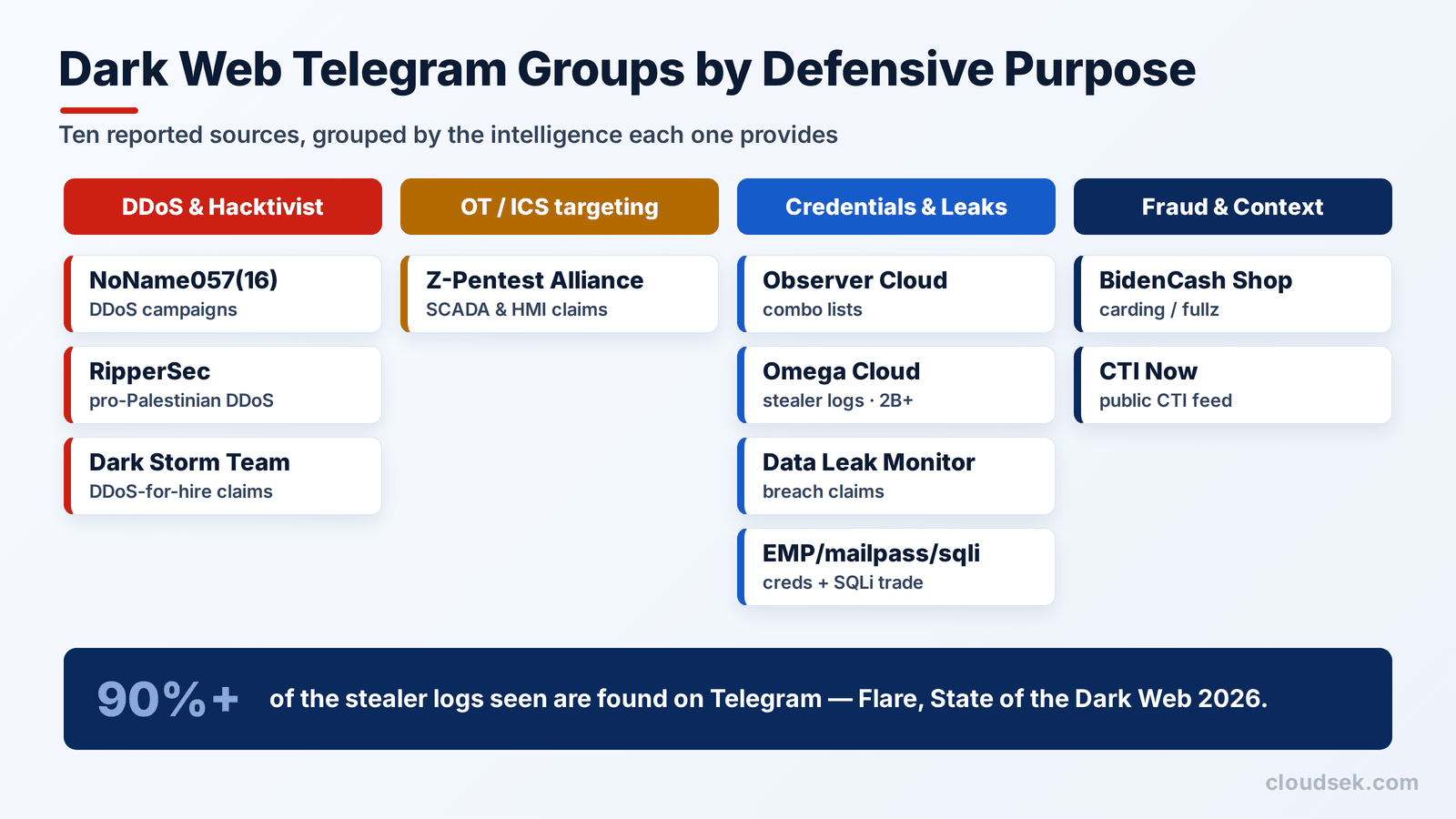
NoName057(16) is a key source to watch during geopolitical tension. After Russia’s invasion of Ukraine in 2022, the pro-Russian actor became linked to DDoS campaigns against Ukraine-supporting countries, government agencies, media outlets, transport systems, and financial institutions.
DDoSia makes the group more dangerous because it turns political support into volunteer-led disruption. Activity can increase around sanctions, elections, military updates, diplomatic statements, and policy decisions involving Russia or Ukraine.
Early target signals give SOC and network operations centers time to prepare before service disruption reaches customers. Repeated country names, sector themes, or target lists can guide CDN capacity review, WAF tuning, uptime tracking, traffic baseline checks, and communication planning.
RipperSec appeared in June 2023 as a pro-Palestinian hacktivist collective tied to DDoS operations against countries and organizations viewed as pro-Israel. The group matters because its messaging can spread quickly before outage activity becomes measurable.
Campaign language often moves across allied groups, regional communities, and multilingual forwarding networks. Education, government, civic service, and policy-linked organizations can become visible targets during emotionally charged events.
Rising attention around a country, institution, or sector gives threat intelligence teams a stronger timing signal. Conflict escalation, protests, diplomatic shifts, and high-profile military developments can shape alert tuning and escalation planning.
Dark Storm Team is difficult to read quickly because ideological messaging, disruption announcements, and service-style wording often appear together. That mix can make a real outage, a promotion attempt, and a symbolic threat look similar at first glance.
Regional conflict adds more uncertainty. Since 2023, the actor has drawn attention for DDoS assertions and politically framed targeting involving government entities, corporate websites, critical infrastructure, and Middle East-related targets.
Incident responders need evidence outside the Telegram message before escalating. Outage screenshots, check-host images, sector wording, and brand names should be compared with telemetry, customer complaints, vendor notices, and confirmed service degradation.
Z-Pentest Alliance needs separate attention because its reported activity involves operational technology and industrial control systems. Open-source profiles describe the actor as pro-Russian and connected to water, energy, aviation, and industrial-facility references.
Technical details make these messages more serious than ordinary website disruption posts. HMI panels, SCADA screens, remote portals, pump systems, facility names, and supplier details can point toward exposed equipment, even where screenshots are recycled or exaggerated.
Utilities, manufacturers, logistics operators, and energy firms should move from Telegram review to asset review before accepting or dismissing any message. Inventory records, authentication logs, supplier connections, segmentation controls, and maintenance routes help separate noise from real plant-level concern.
Password dumps rarely stay in one criminal space. Observer Cloud circulates credential material, combo lists, and identity records gathered from multiple sources, which can turn older or mixed sets into active abuse opportunities.
Redistribution gives old material a second life. Stale password pairs can still feed phishing, takeover attempts, and automated abuse after reaching a larger audience.
Corporate domains, executive mailboxes, supplier addresses, and customer identifiers are the main signals to review. Identity-risk teams can confirm affected users, examine reuse behavior, and reduce downstream abuse routes.
Omega Cloud is high priority because stealer logs can expose fresh account evidence from infected devices. SOCRadar’s 2026 profile describes free tiers, paid feeds, real-time delivery, and a database exceeding 2 billion entries.
Endpoint origin changes the response. One infected device can expose saved passwords, portal URLs, browser artifacts, session material, SaaS dashboards, cloud consoles, advertising profiles, developer tools, and personal devices used for work.
Fresh corporate email matches or repeated employee appearances should move into containment. Session revocation, password resets, MFA review, and endpoint investigation become the next steps after Google Ads, YouTube, regional log clusters, or work-device clues surface.
Data Leak Monitor pushes breach-related material into broader circulation. Victim names, leak announcements, forum chatter, ransomware references, and alleged database samples can move from smaller spaces into a larger audience.
Speed only has value when the first sighting leads to confirmation. A supplier, partner, or brand name may appear in a forwarded message before internal stakeholders notice the original leak-site entry or forum thread.
Vendor-risk, brand protection, and incident-response workflows should treat this feed as an early warning, not proof of compromise. Archive titles, alleged record types, sector concentration, and timing still need comparison against ransomware sites, supplier files, and internal investigation findings.
BidenCash Shop is relevant for payment-fraud tracking because the wider BidenCash ecosystem has been linked to stolen card records and associated personal information. U.S. authorities announced the seizure of about 145 darknet and traditional internet domains connected with BidenCash in June 2025.
Enforcement action can split a criminal brand into mirrors, impersonator groups, copycat names, and scattered promotion points. That noise makes verified financial indicators more important than brand mentions alone.
Fraud specialists need details tied directly to payment abuse. BIN ranges, issuer names, card-testing chatter, marketplace promotion, and customer PII references can guide fraud-rule tuning and issuer coordination without relying on carding content itself.
EMP/mailpass/sqli Chat shows how credential leakage can turn into tradeable intrusion routes. SOCRadar places its start around April 2019 and describes a long-running source tied to stolen identities, SQL injection discussion, stealer material, malware deployment, and compromised password pairs.
Long-running groups show more than recent dumps. They reveal pricing, packaging, resale behavior, and reuse patterns across fraud or intrusion workflows.
Application-security and identity teams can use these details to prioritize app and identity review. VPN credentials, admin panels, SQLi chatter, table dump offers, financial profiles, and resale discussions guide web testing, bot controls, and automated abuse detection.
CTI Now works best as a public cyber intelligence feed rather than a dark web source. It brings cybersecurity headlines, vulnerability updates, breach reports, threat actor activity, vendor advisories, and security research into one place.
This feed becomes valuable after a suspicious dark web or Telegram message appears somewhere else. Broader reporting can show whether the issue is isolated, exaggerated, confirmed, or linked to a vulnerability, takedown, ransomware incident, or advisory.
CTI Now does not provide the same early visibility as direct dark web tracking. The value lies in transforming a concerning signal into actionable context, helping analysts determine whether to escalate, monitor, or dismiss the issue.
Telegram groups included in this guide were evaluated for intelligence value across proactive cyber defense workflows. Selection focused on sources linked to DDoS activity, hacktivist campaigns, geopolitical signals, OT and ICS targeting, credential exposure, breach claims, stealer logs, access trading, and payment fraud.
Verification relied on public reporting, threat intelligence research, and recent security investigations rather than isolated screenshots or short-term visibility. Since Telegram communities often change names, shift to private mirrors, or disappear without notice, current activity was weighed with historical relevance.
Final ordering follows monitoring value rather than popularity. Campaign coordination, infrastructure targeting, exposed identities, unauthorized access, financial crime, and compromise indicators were separated so every group adds a distinct view of cyber risk.
Cybersecurity teams monitor dark web Telegram groups because early warnings about exposed data, stolen access, and attack claims often appear there before official disclosure.
Analysts should focus on Telegram activity that connects directly to a company, asset, user, vendor, or active campaign.
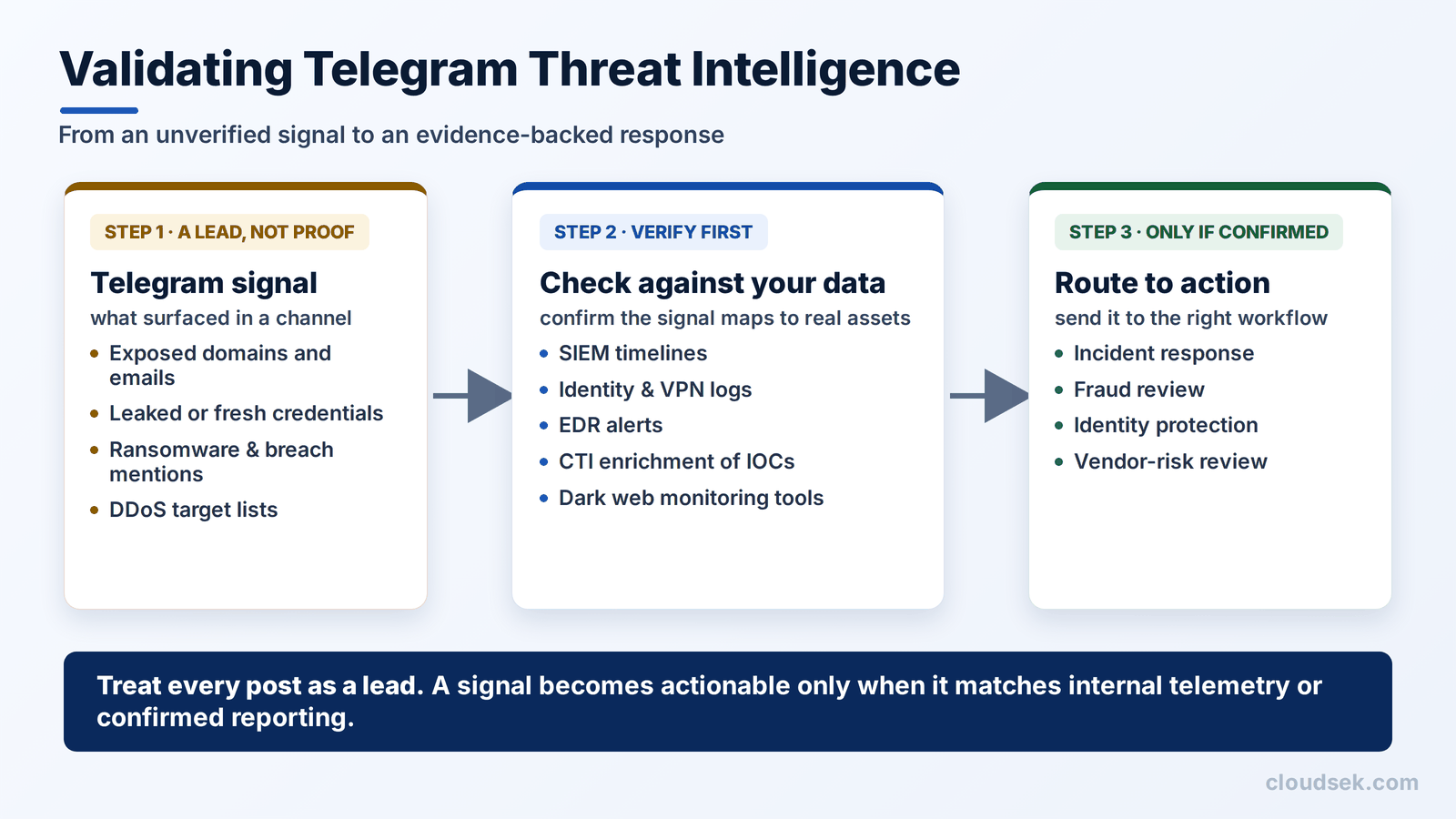
Validation turns Telegram chatter into evidence-backed action by checking whether a claim connects to real assets, active accounts, internal telemetry, or confirmed external reporting.
CloudSEK XVigil monitors dark sites, marketplaces, code-hosting platforms, document-sharing sources, breach repositories, IRC channels, I2P pages, and other deep or dark web spaces where exposed data can surface. Its coverage focuses on leaked credentials, stolen records, fraud discussions, brand abuse, and targeted threats connected with an organization’s real assets.
An asset and watchword-led approach keeps the intelligence specific instead of flooding analysts with broad underground noise. Mentions involving employee accounts, customer data, internal files, domains, executive names, or business-related conversations can be mapped back to actual exposure, making each alert easier to assess and prioritize.
After discovery, the platform adds context, severity, integrations, exports, and takedown support. Teams can route intelligence into incident management tools, SIEM, SOAR, APIs, Syslog, STIX, and TAXII feeds, while takedown workflows support action against phishing pages, fake social profiles, infringing domains, unofficial apps, and other abuse cases.
Yes, passive monitoring can be legal when it is approved, read-only, and done for defensive intelligence. It becomes risky when analysts contact actors, buy data, request samples, download stolen files, or bypass compliance rules.
These groups may contain leaked credentials, breach samples, ransomware victim names, stealer logs, access offers, malware references, stolen cards, and fraud chatter. Not every post is real, so each finding needs verification before action.
SOC teams use it to detect exposed accounts, validate breach claims, enrich alerts, tune detection rules, and prepare incident response. A Telegram post becomes useful only when it matches SIEM logs, identity records, EDR data, CTI tools, or known business assets.
Analysts should avoid personal accounts, direct messages, downloads, and unmanaged devices. Monitoring should run through isolated environments, approved accounts, documented workflows, and strict non-engagement rules.
Yes, automation improves coverage and reduces direct analyst exposure. Human review is still needed because fake leaks, cloned channels, old dumps, and exaggerated claims can create false positives.
The main risks are illegal engagement, mishandled stolen data, malware exposure, impersonator channels, weak OPSEC, and poor evidence handling. Organizations should define collection limits, approval rules, storage standards, and escalation paths before monitoring begins.
