🚀 Introducing the CloudSEK MCP Server!
Read more
.avif)

Preventing Business Email Compromise (BEC) attacks requires multi-factor authentication, email authentication, independent payment verification, and employee awareness training. BEC attacks impersonate trusted people to trick employees into sending money or data, so prevention closes the account, domain, and payment gaps that attackers exploit.
The losses are severe. The FBI's Internet Crime Complaint Center recorded more than $55 billion in exposed BEC losses between October 2013 and December 2023, which makes it one of the costliest cybercrimes the FBI tracks.
Unlike traditional phishing, BEC relies on social engineering, account compromise, email spoofing, and payment fraud rather than malware. Attackers target finance teams, executives, HR, and vendors because a single convincing email can cause major financial loss or data exposure.
This guide explains what Business Email Compromise attacks are, how attackers exploit business communication channels, and the best practices organizations can use to prevent fraudulent payments, account compromise, and email-based social engineering attacks before damage occurs.
BEC attackers exploit weak email security, compromised accounts, and trusted communication channels to launch fraudulent payment and impersonation attacks.
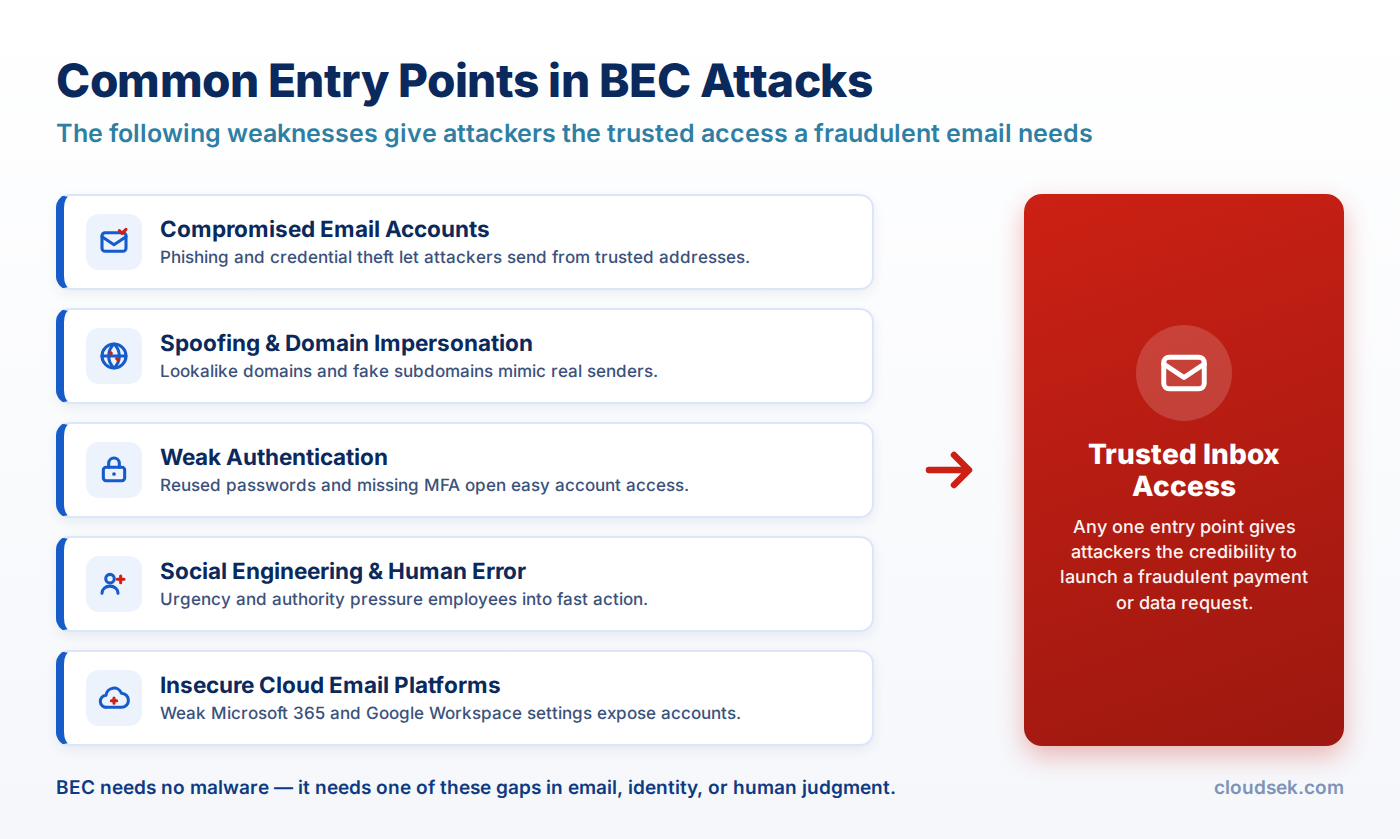
Attackers often gain access to legitimate business email accounts through phishing attacks, credential theft, password reuse, or malware infections. Compromised accounts allow attackers to monitor conversations, study business workflows, and send fraudulent emails from trusted addresses without raising immediate suspicion.
BEC attackers frequently use spoofed email addresses and lookalike domains that closely resemble legitimate company or vendor domains. Small spelling changes, fake subdomains, and manipulated sender information help attackers impersonate executives, suppliers, or business partners convincingly.
Weak passwords, reused credentials, and missing multi-factor authentication create easy entry points for attackers targeting business email systems. Once attackers gain account access, they may launch internal fraud campaigns, steal sensitive data, or bypass standard verification processes.
BEC attacks rely heavily on human trust and psychological manipulation rather than malware. Attackers use urgent language, confidential requests, financial pressure, and authority-based impersonation to convince employees to process payments or share sensitive information quickly.
Cloud-based email platforms such as Microsoft 365 and Google Workspace have become major BEC targets because organizations rely heavily on them for communication and collaboration. Weak security settings, exposed accounts, and poor monitoring increase the risk of unauthorized access and email-based fraud.
Preventing Business Email Compromise attacks requires strong email security, strict verification processes, account protection, and continuous employee awareness across the organization.
The following are the best strategies that help to prevent BEC attacks:
Multi-factor authentication adds a security layer to business email accounts and cloud platforms by requiring users to verify their identity through multiple methods. Even if attackers steal usernames and passwords through phishing or credential theft, MFA significantly reduces the chances of unauthorized account access.
Organizations should enable MFA across executive accounts, finance systems, payroll platforms, remote access services, and cloud email environments such as Microsoft 365 and Google Workspace. Strong MFA implementation limits account compromise risks and reduces attacker access to sensitive business communication.
SPF, DKIM, and DMARC are email authentication protocols that help organizations prevent email spoofing and domain impersonation attacks. SPF verifies which mail servers are allowed to send emails on behalf of the organization, while DKIM validates email integrity through cryptographic signatures. DMARC adds policy enforcement and reporting capabilities that help organizations block fraudulent emails using spoofed domains.
Properly configured email authentication reduces the risk of attackers impersonating executives, vendors, and internal departments through fake email addresses.
Organizations should never approve wire transfers, invoice payments, payroll updates, or banking changes based only on email requests. Employees must independently verify financial requests through trusted communication channels such as direct phone calls, secure messaging systems, or approved internal workflows before processing transactions.
Verification procedures are especially important for urgent, confidential, or unusual requests involving large payments or updated banking details. Independent verification reduces the success rate of vendor fraud, executive impersonation, and payment diversion attacks significantly.
Employee awareness training is one of the most important defenses against BEC attacks because attackers heavily rely on human error and trust manipulation. Organizations should train employees to identify suspicious payment requests, urgent financial instructions, spoofed domains, fake executive messages, and social engineering techniques commonly used in BEC campaigns.
Training should include real-world attack examples, phishing simulations, reporting procedures, and verification requirements for financial transactions. Regular security awareness programs improve employee decision-making and reduce the likelihood of fraudulent approvals.
Organizations should apply least-privilege access controls across finance systems, executive email accounts, payroll platforms, vendor payment systems, and sensitive business applications. Employees should only have access to the resources required for their job responsibilities.
Limiting administrative privileges and restricting financial authorization reduces the impact of compromised accounts and prevents attackers from moving freely across systems after gaining access.
Continuous monitoring helps organizations identify suspicious login behavior, unauthorized mailbox access, unusual email forwarding rules, abnormal communication patterns, and compromised business accounts before attackers escalate BEC attacks. Security teams should monitor login locations, impossible travel activity, failed authentication attempts, new device access, and suspicious email behavior across cloud email platforms.
Early detection improves incident response speed and helps organizations contain account compromise before financial fraud or sensitive data exposure occurs.
Advanced security controls help organizations detect sophisticated Business Email Compromise attacks that bypass traditional email filtering and basic account protection measures.
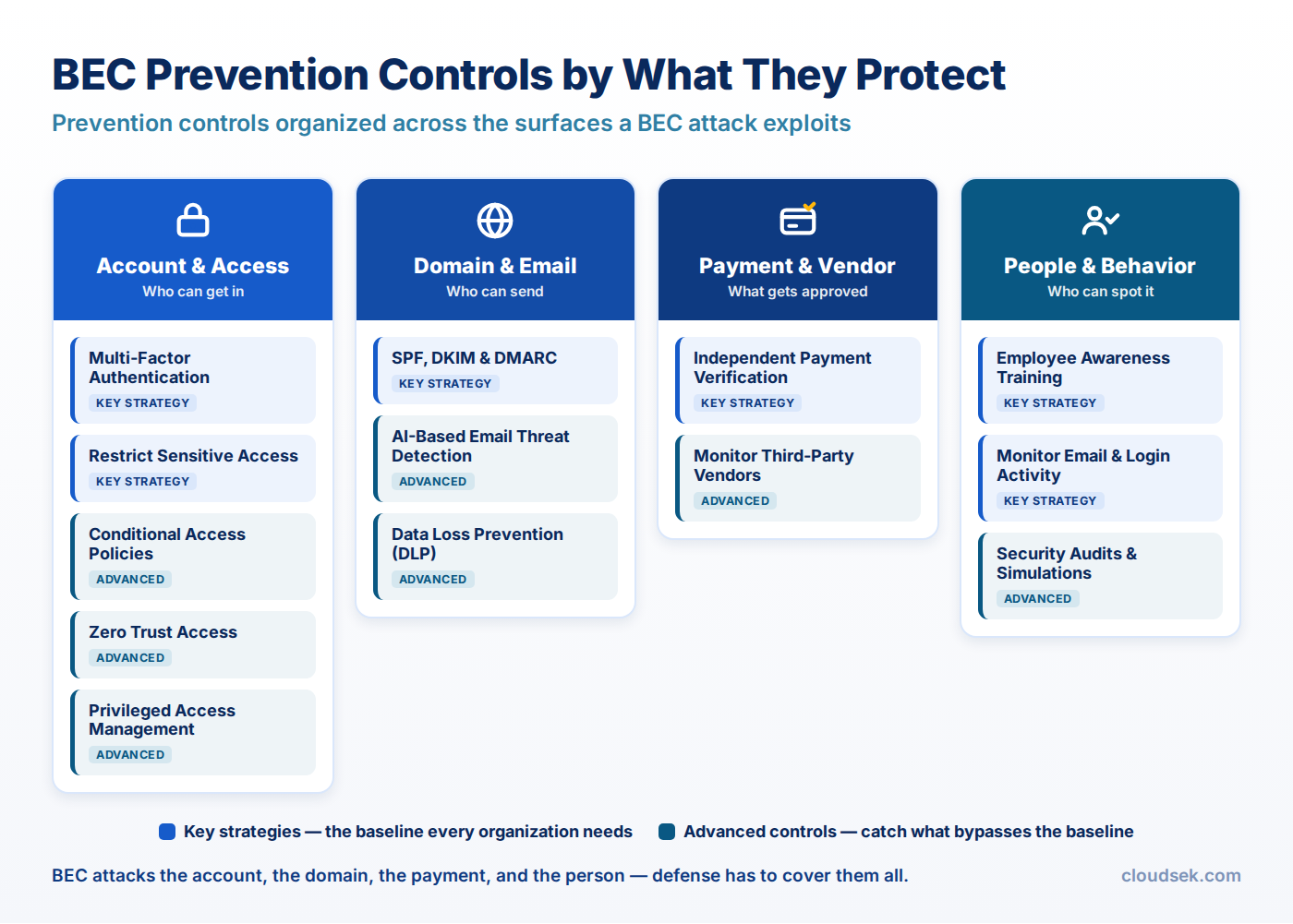
Conditional access policies restrict email and cloud account access based on user behavior, device trust, geographic location, IP reputation, and risk level. These controls help organizations block suspicious login attempts and reduce unauthorized access to business email accounts.
AI-driven email security systems analyze communication behavior, writing patterns, sender reputation, and abnormal activity to identify sophisticated BEC attacks that traditional spam filters may miss. Behavioral analysis improves the detection of executive impersonation, account compromise, and vendor fraud attempts.
Zero Trust security limits implicit trust across email systems, cloud applications, and enterprise accounts. Every login request, device connection, and access attempt requires continuous verification before users receive access to sensitive resources or financial systems.
Privileged Access Management helps organizations secure executive accounts, finance systems, administrator credentials, and sensitive applications through controlled access, session monitoring, and credential isolation. PAM reduces the impact of compromised high-privilege accounts during BEC attacks.
BEC attackers frequently target vendor relationships and external business communication channels. Organizations should continuously monitor vendor email behavior, payment communication, and third-party account activity to identify suspicious changes or impersonation attempts early.
Data Loss Prevention solutions help organizations monitor and restrict unauthorized sharing of financial records, payroll data, customer information, and confidential business documents through email systems. DLP controls reduce the risk of sensitive data exposure during BEC attacks.
Regular security audits, phishing simulations, and email compromise assessments help organizations identify weak security controls, risky user behavior, and gaps in payment verification processes. Continuous testing improves organizational readiness against evolving BEC attack techniques.
Early detection helps organizations stop Business Email Compromise attacks before attackers complete fraudulent payments, steal sensitive information, or compromise additional accounts.
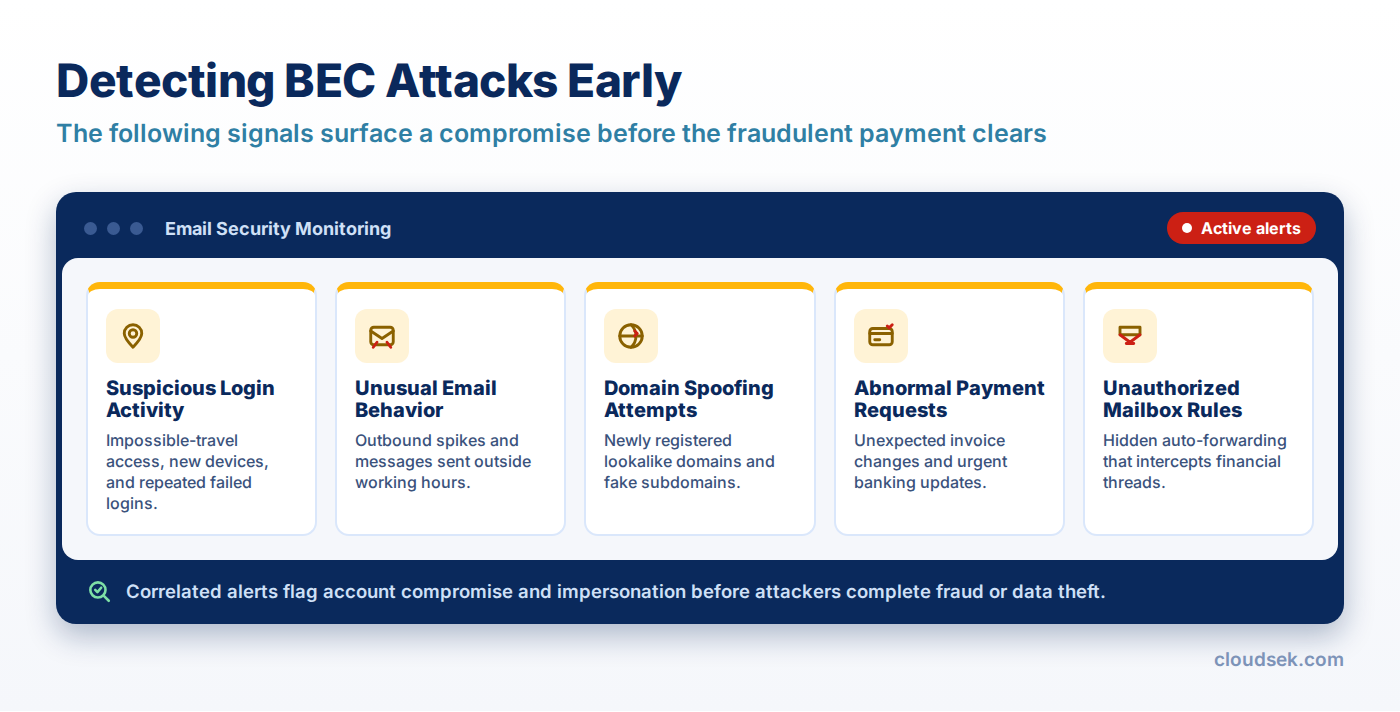
Organizations should monitor login behavior across business email accounts and cloud platforms to identify unauthorized access attempts. Unusual login locations, impossible travel activity, repeated failed login attempts, unfamiliar devices, and abnormal access times often indicate compromised accounts or credential theft activity connected to BEC attacks.
BEC attacks frequently involve abnormal email activity that differs from normal communication patterns. Security teams should monitor sudden spikes in outbound emails, unusual executive communication, unexpected financial requests, suspicious reply behavior, and emails sent outside normal working hours to identify possible account compromise.
Attackers commonly use spoofed domains and lookalike email addresses to impersonate executives, vendors, and business partners. Organizations should continuously monitor newly registered domains, fake subdomains, and suspicious sender addresses that closely resemble legitimate business domains to detect impersonation attempts early.
Unusual wire transfer requests, unexpected invoice changes, confidential payment instructions, and urgent financial approvals often indicate BEC fraud attempts. Organizations should implement monitoring controls that flag high-risk payment behavior and require additional verification before processing transactions.
BEC attackers often create hidden mailbox rules or automatic forwarding settings after compromising business email accounts. These rules allow attackers to monitor conversations, hide security alerts, and intercept financial communication silently. Continuous mailbox auditing helps organizations identify unauthorized changes before attackers escalate fraudulent activity.
CloudSEK helps prevent BEC attacks by detecting and removing the impersonation infrastructure attackers build in advance.
DMARC blocks spoofing of your exact domain but cannot stop a lookalike domain the attacker legitimately registered. XVigil detects lookalike and typosquatted domains at registration, identifies fake executive profiles, and surfaces leaked mailbox credentials across the surface, deep, and dark web, then removes confirmed impersonation assets through end-to-end takedowns. Email filtering and payment verification handle the message itself.
The best way to prevent BEC attacks includes MFA, employee training, payment verification, and email authentication protocols.
BEC attacks often use legitimate accounts, realistic communication, and spoofed domains that appear trustworthy.
MFA significantly reduces account compromise risks, but organizations still need employee verification and email security controls.
Yes. Small businesses are common BEC targets because attackers often expect weaker security controls, limited employee training, and fewer payment verification procedures.
Yes. Employees using smartphones and tablets may overlook spoofed domains, suspicious sender details, or warning signs because mobile email applications display limited security information.
Encrypted email improves communication security, but encryption alone does not stop impersonation, social engineering, or fraudulent payment requests used in BEC attacks.
