🚀 CloudSEK featured in the 2026 Frost Radar™!
Read more
.avif)

Ransomware can halt operations, interrupt the delivery of products or services, and expose an organization to financial, data, and reputational harm. Businesses reduce that risk by closing common entry routes, protecting accounts, restricting an intruder’s reach, and maintaining the ability to recover from disruption. No single safeguard can address every point at which an intrusion may succeed.
Layered defense reduces the chance that one weakness leads to wider disruption. Measures that make unauthorized entry more difficult work alongside identity and permission boundaries that constrain what an intruder can do afterward. Restrictions within the environment can limit further movement, while recovery capability preserves a path back to normal operations.
Prevention lowers the likelihood that ransomware develops into a disruptive incident. Mitigation begins after malicious activity is detected and focuses on containing the damage and restoring operations.
Ransomware is a malicious attack in which organizational data is encrypted and a ransom is demanded for its restoration. Making essential information or systems unusable gives the perpetrator leverage over the victim. The demand turns that disruption into a means of coercion rather than leaving encryption as the final objective.
Data theft can create another source of leverage. Stolen information may be paired with a threat of disclosure unless an additional demand is met. This introduces a confidentiality consequence alongside the loss of availability, allowing the incident to rely on restricted use, threatened exposure, or both.
Initial entry often traces back to a reachable weakness, stolen identity, deceptive message, public management service, pre-existing malware foothold, or compromised external partner.
These 12 practices reduce known entry opportunities, strengthen authentication and permissions, constrain malicious execution and lateral movement, identify public assets and provider connections, and preserve a tested recovery path.
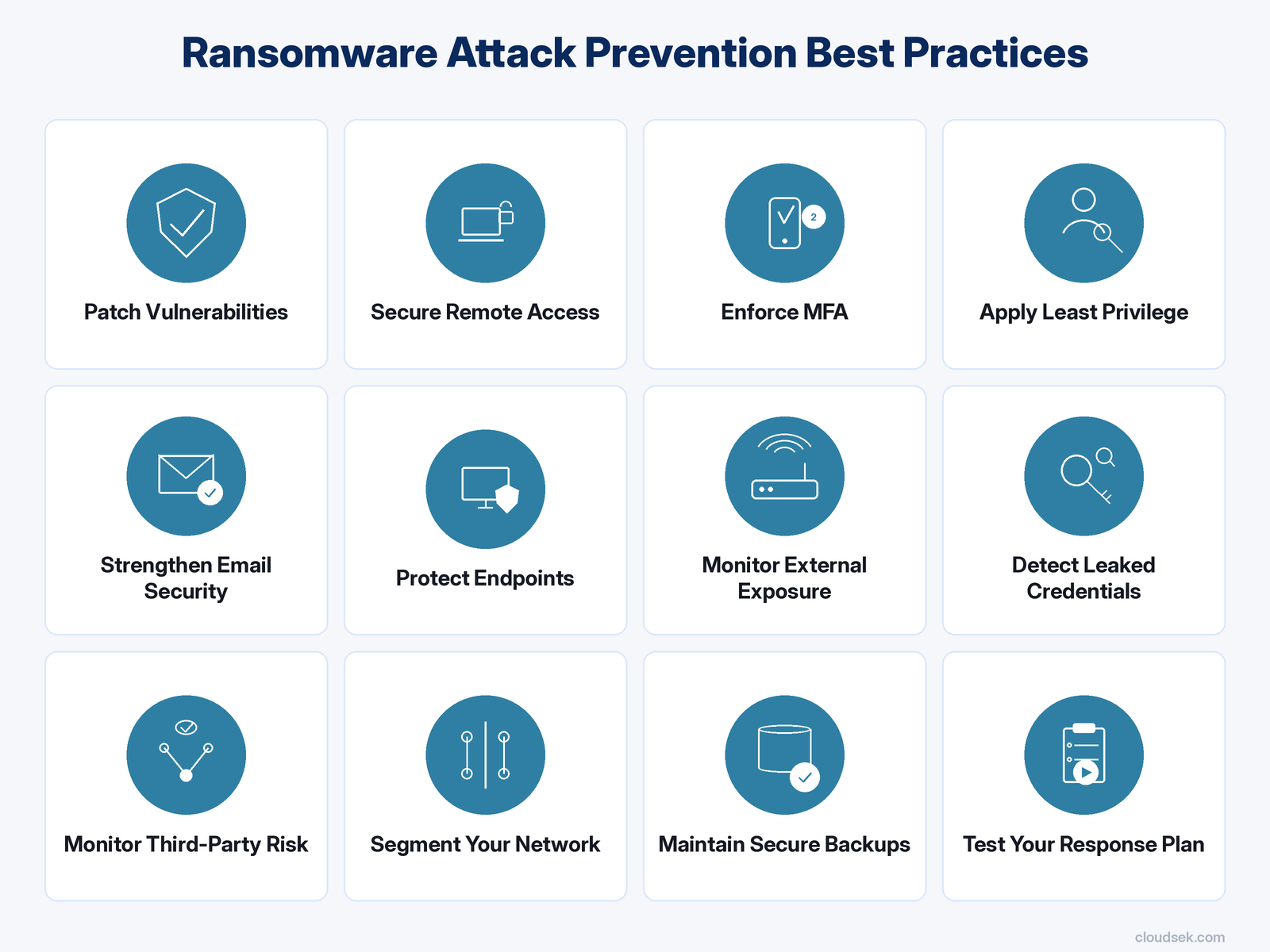
Prioritize vulnerabilities on internet-facing technology and assets that support critical operations. Evidence of exploitation should raise a flaw in the remediation queue, especially if the affected system is reachable from the internet. Patch timing should reflect observed abuse and business importance rather than follow a routine calendar alone.
CVSS can inform the decision, but the score should not determine it by itself. A lower-scoring issue on an essential application may deserve earlier treatment than a higher-scoring flaw on a less important host. KEV inclusion confirms exploitation in the wider threat landscape; it does not show that a specific enterprise was targeted.
If immediate installation is impractical, document a temporary safeguard such as segmentation or additional monitoring. Leave the item open for remediation until the patch or another permanent fix is deployed.
Remote-management services that remain online need deliberate restrictions. Disable RDP wherever no operational requirement exists. Necessary sessions should use suitably secured VPN connectivity, with only the required administration paths enabled. Devices supporting those sessions need timely security updates, while elevated privileges should remain limited to people whose roles require them.
Sensitive sign-ins should require more than a password. Multi-factor authentication adds another verification step for remote-entry and privileged accounts, so stolen credentials alone cannot satisfy the full login process. This removes reliance on password-only authentication without implying that compromise becomes impossible.
Prefer an authenticator application to SMS where possible. Apply MFA consistently to remote-entry and privileged identities instead of leaving weaker exceptions in place.
Authentication verifies a sign-in; authorization determines what that identity may do afterward. Use non-privileged roles for routine tasks and reserve sensitive security functions for designated users. Everyday accounts should not carry administrative authority without a defined need.
Revisit permissions as responsibilities change. Remove rights that no longer match assigned duties and separate administrative activity from ordinary use. Periodic authorization reviews help identify privileges that have outlived their original purpose.
Phishing emails may carry malicious links or attachments while imitating trusted people or organizations. Filtering should screen harmful material and spam before delivery, while employees need a direct way to report suspicious messages that still reach the inbox. Unexpected links and files deserve scrutiny instead of automatic interaction.
A malicious file that reaches a workstation or server still has to execute before performing its intended actions. Host defenses create several opportunities to interrupt that process.
Anti-malware can identify known malicious artifacts, while behavioral detection looks for suspicious actions as processes run. EDR extends that visibility with ongoing detection and response on the device, including isolation of an affected endpoint. Application control narrows execution further through allow and deny lists.
Together, these measures act where hostile code attempts to run. They can block, surface, or contain harmful behavior, but none guarantees that every ransomware attempt will fail.
Public infrastructure can change without appearing in the maintained asset inventory. Continuous attack-surface management identifies and catalogues internet-facing elements that security teams may not already have recorded. Recurring reassessment reveals newly visible assets and configuration changes before they remain unnoticed for long periods.
Usernames and passwords can surface in stolen credential datasets or broker listings associated with ransomware operations. Finding such material gives the security team a specific account and secret to validate. The discovery alone does not prove that anyone successfully signed in.
Confirm that the credential belongs to the company and determine whether it remains valid. Keep that finding separate from confirmed account compromise during triage.
Evidence that an authenticator has been compromised warrants prompt reset or invalidation. Examine related sign-in records for indications of unauthorized use, and label the account compromised only if the investigation supports that conclusion.
Suppliers and MSPs may retain approved connections to corporate systems or data. Those relationships need oversight throughout the contract because a breach at the service provider can create an indirect route into customer infrastructure. That possibility alone does not establish that the customer has also been breached.
Record which vendors hold sensitive connections and what permissions they receive. Reassess relevant safeguards during the relationship rather than relying on onboarding checks. Contractual reporting duties and named escalation contacts should define how urgent issues move between both parties. Independent logging provides a separate record of vendor activity.
One compromised workstation should not be able to communicate freely with every other host. Flat networks make lateral movement easier because communication is broadly available across the infrastructure. Segmentation divides the network into isolated zones, while firewalls and default-deny rules restrict traffic between them. Monitoring can reveal attempts to cross those boundaries.
Place critical workloads behind rules that prevent unrestricted communication from ordinary workstation networks. Review inter-zone policies periodically so obsolete exceptions do not recreate broad connectivity. A compromise in one segment then affects a smaller portion of the infrastructure instead of opening paths across the wider network.
Files and systems affected by ransomware may need to be restored even if spread has been contained. Operators may deliberately destroy backups connected to production, so a second copy has value only if it survives those destructive actions.
The backup environment should be isolatable and retain versions that survive deletion or alteration attempts. Protect deletion and retention changes because authority over those operations can undermine stored copies. Restoration tests should confirm that teams can regain use of the backup service even if normal corporate IT is unavailable.
Protected backups improve recoverability; they do not prevent the original intrusion or disclosure of stolen information.
A ransomware incident requires people to make decisions under pressure, not just follow technical controls. Simulations reveal whether documented procedures, reporting routes, communication responsibilities, and available resources hold up during a realistic scenario.
Assign each response role before an incident occurs and define the authority attached to it. Specify which events require reporting, who receives the escalation, and who communicates with internal or external parties. Train participants for those duties, then use tabletop exercises or simulated events to test the plan as a working process rather than a document on paper.
Once ransomware is detected, responders need to contain the damage, establish its extent, preserve forensic material, remove the hostile presence, and return business services safely. Restoration should begin only after the cause and remaining threat have been addressed.
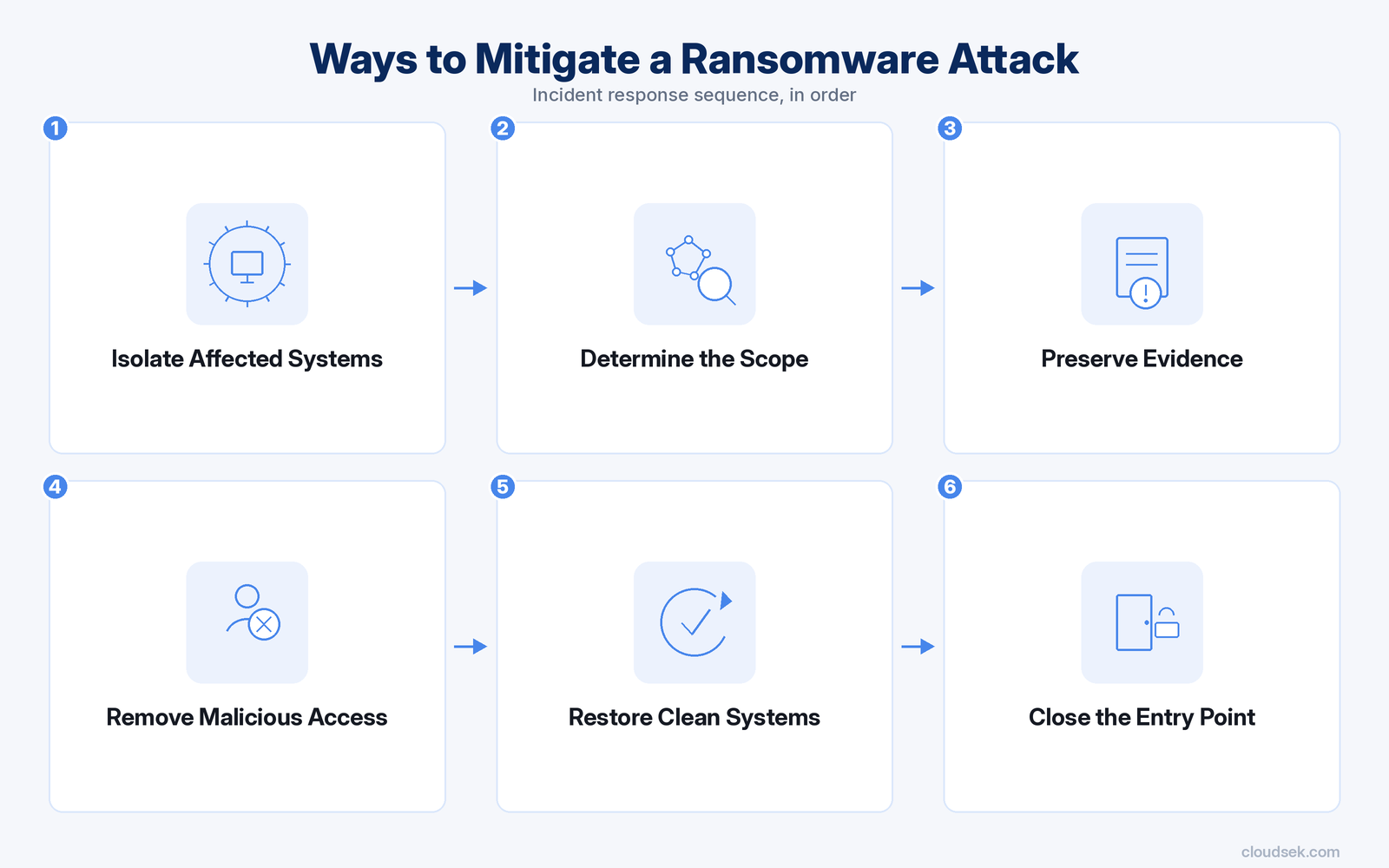
Disconnect impacted devices, servers, or network segments from healthy infrastructure as quickly as practical. Separation limits further spread while keeping the original hosts available for examination. Avoid wiping or rebuilding them immediately because those actions may destroy useful forensic traces.
Map how far the intrusion spread across hosts, accounts, applications, and data. Correlate endpoint findings, authentication records, logs, and telemetry to distinguish contained machines from assets requiring deeper review or rebuilding. That picture guides the next response actions without assuming the intrusion reached every part of the network.
Retain artifacts that can reconstruct what happened before cleanup changes the machines involved. Useful material may include ransom notes, suspicious files, timestamps, security logs, endpoint traces, and forensic images. Capturing these records early gives analysts a stronger basis for determining sequence and cause.
Eliminate every confirmed mechanism that lets the intruder remain present. Remove malware, persistence mechanisms, unauthorized accounts, active sessions, and compromised credentials identified during analysis. Reconnect cleaned assets only after those footholds have been cleared.
Bring critical services back from trusted copies or freshly rebuilt machines after eradication is complete. Validate data and configuration first, then return workloads in a controlled order instead of reconnecting everything simultaneously. Continue watching the restored systems for signs of hostile activity.
Correct the specific weakness that enabled the original breach. Depending on the findings, that may mean patching an exploited flaw, replacing an exposed secret, disabling an unnecessary service, or fixing another confirmed condition. Normal operations should not resume while the original entry condition remains unresolved.
Predictive attack intelligence identifies external signals that may precede ransomware execution. An internet-facing vulnerability, leaked credential, or exploited CVE warrants faster attention when it maps to a system, identity, or service the organization actually uses. Correlating those findings shows which weaknesses could form an initial entry path and where remediation can interrupt it.
Third-party exposure can extend the same route beyond infrastructure owned directly by the business. A vendor weakness becomes more relevant when that provider has approved connectivity to corporate systems or handles sensitive data. Linking supplier posture with ransomware activity and exploited vulnerabilities reveals whether that dependency could contribute to an indirect path into the enterprise.
CloudSEK uses BeVigil to identify internet-facing assets and weaknesses, XVigil to detect leaked credentials and organization-specific digital exposure, CloudSEK Threat Intelligence to track ransomware activity, malware, threat actors, and exploited CVEs, and SVigil to monitor supplier and fourth-party risk. Nexus AI correlates those findings into predictive attack graphs that map how separate weaknesses may connect. Security teams can then prioritize the asset, credential, vulnerability, or dependency whose remediation would interrupt the ransomware path.
No. Businesses can lower the likelihood and business impact of ransomware, but no defensive program can guarantee complete prevention.
A business should not treat payment as the default response. The decision requires legal and executive review based on the specific incident, applicable obligations, and available recovery options.
Notify internal security, executive, and legal teams first. External notification depends on the affected data, contractual requirements, insurance terms, and applicable laws or regulations.
Cloud and SaaS environments place more emphasis on identities, administrative roles, tenant configuration, APIs, and the responsibilities shared between the customer and provider. Recovery planning must also account for provider-managed services and data that the organization does not host directly.
Prioritize by business impact and exposure. Protect the systems, accounts, and services whose compromise would cause the most serious operational disruption before expanding coverage to lower-risk assets.
Measure whether critical safeguards perform as expected. Remediation speed, MFA coverage, asset-inventory accuracy, successful restoration tests, and findings from response exercises provide practical indicators of readiness.
