🚀 CloudSEK featured in the 2026 Frost Radar™!
Read more
.avif)

An advanced persistent threat (APT) is a prolonged, stealthy, and targeted intrusion in which a well-resourced attacker gains access to a specific organization and stays inside it to pursue a defined objective.
That objective is espionage, intellectual property theft, financial theft, or pre-positioning for future disruption.
Commodity attacks take whatever they find and move on. APT operators pick the target first, then keep returning until they achieve the goal, rebuilding access after each eviction attempt.
Each word in the term carries a specific meaning, and the first one causes most of the confusion.
Zero-day exploitation appears in APT campaigns, and treating it as the defining trait misreads the risk. A group that phishes an employee, collects valid credentials, and logs in through a VPN has achieved the same result as one burning a zero-day, at a fraction of the cost.
An APT attack moves through three stages: infiltration, expansion, and extraction, each mapping to specific tactics in the MITRE ATT&CK framework.
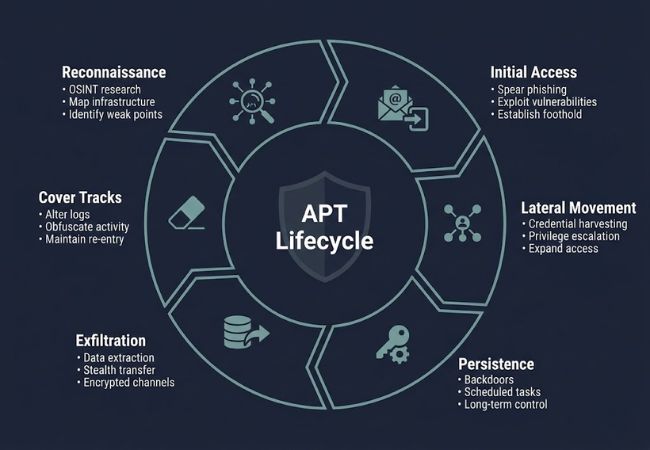
Reconnaissance runs before all three stages and continues throughout. Operators study org charts, job postings, supplier relationships, and exposed infrastructure to pick a target, choose a lure, and select the technology worth exploiting.
Operators gain the first foothold through spear-phishing attachments, exploited internet-facing appliances, stolen credentials bought from access brokers, or a compromised supplier in the software supply chain.
Initial payloads stay small and quiet enough to survive the first week. A loader establishes persistence through a registry key or scheduled task, checks for analysis tools, and waits before contacting command-and-control infrastructure.
ATT&CK tactics in play here are initial access, execution, and persistence. Dwell begins at this point, and the intrusion generates its smallest detection footprint of the entire campaign.
Internal reconnaissance maps domains, network shares, and administrative accounts across the estate. Credential theft from memory and browser stores feeds lateral movement through remote services, and privilege escalation opens the identity infrastructure that controls everything else.
Redundancy defines this stage more than speed does. Operators plant multiple persistence mechanisms across separate hosts, so removing one implant leaves the campaign intact and the defender believing the incident closed.
Discovery, credential access, privilege escalation, and lateral movement all belong to this stage. It produces the noisiest telemetry of the campaign, which makes it the strongest detection window defenders get.
Collection happens inside the network first, where data is compressed and staged in archives split into small parts. Exfiltration travels over encrypted channels, cloud storage services, or the same protocols employees use daily.
Cleanup work follows every transfer out of the network. Operators delete staging archives, clear or thin event logs, alter file timestamps, and retire the tooling that served its purpose, leaving the quieter access channels untouched.
Not every APT campaign ends in data theft at all. Pre-positioning operations skip exfiltration entirely and hold quiet access inside IT and OT environments, waiting for a moment when disruption serves a strategic purpose.
Stage boundaries blur in practice, and the sequence rarely runs once. Campaigns cycle back from extraction to expansion as new intelligence requirements arrive, and a partial eviction sends operators to stage one again through a foothold nobody found.
CloudSEK's TRIAD team documented an Iran-linked MuddyWater campaign that shows each stage in operational detail. The RustyWater investigation traced spear-phishing against diplomatic, maritime, financial, and telecom organizations across the Middle East.
Tooling evolution carries the analytic lesson here. MuddyWater historically relied on PowerShell and VBS loaders, and the move to Rust produced a quieter, modular implant that existing detections were never written for.
APT operations divide into three sponsor categories, and state backing is not a requirement for the label.
Criminal groups increasingly borrow the same tradecraft for their own ends. Ransomware crews now conduct weeks of reconnaissance before encryption, a pattern visible across ransomware intelligence reporting.
Objective separates the two categories more cleanly than skill does.
APT operations run on staffed teams with defined roles, reporting lines, and budgets, a structure that rarely surfaces in public reporting because the evidence stays inside the group.
CloudSEK's TRIAD team analyzed a leaked repository of internal documents belonging to the IRGC-linked APT35, tracked elsewhere as Charming Kitten. The Persian-language files covered personnel rosters, monthly reports, and campaign records from an active espionage operation.
Defensive implications follow directly from that structure. A group with dedicated malware developers rebuilds tooling after detection, a group with a social engineering team keeps producing new lures, and a group with salaried staff continues the campaign whether or not any single intrusion succeeds.
Vendors assign their own designations because attribution clusters form independently, so a single group appears under several names at once.
Alias confusion carries a practical cost inside security teams. Two teams reading reports about the same intrusion set under different names duplicate work, so threat analysis starts by resolving aliases before comparing behavior.
Public attribution comes from government advisories and vendor investigations, with confidence levels that vary by case.
Volt Typhoon changed how defenders read the word persistence. CISA, the NSA, and the FBI reported that the group maintained access inside some victim environments for at least five years without deploying conventional malware, using valid accounts and built-in system tools throughout.
Telecom intrusions produced a second shift in official language. A joint advisory issued in August 2025 described Chinese state-sponsored actors compromising networks worldwide to feed espionage collection, and deliberately described the behavior rather than the vendor alias.
Financially motivated operations reached comparable scale in 2025. The FBI attributed the theft of roughly $1.5 billion from Bybit in February 2025 to North Korean actors it tracks as TraderTraitor, the largest cryptocurrency heist recorded.
Regional campaigns deserve the same attention as headline groups. CloudSEK's APT36 investigation documented Pakistan-linked espionage against Indian government and defense entities using Linux desktop-entry files and Google Drive for payload delivery.
Detection fails against APT campaigns for structural reasons, not because teams ignore alerts.
Dwell time figures reflect that design directly. Mandiant's M-Trends 2026 reported a global median dwell time of 14 days across investigations, while espionage and North Korean IT worker cases ran undetected for a median of 122 days.
To detect APT activity, security teams hunt for behavioral patterns across identity, endpoint, network, and data layers instead of waiting for signature alerts.
External signals matter as much as the telemetry inside the network. Credential exposure surfaced through leaked credential monitoring and campaign reporting from dark web monitoring indicates targeting before any internal alert fires.
Hunting converts those raw signals into findings worth acting on. Analysts start from a hypothesis drawn from current campaign reporting, search existing telemetry for the matching behavior, and escalate what survives scrutiny to the SOC for containment.
APT defense works by removing easy entry points, limiting movement after compromise, and shortening the time between intrusion and discovery.
CloudSEK's guide to preventing advanced persistent threats covers each control in implementation detail.
Response to an APT differs from standard incident handling because premature eviction warns an operator who still holds other access.
Detecting an APT inside the network belongs to EDR, identity monitoring, and dedicated hunting teams.
Knowing which groups target the organization’s sector, what tools they recently adopted, and which credentials are already circulating outside the perimeter is equally important.
CloudSEK Threat Intelligence provides this context by tracking threat actors and their TTPs, exploited CVEs, malware families, and campaign activity, curated to a customer's industry and region.
The investigations into MuddyWater, APT35, and APT36 highlight the same research team’s depth and reach in campaign‑level tracking.
Campaigns run from weeks to years. Espionage operations persist for months, and some critical infrastructure intrusions have lasted five years or more.
Ransomware seeks fast payment and announces itself. An APT stays hidden to collect intelligence or hold access, though some groups now use both approaches.
Yes. Small suppliers, law firms, and contractors get targeted for the access and data they hold on behalf of larger organizations.
No. Most campaigns start with phishing, stolen credentials, or unpatched known vulnerabilities, and zero-days appear only where cheaper routes fail.
Mercenary spyware is commercial surveillance software sold to government customers, deployed against journalists, dissidents, and officials through APT-style operations.
Notification arrives through government agencies, industry sharing groups, hosting providers, or vendor outreach, ahead of internal detection in many cases.
