What Is Threat Detection and Response (TDR)? Process & Tools
Threat detection and response identifies malicious activity across endpoints, networks, cloud, and identity, then contains it before a breach escalates.
Threat detection and response is the practice of identifying malicious activity across endpoints, networks, cloud services, and identity systems, then investigating and containing it before an intrusion becomes a breach.
CloudSEK researchers recovered a timestamped, command-level record of one intrusion operation from an exposed server belonging to a Russian-speaking initial access broker. Activity spanning mid-2025 into late 2026 covered targets in more than a dozen countries, with exploits staged for at least twelve CVEs and plaintext credentials, device configurations, and cloud backup repositories taken from government, managed services, and enterprise victims.
Ransomware claims against those victims followed the broker's access by weeks. That interval is the entire operating window for a threat detection and response program, and closing it is the only measure of the program that matters.
TDR Compared With EDR, XDR, SIEM, and MDR
Threat detection and response describes a discipline, while EDR, XDR, SIEM, and MDR name the technologies and delivery models used to run it. Treating any one product as a substitute for the discipline is the most common category error in this space, and it leaves whole environments uncovered.
Monitor device behavior and detect malicious execution
Correlate signals across several telemetry sources
Centralize, retain, and query security events
Operate detection and response on a client's behalf
Response Capability
Full lifecycle through recovery and lessons learned
Device isolation and local remediation
Automated response across connected platforms
Limited, dependent on integrations
Provider-executed containment within agreed authority
Best Suited To
Any organization defining how detection work gets done
Teams prioritizing endpoint visibility
Hybrid and multi-cloud estates
Compliance reporting and centralized retention
Organizations without round-the-clock in-house staffing
Mature security operations layer several of these together instead of choosing between them. EDR, XDR, and SIEM feed telemetry and response actions into the detection and response program, and MDR determines who operates that program without changing what it does.
How Threat Detection and Response (TDR) Works
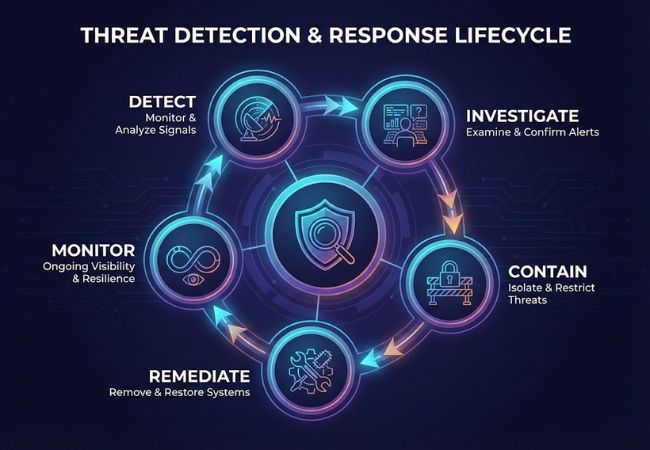
Threat detection and response works through a six-stage operational cycle that converts raw security signals into a contained and resolved incident. Each stage passes a narrower, better-evidenced set of events to the next.
1. Detect suspicious activity
Monitoring across endpoint behavior, network traffic, cloud control planes, and authentication logs surfaces anomalies, with analytics correlating events that mean little in isolation.
2. Triage and prioritize alerts
Incoming detections are ranked by asset criticality, confidence, and potential blast radius, since queue order determines what an analyst reaches before an attacker finishes moving.
3. Investigate and scope
Analysts examine logs, user behavior, and process activity to separate genuine malicious activity from a false positive, then establish which accounts and systems are involved.
4. Contain the incident
Confirmed threats trigger isolation of affected devices, revocation of compromised sessions, and restriction of implicated credentials, with automation covering the steps that outpace manual action.
5. Remediate and recover
Malicious artifacts are removed, exploited weaknesses are closed, and systems return to a known-good state so the same entry point stays shut.
6. Feed findings back into detection
Incident evidence becomes new detection content, updated playbooks, and revised priorities, which is the step that separates a program from a sequence of unrelated incidents.
Core Components of a Threat Detection and Response Stack
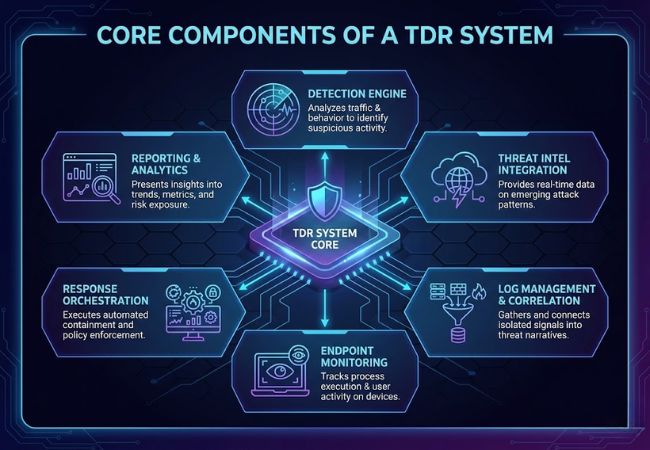
A working detection and response stack rests on seven capabilities, each supplying visibility or action the others cannot. Gaps appear wherever one capability is assumed to cover another's ground.
Detection engines: analytics evaluating network traffic, system logs, and endpoint activity against behavioral baselines and known attacker techniques.
Log management and correlation: centralized collection from servers, firewalls, applications, and cloud platforms, with correlation joining isolated signals into a single incident narrative.
Endpoint telemetry: process execution, file modification, and user activity records that expose ransomware staging, credential access, and unauthorized system changes at the host level.
Identity monitoring: authentication patterns, privilege changes, and session anomalies, which carry the weight now that valid credentials open more intrusions than exploits do.
Threat intelligence integration: current information on attacker infrastructure, exploited vulnerabilities, and campaign activity that raises alert accuracy and sharpens prioritization.
Response orchestration: automated workflows executing predefined containment such as host isolation and access restriction, cutting the interval between decision and action.
External exposure monitoring: visibility into leaked credentials and exposed assets outside the perimeter, which produces warnings before any internal telemetry registers activity.
Threats a TDR Program Detects
Detection and response covers six main threat categories, and behavioral analysis carries most of them because signatures fail against anything unseen.
Malware: Trojans, spyware, and worms that infiltrate systems to steal data or disrupt operations, detected through execution patterns when the malware file itself is unknown.
Ransomware: encryption campaigns preceded by reconnaissance and credential theft, where abnormal file-encryption activity and shadow copy deletion give the earliest reliable signal of ransomware execution.
Phishing and credential abuse: deceptive messages harvesting logins, followed by authentication from unfamiliar devices and locations that phishing detection alone never sees.
Insider misuse: employees and contractors acting within their granted access, surfaced through irregular data transfers, off-hours activity, and access to records unrelated to a role.
Zero-day exploitation: attacks against vulnerabilities with no available patch, caught through the post-exploitation behavior that follows, since the exploit itself produces no recognizable signature.
Advanced persistent threats: long-running intrusion campaigns against high-value assets, where correlated analysis across weeks exposes the multi-stage pattern that advanced persistent threat (APT) activity produces.
Detection Engineering Inside a TDR Program
Detection content is written, tested, tuned, and retired on a cycle, and treating it as a one-time configuration is what causes coverage to decay silently. Four practices keep the detection layer current as attacker techniques move.
Technique-led authoring: rules are written against documented adversary behavior and the threat analysis of campaigns targeting the organization's sector, not against whatever the last incident happened to involve.
Pre-deployment validation: every rule is tested against benign activity from the production environment before release, which is where false positive rates are set.
Measured tuning: thresholds and exclusions are adjusted from recorded outcomes, with each change logged so a suppressed detection can be traced back to a decision.
Scheduled retirement review: rules that have not fired in months are examined deliberately, since a silent rule signals either a closed attack path or a broken log source, and the two look identical from a console.
Metrics That Measure TDR Performance
Threat Detection and response performance is measured in time and coverage, never in alert volume. Here are the key metrics that measure TDR performance:
Mean time to detect: the interval between compromise and first accurate detection, tracked as a trend across many incidents, since one figure describes nothing.
Mean time to contain: the interval between detection and removal of attacker access, which reflects workflow design more than tooling quality.
Internal detection rate: the proportion of incidents the organization finds itself instead of learning about from a customer, partner, or law enforcement agency.
Detection coverage by technique: the share of relevant attacker techniques with working detection content, measured against the MITRE ATT&CK framework and never estimated from memory.
Alert precision: the proportion of escalated alerts that prove genuine, which determines whether analysts trust the queue enough to work it carefully.
Automation rate: the share of containment actions executed without manual intervention, which is where response time compresses at scale.
Where Threat Detection & Response (TDR) Programs Fail
Programs fail in a small number of recurring ways, and additional tooling rarely resolves any of them.
Incomplete telemetry coverage: systems never onboarded produce silence that reads exactly like safety on a dashboard.
Queues that never empty: unmanageable alert volume trains analysts to close findings quickly, which is how genuine detections get dismissed alongside noise.
Detection content that ages: rules written against last year's techniques degrade quietly, since a rule that stops firing looks identical to an environment with no threats.
Containment without authority: an accurate detection delivers nothing when nobody holds the authority to isolate a production system at two in the morning.
No feedback loop: incidents that close without producing new detection content leave the organization equally exposed to the same technique next quarter.
Business Outcomes of a Mature TDR Program
Detection and response produces outcomes that reach beyond the security team. Each one follows from compressing the interval between compromise and containment.
Lower breach cost: early containment limits downtime, recovery spend, and regulatory penalty exposure, since cost scales with the time an attacker holds access.
Regulatory evidence: structured logging and documented remediation supply the audit trail that information security management obligations require.
Recovered analyst capacity: accurate prioritization returns hours previously spent filtering false positives to investigation and detection engineering.
Operational continuity: contained incidents keep revenue-generating systems available, which is the outcome executives measure the function against.
Choosing a TDR Approach: Build, Buy, or Managed
Organizations run detection and response through one of three delivery models: built in-house, bought as a platform and operated internally, or contracted to a managed provider. Staffing depth for continuous coverage decides that choice more than budget does.
Integration depth: clean connection to existing endpoint protection, cloud platforms, and identity providers, without creating a telemetry source nobody queries.
Detection accuracy: behavioral analytics combined with current intelligence, evaluated on false positive rate in a live environment instead of on a vendor datasheet.
Automation and orchestration: automated containment workflows with defined authority boundaries, rather than a console that requires an analyst for every action.
Coverage across environments: consistent capability across cloud, hybrid, and on-premises estates as infrastructure changes shape.
Compliance reporting: audit trails and incident documentation matching the regulations the organization actually reports against.
Response support: access to practitioners during an active incident, which separates a monitoring subscription from a response capability.
Evaluation criteria carry different weights by sector and existing stack. A security operations function with mature in-house detection engineering weights automation and integration heavily, while an organization staffing a single shift weights response support above everything else.
Extending TDR Beyond the Perimeter with CloudSEK
Threat Detection and response begins when activity appears inside the environment, and the access that produces that activity is bought, stolen, or brokered somewhere else first. Credentials reach criminal markets, exposed services get catalogued, and access listings appear for sale while internal telemetry stays entirely quiet.
XVigil, CloudSEK's digital risk protection platform, monitors surface, deep, and dark web sources for organization-specific exposure: leaked employee credentials, access listings naming the company, exposed code, and brand abuse used to stage the phishing that precedes an intrusion.
BeVigil covers the external attack surface, CloudSEK Threat Intelligence tracks the actors and exploited CVEs behind current campaigns, and Nexus AI correlates all of it into validated attack paths. A warning that arrives at the exposure stage extends the detection window backward, which is the only way to widen an interval that response speed alone can only shorten.
FAQs About Threat Detection and Response
How does threat detection and response differ from antivirus software?
Antivirus blocks known threats by signature. Detection and response analyzes behavior, correlates events across systems, and coordinates containment beyond any single device.
Can threat detection and response prevent breaches completely?
No. It shortens the time an attacker holds access and limits movement, and no detection capability eliminates breach risk on its own.
Which industries gain most from threat detection and response?
Finance, healthcare, government, and retail, since each holds sensitive data under regulatory reporting obligations and faces sustained targeting.
Does threat detection and response replace an incident response plan?
No. The plan defines authority, roles, and escalation. Detection and response is the operating capability that plan directs during an incident.
How long does a detection and response program take to mature?
Between twelve and twenty-four months, with telemetry onboarding and detection content development consuming most of the first year.
What team size supports round-the-clock detection coverage?
Roughly eight to twelve analysts across shifts for continuous in-house coverage, so many organizations contract overnight hours to a managed provider.
Retail cybersecurity statistics for 2026 show 56 US breach events, roughly 300,000 reported exposures, and 3,865 Singapore e-commerce scams, plus incidents of ransomware.
Dropbox phishing uses fake emails or genuine file shares to trick recipients. Verify sender addresses, inspect suspicious links, and respond safely to a phishing attempt.
The 2020 SolarWinds supply chain attack inserted SUNBURST in legitimate Orion updates, putting up to 18,000 customers at risk and enabling selective follow-on intrusions.
.avif)