🚀 أصبحت CloudSek أول شركة للأمن السيبراني من أصل هندي تتلقى استثمارات منها
اقرأ المزيد
.avif)

A supply chain attack compromises a trusted third-party vendor, software component, or dependency to reach that supplier’s customers indirectly.
Rather than attacking a hardened target head-on, the attacker breaches a weaker link upstream and travels inward along a trusted relationship, arriving as a signed update or a routine package version that security controls were built to permit. Scale is what makes the technique attractive: one upstream compromise reaches every organization downstream at once.
Compromise something upstream and normal distribution carries it downstream without further attacker effort. Four stages describe nearly every case, from a poisoned open-source package to a breached managed service provider.
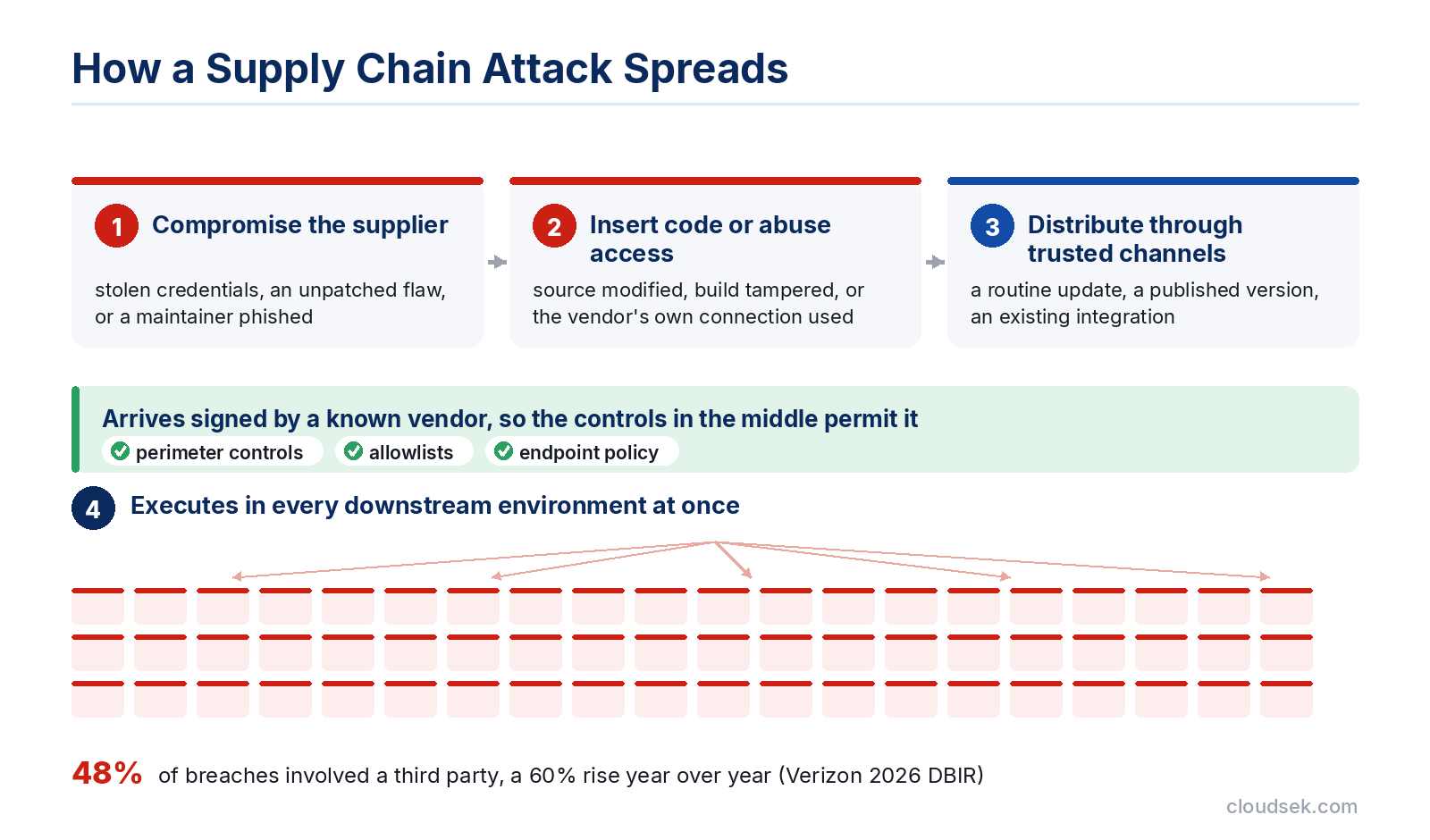
Trusted delivery is what defeats the defenses in the middle. A signed update from a known vendor passes perimeter controls, allowlists, and endpoint policies designed to stop unfamiliar software, which is why a supply chain compromise surfaces downstream as a third-party data breach disclosed weeks or months after the initial intrusion.
Supply chain attacks are classified by where in the chain the compromise happens, and the distinction matters because each point calls for different controls.
OWASP formalized the category in 2025, adding Software Supply Chain Failures to its Top 10 at position three, where 50% of community survey respondents ranked it the single most important application security risk. That category carries the highest average incidence rate on the list at 5.19%, while only 11 CVEs map to its associated weaknesses, which means scanners have little to match against.
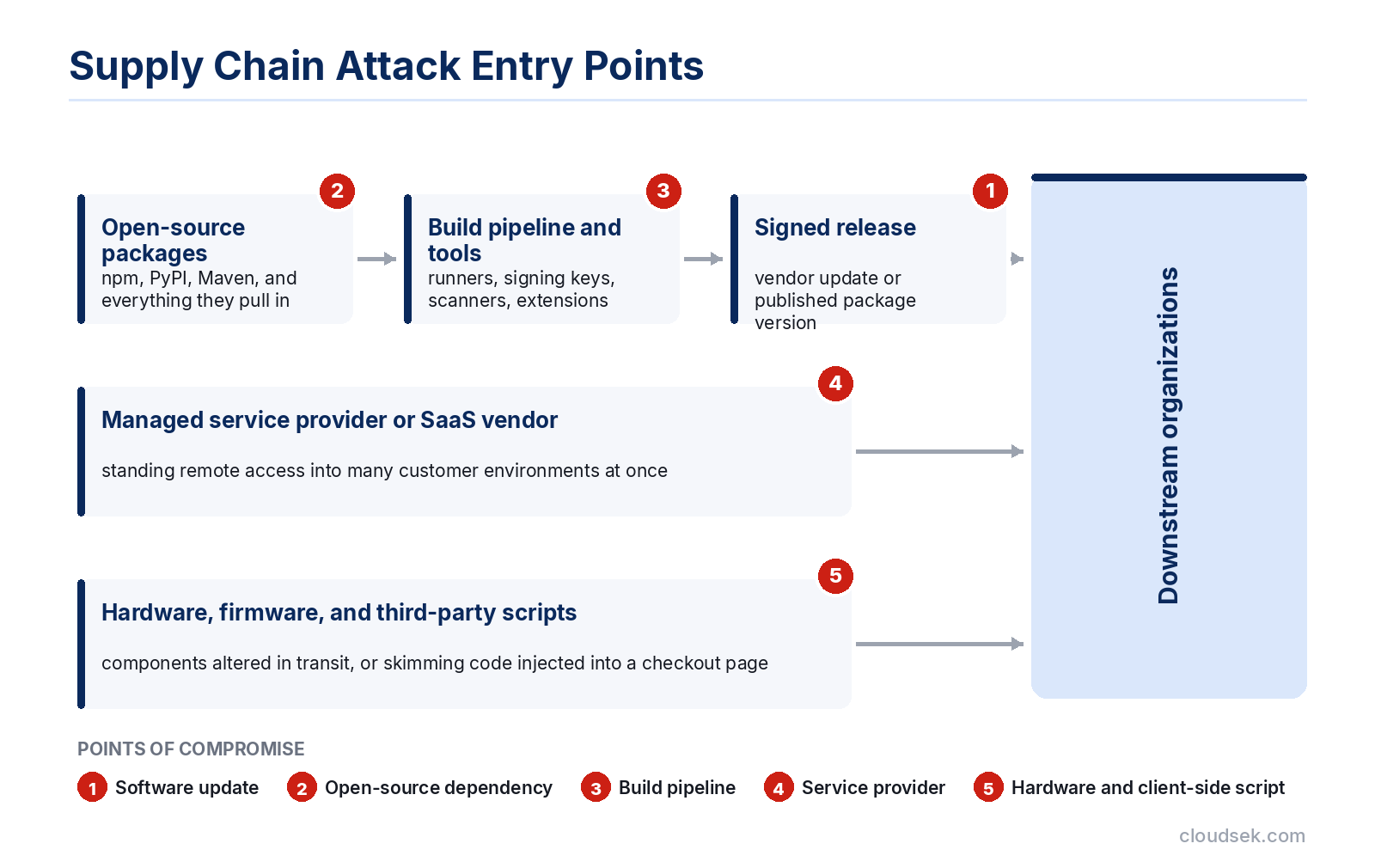
Attackers who reach a vendor’s release process insert malicious code into a legitimate product update, which then ships to the entire customer base under the vendor’s signature. SolarWinds remains the reference case, and the technique stays effective because customers have no practical way to inspect a compiled binary before installing it.
Public registries such as npm, PyPI, and Maven distribute the components most applications are assembled from, and an attacker who takes over a maintainer account publishes a malicious version under a trusted package name. Transitive dependencies widen the reach considerably, since a project that never imported the poisoned package directly still receives it through something else it depends on.
CI/CD systems hold the credentials, signing keys, and write access that make them a higher-value target than the source repository itself. Attackers who reach a build runner tamper with artifacts after code review has passed, and trojanized compilers, IDE extensions, and scanning tools extend the same problem to every project a developer touches.
Managed service providers, IT integrators, and SaaS vendors hold standing remote access into many customer environments at once. Compromising one of them converts a single intrusion into simultaneous access across every downstream client, which is why remote monitoring and management tooling attracts sustained attacker attention.
Hardware attacks insert malicious components or firmware during manufacturing or transit, and they remain rare because they demand physical access and considerable resources. Client-side script compromise is far more common: attackers inject skimming code into third-party JavaScript loaded by a checkout page, capturing payment data in the browser where server-side controls never see it.
The following eight major incidents trace how the technique moved from single-vendor compromises to self-propagating worms that spread without operator involvement.
Scale and speed both jumped in the 2025 npm campaigns. Reporting on the Shai-Hulud second wave put the damage at roughly 400,000 secrets exposed across some 30,000 GitHub repositories, with the worm executing at the preinstall stage so it fired before any build step ran. More than 60% of the leaked npm tokens remained valid a week after the campaign became public, which turned a single weekend of compromise into an open window that stayed open.
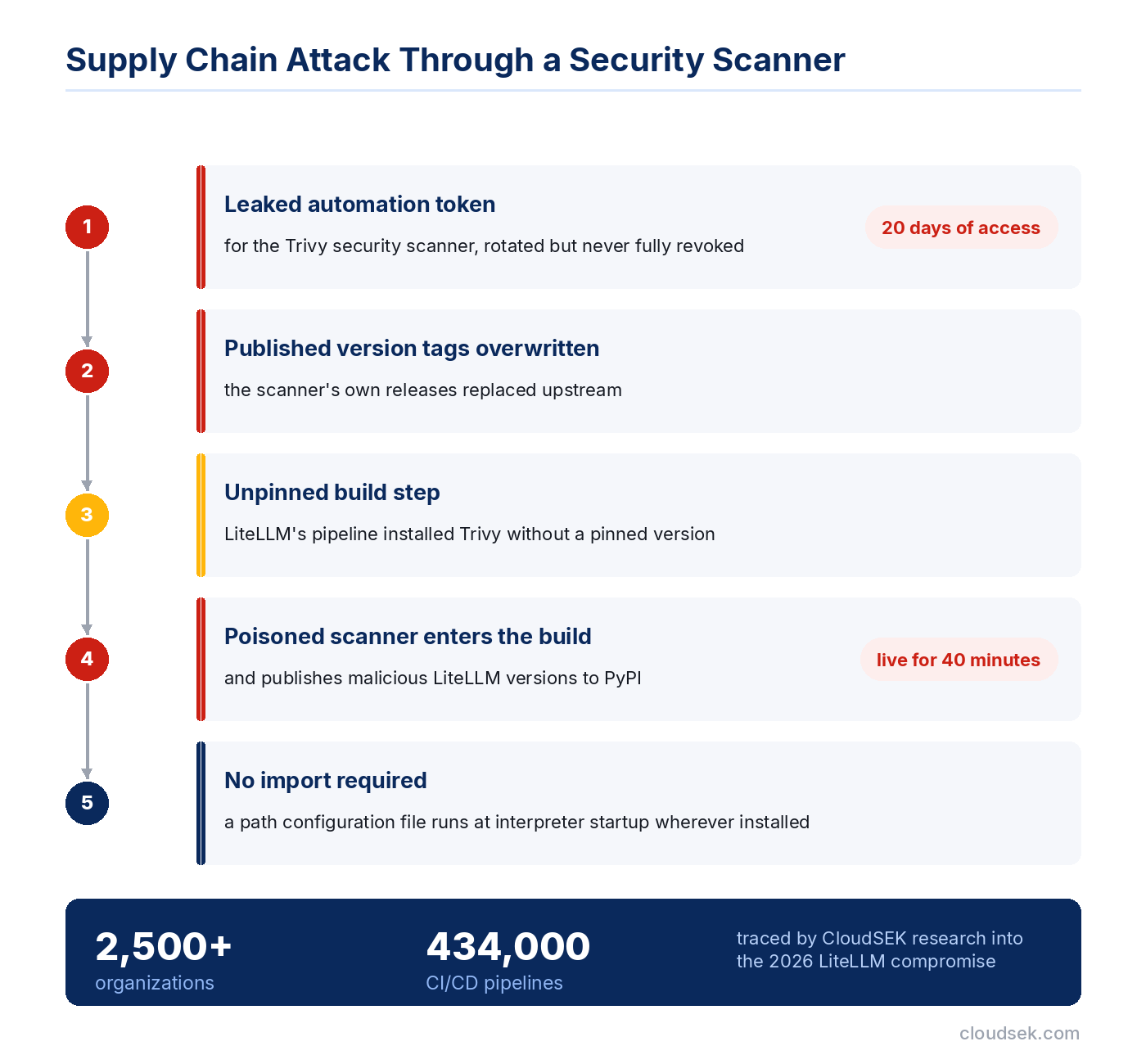
The 2026 LiteLLM compromise shows how compressed these events have become. CloudSEK’s investigation traced the entry point to a leaked automation token for the Trivy security scanner that was rotated but never fully revoked, giving attackers roughly 20 days to overwrite the scanner’s published version tags. LiteLLM’s build pipeline installed Trivy unpinned, so the poisoned scanner flowed into the build automatically and published malicious package versions to PyPI. Those versions stayed live for about 40 minutes, and execution required no import statement at all, because a Python path configuration file ran at interpreter startup wherever the package was merely installed.
Three patterns run through the recent entries. Attackers increasingly target the tools that development teams run to catch supply chain risk, worms now use stolen publishing tokens to republish themselves automatically, and the tooling itself has become reusable: after TeamPCP leaked the Shai-Hulud source code publicly, other operators picked it up and ran fresh waves with it, which lowers the skill required to launch the next campaign.
Reach and stealth combine to make this attack class disproportionately costly. Verizon’s 2026 Data Breach Investigations Report recorded third-party involvement in 48% of breaches, a 60% increase year over year, which places supplier compromise close to the center of enterprise breach risk rather than at its edge.
Four structural factors explain the difficulty:
Speed compounds all four. The malicious LiteLLM versions were live for roughly 40 minutes, a window shorter than most dependency review cycles, which means controls that depend on human inspection of new versions never engage before the artifact is already inside the build.
Detection is difficult because the compromise happens on infrastructure the downstream organization cannot observe, and the delay this creates is measurable in the response record.
Weeks after the Shai-Hulud campaign was public and its indicators published, most of the stolen npm tokens had still not been revoked, which shows the gap is rarely awareness alone. Knowing an upstream component was compromised does little without an inventory that maps the component to the systems running it.
Four capabilities close most of that gap.
Prevention works by reducing implicit trust and limiting how far a compromised supplier reaches. Six controls carry most of the benefit.
Assessment at onboarding establishes a baseline, and a supplier’s security posture changes constantly afterward. Continuous external monitoring detects the exposures that emerge between review cycles, an approach set out in CloudSEK’s explainer on how vendor risk monitoring works.
Demand a component inventory from suppliers, prefer signed artifacts, and require build attestations that record what was produced and by which pipeline. A vendor unable to produce an SBOM on request is itself a useful signal, because that inability reflects the limits of the vendor’s own internal visibility.
Unpinned dependencies allowed the poisoned Trivy scanner to enter the LiteLLM build automatically, and pinning to verified versions with lockfiles removes that path. Disabling or restricting install-time scripts blocks the preinstall and postinstall hooks that recent npm worms rely on for execution.
Every vendor connection needs continuous verification and the narrowest access that supports its function. Zero trust principles matter most for integrations nobody revisits: an access grant approved two years ago retains its permissions while the vendor’s own risk profile changes, and periodic re-evaluation keeps least privilege from eroding quietly.
Network zones stop a compromise in one area from reaching critical systems elsewhere. Segmentation does not prevent the initial intrusion, and it determines how much of the environment a compromised vendor connection can actually touch.
Build systems deserve production-grade protection, including scoped credentials, egress restrictions on runners, artifact signing, and separation of duties so no single account pushes code to release unchecked. Pair that hardening with a vendor-breach playbook that assumes compromise and defines containment, investigation, and recovery steps before they are needed.
Most supply chain controls operate inside the organization, and the compromise itself happens on infrastructure the security team cannot see. CloudSEK SVigil addresses that external layer, monitoring vendors, software components, and third-party dependencies continuously, fingerprinting the digital supply chain, and mapping the fourth-party dependencies sitting behind direct suppliers. It surfaces supply-chain-driven initial access vectors, such as a vendor’s exposed credentials or a vulnerable dependency, as they appear rather than at the next review cycle.
That difference between continuous and periodic visibility is what determines whether a supplier weakness is found before or after an attacker uses it. In one documented case, SVigil detected exposed credentials belonging to a third-party communication provider serving major banks, which had granted access to a central portal governing campaign orchestration and cloud infrastructure configuration. Identifying that exposure at the supplier stage closed the window in which a single compromised vendor cascades across every organization depending on it.
SVigil covers third-party and supply chain exposure specifically. Detection inside the build pipeline, endpoint containment, and incident response remain the work of other tooling, and external supplier visibility complements those controls rather than replacing them.
Supply chain attacks succeed by exploiting the trust that modern software delivery depends on, and that trust cannot simply be withdrawn. No organization builds its own compilers, package registries, and monitoring tools, so the practical question is not whether to depend on suppliers but how much unverified authority each dependency carries.
Programs that hold up treat suppliers as part of the attack surface rather than as a procurement category. Component inventories stay current, dependencies are pinned and their install-time behavior constrained; vendor access is scoped and revisited, and monitoring extends past the organizational boundary to the suppliers themselves. Each of those measures narrows the window between an upstream compromise and the moment somebody downstream notices.
A supply chain attack is the method in which a supplier is compromised deliberately to reach its customers. A third-party data breach is an outcome, covering any exposure of an organization’s data held by a vendor, including breaches that were never aimed downstream.
No. Popularity increases the incentive to compromise a package, since one takeover reaches more victims.
No. Hardware implants require physical access to manufacturing or shipping and considerable resources, which largely restricts them to state-level operations.
Under GDPR and comparable regimes, the organization that determines how personal data is processed remains accountable to regulators and customers, regardless of which party was breached. Contractual terms allocate costs and liabilities between the parties, but they do not transfer regulatory responsibility.
No. Any organization consuming third-party software inherits risk it cannot fully eliminate. Realistic programs reduce the likelihood of compromise, shorten detection time, and limit how far an attacker moves once inside.
Annual reassessment satisfies most compliance frameworks and leaves an eleven-month blind spot. Continuous external monitoring of critical suppliers, paired with formal review on contract renewal or after a material change, closes the interval where posture shifts go unnoticed.
