🚀 أصبحت CloudSek أول شركة للأمن السيبراني من أصل هندي تتلقى استثمارات منها
اقرأ المزيد
.avif)

Cybersecurity due diligence is the process of assessing an organization's security posture, incident history, and cyber risk before a merger, acquisition, investment, partnership, or vendor engagement.
The risk is concrete: a Forescout survey found that 53% of organizations encountered a critical cybersecurity issue during an M&A deal that put the deal in jeopardy.
Cybersecurity due diligence gives acquirers, investors, and security teams an evidence-based view of what they are taking on before they commit. This guide explains what cybersecurity due diligence is, why it matters, when it applies, what it assesses, the process and checklist behind it, real-world cases, and the practices that make it effective.
Cybersecurity due diligence is the structured assessment of a company's security controls, posture, and incident history before a transaction or business relationship. It examines how an organization protects its data and systems, whether it has suffered breaches, and how much cyber risk a buyer or partner would inherit. The assessment applies across mergers and acquisitions, private equity investment, and third-party onboarding. Cybersecurity due diligence moves the evaluation beyond a target's self-disclosure, because a company cannot report a breach it has not detected.
Cybersecurity due diligence matters because cyber risk transfers to the acquirer the moment a deal closes. Five reasons make it essential:
Forescout found that 73% of organizations treat an undisclosed breach as an immediate deal breaker, and 65% reported regret after closing a deal because of inherited cybersecurity problems.
Cybersecurity due diligence applies whenever one organization takes on risk from another. Four situations call for it:
M&A is the primary context. An acquirer assesses a target's security posture and breach history before closing to price the deal correctly and plan integration. Most cybersecurity due diligence happens here.
Investors evaluate the cyber risk of a company before funding it. A portfolio company with weak security or an undisclosed breach threatens the value of the investment.
Before granting a supplier access to data or systems, an organization assesses its security. Vendor due diligence repeats on a schedule rather than running once, because vendor risk changes over time.
Any partner that connects to an organization's data, APIs, or infrastructure introduces risk. Due diligence confirms the partner's security before the integration goes live.
A thorough cybersecurity due diligence assessment typically examines eight domains:
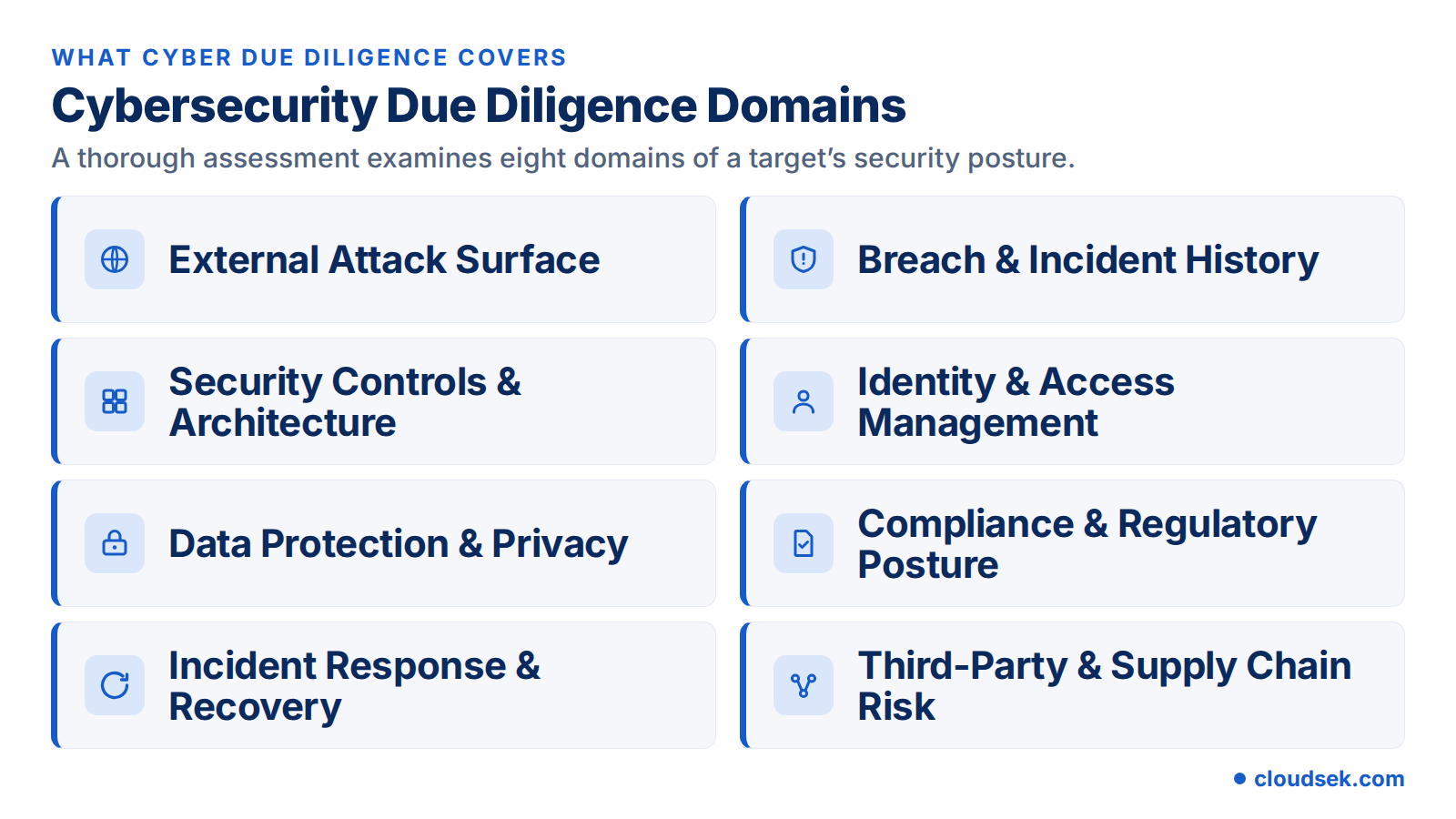
This domain maps the target's internet-facing assets, including domains, subdomains, open ports, and cloud services, and checks them for misconfigurations and exploitable weaknesses. It reflects what an attacker sees from outside.
Reviewers examine past breaches, dark-web exposure, and leaked credentials tied to the target. This domain surfaces the undisclosed and undetected incidents that self-disclosure misses.
This covers the target's defensive controls, network segmentation, patching, and technical debt. Weak architecture signals higher integration cost and risk.
Reviewers assess privileged access, multi-factor authentication, and offboarding practices. Excessive privileges and shared accounts are common findings.
This domain examines how the target stores, encrypts, and handles sensitive and personal data. It establishes whether data practices meet the standards the buyer is held to.
Reviewers verify standing against GDPR, HIPAA, PCI DSS, ISO 27001, and SOC 2. Compliance gaps carry fines that transfer to the acquirer.
This covers incident response plans, business continuity, and disaster recovery. It measures how fast the target detects, responds to, and recovers from an attack.
The target's own vendors extend the risk. This domain maps the supply chain dependencies that the buyer would inherit.
This checklist condenses the assessment into concrete items to verify:
Cybersecurity due diligence runs in three phases tied to the stages of a deal:
Before a letter of intent (LOI) is signed, the target rarely grants internal access, so the assessment is external. Reviewers map the public-facing attack surface, check the dark web for breach exposure and leaked credentials, review disclosed incidents, and build a threat profile from open sources. This phase produces a go or no-go view without the target's cooperation.
With the letter of intent signed and access granted, the assessment deepens. Reviewers examine security controls, identity and access management, data protection, compliance, and incident response through documentation, scans, and interviews with the target's security team.
After the deal closes, the work shifts to remediation and integration. The acquirer fixes the gaps found earlier, integrates the target securely, and places the acquired environment under continuous monitoring.
Two cases show what cybersecurity due diligence is built to prevent:
During Verizon's 2016 agreement to acquire Yahoo, Yahoo disclosed breaches affecting billions of accounts. Verizon cut the purchase price by $350 million, and the two companies agreed to share breach liability. The case became a reference point for how an undisclosed breach reshapes a deal.
Marriott acquired Starwood in 2016 without detecting that attackers had been inside Starwood's reservation system since 2014. The breach surfaced in 2018 and exposed roughly 339 million guest records. The UK regulator fined Marriott £18.4 million and cited insufficient due diligence during the acquisition.
Vendor due diligence applies the same assessment to suppliers, partners, and service providers before they gain access to data or systems. It differs from M&A due diligence in cadence: a vendor is assessed at onboarding and reassessed on a schedule, because its risk changes over time. This work sits inside a broader third-party risk management program, and the single-vendor evaluation is a third-party risk assessment. Continuous monitoring keeps the assessment current between cycles.
Cybersecurity due diligence faces practical constraints:
These practices keep cybersecurity due diligence effective:
A security audit measures an organization's own controls against a standard. Cybersecurity due diligence assesses another party's security and inherited risk before a deal or relationship, often with limited access and under deal deadlines.
Cybersecurity due diligence ranges from a few days for a pre-deal external review to several weeks for a full assessment. Competitive deals compress the timeline, sometimes to 48 to 72 hours for an initial review.
Specialist cybersecurity firms, the acquirer's internal security team, or advisory partners perform cybersecurity due diligence. Legal, compliance, and deal teams act on the findings during negotiation.
Cybersecurity due diligence in M&A is the assessment of a target's security posture, breach history, and inherited cyber risk before an acquisition closes, so the buyer can price the deal and plan integration accurately.
Yes. Much of the pre-deal assessment is external, covering the public attack surface, dark-web exposure, and disclosed incidents. Internal control review and interviews require the target's cooperation after a letter of intent.
A discovered breach reshapes the deal. The buyer renegotiates the price, adjusts terms and liability, requires remediation before closing, or walks away when the risk runs too high.
