🚀 أصبحت CloudSek أول شركة للأمن السيبراني من أصل هندي تتلقى استثمارات منها
اقرأ المزيد
.avif)

Most people have learned to distrust a suspicious email, yet far fewer extend that caution to a text message. Smishing is a social engineering attack that uses fraudulent SMS or text messages to trick people into revealing sensitive information, sending money, or installing malware by impersonating a trusted organization. The name combines SMS, the technology behind text messaging, with phishing, the broader practice it belongs to.
That trust gap is the whole point. As email spam filters improved, attackers followed users to a channel where filtering is weaker and click rates run far higher, and the losses followed. The Federal Trade Commission reported that consumers lost $470 million to text scams in 2024, more than five times the total reported in 2020.
Smishing manipulates people rather than exploiting software, which places it in the social engineering family alongside email phishing and voice-based vishing. A smishing message impersonates a bank, a delivery company, a government agency, or a colleague, and it carries a hook designed to trigger action before thought: an urgent problem, a threat, a reward, or a routine-looking request.
The payload takes one of three forms. A malicious link leads to a spoofed page that harvests credentials or payment details, a callback number connects the victim to a fake support agent, or an attachment or app download delivers malware. In every case, the message itself is harmless until the recipient engages with it, which is why smishing depends entirely on persuasion.
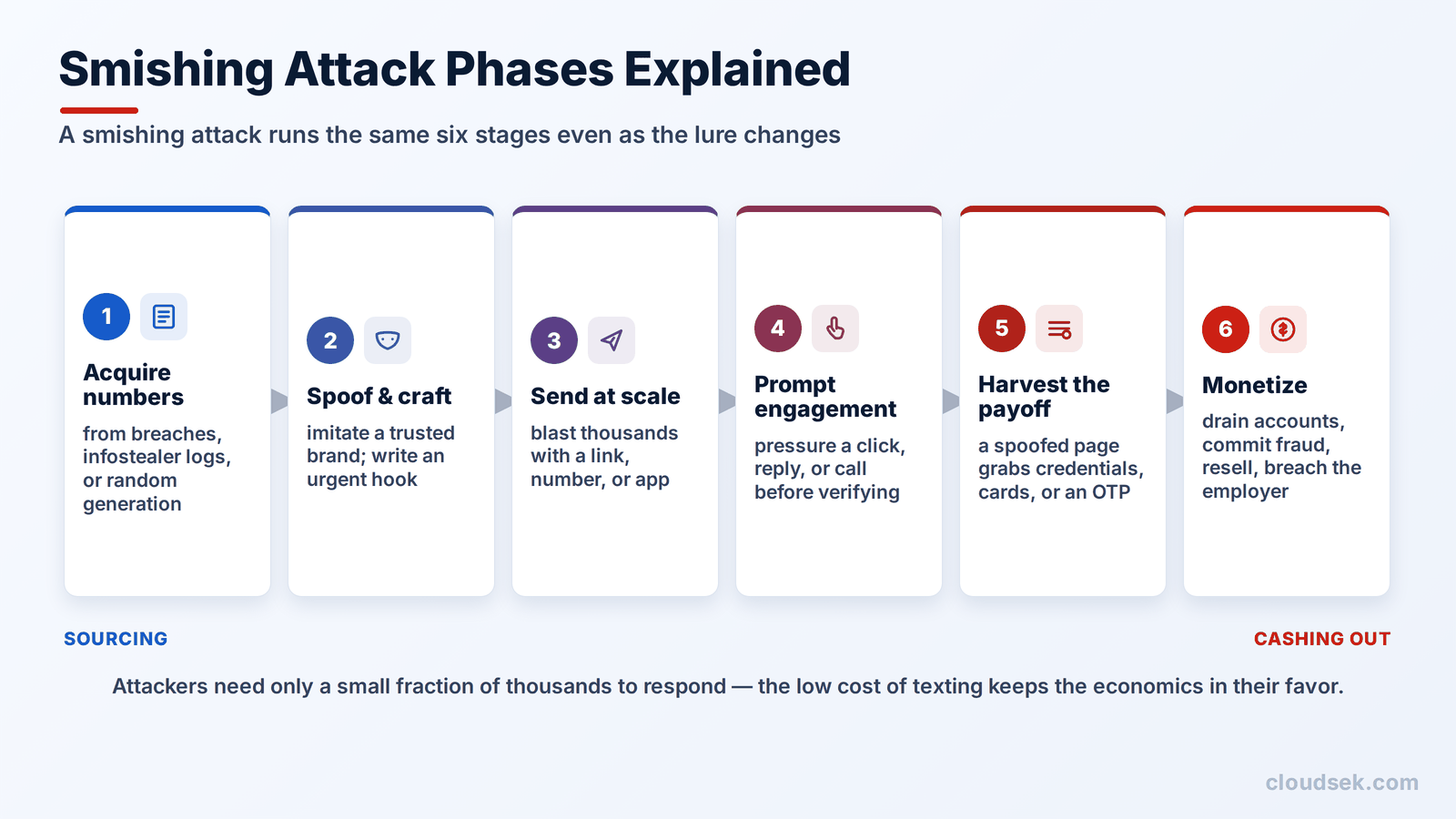
Scale separates smishing from a targeted con. Attackers send the same lure to thousands of numbers at once, needing only a small fraction to respond to profit, and the low cost of sending text messages keeps the economics firmly in the attacker's favor.
Smishing, phishing, and vishing are three branches of the same social engineering tree, separated by the channel the attacker uses to reach a victim. The channel shapes the lure and the defense, so distinguishing them matters.
The three increasingly combine. An attacker sends a text, follows with a call, and confirms by email, and seeing the same story across channels makes the scam feel legitimate rather than suspicious.
Smishing succeeds because the mobile channel resists the defenses that curbed email phishing. Smishing mitigation is difficult due to the limits of mobile devices, the complexity of cellular networks, and how people use phones. Six factors make a text a softer target than an inbox.
A smishing attack runs through six stages, from sourcing phone numbers to cashing out. The steps stay consistent even as the lure changes.
Smishing lures cluster into eight recurring pretexts. Recognizing the pattern behind each one makes an unfamiliar variant easier to catch.
The following campaigns show how these pretexts play out at scale in recent years, and how the same technique reaches both consumers and enterprises.
Toll-agency fraud defined consumer smishing across 2024 and 2025. Messages claimed an unpaid road toll and threatened late fees or license suspension, steering victims to a spoofed payment page, and the campaigns swept state to state as the FBI and FTC issued repeated public warnings. The lure worked by pairing something plausible, a road most people have driven, with something urgent.
Enterprises face the targeted form. CloudSEK's investigation of a CEO-impersonation campaign documented employees receiving SMS messages from an unknown number posing as a senior executive, using urgency and authority to push a quick task before the recipient could verify the sender.
CloudSEK’s Threat Research Team also uncovered a fake airport lounge-pass app targeting travelers at Indian airports. Between July and August 2024, more than 450 travelers installed it, letting attackers steal incoming SMS messages and over INR 9 lakh.
Smishing increasingly runs as a rented, AI-assisted business rather than a lone scammer's effort. Phishing-as-a-service kits bundle templates, bulk-sending tools, and stolen contact lists so criminals with no technical skill can launch campaigns at scale, and generative AI now writes the fraudulent pages those kits deploy.
The pattern surfaced concretely in June 2026, when Google filed a lawsuit against a Chinese cybercrime network it calls Outsider Enterprise, alleging the group used Gemini to help build phishing pages for its smishing operation. The network ran a phishing-as-a-service kit, also called Outsider, coordinated through Telegram and rented for as little as $88 a week, letting criminals with no technical skill launch campaigns impersonating trusted brands. According to Google, the operation sent 2.5 million scam texts to Android users, with lures ranging from fake brokerage-account problems to mobile-carrier rewards.
Most smishing messages share a recognizable set of warning signs. Six red flags separate a scam from a genuine text.
Responding to a suspected smishing text takes five steps, and quick action limits the damage even after a mistake.

Prevention works on two levels, since smishing targets individuals but reaches organizations through them. Personal habits and organizational controls reinforce each other.
Treating unsolicited texts with the same suspicion as unsolicited email removes most of the risk. Verifying requests independently, never sharing codes or credentials by text, keeping a phone updated, and using built-in spam filtering close the common openings a smisher relies on.
Organizations reduce exposure by combining technology with culture. Mobile device management and unified endpoint management enforce security policy on work phones, and security awareness training teaches staff to recognize and report smishing.
Process closes the gap that tools leave open. Clear verification procedures for payments and data requests stop a convincing text from triggering an irreversible action, and smishing simulations measure recognition while surfacing the roles that need reinforcement.
Smishing campaigns run on impersonation infrastructure built before the first message is sent: lookalike domains that host the spoofed payment pages, fake brand and executive profiles, and leaked credentials that let attackers target the right people. That preparation happens on the open, deep, and dark web, where external monitoring sees it.
CloudSEK XVigil detects that groundwork early, flagging newly registered lookalike domains, fake apps and fake customer-care numbers, brand and executive impersonation, and leaked credentials, and supporting takedowns of the domains, pages, and apps a smishing campaign depends on. Removing the infrastructure disrupts the campaign before or during its run.
XVigil does not intercept text messages on a recipient's phone, which is the job of device controls and user awareness; it attacks the external infrastructure behind the campaign, complementing the on-device defenses rather than replacing them.
The difference between smishing and phishing is the channel: smishing is phishing carried out through SMS or text messages, while phishing traditionally arrives by email. Both are social engineering attacks that impersonate trusted organizations.
If you click a smishing link, it opens a spoofed page that harvests credentials or payment details, or it triggers a malware download. Most commonly, the link loads a fake page and the damage comes from entering details or installing a download. If you entered anything, change those passwords immediately and contact your bank.
Replying to a smishing text won’t hack your phone by itself, but it confirms the number is active, which marks it for more targeting and follow-up attempts to steal credentials, codes, or money.
Report a smishing text by forwarding it to 7726, which spells SPAM, so your carrier can act, and then filing a report with the FTC at ReportFraud.ftc.gov and the FBI Internet Crime Complaint Center.
An example of a smishing attack is a text claiming an unpaid road toll that threatens late fees and links to a fake payment page, a campaign that impersonated toll agencies across the US in 2024 and 2025.
Yes, smishing is illegal in most jurisdictions. Smishing is illegal as a form of wire fraud and identity theft. The FBI investigates smishing crimes for criminal prosecution, and the FTC brings civil enforcement actions and collects consumer reports.
