What Is Cybersecurity Risk Management? Frameworks, and Best Practices

Cybersecurity risk management is the process of identifying, assessing, and treating cyber risk. Explore its steps, frameworks, quantification, and best practices.
تم كتابته بواسطة
تم النشر في
Friday, October 16, 2026
تم التحديث بتاريخ
October 16, 2026

What Is Cybersecurity Risk Management?

Cybersecurity risk management is the continuous process of identifying, assessing, prioritizing, and treating the cyber risks that threaten an organization's data, systems, and operations. Rather than trying to eliminate every threat, it directs limited resources toward the risks that matter most, measured against how much risk the organization is willing to accept.

Cyber risk itself is the probability that a threat exploits a vulnerability to compromise the confidentiality, integrity, or availability of information, and the financial, operational, or reputational damage that follows. Risk rises with the likelihood of an event and the severity of its impact, which is why the discipline weighs both rather than reacting to threats in isolation.

Ownership has shifted over the past decade, as cybersecurity risk management moved from a technical task owned by IT into a business decision owned by leadership, because a breach now carries balance-sheet consequences, regulatory penalties, and board-level accountability. Modern programs translate technical exposure into business terms, so executives decide what to fix, insure, or accept.

Benefits of Cybersecurity Risk Management

A working program produces five benefits that justify the investment behind it.

  • Fewer and less costly breaches: Prioritized controls close the exposures most likely to cause harm, lowering both the odds and the cost of an incident.
  • Smarter resource allocation: Ranking risks against tolerance directs limited budget and staff toward what matters instead of spreading effort evenly.
  • Regulatory compliance and audit readiness: A documented program supplies the evidence that frameworks and regulators expect, easing examinations.
  • Informed leadership decisions: Risk expressed in business terms lets executives decide what to fix, insure, or accept with a clear view of the trade-offs.
  • Stronger resilience: Identifying and treating risk before it materializes shortens recovery and limits operational disruption when incidents occur.

Cybersecurity Risk Management Process

The process runs as a repeating lifecycle rather than a one-time project, and most programs structure it on NIST SP 800-39, which frames the overall risk management process, with SP 800-30 guiding the assessment stage.
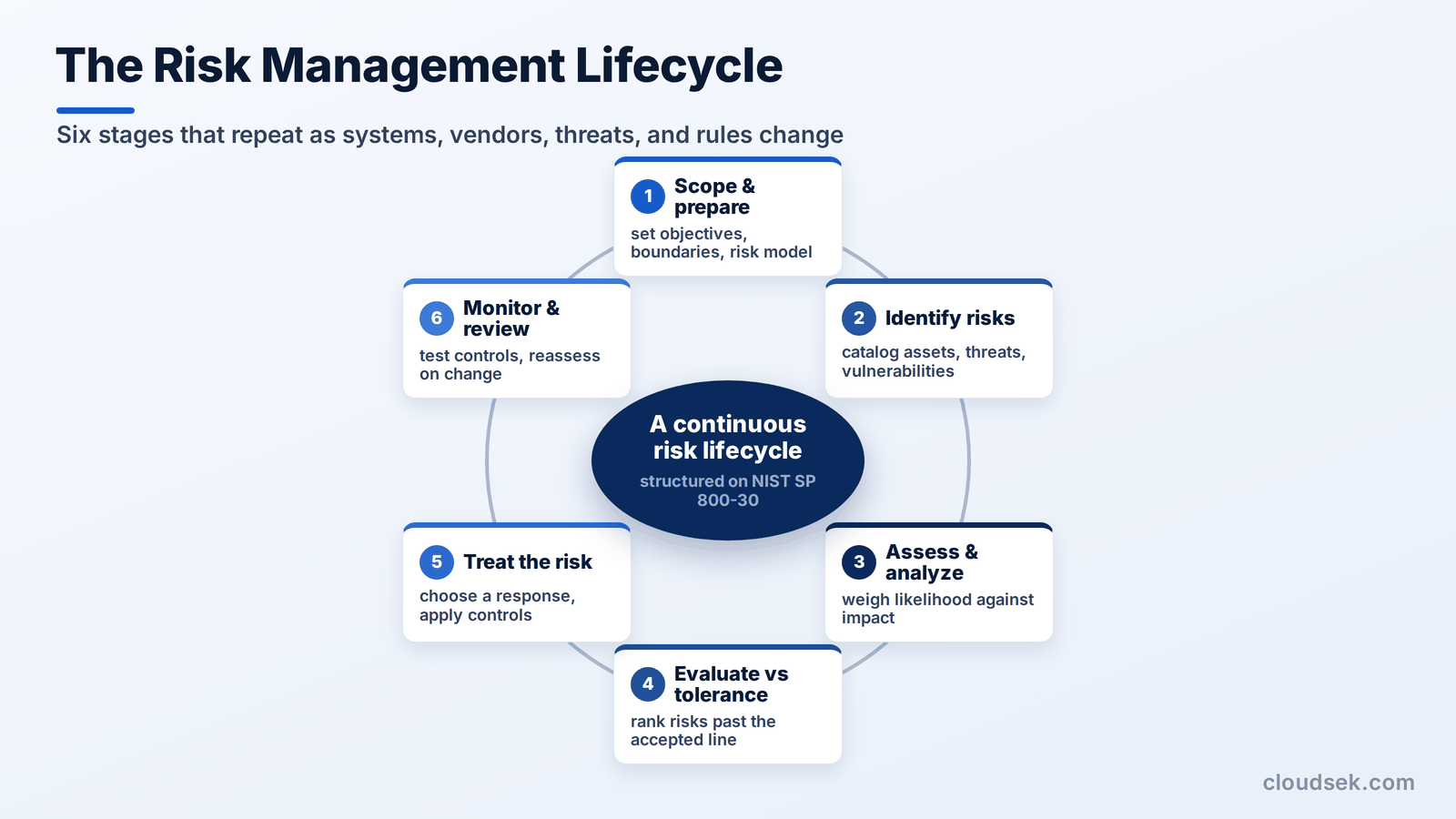
risk management lifecycle
  1. Scope and prepare. Define the objectives, boundaries, and risk model for the assessment, along with the risk tolerance the results will be measured against.
  2. Identify risks. Catalog assets and the threats and vulnerabilities that converge on them, from unpatched systems and weak credentials to vendor and supply-chain exposure.
  3. Assess and analyze. Determine the likelihood of each risk event and the impact if it occurs, producing a comparable measure across the whole risk landscape.
  4. Evaluate against tolerance. Rank the risks and compare them to the organization's defined tolerance, so attention and budget flow to the exposures that exceed it.
  5. Treat the risk. Choose a response for each prioritized risk, then select and implement the controls the chosen response requires.
  6. Monitor and review. Track identified risks, test control effectiveness, and reassess as systems, vendors, threats, and regulations change.

Risk Treatment: Four Ways to Respond to Cyber Risk

Every assessed risk leads to one of four treatment decisions. The right choice depends on where the risk sits against tolerance and what mitigation would cost.

four ways to treat cyber risk

1. Mitigate

Mitigation reduces a risk's likelihood or impact by applying controls, and it is the default response for risks above tolerance that controls address. Examples include multi-factor authentication against credential theft, patching against known exploits, and network segmentation to limit how far a compromise spreads.

2. Transfer

Transfer shifts the financial consequence of a risk to a third party, through cyber insurance or contractual terms that assign liability to a vendor. It suits high-impact events an organization cannot fully prevent, absorbing the cost when a risk materializes rather than lowering its odds.

3. Accept

Acceptance means taking no further action, appropriate when a risk sits below tolerance or when mitigation would cost more than the exposure warrants. Acceptance is a deliberate decision recorded in the risk register, not an oversight or an ignored risk.

4. Avoid

Avoidance eliminates a risk by stopping the activity that creates it, reserved for intolerable exposure that no control brings within tolerance. Retiring a vulnerable legacy system or declining to enter a market with unacceptable risk are examples of avoidance.

Residual Risk

Residual risk is the exposure that remains after controls are applied, since no treatment removes risk entirely. Organizations accept residual risk once it falls within tolerance or transfer it to an insurer, and documenting that decision closes the loop on each treated risk.

Cybersecurity Risk Management Frameworks

Frameworks give a program a common structure for assessment, controls, and reporting, and most organizations adopt at least one. Five recur across the field, each suited to a different need.

Framework Scope and Best Fit Distinguishing Feature
NIST CSF 2.0 Voluntary, all sectors; broad risk governance Six functions including the 2024 Govern function; outcome-based
ISO/IEC 27001 Organizations needing certifiable external assurance Auditable management-system standard with a formal risk-assessment clause
NIST RMF Federal systems and contractors; system-level controls Seven-step process integrated with the system lifecycle
CIS Controls Resource-constrained teams needing a starting set Prioritized, actionable safeguards grouped into Implementation Groups (IG1–IG3)
FAIR Programs quantifying risk in financial terms Models risk as probable frequency and magnitude in dollars

The NIST Cybersecurity Framework 2.0 anchors many programs. It organizes work around six functions, Govern, Identify, Protect, Detect, Respond, and Recover, and its Govern function, added in 2024, places accountability and risk strategy at the center while naming supply-chain risk management as a first-class obligation.

Qualitative vs Quantitative Risk Analysis

Risk analysis takes two forms, and mature programs combine them.

Qualitative Risk Analysis

Qualitative analysis rates risks as high, medium, or low and plots them on a heat map of likelihood against impact. It is fast and intuitive, which makes it a common starting point, though its subjective ratings are hard to defend in budget conversations.

Quantitative Risk Analysis

Quantitative analysis, or cyber risk quantification, expresses risk in money. Models such as FAIR estimate annualized loss exposure by combining loss event frequency with loss magnitude, expressed as ranges rather than single figures, letting leadership compare a security investment against the loss it prevents. Quantification moved from a niche practice toward the mainstream of board reporting as boards demanded financial clarity.

How to Build a Cybersecurity Risk Management Program

Building a program turns the process into a standing capability. Seven steps establish it and keep it running.

  1. First, establish governance and ownership. Name who sets risk tolerance, who runs the program, and who owns each category of risk, since unowned risk goes unmanaged.
  2. Second, inventory assets and data. Map the systems, data, cloud services, and third parties in scope, because unknown assets cannot be protected or assessed.
  3. Third, define risk tolerance. Set the level of risk the organization accepts in pursuit of its goals, recorded in a risk management policy so decisions stay consistent.
  4. Fourth, build a risk register. Record each identified risk with its owner, likelihood, impact, and treatment, turning scattered threats into ranked, decision-ready risks the program tracks over time.
  5. Fifth, select and implement controls. Apply the people, process, and technology controls each treatment decision requires, mapped to the chosen framework.
  6. Sixth, track metrics and key risk indicators. Measure control effectiveness and risk trends with indicators that signal when exposure is rising toward tolerance.
  7. Seventh, review and improve continuously. Reassess on a set cadence and after major changes, feeding lessons from incidents and audits back into the program.

Governance, Roles, and Ownership

Cybersecurity risk management is a shared responsibility, and NIST CSF 2.0 made governance explicit through its Govern function. Five roles carry distinct parts of the program.

  • Board and executives: Set risk tolerance, fund the program, and own accountability for cyber risk as a business risk.
  • CISO and security team: Run assessments, prioritize risks, and select the controls that bring exposure within tolerance.
  • IT and operations: Implement and maintain the technical controls and keep the asset inventory current.
  • Compliance and audit: Map controls to regulatory requirements, test their effectiveness, and produce evidence for examinations.
  • Business units and employees: Own the risks inside their function and follow the policies that keep day-to-day behavior within tolerance.

Cyber Risks to Prioritize in 2026

The risk landscape keeps shifting, and a current program weights its attention toward the threats defining the moment. Cyber threat trends heading into 2026 concentrate in six areas.

  • Vulnerability exploitation: Exploitation of known, unpatched flaws became the leading initial access vector in the 2026 Verizon DBIR, ahead of stolen credentials.
  • Ransomware and extortion: Encryption paired with data-theft extortion remains a major driver of financial and operational loss.
  • Third-party and supply-chain risk: Vendors and dependencies now carry a large share of breaches, which is why frameworks elevated supply-chain risk to a governance obligation. In 2026, 48% of breaches in the Verizon DBIR involved a third party, up from 30% the year before.
  • Identity-based attacks: Stolen and abused credentials bypass perimeter controls, making identity a primary risk surface.
  • AI-enabled threats: Generative AI scales phishing and reconnaissance, and unmanaged AI tools create new data-exposure paths.
  • IT and OT convergence: Connecting operational technology to IT networks extends cyber risk into physical and industrial systems.

Challenges of Cybersecurity Risk Management

Running a program is harder than describing one, and mainly five obstacles recur across organizations.

  • Expanding attack surface: Cloud services, remote work, and a growing web of third parties widen the exposure a program has to track.
  • Overlapping regulations: A rising number of frameworks and disclosure rules, each with its own demands, stretches limited compliance capacity.
  • Limited budget and talent: Security skills are scarce, and budgets are finite, forcing hard choices about which risks receive attention.
  • Credible quantification: Turning technical exposure into defensible financial estimates requires data and modeling many teams still lack.
  • Keeping assessments current: Environments change faster than periodic reviews, so a point-in-time assessment ages quickly without continuous monitoring.

Cybersecurity Risk Management Best Practices

Six best practices separate a program that reduces risk from one that only documents it.

  • Treat it as continuous: Reassess on a cadence and after change, since a point-in-time assessment ages the moment the environment shifts.
  • Quantify where possible: Express high-stakes risks in financial terms so leadership weighs investment against prevented loss.
  • Prioritize by business impact: Rank remediation by the harm a risk would cause, not by the recency or visibility of the finding.
  • Govern third-party risk directly: Assess and monitor vendors continuously, since their weaknesses become the organization's exposure.
  • Align to a recognized framework: Standardize assessment, controls, and reporting against NIST, ISO, or an equivalent for consistency and audit readiness.
  • Report risk in business language: Give the board decision-ready risk in terms of impact and tolerance rather than raw technical detail.

Where CloudSEK Fits in Cybersecurity Risk Management

CloudSEK’s monitoring modules each feed a different part of the risk register. BeVigil continuously discovers internet-facing assets and their vulnerabilities across eight attack surfaces. SVigil replaces point-in-time vendor questionnaires with continuous third- and fourth-party monitoring. XVigil watches the deep and dark web for leaked credentials, exposed data, and brand impersonation. AIVigil inventories exposed AI infrastructure and leaked AI credentials, the risk category most registers don’t yet track. CloudSEK Threat Intelligence adds which threat actors and actively exploited CVEs matter for the organization’s sector.

Nexus AI correlates those findings into potential attack paths and prioritizes them by exploitability, impact, and attacker behaviour rather than severity score alone. It also quantifies the resulting cyber risk in financial terms. That gives the Assess and Evaluate stages a continuously updated input, and gives the board an answer in the language it asks for: which exposures could lead to a breach, what that would cost, and what to fix first.

CloudSEK supplies the external risk intelligence behind identification, prioritization, and quantification. It doesn’t run an organization’s internal governance, control implementation, or audit program, and it complements those functions rather than replacing them

FAQs About Cybersecurity Risk Management

What is the difference between cybersecurity risk management and risk assessment?

Risk assessment is one stage within cybersecurity risk management. The assessment identifies and analyzes risks, while risk management is the full ongoing cycle of assessing, treating, monitoring, and governing those risks.

What are the steps of the cybersecurity risk management process?

The steps of the cybersecurity risk management process are scope and prepare, identify risks, assess and analyze, evaluate against tolerance, treat the risk, and monitor and review continuously.

What is the difference between a threat and a risk?

The difference between a threat and a risk is: A threat is a potential source of harm, such as an attacker or malware, while a risk combines the likelihood that a threat exploits a vulnerability with the impact if it does.

What is residual risk in cybersecurity?

Residual risk in cybersecurity is the risk that remains after controls are applied, since no treatment removes risk entirely. Organizations accept it once it falls within tolerance or transfer it to an insurer.

Which framework is best for cybersecurity risk management?

It depends: no single framework is best for cybersecurity risk management. NIST CSF 2.0 suits broad governance, ISO 27001 suits certification, CIS Controls suit a prioritized start, and FAIR suits financial quantification.

What is cyber risk quantification?

Cyber risk quantification expresses cyber risk in financial terms, using models like FAIR to estimate the annualized loss exposure a risk is likely to cause, so leadership can compare security investment against prevented loss.

المشاركات ذات الصلة
What Is Cybersecurity Risk Management? Frameworks, and Best Practices
Cybersecurity risk management is the process of identifying, assessing, and treating cyber risk. Explore its steps, frameworks, quantification, and best practices.
What is a Keylogger? Types, and How to Detect It
A keylogger secretly records every keystroke to steal passwords and data. Learn its types, how it works, its infostealer evolution, and how to detect and remove it.
What Is Smishing? How SMS Phishing Works?
Smishing is phishing by text message, using fake SMS to steal data and money. Learn how it works, its scam types, red flags, and how to spot and prevent it.

ابدأ العرض التوضيحي الخاص بك الآن!

جدولة عرض تجريبي
إصدار تجريبي مجاني لمدة 7 أيام
لا توجد التزامات
قيمة مضمونة بنسبة 100%

مقالات قاعدة المعارف ذات الصلة

لم يتم العثور على أية عناصر.