🚀 أصبحت CloudSek أول شركة للأمن السيبراني من أصل هندي تتلقى استثمارات منها
اقرأ المزيد
.avif)

The 2019 Capital One data breach began with a misconfigured web application firewall, but the WAF misconfiguration alone does not explain why the intrusion reached customer data. Failures in request routing, workload identity, IAM authorization, detection, and cloud governance combined into an exploitable attack path.
Cloud teams should prioritize internet-facing weaknesses that provide a route to privileged workload identities, excessive permissions, or sensitive data stores.
Unauthorized activity occurred on March 22 and 23, 2019. Capital One stated that an external security researcher reported a configuration vulnerability on July 17, and the company confirmed the intrusion on July 19. Approximately 100 million people in the United States and 6 million in Canada were affected.
Capital One reported that the compromised information included approximately 140,000 U.S. Social Security numbers and 80,000 linked bank account numbers.
Capital One documented the timing, discovery, and impact in its 2019 cyber incident disclosure. The U.S. Department of Justice described the intrusion as occurring through a misconfigured web application firewall.
The WAF established the entry point. The next stage involved requests reaching AWS resources behind that boundary.
The breach progressed through dependent stages rather than through one flaw that directly exposed customer records.
Misconfigured WAF → EC2 instance metadata → temporary credentials → IAM permissions → Amazon S3
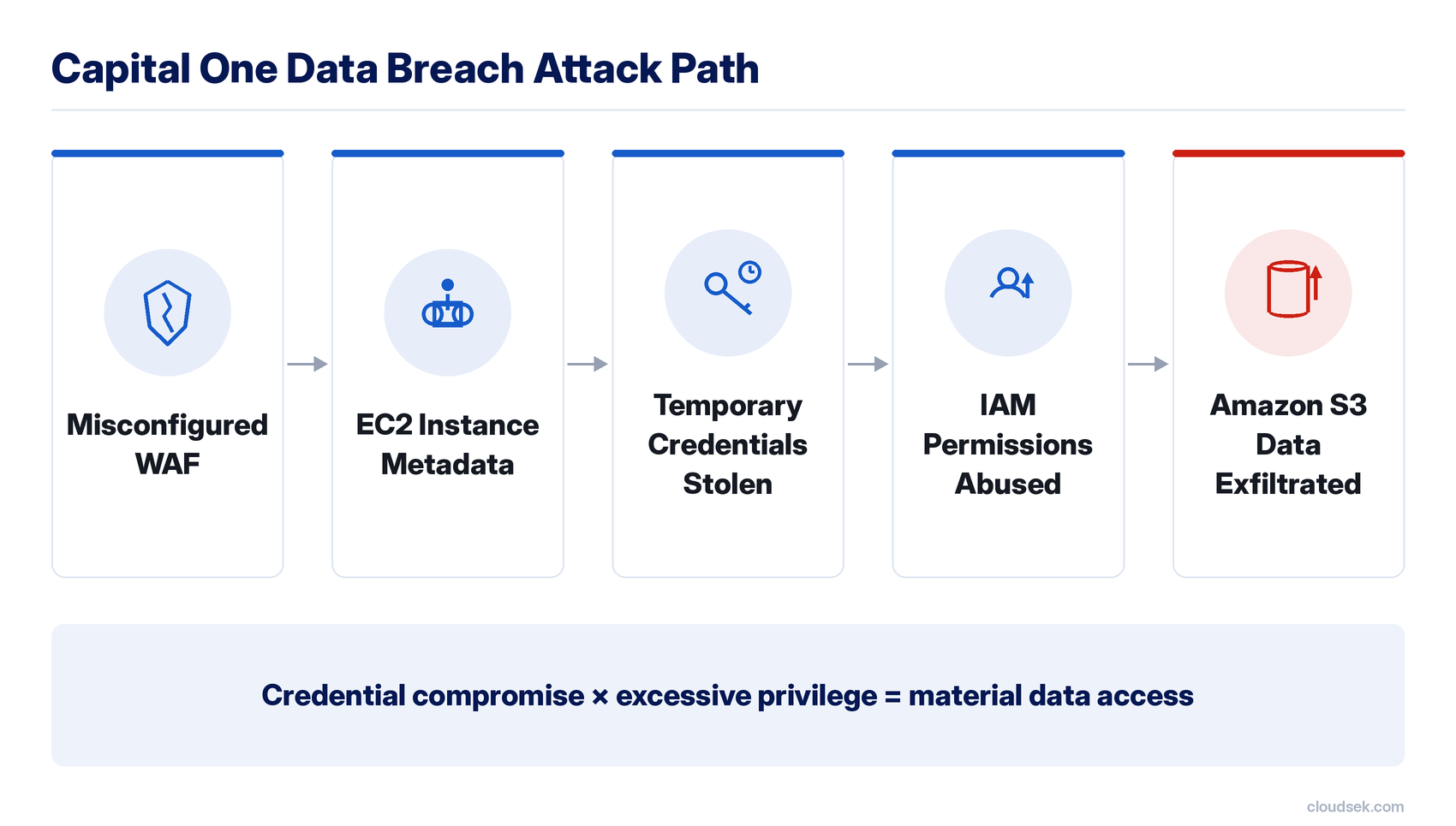
The documented starting point was a misconfigured web application firewall. Its configuration allowed externally supplied requests to reach backend resources that were intended to remain restricted.
The precise mechanism has been characterized differently. The breach is frequently associated with server-side request forgery, or SSRF. A systematic analysis published in ACM Transactions on Privacy and Security discusses an SSRF-based hypothesis. The same analysis records AWS's description of the technique as an open reverse-proxy attack.
The evidence confirms the WAF misconfiguration and the unintended request path it created. It does not establish SSRF and the reverse-proxy interpretation as interchangeable confirmed explanations.
Amazon EC2 provides an Instance Metadata Service, or IMDS, through which an instance retrieves information about itself. When a workload has an attached IAM role, the metadata service can provide temporary credentials associated with that role. Those credentials represent the AWS identity assigned to the workload.
The ACM analysis describes metadata-service requests returning information about the attached role and temporary credentials. The attacker therefore obtained the temporary credentials associated with the workload identity.
Temporary credentials did not create new authority. Their capabilities came from the effective permissions already attached to the workload role.
The compromised role had sufficient authority to enumerate and read relevant Amazon S3 resources. The permissions attached to that role determined how far the attacker could proceed after obtaining the credentials.
Credential compromise × excessive privilege = material data access
The WAF explains how the intrusion began, but several control failures allowed it to progress:
The ACM analysis identifies multiple interacting technical and control failures rather than attributing the incident to one configuration problem. The Office of the Comptroller of the Currency found weaknesses in Capital One's risk-assessment processes before significant public-cloud migration and cited failures to correct identified deficiencies promptly.
The OCC later imposed an $80 million civil money penalty related to those findings. The regulatory record therefore extends the root-cause analysis beyond the WAF to the processes used to assess and remediate cloud risk.
Encryption did not prevent the unauthorized party from obtaining affected data in usable form. Capital One stated that its data was encrypted and that the circumstances of the incident enabled decryption of affected information.
The ACM analysis discusses a possible explanation involving AWS Key Management Service permissions, but labels that explanation as speculative. The evidence used for this article does not establish the exact KMS permission chain, so that mechanism should not be presented as confirmed fact.
Encryption at rest did not independently prevent retrieval of the affected data. Restrictive IAM policies and resource-level authorization remain necessary because encryption does not compensate for excessive authority assigned to a workload identity.
Each stage required the preceding control to permit the next action.
Two examples show how a control removes the next step:
This model changes prioritization. An internet-facing configuration error requires faster remediation when exploitation leads directly to workload credentials, privileged IAM permissions, or sensitive S3 data. The same external weakness produces a smaller blast radius when later controls prevent credential retrieval or restrict what the attached role can read.
Two questions help separate an isolated weakness from an exploitable chain:
AWS introduced IMDSv2 in November 2019 to strengthen the EC2 Instance Metadata Service. IMDSv2 uses a session-oriented token flow, requiring a client to obtain a token before requesting metadata.
AWS described the change as defense in depth against scenarios involving open firewalls, reverse proxies, and SSRF vulnerabilities. Organizations can require IMDSv2 for EC2 instances rather than allowing fallback to IMDSv1.
Since March 2024, AWS has supported IMDSv2 as the account-level default for new EC2 launches. Existing instances still require appropriate configuration where older metadata behavior remains enabled.
IMDSv2 specifically hardens the metadata-retrieval stage. Application security governs whether attacker-controlled requests reach internal resources, IAM limits the authority of workload credentials, resource policies constrain S3 access, and cloud telemetry supports detection of abnormal API or data activity. Each control protects a different stage rather than relying on IMDSv2 to stop the entire sequence.
Security teams often face many internet-facing security issues at the same time: exposed services, configuration errors, vulnerable applications, weak SSL settings, DNS problems, and known CVEs. A flat list does not show which of those weaknesses could function as an initial access vector or connect to a broader attack path.
CloudSEK's BeVigil continuously examines web applications, mobile applications, APIs, cloud assets, CVEs, DNS, SSL, and network surfaces for externally visible weaknesses. By surfacing misconfigurations, vulnerabilities, and other potential initial access vectors, BeVigil helps defenders identify exposed assets that warrant investigation as possible entry points rather than treating every external observation as equally urgent.
The next decision is whether an exposed weakness participates in a larger attack path. Nexus AI correlates signals from CloudSEK products into attack paths, showing where separate weaknesses connect and helping teams prioritize paths that an attacker could use to progress from an initial foothold toward more consequential access.
Together, BeVigil identifies potential entry points across the external attack surface, while Nexus AI adds the relationship context needed to determine which of those entry points participate in broader attack paths. Security teams can then focus remediation on exposed weaknesses that appear within correlated attack paths rather than prioritizing every external issue in isolation.
