🚀 CloudSEK featured in the 2026 Frost Radar™!
Read more
.avif)

Cloud security is the set of policies, controls, and technologies that protect data, identities, workloads, and configurations running in public, private, hybrid, and multi-cloud environments.
It covers infrastructure as a service (IaaS), platform as a service (PaaS), and software as a service (SaaS).
Resources in the cloud are created through APIs, accessed from the internet, and governed by identity permissions. A single misconfigured role or storage policy exposes data without any network intrusion.
Providers such as AWS, Microsoft Azure, and Google Cloud secure the infrastructure they run, yet every customer still owns the security of the accounts, permissions, data, and settings it places on top.
The shared responsibility model divides cloud security duties between the provider, which secures the underlying infrastructure, and the customer, which secures what it deploys and configures.
Responsibility shifts with the service model, but identity, data, and configuration stay with the customer in every model.
Customer rows in this table change with every deployment, so they hold the controls most likely to drift. Capital One, for example, ran on AWS infrastructure that was never breached, yet a misconfigured firewall and an over-permissioned role on the customer side exposed customer data.
AI services from cloud providers follow the same division of responsibility. A model provider secures its platform, while the customer controls which data enters prompts, which identities call the model, and how outputs are stored.
Cloud security differs from on-premises security in its main security boundary, since identity and configuration replace the network perimeter.
These traits push cloud security toward continuous, automated checks. Periodic audits built for fixed data centers miss changes that happen between reviews.
Cloud security works by applying controls at each stage of a resource's life: when it is built, deployed, run, attacked, and restored.
Cloud security requirements change with the deployment model an organization runs.
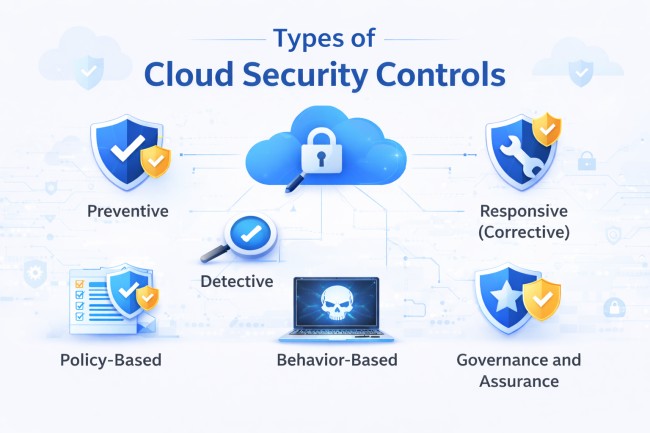
Cloud security components group into identity, posture, workload, data, network, and detection controls, and platforms increasingly combine several of them.
Identity and access management (IAM) defines who and what reaches each resource, and multi-factor authentication protects human sign-ins. Cloud infrastructure entitlement management (CIEM) finds unused and excessive permissions across users, roles, and service accounts.
Non-human identities, such as service accounts, CI/CD pipeline roles, and API keys, need the same governance as people. Short-lived credentials from workload identity federation reduce the damage a leaked static key causes.
Cloud security posture management (CSPM) compares live configurations against benchmarks and policies and flags public storage, open ports, disabled logging, and weak encryption settings.
Kubernetes security posture management (KSPM) applies the same checks to clusters, and SaaS security posture management (SSPM) covers settings inside business applications.
A cloud workload protection platform (CWPP) scans virtual machines, container images, and serverless functions for vulnerabilities and watches their runtime behavior.
Kubernetes controls such as role-based access control (RBAC), network policies, and Pod Security Standards limit what a compromised container can reach.
Encryption at rest and in transit, backed by a managed key service or hardware security module, protects stored and moving data.
Data security posture management (DSPM) locates sensitive data across cloud stores and shows who reaches it, while data loss prevention (DLP) controls how it leaves.
Security groups, private endpoints, and microsegmentation limit lateral movement between workloads.
Web application firewalls and API gateways enforce authentication, rate limits, and input validation on exposed services, and a zero trust access model verifies every request instead of trusting network location.
Cloud detection and response (CDR) analyzes control-plane logs, identity events, and workload telemetry for signs of active attacks, such as unusual key creation or mass data downloads.
Detection teams map these behaviors to the cloud techniques in the MITRE ATT&CK framework and route findings into broader security monitoring and SIEM workflows.
A cloud-native application protection platform (CNAPP) combines CSPM, CWPP, CIEM, and IaC scanning into one product. The consolidation connects findings, so a vulnerable workload with an over-permissioned role and a public endpoint ranks above three separate low-severity alerts.
Identity weaknesses, AI-driven attacks, third-party dependencies, insecure APIs, and misconfiguration lead current cloud security risk rankings. The Cloud Security Alliance's Top Threats to Cloud Computing 2026 survey of 507 security professionals ranked the leading threats in this order:
Incident response data from Google Cloud shows how attackers actually get into cloud environments. The Cloud Threat Horizons Report H1 2026 found that exploited third-party software accounted for 44.5% of initial access in the second half of 2025.
Weak or absent credentials followed at 27.2%, misconfiguration at 21%, and exposed interfaces or APIs at 4.9%. The same report found identity compromise underpinning 83% of compromises.
Stolen passwords, phished session tokens, and leaked access keys let attackers sign in as legitimate users or services. Over-permissioned roles then extend one compromised identity into access across accounts.
Leaked credential monitoring and permission right-sizing belong in the same identity program for that reason.
Google Cloud observed the gap between vulnerability disclosure and exploitation shrink from weeks to days in the second half of 2025. Internet-facing applications running on customer-managed virtual machines and containers stay the customer's patching responsibility under the shared responsibility model.
Public storage buckets, open management ports, disabled logging, and permissive firewall rules expose resources without any exploit.
Drift happens when manual console changes or emergency fixes move a resource away from its approved template, and external attack surface management shows which of those changes are reachable from the internet.
AI training and deployment platforms hold models, datasets, and the cloud storage keys that connect them.
CloudSEK's research on AI infrastructure as a strategic target identified more than 100 exposed credential sets and more than 80 publicly accessible MLOps deployments, several of which exposed connected AWS, Google Cloud, or Azure storage credentials.
SaaS integrations, CI/CD tools, open-source packages, and managed service providers hold trusted access to cloud environments. A compromised dependency or OAuth connection inherits that trust, the pattern behind a software supply chain attack.
A fuller breakdown of each threat appears in CloudSEK's guide to top cloud security risks and threats.
In 2019, an attacker exploited a server-side request forgery (SSRF) flaw in a misconfigured web application firewall running in Capital One's AWS environment.
The request pulled temporary credentials for an IAM role with broad storage access, and the attacker used them to copy data on about 106 million US and Canadian credit card applicants.
Federal regulators at the Office of the Comptroller of the Currency (OCC) later fined Capital One $80 million, citing the bank's failure to establish effective risk assessment processes before moving significant operations to the public cloud. That finding shows why a data risk assessment belongs before migration, not after an incident.
Google Threat Intelligence Group described a campaign by the North Korean group UNC4899 in the second half of 2025. The attackers tricked a developer into downloading a malicious archive on a personal device.
After the developer moved the file to a corporate workstation, the attackers pivoted into the organization's Google Cloud environment. They then abused legitimate orchestration tools to blend their activity into normal operations.
Cloud security best practices harden identity first, then configuration, data, workloads, and monitoring.
CloudSEK's guides to 15 cloud security best practices and top cloud security tips for 2026 expand each practice with implementation details.
Cloud security frameworks give organizations tested control sets and audit evidence for cloud environments.
What is the difference between cloud security and cybersecurity?
Cybersecurity protects all digital systems and data. Cloud security is the subset that protects cloud-hosted infrastructure, platforms, applications, and the identities and configurations that control them.
Is the cloud more secure than on-premises infrastructure?
It varies with configuration. Major providers secure infrastructure at a scale few organizations match, but customer-side identity and configuration errors cause most cloud exposures.
Does encryption protect cloud data from misconfiguration?
No, not fully. A role with decrypt permissions reads encrypted data normally, so an over-permissioned identity exposes encrypted data just like unencrypted data.
Can small businesses rely on a cloud provider's default security settings?
No. Defaults secure the provider's infrastructure, but small businesses still configure MFA, permissions, sharing settings, logging, and backups themselves.
Which certifications prove cloud security skills?
Common cloud security certifications include ISC2 CCSP, CSA CCSK, AWS Certified Security Specialty, Microsoft Azure Security Engineer Associate, and Google Professional Cloud Security Engineer.
What does a cloud security engineer do?
A cloud security engineer designs identity policies, guardrails, logging, and detection for cloud environments, and fixes misconfigurations and vulnerabilities found in cloud accounts.
