🚀 أصبحت CloudSek أول شركة للأمن السيبراني من أصل هندي تتلقى استثمارات منها
اقرأ المزيد
.avif)

Brand impersonation is the unauthorized use of a company's name, logo, domain, or executive identity to deceive its customers, partners, or employees, usually to steal credentials, money, or data. It turns a brand's own reputation into a weapon: people trust a familiar logo or domain and act before they scrutinize it.
The techniques that carry it, phishing and spoofing, were the most reported cybercrimes in the United States in 2024, with 193,407 complaints to the FBI's Internet Crime Complaint Center. Generative AI has made the problem worse, letting attackers spin up convincing fake sites, profiles, and voice clones at scale.
That’s why it’s essential to know what brand impersonation is, the main types, how each works, how to detect, prevent, report, and take down brand impersonation campaigns before they reach customers.
Brand impersonation, known as brand abuse or brand spoofing, is any attempt to pass off fraudulent content as an official brand asset. Attackers copy enough of a brand's visual identity, name, domain, or messaging to pass a quick check, then place the fake where customers expect to find the real brand. The target is not a technical flaw but human trust, which is why brand impersonation reaches customers that internal security tools never see.
Every successful impersonation transfers the brand's hard-won trust to the attacker. Victims who lose money or credentials frequently blame the real company, so the damage extends past the immediate fraud into reputation, customer loyalty, and legal exposure.
Most brand impersonation campaigns follow the same four-step pattern:
Attackers copy logos, color schemes, email templates, and product imagery from the legitimate brand.
After harvesting brand assets, attackers register a lookalike domain, clone a login or checkout page, or create a fake social profile or app.
They reach victims through email, search and social ads, messaging apps, or fake support listings where customers expect the real brand.
Lastly, attackers harvest credentials, payments, or installs, then rotate to fresh infrastructure before the brand can take the fake down.
Brand impersonation appears across many channels, and a single campaign often combines several at once. The table summarizes the main types, followed by a closer look at each.
Attackers forge a sender address or register a lookalike domain, then send messages that copy a brand's email templates to harvest credentials or payments. Phishing that abuses a trusted brand is one of the most common forms of online fraud, and a single template can target thousands of customers at once.
Typosquatting registers domains that resemble the real address through character swaps (replacing "m" with "rn"), added words (brand-support.com), or alternate extensions (.co instead of .com). These domains host the cloned pages a campaign funnels victims into and often sit on legitimate hosting to dodge blocklists.
Attackers clone a brand's login portal, payment page, or online store, copying it closely enough to pass a glance. Fake storefronts advertise discounted products, collect payment and card details, and deliver nothing. Many are built to stay live only long enough to collect from victims before being replaced.
Fake brand accounts, pages, and groups siphon followers, run fraudulent giveaways, and direct people to credential-harvesting pages. Impersonators pose as customer-support or sales representatives in direct messages. Abused verification badges make these accounts look authentic, which is exactly the trust attackers rely on.
Rogue apps on third-party stores, and sometimes official ones, copy a brand's name, icon, and design to trick users into installing them. Once installed, they harvest login credentials, payment data, or device permissions. Outdated or cloned banking and shopping apps are common targets.
Attackers buy paid search and social ads that impersonate a brand, often appearing above the genuine results. The ads lead to lookalike domains and fake stores. Because the ad sits on a trusted platform and ranks at the top, customers click it expecting the official site.
Executive impersonation, the basis of CEO fraud and business email compromise, poses as a senior leader to pressure staff into wiring money, buying gift cards, or sharing data. Attackers research the target, mimic the executive's tone, and add urgency, often timing requests when the real leader is traveling or unreachable.
Fraudsters post fake customer-care numbers and support pages on forums, social media, and search results. Victims searching for help call the number, reach an impersonator, and hand over account details or remote access. The scam thrives wherever a brand's real support contact is hard to find.
Quishing places a brand's QR code in emails, posters, parking meters, or flyers that link to a fake page. Because a QR code hides its destination until scanned, victims cannot inspect the link the way they would a typed address, which makes the lure effective on mobile devices.
Generative AI lets attackers clone an executive's voice or face for fraud, fake endorsements, or video calls that authorize fraudulent transfers. Voice clones built from a few seconds of public audio have convinced staff to approve payments, and deepfake video has impersonated leaders in real-time meetings.
These terms overlap and are often used interchangeably, yet they describe different things. Brand impersonation is the goal; phishing and spoofing are techniques used to achieve it.
In short, an attacker uses domain spoofing and phishing as methods, and brand impersonation as the disguise that makes those methods work.
Brand impersonation runs constantly across every consumer-facing sector. CloudSEK's research has documented the industrialization of these campaigns, including more than 2,000 fake holiday-themed stores spun up around major sales events, each engineered to collect a few thousand dollars from shoppers before takedown.
Its research on fake pages and channels found spoofed groups running fake offers under a banking brand's identity, impersonators posing as account representatives to phish for data, and unofficial channels selling counterfeit products under e-commerce brands.
Other common patterns include lookalike banking login portals that capture credentials, fraudulent delivery and postal text messages that impersonate couriers, fake mobile apps mimicking financial services, and cloned checkout pages advertised through paid search ads. The brands targeted span banking, e-commerce, logistics, technology, and government services.
Brand impersonation harms customers, the brand, and internal teams at once, and the damage often outlasts the campaign.
Brand impersonation sits outside normal internal telemetry, so standard security tools rarely see it. Detection depends on continuous external visibility across the channels attackers actually use. Watch for these signals:
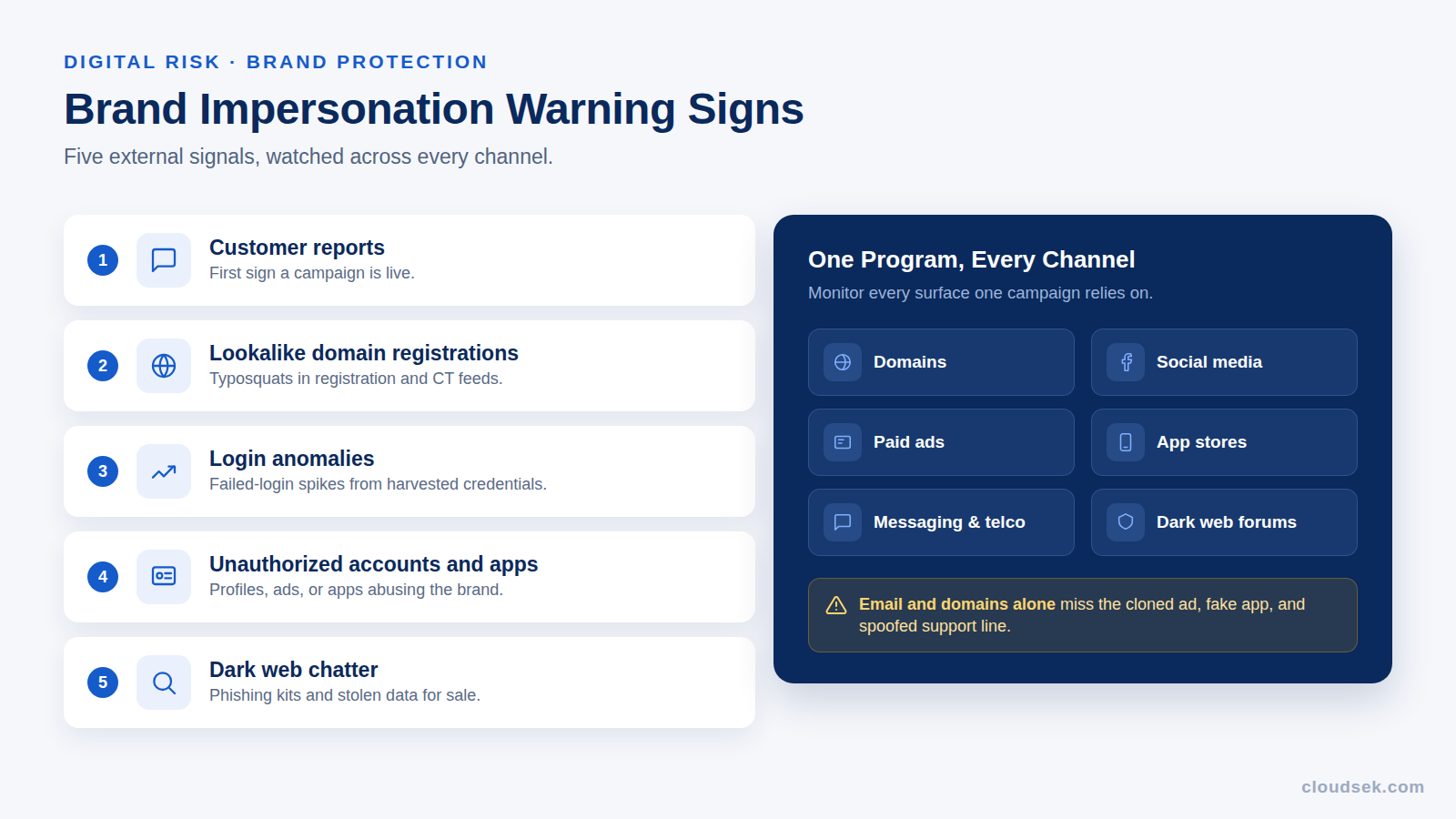
Effective monitoring covers domains, social media, paid ads, app stores, messaging and telco channels, and dark web forums together. A program that watches only email and domains misses the cloned ad, the spoofed support number, and the fake app that the same campaign relies on.
Prevention cannot stop every fake, because the most exposed channels sit outside a brand's control. It can close the easy openings and reduce the number of victims a campaign converts.
Multi-factor authentication helps once a credential reaches a legitimate login, but a fake page can capture it before any MFA challenge applies. That makes external detection and takedown the first line of defense, with MFA as a backstop.
Detecting a fake only reduces risk once the infrastructure comes down, and speed determines how many customers it reaches. Effective phishing and domain takedown follow a clear path:
Yes. Brand impersonation can violate several laws and frameworks. In the United States, the Lanham Act provides civil remedies for trademark infringement, and the FTC's impersonation rule prohibits falsely posing as a business.
In the European Union, the Digital Services Act sets platform obligations around the impersonation of content. For domains specifically, ICANN's UDRP offers an administrative route to challenge lookalike registrations. Enforcement still depends on the brand detecting the abuse and acting on it.
Because brand impersonation plays out on external channels, brands need visibility and takedown reach beyond their own perimeter. CloudSEK XVigil continuously monitors the surface, deep, and dark web for impersonation across domains, social media, mobile apps, paid ads, and fake customer-support listings, scoring threats by whether they are live and reaching customers.
When a fake is confirmed, CloudSEK's in-house takedown team drives the case to removal through direct relationships with registrars, hosting providers, and platforms, covering submission, follow-up, and confirmation.
The team reported more than 2,200 takedowns in a single quarter at a 96 percent success rate, with an average turnaround of about four business days. CloudSEK focuses on external detection and takedown rather than acting as a customer-side email gateway or endpoint tool, giving brand, security, and fraud teams a single view of impersonation and a path to remove it quickly.
A common example is a scammer registering a domain that resembles a bank's real address, sending an email that copies the bank's design, and linking to a fake login page that captures the victim's credentials.
Yes. It can violate trademark law, such as the US Lanham Act, the FTC's impersonation rule, and the EU Digital Services Act. Lookalike domains can be challenged through ICANN's UDRP process.
Signs include customer reports of suspicious emails or ads, lookalike domains appearing in registration feeds, spikes in failed logins, and unauthorized social accounts or apps using the brand's name. Continuous external monitoring surfaces these early.
Brand impersonation is the goal of posing as a trusted brand. Phishing is a technique, fraudulent messages to trick people into sharing data, often used to carry out brand impersonation. Not all phishing impersonates a brand.
Report it with evidence to the domain registrar and hosting provider, file a UDRP complaint for lookalike domains, and use platform and ad-network reporting. Removing the connected ads and accounts at the same time stops the campaign rerouting.
AI lowers the cost of convincing fakes, generating polished phishing pages, cloned voices, and deepfake videos at scale. This lets attackers run more campaigns across more channels at once, raising both volume and believability.
