🚀 أصبحت CloudSek أول شركة للأمن السيبراني من أصل هندي تتلقى استثمارات منها
اقرأ المزيد
.avif)

Google dorking is the practice of using advanced search operators to surface sensitive information that an organization has unintentionally left exposed and searchable online. It exploits no software and breaks no lock; it simply filters what Google has already indexed down to the files, pages, and systems nobody meant to publish.
The exposure is real and routine. CloudSEK's XVigil recently traced a public code repository leaking credentials that put more than 500 employees' data at risk, the kind of oversight that sits quietly in a search index until someone thinks to look for it.
Google dorking, or Google hacking, is a reconnaissance technique that combines search operators with keywords to pinpoint data that was never meant to be public. The security researcher Johnny Long coined the idea in the early 2000s, cataloguing search queries that reliably surfaced other people's mistakes.
The technique cuts both ways. Attackers use it to map a target before touching a single system, and defenders, penetration testers, bug bounty hunters, and journalists use the identical operators to audit exposure and investigate.
Its defining trait is stealth. Dorking is passive reconnaissance, running entirely inside Google, so the target organization sees no scan, no probe, and no trace of anyone studying it.
Google dorking rests on a simple gap. Google's crawler indexes everything it reaches, which is far more than most organizations intend to publish, and dorking filters that oversized index down to the sensitive remainder.
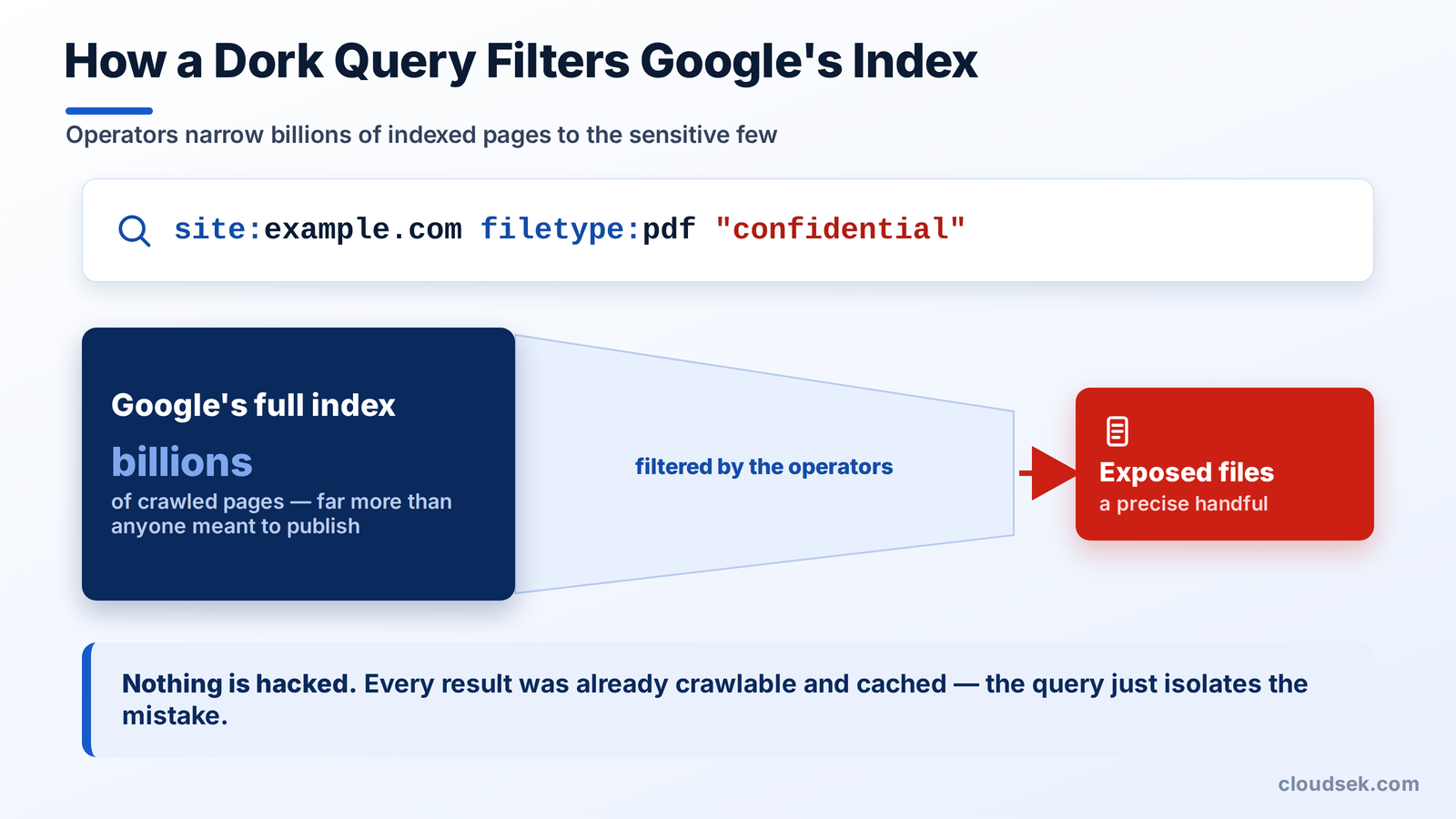
An operator supplies the filter. Asking for one file type on one domain, or one phrase inside a page title, narrows billions of pages to a precise handful, and the exposure surfaces because the data was reachable, not because anything was broken.
Nothing is exploited in the technical sense. No system is breached, no code is injected, and no control is bypassed, since every result was already crawlable and cached. Dorking reveals a pre-existing mistake rather than creating a new one.
A small set of operators does most of the work. Each is a legitimate, documented Google feature, and their power comes from combination rather than from any single term.
Combining operators sharpens the result, pairing a domain filter with a file type, for instance, to isolate a specific kind of document on a specific site.
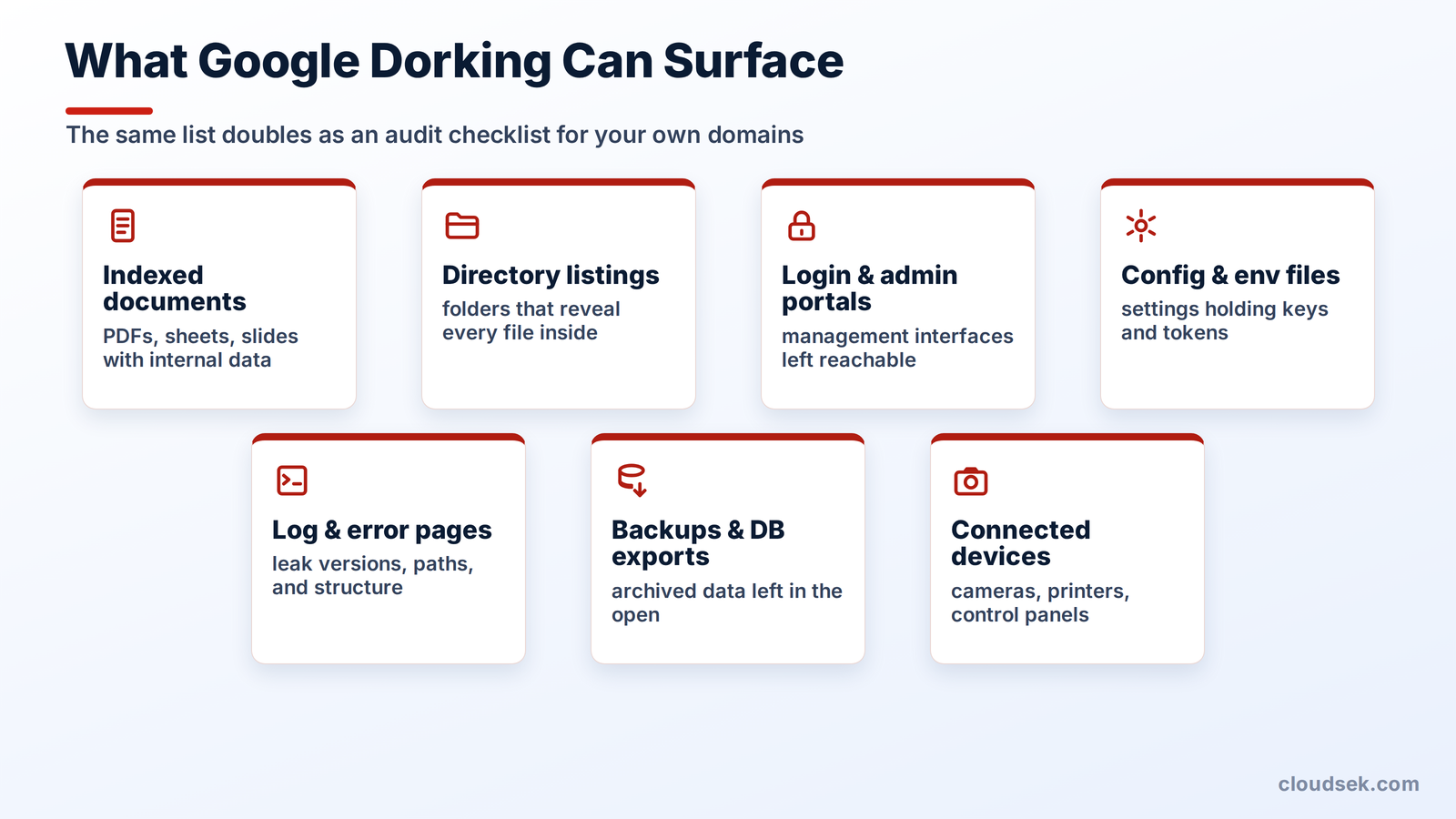
The categories below double as an audit checklist an organization uses to confirm nothing sensitive is indexed against its own domains:
Johnny Long published the first Google Hacking Database in 2004, collecting the queries security testers relied on into a single reference. In 2010, he handed it to Offensive Security, the team behind Kali Linux, which has maintained it on Exploit-DB ever since.
The database now holds thousands of curated entries across categories such as exposed files, error messages, login portals, and vulnerable servers. Read defensively, it is a checklist of the mistakes worth auditing against an organization's own infrastructure before somebody else does.
Google dorking targets one index among several, and a full exposure audit reaches past it:
Artificial intelligence is reshaping this landscape from both directions. Language-model tools now generate dork queries from plain-language prompts, lowering the skill barrier and letting reconnaissance run at scale.
At the same time, attackers have gained a fresh target: exposed AI infrastructure. Unprotected model endpoints, leaked AI API keys, and misconfigured vector databases are the same old exposure mistakes wearing new technology. Monitoring that AI attack surface falls to dedicated tooling such as CloudSEK's AIVigil rather than to traditional web reconnaissance.
Running a search is legal everywhere. Search operators are a standard Google feature, and querying a public index breaks no law on its own.
Intent and action decide the rest. Accessing, downloading, or using data found through dorking without authorization is a separate offense. It falls under the Computer Fraud and Abuse Act in the US, the General Data Protection Regulation in the EU, and comparable laws elsewhere, including India's statutes on unauthorized access.
The responsible path on finding exposed data is to leave it untouched and report it through an official channel, such as a security.txt contact, rather than opening the file.
Defending against dorking means controlling what reaches the index in the first place, not hiding it after the fact:
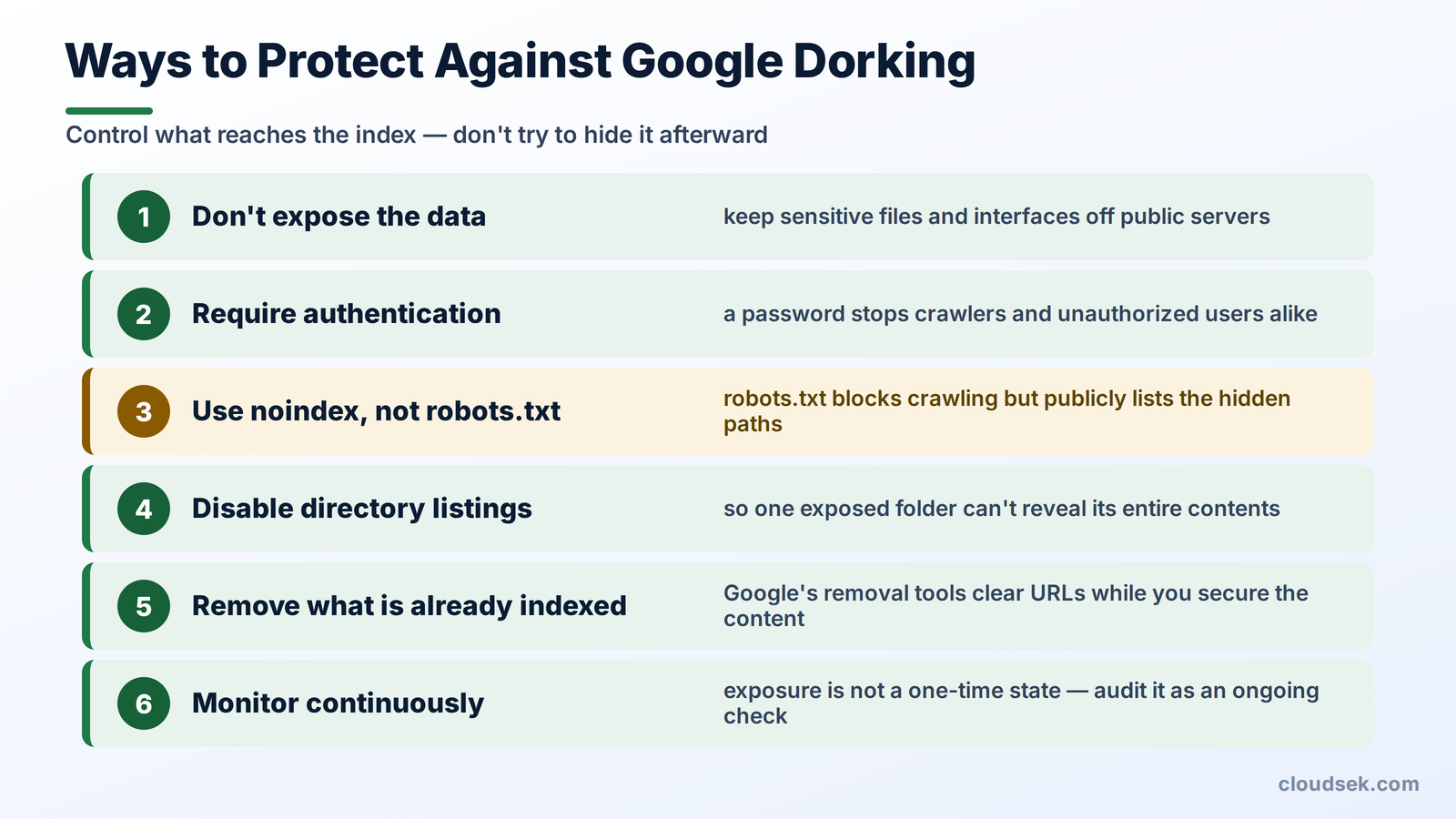
Google's own guidance on removing information sets out the correct sequence: secure or delete the content, then use the removal tools, and treat robots.txt as a crawling preference rather than a security control.
Manual dorking checks a handful of queries against a handful of domains. Real organizations sprawl across forgotten subdomains, third-party vendors, code repositories, and cloud storage, far more surface than anyone audits by hand.
CloudSEK's BeVigil maps that external attack surface continuously, flagging the exposed files, misconfigured storage, and indexed assets that dorking targets. XVigil extends the same visibility to leaked credentials and sensitive data surfacing across public repositories, paste sites, and the dark web, which is how it caught the repository leak described earlier while the exposure could still be closed.
No, Google dorking is one technique within open-source intelligence (OSINT). OSINT is the broader practice of gathering information from public sources, of which search-engine reconnaissance is a single method.
The target organization cannot see the searches, since the activity happens inside Google rather than against their systems. Google itself logs queries, so the searcher is not anonymous to the search engine.
Google applies rate limits and CAPTCHA challenges to heavy automated querying and removes some flagged results, but the operators themselves remain fully functional. The technique still works for ordinary manual use.
GitHub dorking applies the same idea to code repositories, using search filters to find secrets such as API keys, passwords, and tokens committed by mistake. Exposed repositories are among the most common sources of leaked credentials.
Yes, when configuration files, database exports, or credential lists are left publicly reachable, they can be indexed and surfaced. This is precisely why such files must never sit on a public server.
Yes, it remains a common first step in reconnaissance, because it is free, passive, and invisible to the target. Attackers often dork a target before any active scanning begins.
