🚀 A CloudSEK se torna a primeira empresa de segurança cibernética de origem indiana a receber investimentos da
Leia mais
.avif)

Um caminho de ataque é a sequência de passos conectados que um atacante percorre num ambiente, desde um ponto de entrada inicial até um ativo crítico. Em vez de depender de uma única fraqueza, o atacante encadeia vulnerabilidades, configurações incorretas e credenciais expostas para atingir um objetivo como acesso de administrador de domínio ou roubo de dados. Este encadeamento é a razão pela qual as análises isoladas de vulnerabilidades perdem o risco real: apenas cerca de 1,1 por cento das vulnerabilidades publicadas são conhecidas por serem exploradas na prática, então o que importa é quais fraquezas se conectam para formar um caminho utilizável.
Este guia explica o que é um caminho de ataque, como ele difere de um vetor de ataque e de uma superfície de ataque, as fases pelas quais um atacante passa, um exemplo concreto, por que os caminhos de ataque são importantes e como a análise e a gestão de caminhos de ataque funcionam para interrompê-los.
Um caminho de ataque é a rota que um atacante segue através de um ambiente, ligando uma fraqueza à próxima até atingir um alvo de valor. As equipas de segurança chamam a esses alvos "joias da coroa": contas de administrador de domínio, bases de dados sensíveis, sistemas financeiros ou propriedade intelectual. O caminho é a história de como um atacante vai da porta da frente ao cofre.
A ideia central é que os atacantes raramente dependem de uma única falha. Uma senha fraca por si só pode expor pouco, e um servidor sem patches pode permanecer isolado. Encadeados, a senha fraca concede um ponto de apoio, o ponto de apoio revela o servidor, e o servidor abre uma rota para dados críticos. O perigo reside nas conexões, não em uma única exposição.
Os caminhos de ataque abrangem todas as partes de um ambiente moderno. Eles atravessam sistemas locais, infraestrutura de nuvem, provedores de identidade, a superfície de ataque externa e dependências de terceiros. Para os defensores, a mudança é de pensar em vulnerabilidades isoladas para pensar em caminhos, porque é assim que um adversário já vê o ambiente.
Caminho de ataque, vetor de ataque e superfície de ataque estão intimamente relacionados, mas são distintos. A maneira mais simples de os distinguir é com um edifício: o vetor é uma porta de entrada, a superfície é cada porta e janela, e o caminho é a rota que um intruso percorre da porta de entrada ou janela até as joias no cofre.
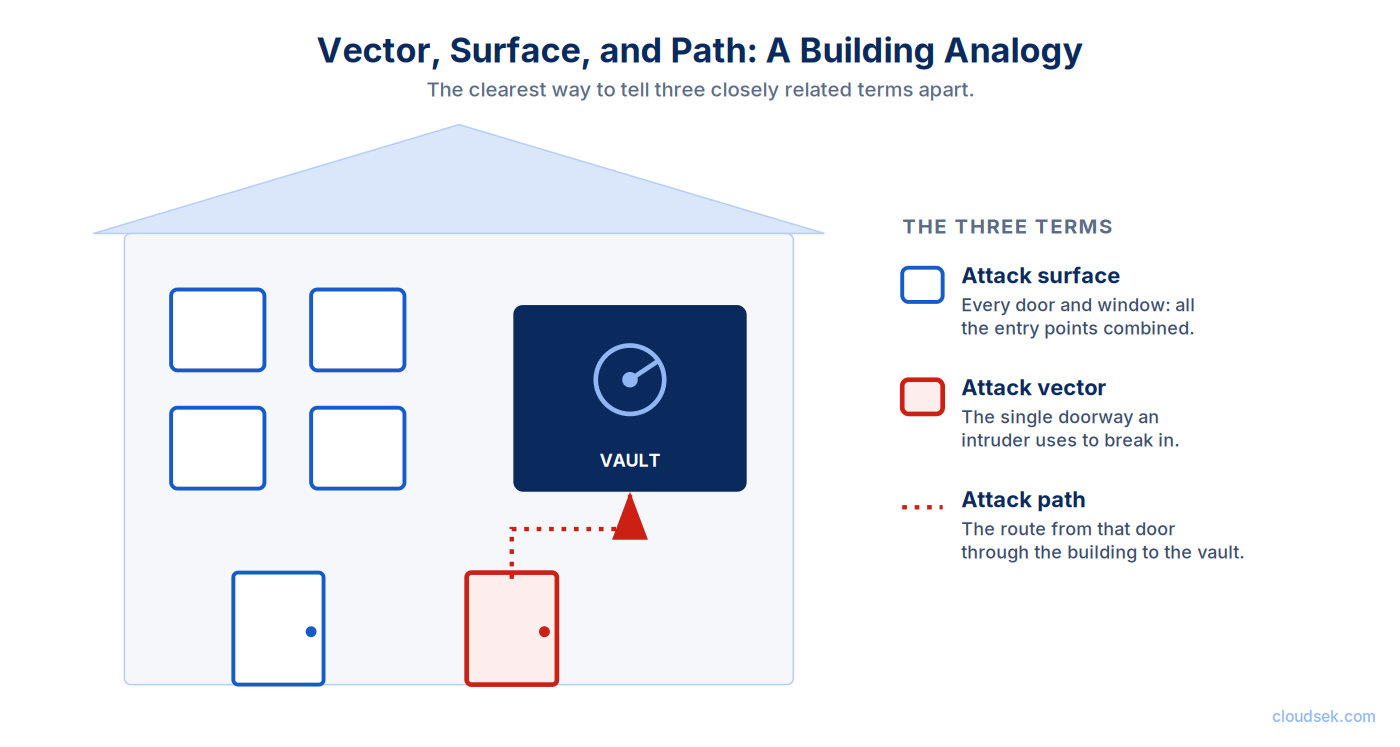
Simplificando, o vetor permite a entrada do atacante, a superfície de ataque define por onde eles podem entrar, e o caminho de ataque mostra para onde eles vão a seguir. Um único vetor torna-se perigoso apenas quando abre um caminho para algo que vale a pena alcançar.
A maioria dos caminhos de ataque passa por cinco fases, embora os atacantes adaptem a ordem ao que cada passo revela. A progressão abaixo traça uma rota típica desde a entrada até o objetivo.
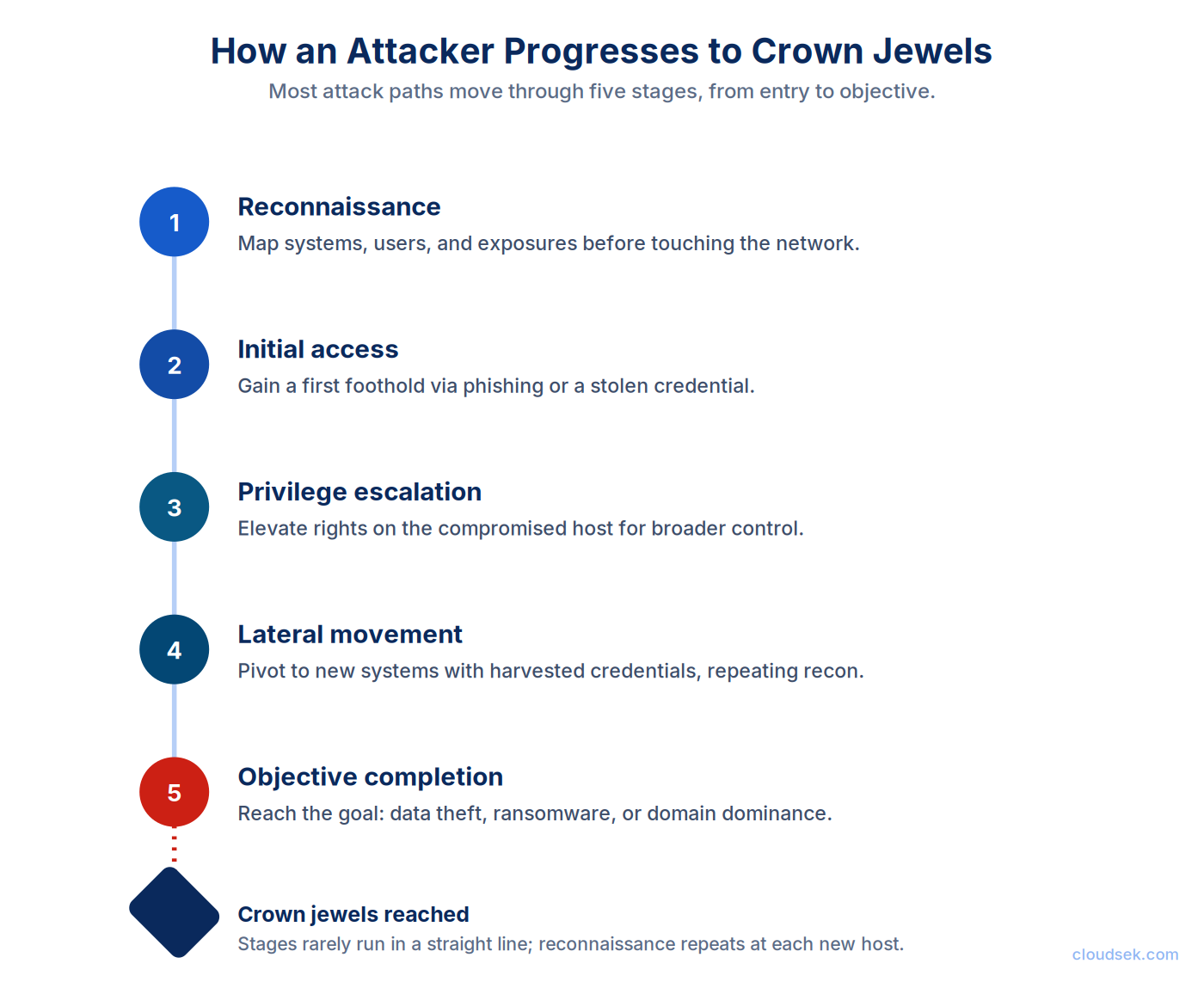
Esses estágios raramente são uma linha reta. O reconhecimento se repete em cada novo host, e um atacante pode escalar privilégios várias vezes à medida que o contexto muda, o que torna um caminho de ataque real dinâmico em vez de fixo.
Um exemplo concreto mostra como descobertas de baixo risco se combinam em uma cadeia crítica. Considere um atacante visando o banco de dados de clientes de uma empresa.
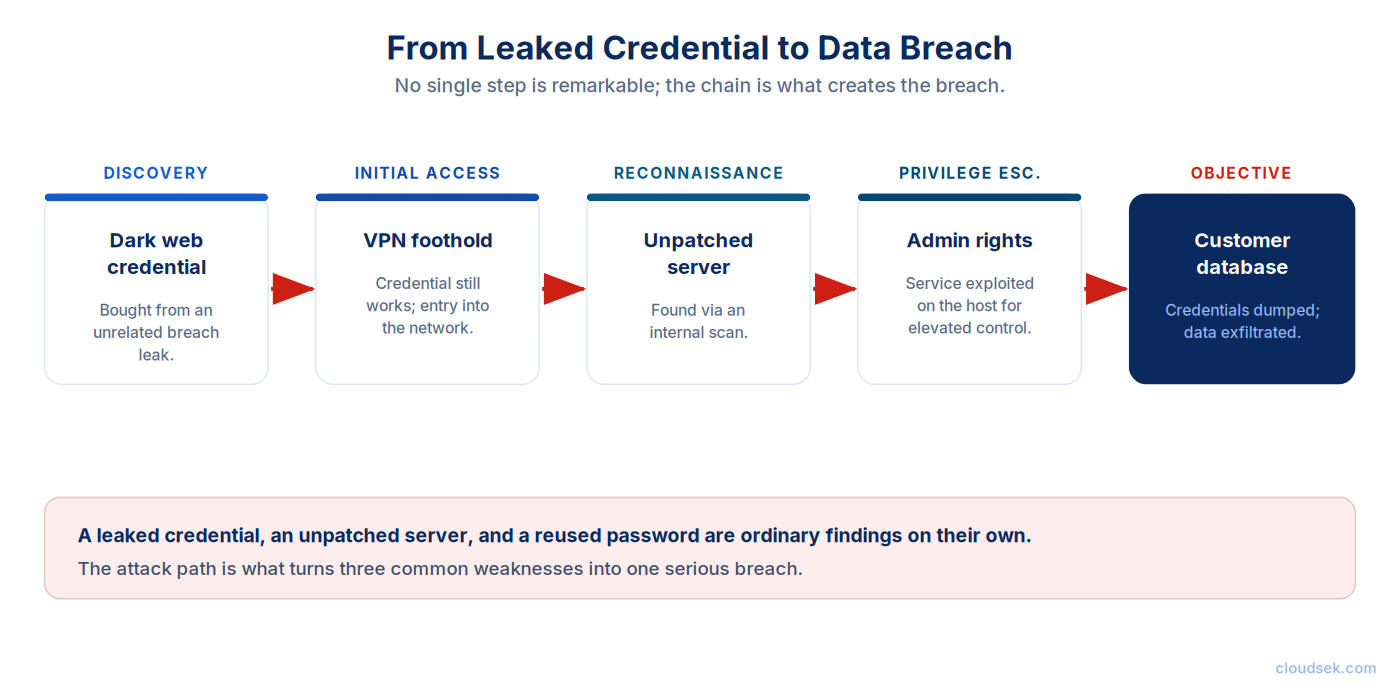
Nenhum passo isolado aqui é notável. Uma credencial vazada, um servidor sem patches e uma senha reutilizada são descobertas comuns. O caminho de ataque é o que transforma três fraquezas comuns em uma violação grave.
Os caminhos de ataque importam porque revelam o risco real de uma forma que as descobertas isoladas não conseguem. Quatro benefícios os tornam centrais para a defesa moderna.
A análise de caminhos de ataque é o processo de identificar e mapear sistematicamente as rotas que um invasor poderia seguir, conectando então fraquezas isoladas em cadeias coerentes. Começa por identificar ativos críticos e depois rastreia como um intruso poderia progredir de um ponto de entrada para esses ativos através de configurações incorretas, privilégios fracos e problemas de credenciais.
A diferença em relação à varredura de vulnerabilidades é fundamental. Um scanner produz uma longa lista de falhas isoladas sem qualquer indicação de quais se conectam. A análise de caminhos de ataque mostra como essas falhas se combinam em rotas exploráveis, substituindo o volume pelo contexto. Uma descoberta que parece de baixa gravidade isoladamente pode ser o ponto-chave de um caminho para os ativos mais valiosos.
A análise geralmente se baseia em um modelo baseado em grafos. Ativos e identidades tornam-se nós, e as técnicas que um invasor usa para se mover entre eles, como abuso de credenciais ou escalonamento de privilégios, tornam-se as arestas. Visualizar o grafo permite que os defensores tracem uma rota completa de um ponto de entrada a um alvo de alto valor e vejam exatamente onde intervir.
O gerenciamento de caminhos de ataque é a prática contínua de descobrir, mapear, validar e eliminar caminhos de ataque à medida que um ambiente muda. Onde a análise pode ser um exercício pontual, o gerenciamento a transforma em uma disciplina contínua porque cada novo usuário, sistema ou exposição pode abrir uma rota que não existia ontem.
A prática funciona como um ciclo: descobrir os caminhos, mapear como eles se conectam, priorizar os que atingem ativos críticos, remediar as etapas de maior impacto e revalidar para confirmar que o caminho foi quebrado. Mirar em pontos de estrangulamento compartilhados torna essa remediação eficiente, já que uma única correção pode romper múltiplas cadeias.
O objetivo é a durabilidade. Um ambiente seguro hoje muda à medida que cresce, portanto, o gerenciamento de caminhos de ataque mantém os caminhos quebrados ao longo do tempo, em vez de confirmar a segurança apenas uma vez. Ele reduz as rotas disponíveis para um invasor continuamente, em vez de em um único momento.
Interromper caminhos de ataque significa encontrá-los antes que um invasor o faça e quebrá-los nos pontos que mais importam. Cinco etapas formam o cerne da prática.
A maioria das ferramentas de caminho de ataque funciona dentro da rede, reproduzindo o movimento após uma suposta violação. CloudSEK Nexus AI adota a visão preditiva de fora, correlacionando sinais de risco digital, superfície de ataque externa, sistemas de IA e ecossistemas de terceiros em um grafo de ataque unificado. Ele mostra como um invasor encadearia vetores de acesso iniciais, como uma credencial vazada, um ativo exposto ou uma fraqueza de fornecedor, em uma rota real para ativos críticos, priorizando cada caminho pela explorabilidade e comportamento do invasor.
A vantagem de começar fora do perímetro é o tempo. Como o Nexus AI constrói caminhos a partir da exposição externa e da inteligência de atores de ameaça, ele revela a rota antes que um invasor a execute, incluindo cadeias que começam com uma comprometimento da cadeia de suprimentos ou um ativo externo exposto. Isso permite que as equipes de segurança quebrem a cadeia de ataque em seu elo mais fraco, em vez de reconstruí-la depois que o dano já foi feito.
Um vetor de ataque é o método ou ponto de entrada que um invasor usa para invadir, como phishing ou uma credencial roubada. Um caminho de ataque é a cadeia completa de etapas que se segue, rastreando como o invasor se move desse ponto de entrada para um ativo crítico.
Um ponto de estrangulamento é uma etapa que aparece em muitos caminhos de ataque diferentes, como uma única conta com privilégios excessivos. Como múltiplas cadeias passam por ele, remediar um ponto de estrangulamento pode interromper vários caminhos de ataque de uma só vez, tornando-o uma correção de alto valor.
A varredura de vulnerabilidades lista falhas isoladas sem mostrar como elas se conectam. A análise de caminho de ataque mapeia como essas falhas se encadeiam em rotas exploráveis para ativos críticos, revelando quais descobertas realmente importam, em vez de produzir uma lista indiferenciada.
Continuamente, ou pelo menos após qualquer mudança significativa no ambiente. Cada novo usuário, sistema ou exposição pode abrir um caminho que não existia antes, então uma análise única se torna obsoleta rapidamente à medida que a infraestrutura evolui.
As joias da coroa são os ativos mais críticos de uma organização, os alvos para os quais os caminhos de ataque levam. Incluem contas de administrador de domínio, bancos de dados sensíveis, sistemas financeiros e propriedade intelectual cujo comprometimento causaria o maior dano.
Não. Os caminhos de ataque abrangem sistemas locais, nuvem, identidade, a superfície de ataque externa e dependências de terceiros. Muitos caminhos reais começam fora do perímetro com uma credencial ou ativo exposto, então a visibilidade externa é tão importante quanto a interna.
