🚀 A CloudSEK se torna a primeira empresa de segurança cibernética de origem indiana a receber investimentos da
Leia mais
.avif)

A threat intelligence feed is a continuous stream of structured cyber threat data used to identify and prevent malicious activity. Within Cyber Threat Intelligence (CTI), such feeds support proactive detection by continuously exposing emerging risks and attack patterns.
Detection of those risks relies on Indicators of Compromise (IOCs), including malicious IP addresses, domains, URLs, and file hashes. Patterns derived from these indicators allow security systems to recognize known attack behaviors and respond to suspicious activity in real time.
Operational value increases through integration with Security Information and Event Management (SIEM) systems and Threat Intelligence Platforms (TIPs). Correlation between external threat intelligence and internal network activity strengthens detection accuracy and significantly reduces response time.
Threat intelligence feeds works through a continuous lifecycle where each stage builds on the previous one to refine and deliver usable insights.
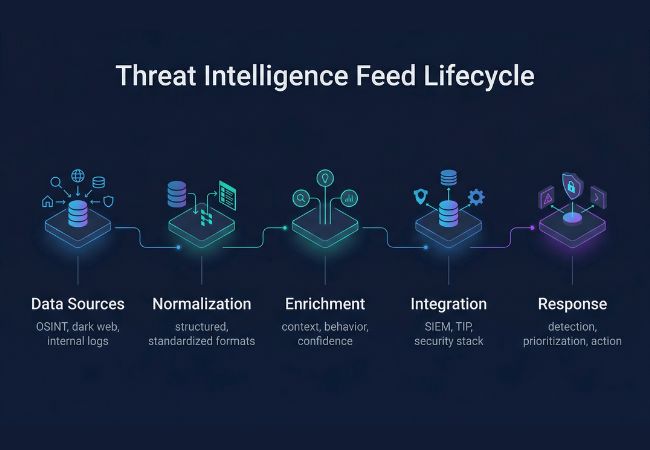
Threat intelligence platforms rely on multiple data sources that continuously supply raw inputs about attacker infrastructure, malicious activity, and emerging threat campaigns.
Public platforms such as security blogs, forums, and dark web marketplaces expose early indicators like leaked credentials, malicious domains, and exploit discussions. Unstructured information from these sources requires validation but often reveals threats before formal detection systems identify them.
Security vendors collect threat data through global sensor networks, malware analysis pipelines, and large-scale traffic monitoring. Curated outputs include verified indicators, infrastructure mapping, and attribution data linked to active threat campaigns.
Organizational environments generate continuous records through firewalls, endpoint detection systems, and network monitoring tools. Correlation of this telemetry with external indicators confirms whether identified threats are actively interacting with internal assets.
Trusted groups and sector-specific alliances distribute intelligence related to ongoing incidents and coordinated attack activity. Shared datasets improve visibility into campaign patterns targeting similar industries and environments.
Deception environments and distributed sensors capture live attack traffic, including exploitation attempts and command-and-control communication. Observed behavior provides direct insight into attacker techniques and evolving intrusion methods.
Classification of intelligence feeds depends on how information is collected, validated, and applied within security operations.

Open source feeds collect indicators from publicly available repositories, research communities, and shared threat databases. Broad coverage makes them useful for general awareness, but inconsistent validation can introduce false positives.
Commercial feeds provide curated intelligence gathered through global monitoring infrastructure, research teams, and proprietary detection systems. Verified indicators and contextual enrichment improve accuracy and support real-time security operations.
Community-driven feeds are built through information-sharing groups where organizations exchange threat indicators and incident data. Collective contributions improve visibility into sector-specific attacks and coordinated threat campaigns.
Internal feeds are generated within an organization using telemetry from endpoints, networks, and security tools. Environment-specific intelligence increases detection precision by focusing on threats relevant to internal assets.
Hybrid feeds combine multiple intelligence sources into a single stream to improve coverage and reduce blind spots. Aggregated intelligence enhances consistency by balancing broad visibility with validated insights.
Actionable security insights come from different forms of structured threat information that help identify malicious activity and understand how attacks are executed.
Known indicators such as malicious IP addresses, domains, URLs, and file hashes are widely used to detect threats. Security tools match these indicators against live activity to identify known attack infrastructure.
Unique signatures derived from malware analysis help identify malicious files and their variants. Detection engines use these signatures to recognize threats that have already been studied and classified.
Attack campaigns rely on infrastructure such as command-and-control servers, hosting services, and generated domains. Tracking this infrastructure helps uncover how attackers operate and maintain persistence.
Behavioral patterns describe how attackers gain access, move within systems, and extract data. Mapping these techniques to frameworks like MITRE ATT&CK improves understanding of attacker behavior.
Information about exploited vulnerabilities highlights weaknesses actively targeted by attackers. Awareness of these exposures allows security teams to prioritize patching and reduce risk.
Threat intelligence often includes phishing domains, email templates, and impersonation techniques used in social engineering attacks. Recognition of these patterns helps prevent credential theft and user-targeted attacks.
Additional context such as confidence levels, severity ratings, and attribution details enhances decision-making. Prioritized intelligence enables teams to focus on high-impact threats instead of low-risk noise.
Modern security operations depend on timely threat visibility to detect, prioritize, and respond to attacks before they escalate.
Continuous access to threat indicators allows security teams to identify malicious activity at an early stage. Faster detection reduces the window attackers have to exploit systems and move laterally.
Pre-collected intelligence provides immediate context during security incidents. Response teams can act quickly without spending time on initial investigation and threat identification.
Validated intelligence reduces noise by filtering out irrelevant or low-confidence alerts. Higher accuracy helps security teams focus on genuine threats instead of chasing false positives.
Awareness of emerging threats enables organizations to prepare defenses before attacks occur. Preventive measures such as blocking malicious infrastructure and patching vulnerabilities reduce exposure.
Contextual data such as severity, confidence scores, and attack patterns helps rank threats based on risk. Prioritization ensures that critical threats are addressed before less impactful ones.
Integration with security tools enables automated detection and response workflows. Automation reduces manual effort and allows faster handling of high-volume threat activity.
Continuous intelligence improves overall visibility across networks, endpoints, and applications. Better visibility leads to more informed decisions and stronger long-term security strategies.
Real-world applications span multiple security functions where threat awareness directly influences operational decisions and risk mitigation.
Centralized security teams depend on external intelligence to give meaning to alerts generated across complex environments. Context around attacker infrastructure and known campaigns helps separate real threats from routine noise.
Repeated authentication attempts from IP ranges associated with past intrusion activity often signal coordinated attacks. Quick correlation allows analysts to escalate incidents and block access before compromise deepens.
Undetected threats often remain hidden within normal network activity, requiring proactive investigation guided by intelligence inputs. Known attacker behaviors and infrastructure patterns help uncover anomalies that automated systems overlook.
Outbound connections to domains previously linked with malware campaigns can indicate early-stage compromise. Following such signals enables teams to trace attacker movement and contain threats before escalation.
Financial platforms rely on intelligence to identify infrastructure used in scams, account takeovers, and unauthorized transactions. Visibility into attacker-controlled assets allows early intervention before fraud attempts succeed.
Login attempts originating from regions tied to known phishing operations often trigger risk controls in banking systems. Blocking such access prevents unauthorized transactions and protects customer accounts.
Perimeter controls and internal safeguards use intelligence to restrict communication with malicious infrastructure. Continuous updates strengthen defenses against evolving intrusion methods and unauthorized access attempts.
Traffic directed toward command-and-control servers associated with active campaigns is often blocked at the firewall level. Disrupting that communication prevents attackers from maintaining control over compromised systems.
Email environments depend on intelligence to identify deceptive senders, malicious domains, and impersonation patterns. Recognition of these elements reduces exposure to social engineering attacks.
Messages originating from domains recently used in impersonation campaigns can be filtered before reaching users. Early filtering limits interaction with malicious content and reduces the risk of credential compromise.
Security teams evaluate vulnerabilities and threats based on real-world exploitation trends observed through intelligence. Focus shifts toward risks actively used in attacks rather than theoretical weaknesses.
A vulnerability linked to ongoing ransomware campaigns typically receives immediate attention during patching cycles. Prioritized remediation reduces the likelihood of operational disruption and data loss.
Differences between free and paid threat intelligence feeds mainly appear in data quality, timeliness, coverage, and operational reliability.
Selecting the right threat intelligence feed depends on aligning intelligence quality, compatibility, and operational requirements with the organization’s security strategy.
Reliable intelligence directly impacts how effectively threats are identified and handled. Low-quality inputs often introduce noise, making it harder to distinguish real attacks from harmless activity.
Existing security tools define how smoothly intelligence can be consumed and acted upon. Poor compatibility usually leads to manual workarounds, slowing down analysis and response workflows.
Os cenários de ameaças evoluem constantemente, tornando o tempo um fator crítico. A inteligência que chega tarde demais geralmente não consegue evitar ataques já em andamento.
Os indicadores brutos por si só raramente fornecem clareza suficiente durante as investigações. Contextos adicionais, como padrões de comportamento ou níveis de severidade, ajudam as equipes a entender o risco real por trás de cada sinal.
As decisões de gastos devem refletir o nível de exposição e a maturidade operacional da organização. Investir demais em inteligência complexa sem a capacidade de usá-la de forma eficaz geralmente leva ao desperdício de recursos.
Os feeds de inteligência de ameaças desempenham um papel central na segurança cibernética moderna, transformando sinais de ameaças dispersos em insights acionáveis que as equipes de segurança podem usar de forma eficaz. A visibilidade contínua da infraestrutura, dos padrões de comportamento e dos riscos emergentes dos invasores permite que as organizações se mantenham à frente das ameaças em evolução, em vez de reagirem após a ocorrência de danos.
O uso efetivo da inteligência depende não apenas do acesso a feeds de alta qualidade, mas também de quão bem essa inteligência é integrada e aplicada nas operações de segurança. O forte alinhamento entre inteligência, ferramentas e processos de tomada de decisão determina, em última análise, quão bem uma organização pode detectar, priorizar e mitigar ameaças.
Um exemplo comum inclui feeds que fornecem listas de endereços IP, domínios e URLs maliciosos associados a ataques cibernéticos. Os sistemas de segurança usam essas listas para bloquear ameaças conhecidas e monitorar atividades suspeitas.
A entrega normalmente acontece por meio de APIs, downloads de arquivos ou formatos padronizados, como STIX/TAXII. A integração com plataformas de segurança permite a ingestão automática e o uso em tempo real.
A precisão depende da fonte e do processo de validação por trás da inteligência. Os feeds comerciais geralmente oferecem maior confiabilidade, enquanto os feeds abertos podem exigir filtragem adicional.
Organizações menores podem usar feeds gratuitos ou de baixo custo para melhorar a visibilidade básica da segurança. A integração adequada com as ferramentas existentes ajuda a maximizar a eficácia sem grandes investimentos.
Atualizações frequentes são essenciais para acompanhar a rápida evolução das ameaças e da infraestrutura dos invasores. A inteligência em tempo real ou quase em tempo real fornece a proteção mais eficaz.
