O backdoor oculto para 200 aeroportos: uma falha na cadeia de suprimentos na aviação
Uma única credencial vazada de um fornecedor terceirizado expôs recentemente a infraestrutura digital de 200 aeroportos globais. Essa falha de segurança destaca como a falta de autenticação multifator pode comprometer sistemas críticos, incluindo reconciliação de bagagem e quiosques de passageiros. Descubra como a SviGil identificou esse backdoor antes que ele custasse bilhões ao setor.
Receba as últimas notícias, ameaças e recursos do setor.
Amruth Pothula
Security Researcher at CloudSEK
Hansika Saxena
Product Manager at CloudSEK with a background in cyber threat intelligence and a focus on user experience. She bridges research with product design to shape solutions that are intuitive and impactful.
Airports depend on a network of common-use operational systems to manage passenger movement, baggage reconciliation, check-in devices, kiosks, and terminal workflows. These platforms — run by specialised technology vendors — serve as shared digital infrastructure across continents. For operational efficiency, vendors and contractors are often given direct system access, creating a distributed trust model that is only as strong as its weakest participant.
It was within this model that a single leaked credential became a global incident waiting to happen.
The Discovery: A Password That Opened 200 Doors
While routinely monitoring for threats, SVigil identified that login credentials for a European fourth-party airport service portal were being circulated on underground forums. These credentials unlocked operational dashboards used at airports around the world.
Here’s the breakdown:
The Airport hires a Primary Aviation IT Vendor to manage its core operations.
This Primary Vendor then sub-contracts parts of its IT operations and maintenance to a different Third-Party Maintenance Firm.
This makes the maintenance firm a 4th-party to the original airport.
The breach itself was dangerously simple:
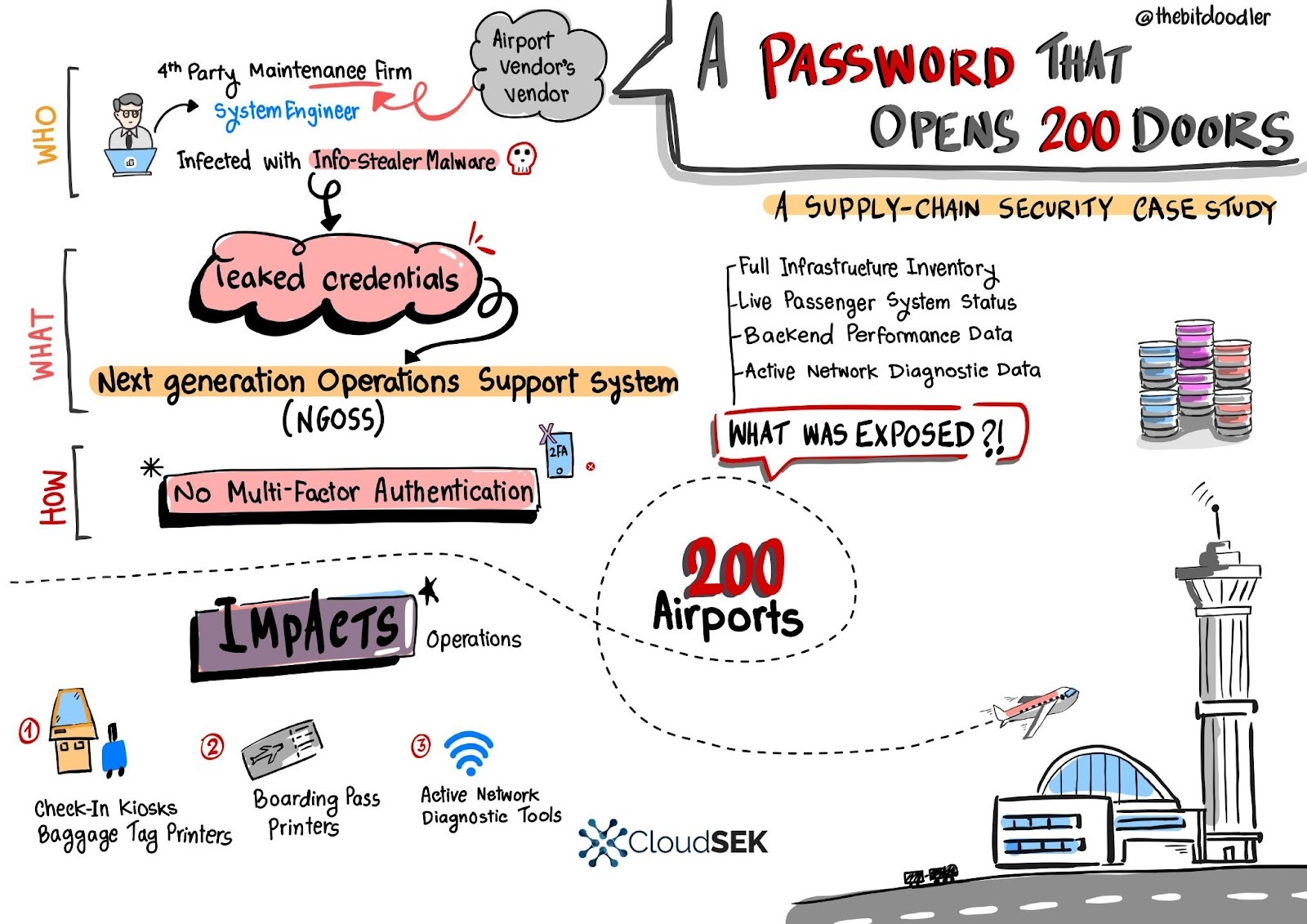
The "Who": A system engineer at this 4th-party maintenance firm had their credentials (a simple username and password) leaked and posted on a dark web forum.
The "What": These credentials (a simple username and password) were the only keys needed to access the primary vendor's main Next Generation Operations Support System (NGOSS) portal.
The "How": The portal, which served as the central control panel for over 200 client airports, lacked Multi-Factor Authentication (MFA).
No breach occurred — but the potential for one was immediate and severe.
Technical Analysis: What Was Exposed?
This wasn't just a view into a single server. It was a complete, real-time map of the entire operational ecosystem for hundreds of airports. Access was leaked to:
Full Infrastructure Inventory: Every server, switch, and core manager, complete with internal IP addresses, hostnames, and device roles (e.g., BHS-SVR-02 for Baggage Handling).
Live Passenger System Status: Real-time dashboards showing the online/offline/error status of every single check-in kiosk, boarding pass printer, and baggage tag printer.
Backend Performance Data: Live CPU, memory, and disk usage for critical servers. This even included performance metrics for the MSSQL and PostgreSQL databases running the passenger service applications.
Active Network Diagnostic Tools: The portal allowed the user to run live "Ping" and "Trace Route" commands from inside the trusted airport network—a perfect tool for launching internal Denial-of-Service (DoS) attacks.
How Attackers Could Weaponise Such Access?
With no malware, ransomware, or phishing required, an attacker holding operational credentials could weaponize the environment in multiple, high-impact ways. Below are the realistic attack scenarios, the immediate operational outcomes, and conservative financial loss estimates (with the assumptions used).
Attack Scenario
Operational Outcome
Cyber Risk Quantification
Targeted Kiosk / Terminal DoS
Attackers use live dashboards to identify
busiest self-service kiosks
at a terminal during peak hours and
repeatedly trigger diagnostics / flood
connectivity, rendering kiosks and associated CUSS/CUPPS stations
unavailable for 6 hours.
Approximately
$3.5M to $10M
Baggage Reconciliation System (BRS) Outage
Attackers identify and disrupt the BRS servers (via inventory data),
preventing verification of bag-to-flight mappings. Regulatory requirements
prevent departures without verification → widespread flight groundings.
Approximately
$12M to $30M+
Coordinated Multi-Hub Attack
Using the same leaked credentials and inventory mapping, attackers coordinate
simultaneous internal network DoS attacks against central managers at multiple
major hubs (e.g., 5–10 global hubs), causing system-wide outages and
a global travel ripple.
Hundreds of millions to over $1B
Business Impact: Where Operations and Revenue Collide
Aviation is an industry where minutes equal money, and availability equals safety. If exploited, the leaked access could have triggered a chain of failures cutting across core airport business KPIs:
Operational Disruption
Slowed or stalled check-ins, boarding, and baggage handling
Terminal throughput collapse due to kiosk and workstation outages
Increased MBR (Mishandled Baggage Rate) from reconciliation failures
Revenue & SLA Impact
Breach of OTP (On-Time Performance) metrics → airline penalty payouts
Loss of aeronautical and non-aeronautical revenue (retail, E-gates, lounges)
Compensation obligations due to passenger delays and baggage incidents
Regulatory & Safety Escalation
Non-compliance with aviation cybersecurity mandates (ICAO, regional regulators)
Mandatory audits, financial penalties, or grounding of affected systems
Reputational Damage
Headlines about “airport systems compromised” — even if only via a vendor
Loss of public confidence in digital aviation systems
Recommendations
This incident was a wake-up call. Immediate mitigation involved revoking the credentials, enforcing an emergency MFA rollout, and auditing all third-party accounts.
But the strategic lessons are what matter most for every business:
MFA is Non-Negotiable: Any partner, vendor, or internal system with administrative access to critical operations must be protected by Multi-Factor Authentication. The potential cost of an outage (tens of millions) dwarfs the cost of MFA implementation.
Enforce Vendor Zero Trust: Never trust, always verify. Third-party access should be granular, temporary (Just-in-Time), and limited only aos sistemas específicos que eles precisam atender.
Auditoria de credenciais: Inicie uma auditoria completa e uma rotação forçada de senhas para todas as contas de terceiros e fornecedores com acesso privilegiado.
Audite sua cadeia de suprimentos: Você não pode simplesmente confiar nas declarações de segurança de um fornecedor. Você deve realizar avaliações ativas de risco de seus fornecedores essenciais e das plataformas que eles fornecem.
Essa violação não se tratava apenas de uma senha. Tratava-se de uma falha de confiança e falta de controles básicos de segurança que quase custaram bilhões à indústria da aviação.
A vantagem do SviGil: proteger a pista antes que a interrupção ocorra
Esse incidente reforça uma verdade crítica sobre a aviação moderna: os aeroportos são tão seguros quanto os sistemas de terceiros que os mantêm funcionando. A exposição de uma única credencial vinculada a quase 200 aeroportos mostra como a maior vulnerabilidade do setor não é a tecnologia em si, mas confiança sem verificação.
A aviação moderna não pode ser protegida aeroporto por aeroporto. Deve ser protegido cadeia por cadeia, link por link — porque quando a cadeia de suprimentos enfraquece, toda a pista treme. Ao identificar essa exposição antes de ser transformado em arma, a SVigil ajudou a evitar a possibilidade de paralisia do check-in, falhas no sistema de bagagem, perdas financeiras e interrupções em cascata nos centros globais.
Em um setor em que minutos custam milhões e disponibilidade é o produto, a detecção precoce é a diferença entre resiliência e caos.
A prevenção não é apenas melhor — na aviação, não tem preço.
Sobre o CloudSEK
O CloudSEK é uma plataforma digital unificada de gerenciamento de riscos que aproveita a IA e o aprendizado de máquina para fornecer inteligência de ameaças em tempo real, monitoramento da superfície de ataque e segurança da cadeia de suprimentos em empresas em todo o mundo.
Inscreva-se nos recursos do CloudSEK
Receba as últimas notícias, ameaças e recursos do setor.
.avif)