🚀 CloudSEK featured in the 2026 Frost Radar™!
Read more
.avif)

Subscription bombing is a cyberattack in which an adversary signs a victim's email address up to thousands of newsletters and registration forms at once. Legitimate confirmation messages then flood the inbox, burying a critical alert the victim was meant to see. Subscription bombing costs the attacker almost nothing and costs the victim the one email that mattered.
Researchers writing in Communications of the ACM analyzed 24 real subscription bombing campaigns and found bombing services openly sold on dark web forums, concluding the attack is technically simple to launch and disproportionately difficult for victims to mitigate.
Subscription bombing goes by several names: email bombing, list bombing, list linking, and subscription flooding all describe the same technique. Every variant exploits one design flaw: countless signup forms send a confirmation email to any address entered, with no proof the owner asked.
Classification matters for defense. The US Health Sector Cybersecurity Coordination Center classifies email bombing as a denial-of-service attack that renders a mailbox useless so victims miss sign-in attempts, contact-detail changes, and financial transaction alerts, and it warns that healthcare organizations are actively targeted.
Precedent for the technique runs back to 2016, when a mass campaign flooded thousands of .gov addresses through exactly this list-linking method. Denial of service here targets attention rather than servers. Mail infrastructure keeps running throughout the attack, and the victim's ability to notice one specific message is what fails.
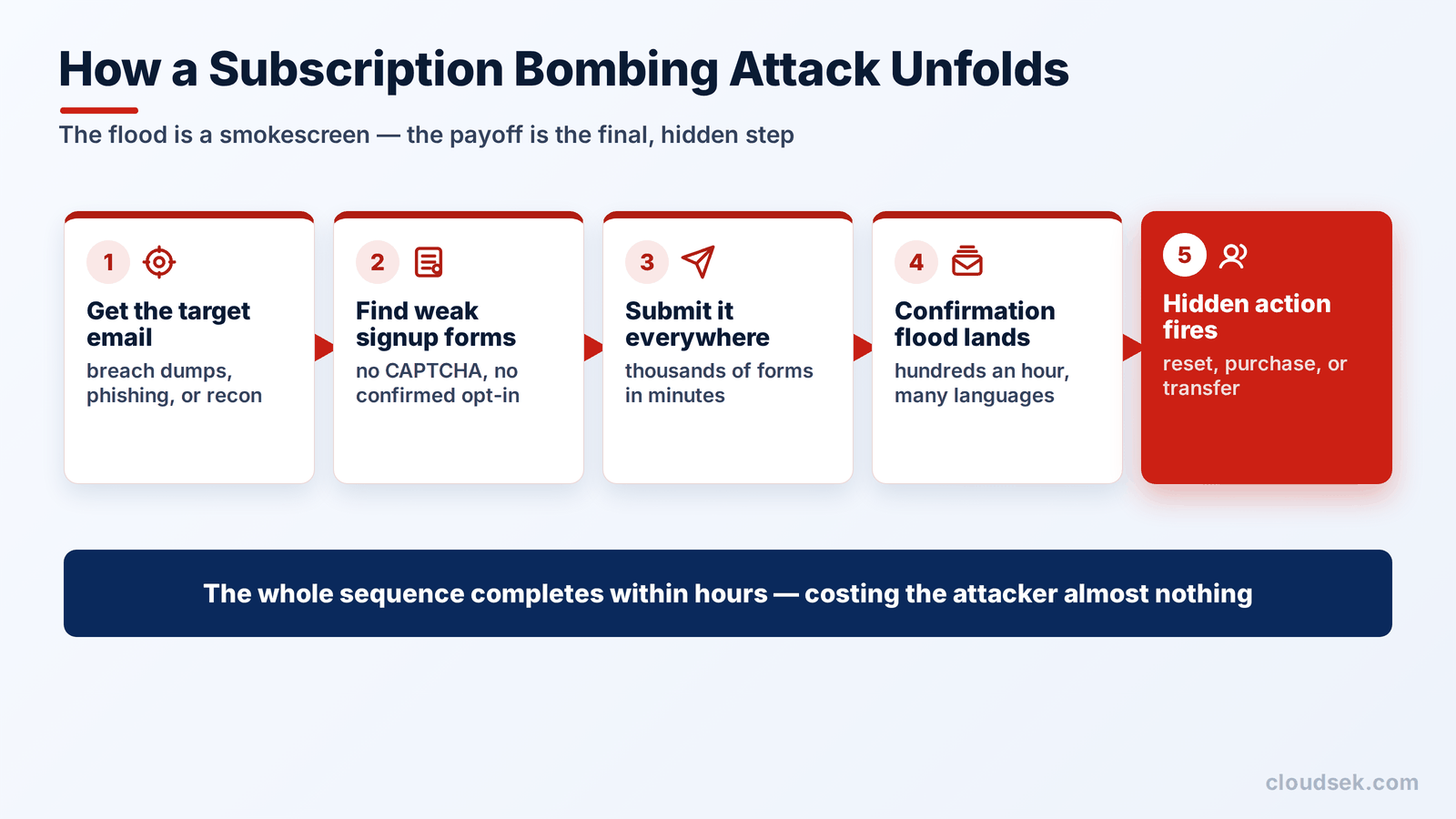
A subscription bombing attack works through five steps, and the whole sequence completes within hours.
Subscription bombing is a smokescreen, not the crime itself. Four alert categories are the usual targets, and each one follows from an account takeover that leaked credentials enabled days or weeks earlier.
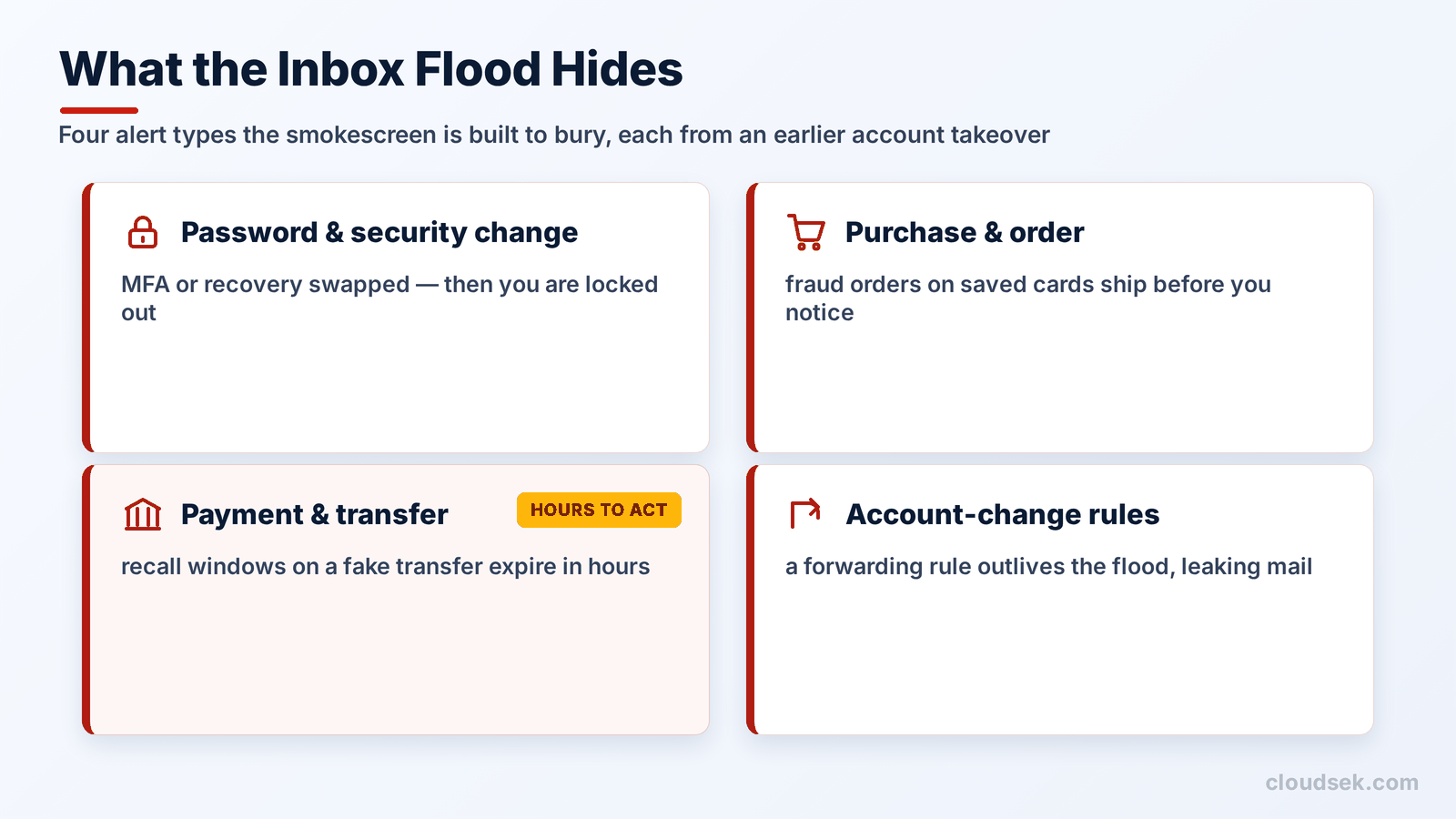
Notices that a password, recovery number, or MFA method changed read as routine housekeeping until the victim is locked out. Burying this class of alert buys the attacker uninterrupted control of the account during the hours that matter.
Receipts for fraudulent orders placed with stored payment details sink into the flood until the goods ship. Retail accounts with saved cards and gift-card balances are the routine targets.
Bank notifications of wire transfers, payee additions, and card transactions the victim never made carry tighter response windows than any other category. Recall rights on a fraudulent transfer expire in hours, which is exactly the interval the flood consumes.
Email forwarding rules, address updates, and payroll or deposit redirections reroute value quietly. A forwarding rule in particular outlives the flood, leaking every future message to the attacker after the inbox returns to normal.
Enterprise cases escalate past concealment into direct contact. Microsoft documents a multi-stage pattern in which ransomware operators bomb an employee's inbox, then pose as IT support on Teams offering to fix the spam problem, walking the victim into installing remote-access tools. Defender now ships named detections for mail-bombing activity and for suspicious Teams contact following a flood, which shows how established the pattern has become.
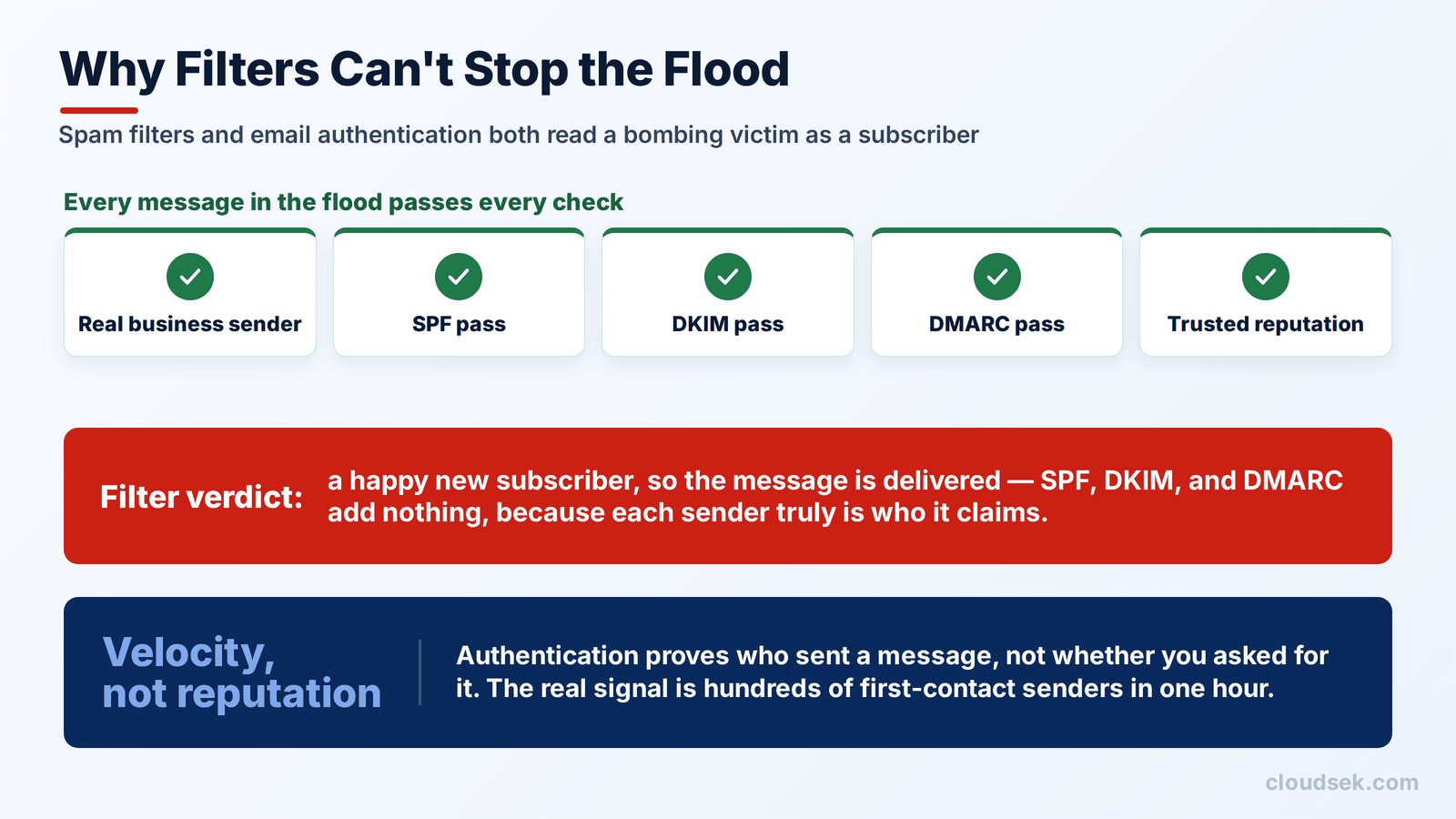
Spam filters miss subscription bombing because every message in the flood is genuinely legitimate. Each confirmation comes from a real business, sent through reputable infrastructure, passing SPF and DKIM checks, and a reputation-based filter sees an enthusiastic subscriber rather than a victim.
Email authentication offers no remedy for the same reason. SPF, DKIM, and DMARC verify that a sender is who it claims to be, and the senders in a bombing attack are exactly who they claim to be. Defense therefore depends on velocity and behavior signals, such as hundreds of first-contact senders in an hour, rather than on sender reputation.
Four signs separate a bombing attack from ordinary newsletter clutter.
To respond to subscription bombing, treat the flood as an active fraud signal rather than a spam problem, and work through six steps in order.
Prevention splits across the two parties the attack exploits, and each controls a different half of the problem.
Individuals reduce exposure through address strategy. Unique aliases per service keep the primary address out of breach dumps, and a separate address reserved for banking keeps financial alerts out of any flood. App-based MFA on high-value accounts adds the deeper layer, making a concealed password reset fail regardless of whether its notification is seen.
Site owners control the root cause. Confirmed double opt-in stops forms from mailing unverified addresses, CAPTCHA and rate limiting price out bot submission, and both protect the business itself, since bombed forms burn sender reputation and land legitimate mail in spam.
Incentives cut against fixes, as the ACM researchers note, since services measuring success in signup counts resist adding friction. Exploitable forms therefore stay in ready supply, visible to anyone running dark web monitoring across the markets where bombing services and form lists trade.
Three sibling techniques apply the same flooding logic to different channels.
Is subscription bombing illegal?
Yes, subscription bombing is illegal in most jurisdictions. Prosecutors charge it under computer misuse and harassment statutes, and the fraud it conceals carries its own separate charges.
How long does a subscription bombing attack last?
A subscription bombing attack lasts from a few hours to several days in observed campaigns, with residual newsletter volume continuing for weeks as unconfirmed lists keep mailing.
Does marking the emails as spam stop subscription bombing?
No, marking the emails as spam does not stop subscription bombing. Each message comes from a different legitimate sender, so per-sender spam reports never catch up with the flood.
Are the newsletter companies behind the attack?
No, the newsletter companies are not behind the attack. Their signup forms are abused as unwitting delivery infrastructure, and the flood damages their sender reputation as collateral.
Can victims trace who launched a subscription bombing attack?
No, victims rarely can trace who launched a subscription bombing attack because it routes through bots and proxies.
What is double opt-in and why does it matter?
Double opt-in is a signup process requiring the address owner to click a confirmation link before any mail flows, and it matters because forms using it send a bombing victim one email instead of hundreds.
