🚀 CloudSEK featured in the 2026 Frost Radar™!
Read more
.avif)

Key Takeaways:
Cloud Infrastructure Entitlement Management (CIEM) is a cloud security capability that helps organizations discover, analyze, and govern permissions across cloud environments. These permissions, known as cloud entitlements, determine what actions identities are allowed to perform across services, accounts, and environments.
In cloud-native setups, automation, shared services, and rapid scaling gradually create complex permission structures that are hard to track and even harder to validate. CIEM brings clarity to this complexity by showing how access is actually structured and where permissions quietly expand beyond what day-to-day operations require.
Clear and continuous control over entitlements allows organizations to reduce security exposure without slowing down cloud usage. Through ongoing visibility and alignment with least-privilege principles, CIEM helps keep access appropriate as cloud environments evolve and change.
Cloud security today depends heavily on controlling permissions, making visibility into entitlements essential for reducing risk in modern cloud environments.
Scale is the first reason manual permission review stopped working. Every service, function, container, and pipeline in a cloud environment carries its own identity, and those identities vastly outnumber the people using the platform.
Research published by the Cloud Security Alliance put non-human identities at roughly 45 times the number of human users across enterprise environments, rising to about 144 to 1 in cloud-native estates, up from 92 to 1 a year earlier. Gartner has estimated that 88% of users and roles in the cloud are machine identities rather than people.
Permission sprawl follows from how cloud access gets granted. Broad policies are attached during a deployment to unblock a team, inherited roles compound across accounts, and temporary access outlives the project that needed it. Gartner has estimated that around 80% of accounts in cloud infrastructure sit inactive, each one retaining whatever permissions it was granted.
Adoption of AI agents sharpened the problem further during 2026. Surveys published that year found that 70% of organizations grant AI systems more access than they would give a human doing the same job, while only 44% have implemented any policy for governing those agents. Every one of those agents authenticates as a cloud identity holding entitlements nobody reviews.
CIEM operates as a continuous loop across four stages, each depending on the one before it.
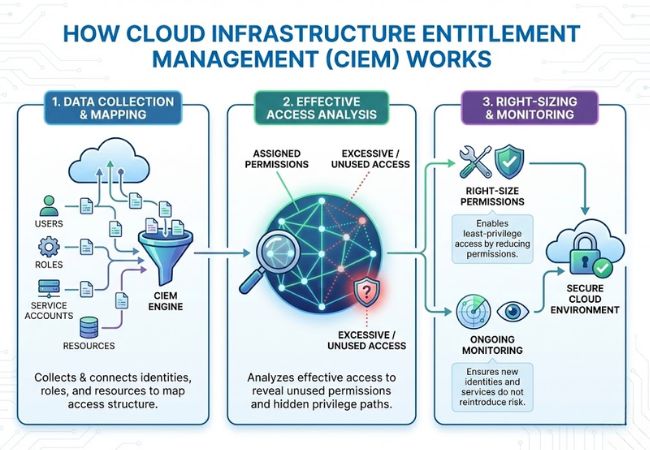
Stage two is what distinguishes CIEM from configuration tooling. A role named read-only that inherits write permissions through a group and can assume a second role across accounts is not read-only in practice, and only effective-access analysis surfaces that.
A CIEM solution is composed of multiple tightly connected components that work together to manage, analyze, and control cloud permissions at scale.
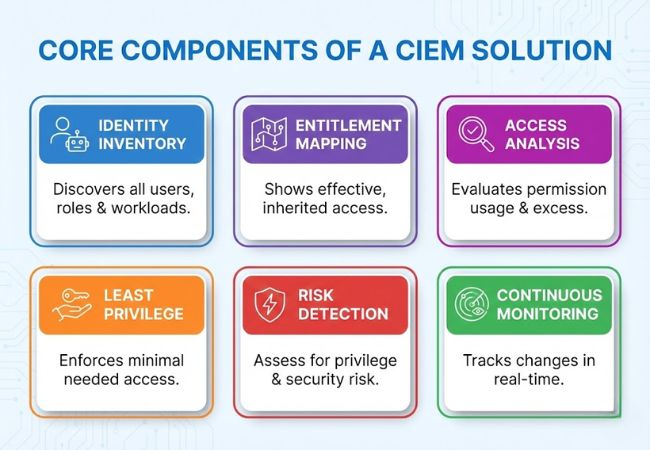
Discovery covers every identity able to reach cloud resources: human users, IAM roles, service accounts, workload identities, CI/CD pipeline credentials, and serverless execution roles. Non-human identities matter most here, because they hold persistent permissions and nobody offboards them when a project ends.
Permissions are mapped across services, accounts, and resources to show how access is granted and inherited. The output is a graph rather than a list, since cloud access travels through group membership, role assumption, resource policies, and cross-account trust.
Access Analysis resolves what an identity can genuinely do after every policy is evaluated together, then compares that against what it has actually done. The gap between the two is the permission creep index, a standard CIEM metric expressing the ratio of unused to used permissions.
Ranking findings by exploitability rather than by volume is what keeps the output usable. Privilege escalation paths, identities able to modify their own permissions, publicly exposed workloads holding administrative roles, and dormant accounts with production access carry more weight than a long list of unused read permissions.
Replacement policies get generated from observed usage rather than from an administrator’s estimate. Mature implementations pair this with just-in-time access, granting elevated permissions for a defined window and revoking them automatically rather than leaving standing privilege in place.
Cloud environments change through automation, so entitlement posture drifts between reviews. Continuous monitoring detects new identities, modified policies, and newly created escalation paths as they appear.
Each of these addresses a different control layer, which is why organizations run several together rather than choosing between them.
Where IAM grants access, CIEM examines what those grants actually produce once policies, inheritance, and trust relationships combine.
Configuration, privileged accounts, and workloads each need their own control, and none of them resolves cloud entitlement risk.
CWPP and CIEM intersect at the point that matters most. A container carrying a critical vulnerability is a problem, and the same container holding administrative cloud permissions is an incident, because the vulnerability becomes a path to everything those permissions reach.
Each provider models identity differently, so effective-access analysis has to account for three separate permission systems before it can present a single view.
Access in AWS runs through IAM users, roles, identity-based and resource-based policies, permission boundaries, and service control policies at the organization level. Effective access requires evaluating all of these together, and role assumption chains across accounts produce reach that no single policy document reveals.
Azure combines role-based access control with Microsoft Entra ID identities, and assignments inherit down through management groups, subscriptions, resource groups, and individual resources. Analysis has to trace that hierarchy, since a role assigned at management group level applies to everything beneath it.
Google Cloud grants access through IAM bindings that attach roles to principals at organization, folder, project, or resource level. Service account impersonation adds a further layer, letting one identity act as another and extending reach beyond its direct bindings.
Organizations running more than one provider face three permission vocabularies describing similar concepts differently. CIEM normalizes entitlement data into a common model, which makes it possible to apply one least-privilege standard rather than maintaining separate reviews per platform.
Permission risk stays theoretical until a credential leaks, and then the blast radius equals whatever that identity was allowed to do. CloudSEK’s BeVigil team documented the pattern at a recruitment services provider, where a single unauthenticated API endpoint vulnerable to SQL injection exposed 45 databases and more than 240 S3 buckets. The finding chained toward remote code execution, and the IAM credentials reachable from that position would have permitted lateral movement across the entire AWS environment.
That reach came from what the associated identities were permitted to do, not from the severity of the flaw itself. Right-sized permissions would have contained the same vulnerability to a single service. Overly permissive IAM roles and misconfigured storage remain among the leading causes of cloud data breaches, and entitlement analysis is what separates the two outcomes.
Security, platform, and compliance teams apply entitlement management to five recurring problems.
Of those five, zero trust depends on entitlement management most directly. Applying zero trust principles to cloud infrastructure means verifying every access request against current context, and standing entitlements that nobody reviews are precisely the implicit trust the model exists to remove.
Tools that genuinely reduce entitlement risk differ from tools that produce inventory reports nobody acts on, and seven criteria draw the line.
Standalone CIEM products are becoming less common as the capability moves inside broader platforms. Analysis of the category notes that Gartner, which defined the CNAPP category, has documented a shift toward consolidation, with CIEM increasingly delivered as a module within cloud-native application protection platforms rather than as a separate purchase.
Consolidation follows from how these tools work rather than from vendor packaging. CSPM, CIEM, and CWPP all build graphs of cloud resources and relationships, so combining them removes duplicate data collection and produces context none of them holds alone. An over-permissioned identity matters more when it attaches to a publicly exposed workload running vulnerable software, and only a combined view establishes that.
Buyers evaluating entitlement management therefore need to check whether a platform already in place covers the requirement. Gartner guidance is explicit that CIEM complements rather than replaces full identity governance and privileged access management, particularly where legacy and on-premises resources remain in scope.
Knowing what an identity is permitted to do answers only half the question. A separate one determines whether anyone outside the organization already holds that identity, and internal tooling cannot see it. CloudSEK BeVigil scans the external attack surface across eight surfaces, including cloud, detecting misconfigured storage, exposed APIs, and hardcoded keys in public code and mobile application binaries.
Neither half is worth much without the other. A right-sized permission set limits damage from a leaked key, and knowing the key leaked determines whether anyone rotates it. XVigil covers the second half by tracking leaked credentials across dark web sources, paste sites, and repositories, while external attack surface management supplies the asset inventory that both depend on.
What none of this does is perform the entitlement analysis itself. Policy evaluation, effective-access computation, and right-sizing remain the work of a CIEM or CNAPP platform, and external exposure intelligence tells that platform which identities need attention first.
Entitlement sprawl is the accumulation of unused, excessive, and forgotten permissions across cloud identities over time, caused by broad grants, role inheritance, and access that outlives its purpose.
Yes. Permission sprawl comes from scale and automation rather than from multiple providers. A single large AWS estate accumulates escalation paths and dormant identities the same way.
No. CIEM analyzes entitlements across all cloud identities. PAM controls sessions and credentials for privileged accounts, including on-premises systems that CIEM does not cover.
A CIEM metric expressing the ratio of permissions an identity holds to permissions it actually uses. Tracking it monthly shows whether right-sizing efforts are reducing exposure.
Rarely. CIEM targets cloud infrastructure entitlements in AWS, Azure, and GCP. SaaS permissions fall to identity governance tools or dedicated SaaS security posture management.
Agents authenticate as service accounts or workload identities, so CIEM analyzes them like any non-human identity. Coverage depends on the agent using cloud-native credentials rather than embedded static keys.
Cloud entitlement risk accumulates through ordinary work rather than through negligence. Teams grant broad access to ship a release, inherit permissions through group structures nobody designed, and create identities faster than any review cycle examines them.
Progress comes from treating entitlements as a live control rather than a periodic audit. Effective access gets computed rather than assumed, standing privilege gets replaced with time-bound elevation where the workflow allows, and non-human identities receive the same scrutiny as the human ones that make up a small fraction of the estate. Organizations that reach that point contain incidents that would otherwise have reached everyone.
