🚀 CloudSEK featured in the 2026 Frost Radar™!
Read more
.avif)

A dark web leak site is a website, typically hosted on the Tor network, where a ransomware or extortion group names its victims and publishes their stolen data to force payment.
Security teams call these sites data leak sites (DLS) or "name and shame" sites.
Not every listing on a leak site is real. CloudSEK's investigation of the Bashe ransomware group found it posting recycled data as new breaches, including a 2019 Malindo Air passenger leak relisted in January 2025.
Most ransomware leak sites share the same building blocks, because each one exists to make the threat of publication feel real and urgent.
The front page lists victim organizations with their logo, website, industry, country, and a short description of the stolen data. New listings appear at the top, so the page works as a public scoreboard for the group.
Each victim listing carries a payment deadline, which many groups display as a live countdown timer. When it reaches zero, the group publishes the data or puts it up for sale.
Groups post a small set of stolen files, such as passport scans, invoices, or screenshots of internal folders. The samples prove access to the victim and to anyone watching, including journalists and regulators.
Many groups run a private chat page reached through a unique link in the ransom note. Victims negotiate there, separate from the public listing.
After the deadline, the group releases the full archive as direct downloads, torrent files, or links to file-sharing services. Copies spread to mirrors and criminal forums within days.
Leak sites are the second half of double extortion, where attackers steal data before encrypting systems. A typical sequence runs like this:
Some groups add a third lever, such as DDoS attacks or direct contact with the victim's customers. CloudSEK explains this in its guide to triple extortion.
Leak sites turned ransomware from a decryption business into a data extortion business. Three milestones shaped how they work today.
In November 2019, the Maze group published almost 700 MB of data stolen from security staffing firm Allied Universal after a missed ransom deadline.
BleepingComputer reported it as the first known case of ransomware operators releasing stolen data. Maze soon launched a dedicated site to list victims.
By 2020, most major ransomware-as-a-service operations were running a leak site of their own. Operators host the site, and affiliates feed it victims, so the listing count doubles as advertising to recruit new affiliates.
Police began taking over leak sites to disrupt groups and warn victims. The FBI seized Hive's sites in January 2023, and the US Justice Department disrupted BlackCat (ALPHV) in December 2023.
In February 2024, the UK's National Crime Agency took control of LockBit's leak site in Operation Cronos. The agency found data from victims who had paid, proof that payment does not guarantee deletion.
Dark web leak sites are curated platforms where attackers upload and showcase stolen data to pressure victims or to sell information to other criminals. These sites operate behind anonymity networks, making them difficult to detect or dismantle.
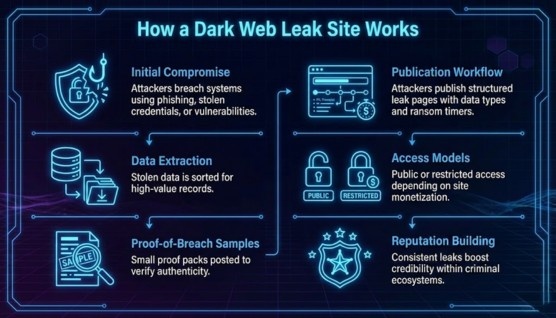
Attackers breach networks using phishing, credential theft, or vulnerabilities and exfiltrate large volumes of data. The stolen information is sorted to identify high-value records that enhance extortion pressure.
Threat actors post small “proof packs” to demonstrate the authenticity of the stolen data. These samples are deliberately chosen to alarm victims and signal credibility to criminal buyers.
Once samples are verified, attackers publish structured pages listing affected data types, ransom demands, and countdown timers. Negotiation links and communication channels are often included for pressured discussions.
Some leak sites are fully public while others require invitations or payment to view full dumps. Restricted models allow operators to monetize access and maintain selective visibility.
Consistent leaking of high-value data increases a group’s status within criminal ecosystems. Strong reputations attract affiliates and amplify the psychological impact on victims.
Attackers publish data that maximizes leverage, financial value, and long-term harm to victims. The following categories represent the most frequently exposed datasets.
Names, addresses, IDs, and contact information enable identity theft and targeted phishing. PII remains one of the most liquid assets in cybercrime markets.
Banking documents, invoices, and payment details support fraud and money-movement schemes. Regulatory actions often follow leaks of financial data.
User passwords, admin credentials, API keys, and access tokens are commonly exposed. These enable deeper system compromise and lateral movement.
Source code, R&D files, designs, and proprietary business documents are published to damage competitive standing. Leaked IP can have long-term strategic consequences.
Emails, HR files, contracts, and incident reports create reputational harm and operational risk. Internal records often reveal sensitive context attackers exploit.
Attackers merge multiple data types (e.g., credentials + PII) to increase effectiveness in fraud campaigns. These combinations escalate downstream risk for individuals and businesses.
Cybercriminals rely on leak sites to increase negotiation leverage during extortion. Public exposure of sensitive data often forces victims to reconsider paying.
Leak sites also serve as reputation tools for threat actors seeking credibility within criminal communities. A visible track record of successful leaks helps attract affiliates and partners.
Additionally, publishing data demonstrates technical capability, which strengthens a group’s standing in the ransomware ecosystem.
Leak sites get confused with several other places where stolen data appears online. Each one serves a different purpose and calls for a different response:
No. Leak site claims are statements by criminals, and some groups inflate or invent them to build a reputation or attract affiliates.
CloudSEK's analysis of Bashe, a group tracked as APT73, found at least five recycled or fabricated listings between December 2024 and January 2025:
False listings still cause harm, because customers, journalists, and regulators react before anyone checks the data.
Early detection provides critical lead time to contain incidents before public exposure escalates harm.
Effective tools must scan TOR, I2P, private forums, marketplaces, and foreign-language sources. Comprehensive coverage increases detection accuracy.
Continuous scanning identifies exposed usernames, passwords, and tokens. Rapid resets prevent secondary compromise.
Correlating leak indicators with internal logs improves prioritization. Contextual threat intelligence enhances triage quality.
Embedded decoy files and tokens reveal unauthorized access attempts. These early signals alert teams to exfiltration events.
Human validation reduces false positives and uncovers hidden context. Skilled analysis strengthens decision-making.
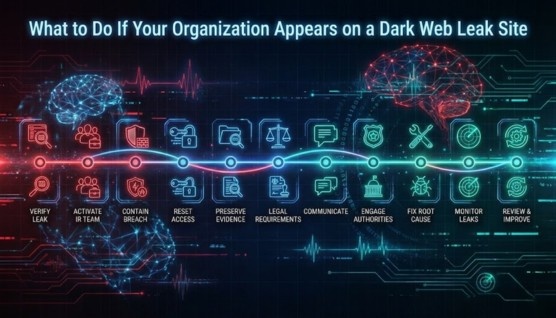
A listing deserves fast, careful verification before anyone announces a breach or opens negotiations. Security teams follow these steps:
Once a listing is confirmed or likely, the response runs on legal deadlines as well as technical ones. These steps keep the response orderly:
Strong preventive controls reduce the likelihood of a breach leading to a public leak. The following areas offer high-impact resilience.
Implement MFA, least privilege, and strict role-based access. Regularly audit privileged accounts for misuse.
Prioritize patching high-risk systems and reduce exposure time through automated workflows. Attackers frequently exploit unpatched vulnerabilities.
Encrypt sensitive data at rest and in transit to reduce its value if exfiltrated. Use tokenization for high-risk fields.
Limit lateral movement with micro-segmentation and zero-trust principles. Segmented environments shrink the blast radius of a breach.
Apply secure coding practices, dependency scanning, and pipeline hardening. Vendor risk reviews strengthen supply-chain integrity.
Educate staff on phishing, impersonation, and data-handling risks. Simulated campaigns reinforce awareness.
Maintain immutable backups with regular recovery testing. This reduces leverage during ransomware negotiations.
Leak site monitoring covers much more than searching for an organization's own name. Security teams watch for:
Monitoring works best as part of a wider dark web monitoring program that covers criminal forums and marketplaces as well as leak sites.
When a supplier appears on a ransomware leak site overnight, the security team needs answers fast. It needs to know which group posted the listing, what that group publishes, and whether its claims hold up.
CloudSEK Threat Intelligence delivers live alerts on global ransomware activity, with impact assessments and visibility into the sectors and victims being targeted. Teams use it to spot listings that involve their organization, suppliers, or peers, and to judge a group's track record before responding.
It depends on the jurisdiction. Viewing a site is legal in many countries, but downloading or using stolen personal data can break data protection and computer misuse laws.
No, not reliably. Leak sites ignore takedown requests, and mirrors and forum reposts keep data available after the original listing disappears.
It changes every month. Dozens are active at any time, as groups launch, rebrand, shut down, or lose their sites to police.
It varies by group. Most listings stay up until the site goes offline, and copies of published data circulate on forums for years.
Yes, indirectly. Organizations that confirm a leak notify affected people, and breach notification services alert users when their email addresses appear in leaked datasets.
