🚀 CloudSEK featured in the 2026 Frost Radar™!
Read more
.avif)

Attack Surface Management identifies and monitors all assets exposed to risk on the other hand Vulnerability Management identifies, assesses, and fixes the weaknesses within those assets. The two disciplines solve different parts of the same problem, and most mature security programs run them in parallel.
ASM focuses on complete asset visibility across internal and external environments. It discovers known, unknown, and unmanaged systems to reveal every possible entry point. Vulnerability Management focuses on the security weaknesses inside those assets, scanning systems, prioritizing flaws based on risk, and applying patches or configuration changes to close them. ASM defines what exists and what is exposed; Vulnerability Management removes the weaknesses within what ASM finds.
Attack Surface Management is a continuous process that discovers, tracks, and analyzes every asset connected to an organization, including the unknown and unmanaged systems that fall outside official inventories. Its scope covers internal and external assets such as servers, applications, cloud services, domains, endpoints, and shadow IT.
The discipline is built around visibility and exposure. It identifies where assets exist and how each one is reachable by attackers, producing a continuously updated asset inventory with exposure context. That inventory is what every other security control (vulnerability scanning, monitoring, incident response) depends on, because no team can defend an asset it does not know it owns.
Vulnerability Management is the process of scanning systems for security flaws (outdated software, misconfigurations, known CVEs), evaluating each one based on risk, and remediating it through patches, configuration changes, or compensating controls. It works on known and managed assets: servers, applications, databases, and network devices that are already tracked in the organization's inventory.
The focus is detection and remediation. Vulnerability Management ranks issues by severity and exploitability, then drives the patching workflow that closes them. The outcome is a measurable reduction in the number of vulnerabilities present across known systems.
ASM and Vulnerability Management solve different parts of the same problem, and using one without the other creates predictable gaps.
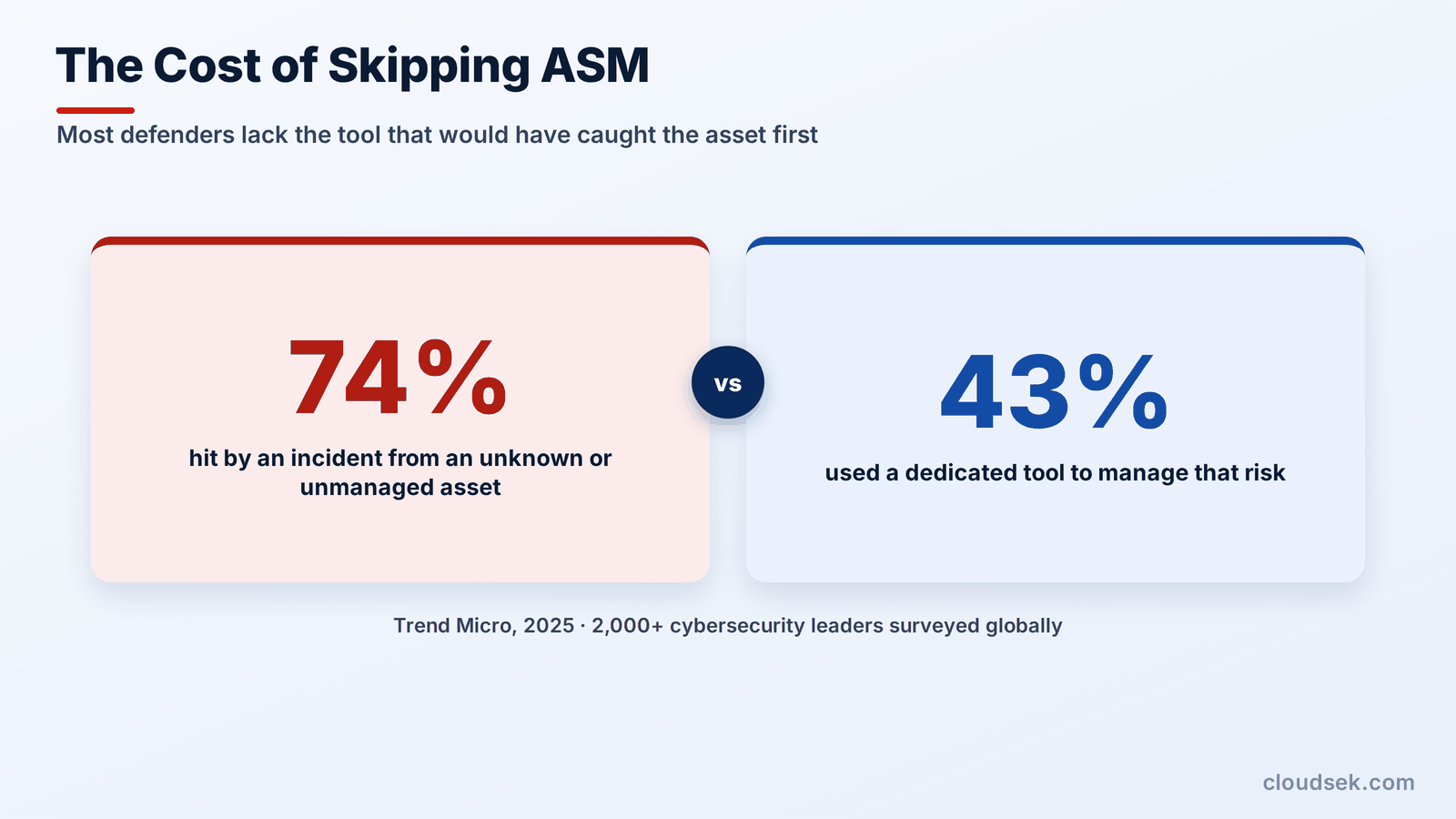
The cost of running VM without ASM is measurable. 2025 global study of over 2,000 cybersecurity leaders found that 74% had experienced a security incident caused by an unknown or unmanaged asset, while only 43% of organizations used a dedicated tool to manage that risk proactively. Vulnerability scanners only scan what they are pointed at, and an asset that is missing from the inventory is also missing from every patch cycle, every audit, and every risk report. It is the asset attackers find first precisely because the defenders never did.
ASM closes that gap by maintaining continuous discovery of internal and external assets, including shadow IT and unmanaged third-party systems, the kind of coverage platforms like BeVigil provide.
Vulnerability Management then operates on the complete inventory ASM produces, identifying and remediating the weaknesses inside each asset, informed by threat intelligence on active CVE exploitation. Run together, the two disciplines deliver coverage from exposure to remediation: ASM defines the attack surface, VM shrinks the vulnerability count within it, and neither leaves the work of the other undone.
Effective security depends on running visibility and remediation as a single coordinated process rather than two parallel programs.
No. ASM finds the assets; VM fixes the weaknesses inside them. They complement each other.
Yes, but it will miss every unknown or unmanaged asset, which is where attackers concentrate.
ASM, because VM cannot scan assets the organization does not know it owns.
ASM is continuous by design. VM runs on scheduled or continuous cycles depending on the tool and policy.
Yes. ASM covers both internal and external assets. The external slice is typically handled by EASM platforms, and the internal slice by CAASM tools.
Neither. Skipping ASM leaves unknown assets exposed; skipping VM leaves known assets vulnerable. Mature programs run both.
