🚀 CloudSEK featured in the 2026 Frost Radar™!
Read more
.avif)

Pastebin is a free online service for storing and sharing plain text and code as a “paste” accessible through a unique URL. Developers use it to share snippets and logs, while security teams watch it for leaked data, which earns it the nickname the “clipboard of the web.”
That dual nature makes Pastebin a security concern. Researchers who analyzed 3.8 million pastes found that 7.5% were tied to criminal activity, from leaked credentials to malware.
Pastebin works by turning any block of text into a shareable web page. A user pastes text into the site, selects a few options, and receives a unique URL that anyone with the link can open.
Each paste carries a visibility setting. Public pastes appear in site listings and get indexed by search engines; unlisted pastes stay off the listings, but are open to anyone with the link, and private pastes restrict access to the account owner.
Extra options shape how a paste behaves. Syntax highlighting formats code by language, and an expiration timer removes the paste after a set period. Users post as guests without an account or sign in for more control.
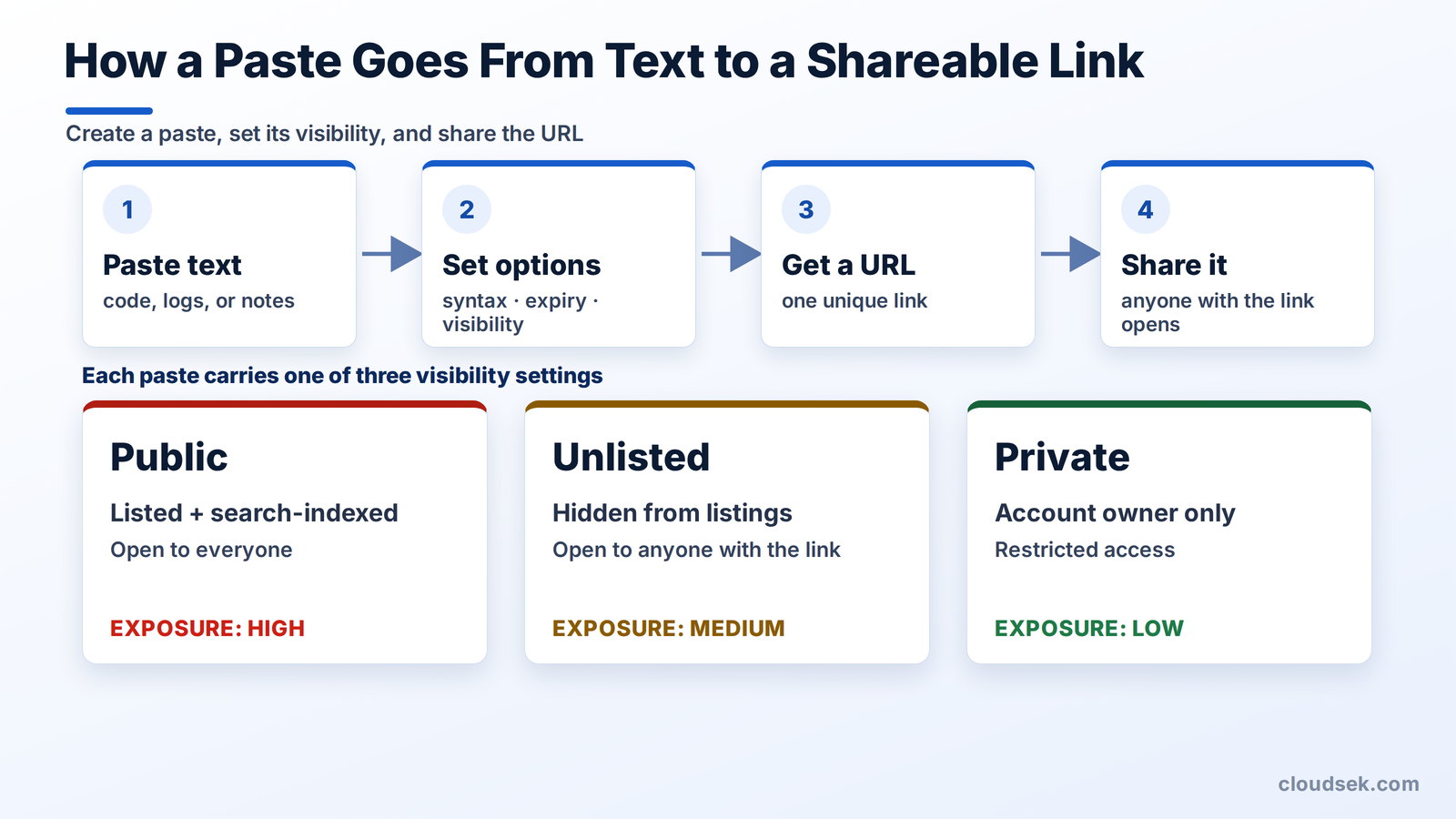
Pastebin is used mainly to share text and code quickly without email or messaging apps breaking the formatting. It grew out of Internet Relay Chat, where pasting long code blocks disrupted the conversation.
Developers rely on it most. They share code snippets for review, post error logs when asking for help, and hand off configuration files to teammates. Writers and students use it to store and share long plain-text notes.
Those same qualities, speed, and openness, attract a second audience. Threat actors use Pastebin to publish stolen data and coordinate operations, which the next sections cover in detail.
Pastebin is safe for ordinary use, but it is neither fully private nor fully anonymous. Public pastes are indexed by search engines, so anything posted openly surfaces in a Google search.
Roughly three in four pastes are unlisted or private, yet unlisted pastes are still open to anyone who has the link. A sensitive value posted by mistake, such as an API key in a log, spreads to anyone watching before the author notices.
Anonymity is limited too. Posting needs no account, but the site records IP addresses and metadata, and public pastes leave a permanent, searchable trail. Opening an unknown paste exposes the visitor to malicious links or scripts.
Attackers use Pastebin because it is free, trusted, and requires no login, which lets malicious content blend into normal traffic. Five patterns show up most often.
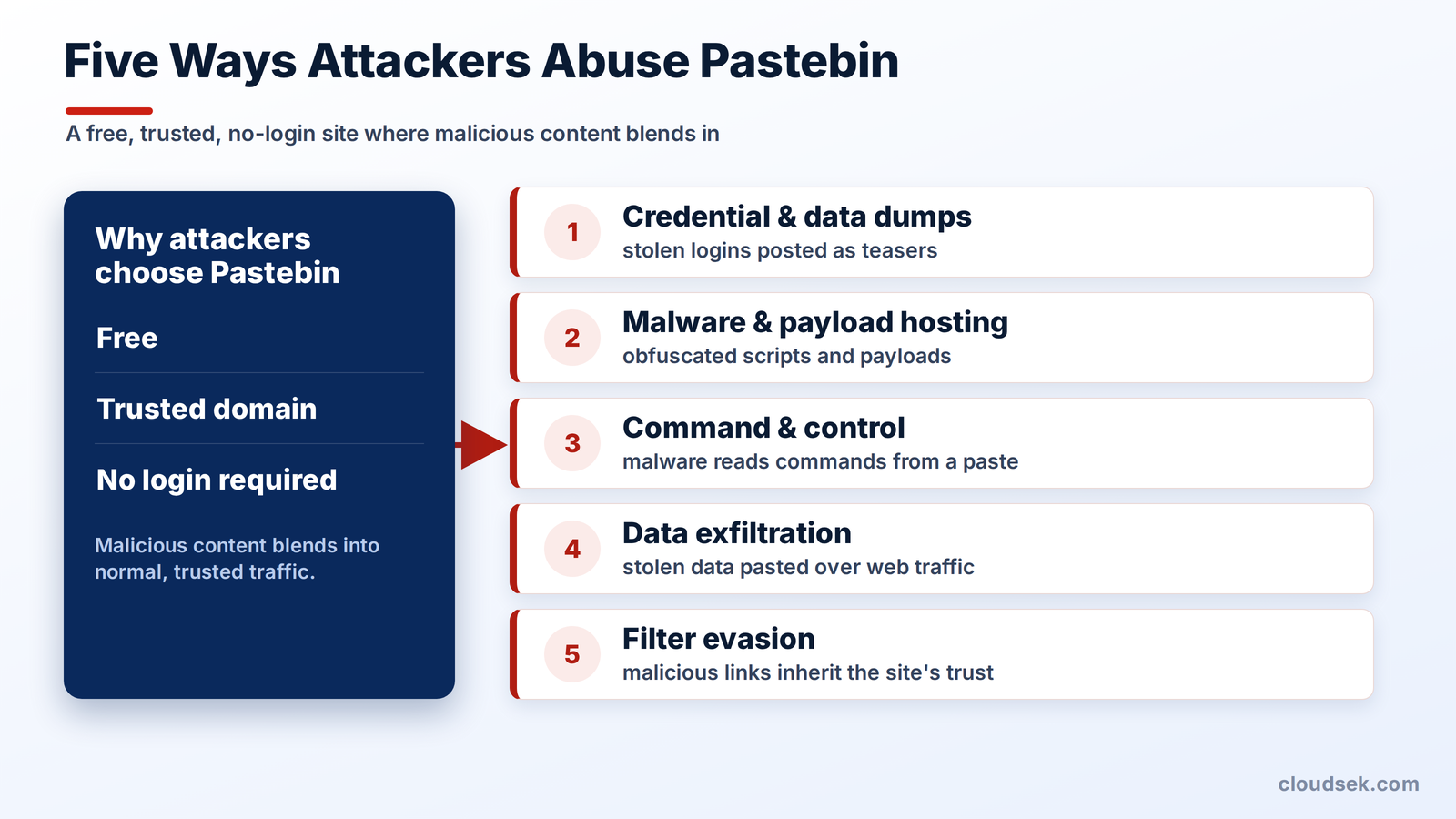
Attackers post stolen usernames, passwords, and database records as teasers to advertise a larger sale or as hacktivist leaks.
In 2011, the group LulzSec posted the names, emails, and cracked passwords of roughly 180 FBI-affiliated InfraGard members to Pastebin. CloudSEK tracks leaked credentials across paste sites for exactly this reason.
Pastebin stores obfuscated scripts, PowerShell commands, and links to malware. Because the domain is trusted, security tools rarely block it, so attackers use it as a delivery vehicle.
Some malware families read commands from a public paste, turning Pastebin into an improvised command-and-control infrastructure. Infected machines fetch instructions from a URL that looks harmless.
Malware pastes stolen data straight to Pastebin over standard web traffic. This channel slips past controls that would flag an unusual server connection.
A malicious link hosted on Pastebin inherits the site's clean reputation. Phishing and command-and-control URLs on a trusted domain slip past proxy and endpoint filters that block suspicious sites.
Security teams monitor Pastebin because a leak often appears there before it reaches dark web forums. Watching paste sites gives defenders early warning of exposure tied to their organization.
Monitoring serves three goals. It catches breaches early when stolen data shows up as a teaser, it profiles threat actors through reused handles and formatting, and it uncovers malware command channels hidden in public pastes.
Doing this safely matters. Even viewing a paste exposes an analyst's IP and metadata, so teams use isolated environments and automated tools rather than a normal browser. Continuous dark web monitoring extends this coverage across paste sites, forums, and marketplaces at once.
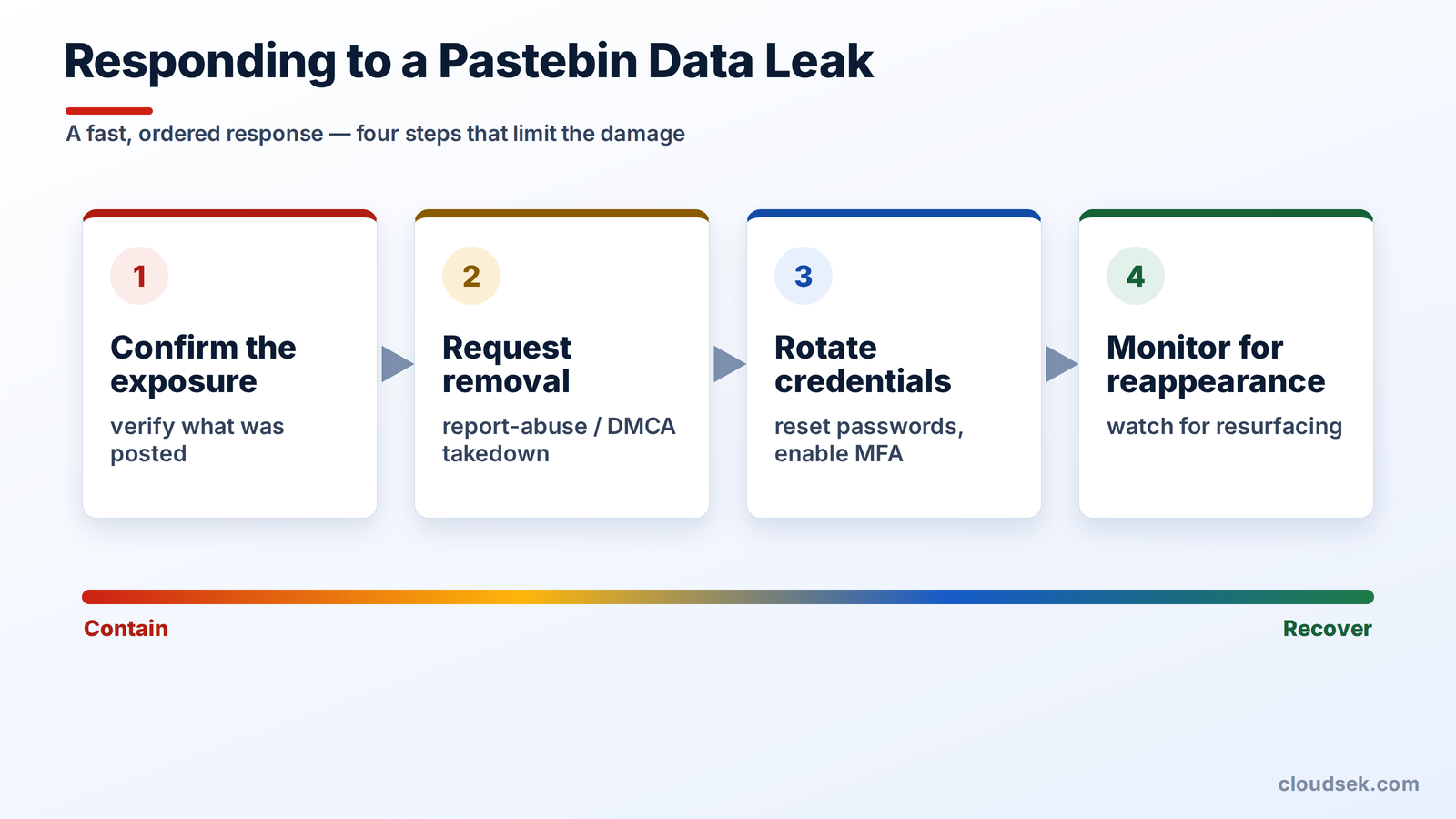
A leak on Pastebin calls for a fast, ordered response. Four steps limit the damage.
Pastebin is one of many paste sites, and each alternative trades off privacy, retention, and features differently.
CloudSEK's XVigil monitors Pastebin and other paste sites for data tied to an organization, such as leaked employee credentials, source code, and internal documents. It matches finds against a company's domains and watchwords, then alerts the security team.
The platform draws on years of historical paste-leak data, The platform draws on seven years of historical paste-leak data, so it flags both fresh exposures and credentials that surfaced earlier. Early detection lets teams rotate exposed credentials before attackers use them for access.
Yes, Pastebin is free to use, with an optional paid Pro tier. The free version supports creating and sharing pastes, while Pro adds larger pastes, more privacy options, and removes ads.
Yes, Pastebin is a legal service; posting stolen or illegal content violates its terms and the law. The platform itself is lawful, but misuse carries the same consequences as anywhere else.
Yes, registered users can delete their own pastes at any time. Guest pastes cannot be removed directly, though a burn-after-read option deletes a paste once it is viewed.
Pastebin removed its built-in search in 2020, so searches now rely on Google queries like site:pastebin.com or dedicated monitoring tools. These surface public pastes that contain specific keywords.
Paul Dixon created Pastebin in 2002. It started as a simple text-storage service for sharing code without disrupting live chat.
Yes, Pastebin removes reported illegal or sensitive content and provides an abuse-reporting tool, but moderation lags behind the volume of new pastes. Sensitive data often circulates before it is taken down.
