🚀 أصبحت CloudSek أول شركة للأمن السيبراني من أصل هندي تتلقى استثمارات منها
اقرأ المزيد


See how separate weaknesses chain into a route to your assets, and what to fix first to break the chain.


تثق الشركات العالمية وشركات Fortune 500 في CloudSEK لتعزيز وضعها في مجال الأمن السيبراني.
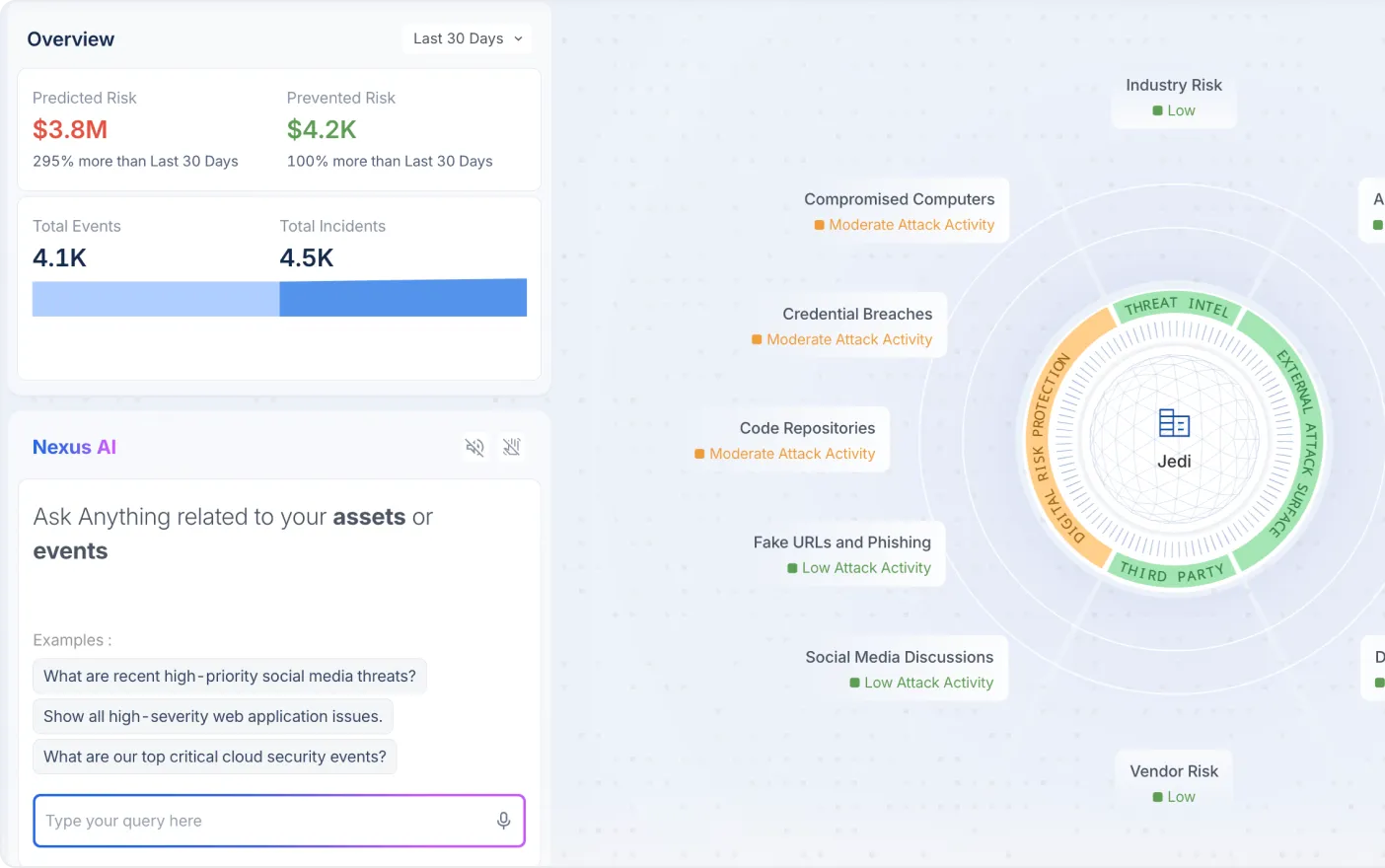
Attack path intelligence is the practice of correlating separate security findings into the routes an attacker could actually take. Nexus AI is CloudSEK's AI-native attack path intelligence layer: it correlates signals from across the CloudSEK platform into a unified attack graph, identifies how attackers chain weaknesses into potential attack paths, and focuses teams on what to fix first to break attack chains before execution.
Attack path analysis across the graph covers:

Know about all the features

Signals from five domains connected by AI agents, without analyst stitching

One model of how weaknesses across domains connect to each other

How an initial access vector links with further weaknesses into a route

Paths ranked by exploitability, impact, and attacker behaviour

Enrichment and correlation done automatically, reducing analyst workload

The weakness whose removal breaks the most potential attack chains
The more domains feeding the attack graph, the more complete the picture of how an attacker could move. Nexus AI correlates findings from every CloudSEK monitoring product, each identifying initial access vectors in its own domain.
Organization-specific exposure from the deep, dark, and surface web that gives an attacker a way in.
(i) Leaked Credentials
(ii) Fake domains and brand abuse
(iii) Exposed code and internal data

Attacker behaviour and intent that turns an exposure into a likely target.
- Threat actor activity relevant to your sector
- Actively exploited CVEs and exploitation timelines
- Ransomware and malware campaigns
Internet-facing weaknesses an attacker can reach directly.
- Exposed and forgotten assets
- Misconfigurations across internet-facing infrastructure
- Known CVEs on external assets
Read a related article on: What is an initial access vector?
Entry points created by AI systems and the infrastructure behind them.
- Prompt injection and model abuse exposure
- Training data exposure
- AI infrastructure misconfigurations
Routes into your organization that exist because of a supplier relationship.
- Vendor posture changes
- Fourth-party dependencies
- Vendor-driven initial access vectors
Read a related article on: What is an attack path?
Attackers rarely rely on one weakness. They chain small findings, each individually low priority, into a route that works. Seen separately, a leaked credential, an exposed asset, and an actively exploited CVE are three tickets in three queues. Seen together, they are one executable attack path.
Nexus AI does the connecting work before an attacker does, so enterprises identify attack paths before a breach. Each potential attack path arrives with the weakness that breaks it, moving teams from alerts to attack paths and from reactive detection to predictive attack disruption.
Alone
LOW PRIORITY
Alone
LOW PRIORITY
Alone
CONTEXT ONLY
Chained
HIGH Fix first: rotate credential
Alert-based tools tell you what happened. Predictive cyber intelligence tells you what it adds up to, and the difference decides what gets fixed first.

Nexus AI powers autonomous investigation and enrichment across CloudSEK's product suite, so the queue that reaches your team is shorter and each item arrives as a decision, with the chain it belongs to and the first fix that breaks it.
Every potential attack path names the weaknesses in the chain and the fix that breaks it.
Exploitability, impact, and attacker behaviour decide what rises, ahead of severity score alone.
Intelligence domains correlated into one attack graph
Reduction in analyst triage time
Priority
HIGH Fix first: rotate credential
Rating
MEDIUM Fix first: rotate credential
Attack path intelligence is the practice of correlating separate security findings into the specific routes an attacker could take through an environment. Instead of treating a leaked credential, an exposed asset, and an exploited CVE as three unrelated alerts, it connects them into a potential attack path and shows which weakness to remove to break the chain.
It works in three stages. Signals are collected across domains such as digital risk, threat actor activity, the external attack surface, AI systems, and third-party ecosystems. Those signals are correlated into a unified attack graph that models how weaknesses connect. The graph is then analysed for viable chains, and each potential attack path is prioritized by exploitability, impact, and attacker behaviour.
An attack vector is a single method of entry, such as a phishing email or an exposed service. An attack path is the full route an attacker follows after entry, chaining an initial access vector with further weaknesses to reach a target. Vectors describe doors; paths describe the journey from a door to the asset that matters.
Alerts are scored one at a time, usually by severity, so three low-severity findings stay at the bottom of three different queues. An attacker who chains those same findings has a working route in. Attack path intelligence scores the chain rather than the finding, which is why it surfaces risk that alert-based prioritization leaves buried.
The more domains, the more complete the graph. CloudSEK correlates digital risk and dark web exposure from XVigil, threat actor and exploited CVE intelligence from CloudSEK Threat Intelligence, external attack surface findings from BeVigil, AI attack surface findings from AIVigil, and third-party and supply chain risk from SVigil.
By combining findings that look minor on their own. A credential from a dark web dump, reused on a forgotten subdomain, running a CVE a tracked actor is actively exploiting: three separate tickets, one executable route. Chaining is why attackers succeed against organizations whose individual findings all looked low priority.
By correlating findings across domains before an attacker does. That requires continuous visibility into the signals attackers use as entry points, a graph that models how those signals connect, and prioritization based on what an adversary could realistically chain. Nexus AI automates this, producing potential attack paths and the first fix that breaks each chain.
Attack path analysis is the examination of how weaknesses connect into viable routes: which initial access vector starts the chain, which exposures extend it, and where it ends. Its output is a prioritized decision, the weakness whose removal breaks the most chains, rather than another list of findings.
Nexus AI. It is CloudSEK's AI-native attack path intelligence layer, correlating signals from XVigil, CloudSEK Threat Intelligence, BeVigil, AIVigil, and SVigil into a unified attack graph and prioritizing potential attack paths by exploitability, impact, and attacker behaviour.
No, they answer different questions. Attack surface management maps every point an attacker could touch, which is the job of an external attack surface monitoring platform like BeVigil. Attack path intelligence works out which routes through that surface are actually viable and which fix breaks them. One produces the map; the other finds the roads an attacker would drive.
