🚀 أصبحت CloudSek أول شركة للأمن السيبراني من أصل هندي تتلقى استثمارات منها
اقرأ المزيد
.avif)

Dark web monitoring is the process of tracking hidden online spaces where cybercriminal activity takes place. As part of a broader Digital Risk Protection (DRP) strategy, organizations use dark web monitoring to identify exposed assets, leaked credentials, impersonation attempts, and emerging threats before they can be weaponized against the business.
Cyber threat intelligence teams use dark web monitoring to uncover early warning signs such as leaked credentials and discussions about potential attacks. Modern DRP solutions combine dark web intelligence with attack surface visibility, threat intelligence, and supply chain risk monitoring to provide actionable and prioritized AI-powered remediation guidance rather than raw threat data alone.
Much of dark web activity exists within anonymous networks like the Tor Network, where traditional search and visibility are limited. Continuous monitoring of these environments gives security teams the context needed to identify risks, assess threats, and respond more effectively.
Dark web monitoring follows a structured workflow that converts hidden data into actionable threat intelligence.
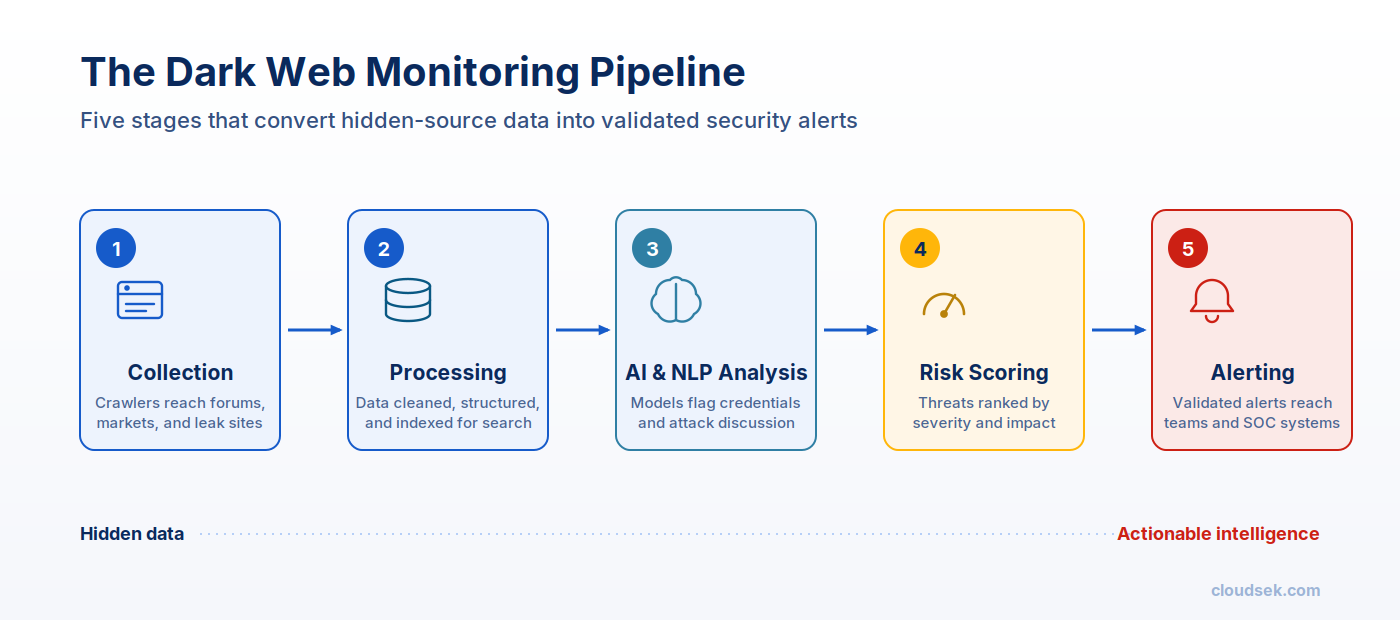
Systems collect data from forums, marketplaces, and leak sites where cybercriminal activity exists. Specialized crawlers operate within encrypted environments to access non-indexed content.
Collected data is cleaned and structured for efficient analysis. Indexed storage allows quick search and retrieval of relevant threat information.
Machine learning models and natural language processing detect patterns, keywords, and suspicious activity. Analysis highlights leaked credentials, attack discussions, and targeted entities.
Each threat is evaluated based on severity and potential impact. Prioritization ensures critical risks receive immediate attention.
Validated threats trigger alerts sent to security teams or integrated systems. Alerts enable rapid actions such as securing accounts or initiating incident response.
Multiple technologies work together to access hidden networks, extract data, and convert it into usable threat intelligence.
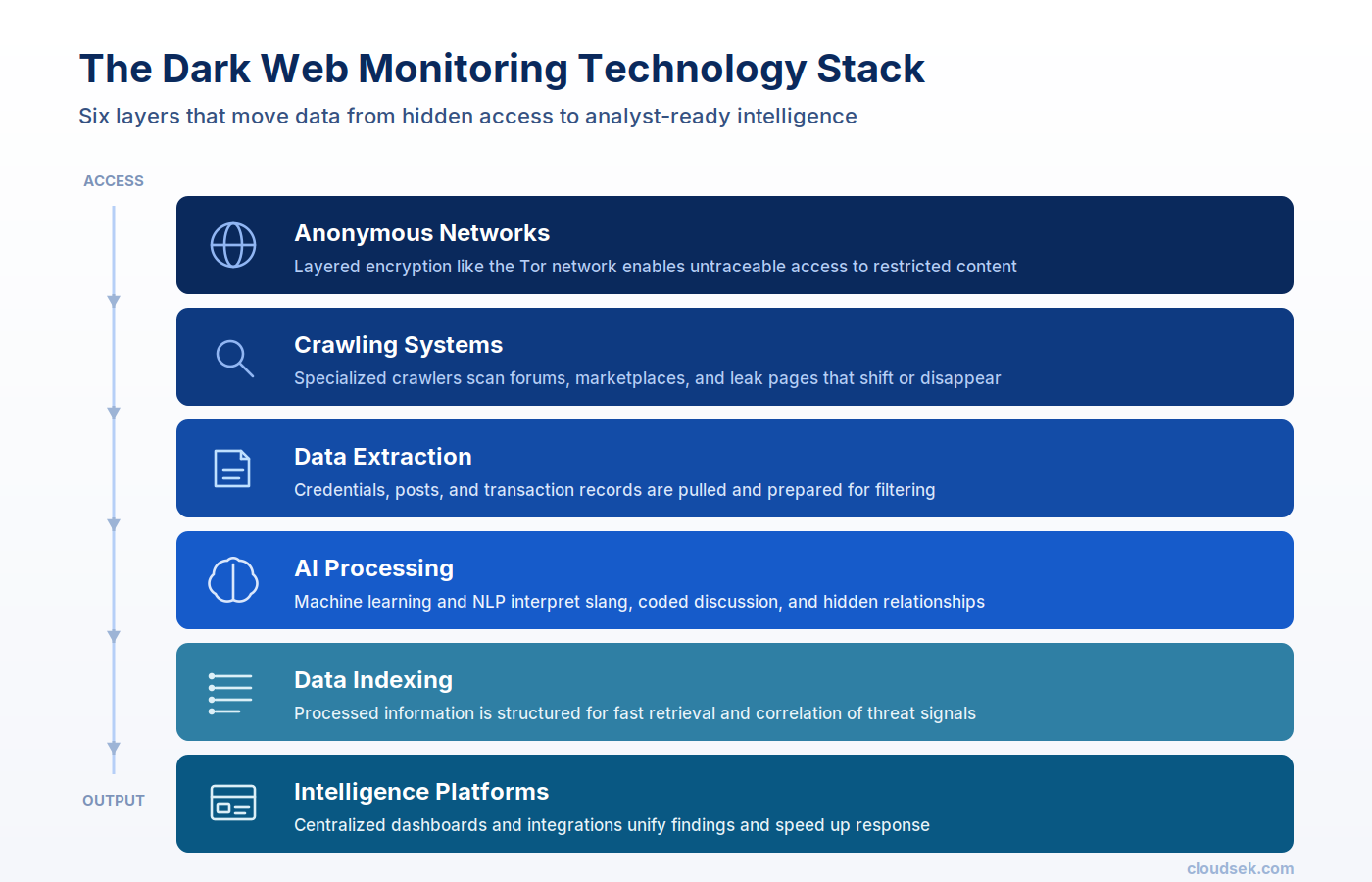
Hidden environments operate on systems like the Tor Network, where traffic moves through layered encryption. This structure enables secure and untraceable access to restricted content.
Specialized crawlers scan forums, marketplaces, and leak pages that frequently change or disappear. These systems are built to handle instability and restricted access conditions.
Raw content such as credentials, posts, and transaction records is pulled from collected sources. Extracted data is then prepared for filtering and deeper analysis.
Machine learning models detect patterns, anomalies, and hidden relationships within large datasets. Natural language processing helps interpret slang, abbreviations, and coded discussions.
Processed information is organized into structured formats for quick retrieval. Indexed datasets allow faster search and correlation of threat signals.
Centralized threat intelligence platforms bring together collected and analyzed data into one interface. Dashboards and integrations improve visibility and speed up response actions.
Sensitive and high-risk information shared across hidden communities reveals early signals of cyber threats and potential attacks.
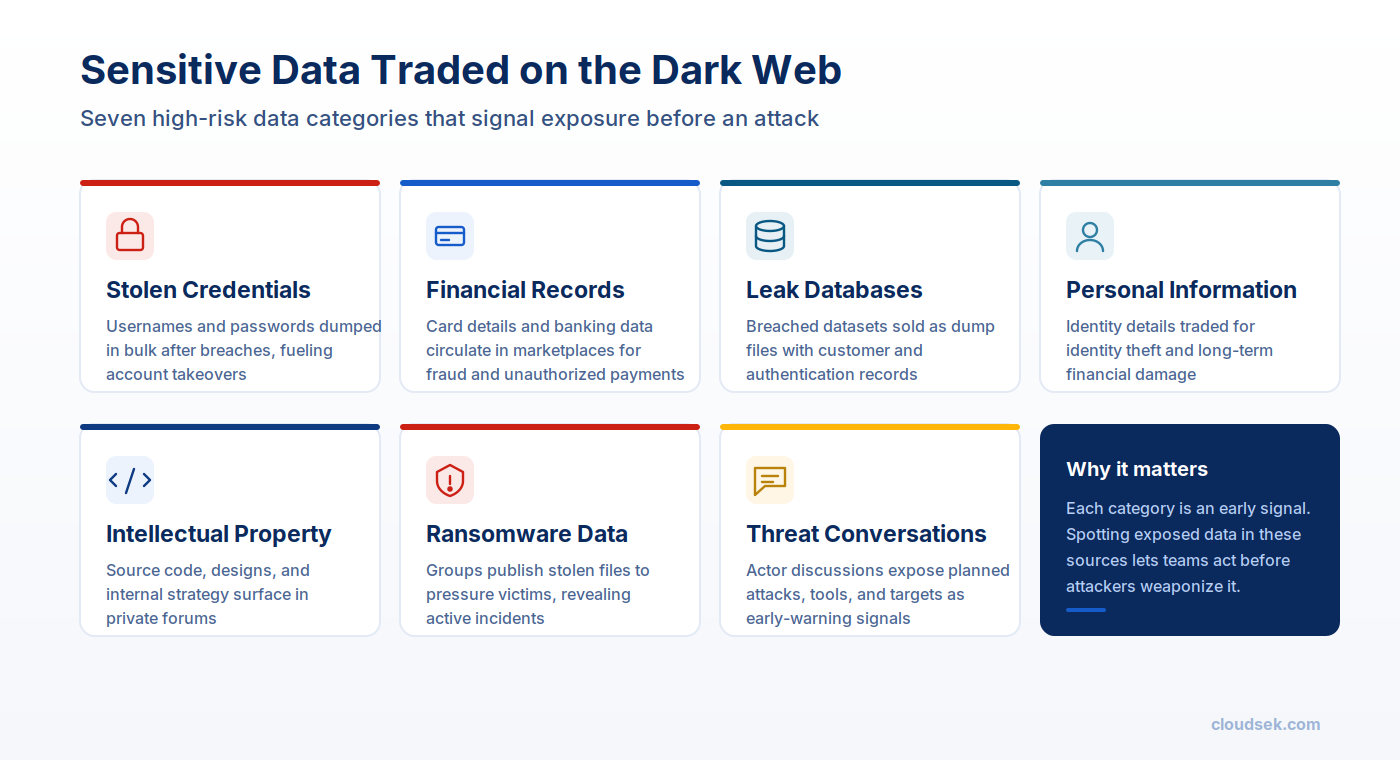
Usernames, passwords, and login combinations often appear in bulk after breaches. Exposure of these credentials increases the risk of unauthorized access and account takeovers.
Credit card details, banking information, and transaction data circulate in dark web marketplaces. Such data is frequently used for fraud and unauthorized payments.
Large datasets from breached organizations are shared or sold as dump files. These leaks may include customer data, internal systems, and authentication records.
Identity details such as addresses, phone numbers, and social security equivalents are traded for identity theft. Misuse of this data can lead to long-term financial and reputational damage.
Confidential assets like source code, product designs, and internal strategies sometimes surface in private forums. Exposure creates competitive risks and potential financial losses.
Ransomware groups publish stolen files or leak samples to pressure victims into paying. Monitoring these leaks helps identify active incidents and affected organizations.
Discussions between threat actors reveal planned attacks, tools, and targeted entities. Monitoring these conversations enables organizations to identify emerging attack campaigns, understand adversary tactics, and assess whether their industry, brand, or infrastructure is being actively targeted.
CloudSEK’s threat intelligence capabilities correlate adversary discussions with exposed organizational assets and data, helping security teams understand not only what threats exist, but whether they are relevant to their environment.
Modern DRP platforms extend visibility beyond traditional dark web forums and marketplaces. For instance, CloudSEK’s XVigil continuously monitors:
This broader intelligence provides organizations with a more complete understanding of their external risk exposure.
Visibility into hidden threat environments helps organizations reduce exposure and act before risks turn into incidents.
Stolen data, leaked credentials, and attack signals can be identified before they are actively exploited. This allows security teams to take preventive action instead of reacting after impact.
Compromised financial data and account details can be tracked across underground sources. Detection enables organizations to block fraudulent activity and protect users.
Company names, domains, and digital assets may appear in malicious listings or discussions. Monitoring helps prevent misuse that could damage trust and reputation.
Unnoticed data exposure increases vulnerability to cyberattacks. Continuous tracking helps limit the attack surface and reduce potential entry points.
Alerts generated from monitored data support quicker investigation and containment. Reduced response time lowers operational and financial impact.
Collected data adds context to ongoing investigations and security insights. Stronger intelligence improves prioritization and decision-making across teams.
Dark web monitoring becomes significantly more valuable when combined with attack surface intelligence. By correlating leaked credentials, exposed assets, vulnerable services, and threat actor activity, organizations can identify potential attack paths before exploitation occurs.
Organizations use hidden-source intelligence to detect exposed data, track cybercriminal activity, and reduce operational risk across different sectors.
Financial institutions monitor stolen card data, account credentials, and fraud-related discussions across underground marketplaces. According to the Verizon 2025 DBIR, around 88% of breaches in basic web application attacks involved stolen credentials, which highlights how exposed login data continues to drive financial fraud risks.
Companies track leaked employee credentials, internal data exposure, and breach-related discussions across forums and dump sites. Visibility into these leaks helps security teams prevent unauthorized access and reduce insider and external threats.
Agencies monitor cybercriminal activity, ransomware leak sites, and discussions linked to national security risks. Intelligence gathered from these environments supports investigations and proactive threat mitigation.
High-profile individuals face risks such as account compromise, impersonation, and exposure of personal data. Monitoring helps detect targeted threats and reduce potential harm.
Online businesses track stolen customer accounts, fake listings, and payment fraud schemes circulating in hidden marketplaces. Data from the Federal Trade Commission (2026) shows consumers reported $15.9 billion in fraud losses in 2025, highlighting the scale of financial impact tied to digital fraud ecosystems.
Threat actors frequently exploit trusted brands through phishing domains, fake websites, social media impersonation, and fraudulent mobile applications. Continuous monitoring helps organizations identify and take down malicious infrastructure before customers or employees are affected.
XVigil provides visibility into digital impersonation risks across domains, websites, and external channels, helping organizations protect their reputation and customers from fraud.
Dark web monitoring connects with Security Operations Center workflows by feeding external threat data into internal security systems. This connection allows teams to view hidden risks alongside real-time network and user activity.

Integration with SIEM platforms helps correlate dark web alerts with internal logs and behavioral signals. Correlation reduces noise and highlights threats that require immediate attention.
Security teams use these insights to trigger incident response actions such as account protection, investigation, and containment. Continuous data flow from monitoring systems strengthens visibility and improves response speed across the security environment.
Hidden environments present multiple barriers that affect visibility, accuracy, and reliability of threat intelligence.
Many forums and marketplaces operate on invite-only or reputation-based entry systems. Gaining access to these spaces requires time, validation, or specialized methods.
Strong encryption and anonymization protect user identities and activity trails. This makes attribution and verification more difficult for security teams.
Large volumes of unstructured and repetitive data make analysis more complex. Identifying meaningful threat signals requires advanced filtering and context.
Automated detection systems may flag unrelated or outdated information as threats. Incorrect alerts can slow down investigation and response efforts.
Monitoring practices must follow regional laws and ethical standards. Non-compliant activity can introduce regulatory and operational risks.
Selecting the right solution depends on how effectively it collects, analyzes, and delivers actionable intelligence.
Access to a wide range of forums, marketplaces, and leak sources increases visibility. Broader coverage improves the chances of detecting relevant threats.
Timely alerts allow faster action when sensitive data appears in hidden spaces. Delayed notifications can reduce the effectiveness of response efforts.
Strong filtering reduces noise and highlights meaningful threat signals. Accurate detection helps teams avoid wasting time on irrelevant data.
Machine learning and language processing improve detection of patterns and hidden signals. Advanced analysis helps uncover threats that are not obvious.
Compatibility with SIEM and other security tools ensures smooth data flow. Integration helps teams act on intelligence without switching systems.
Built-in compliance features support regulatory requirements across regions. Proper handling of monitored data reduces legal and operational risks.
CloudSEK XVigil delivers deep and dark web monitoring by scanning thousands of sources such as underground marketplaces, forums, code repositories, and communication channels. The platform uses AI-driven analysis to identify leaked credentials, exposed data, and threat discussions linked to organizational assets.
Security teams gain contextual intelligence through asset-based monitoring and targeted threat insights tailored to their environment. Centralized dashboards bring all findings into one place, allowing faster analysis, better visibility, and more informed decision-making.
Integrated workflows support alerting, takedowns, and system connectivity through APIs, SIEM, and SOAR platforms. End-to-end automation helps teams respond quickly, reduce manual effort, and manage threats efficiently across the entire security lifecycle.
Traditional dark web monitoring focuses primarily on identifying information that appears in hidden forums and marketplaces. The CloudSEK Platform expands this capability by continuously monitoring the broader external threat landscape, including exposed assets, phishing infrastructure, brand abuse, credential leaks, and adversary activity.
CloudSEK combines dark web intelligence, external attack surface management, supply chain risk monitoring, and threat intelligence into a unified platform, enabling organizations to identify, assess, and remediate external risks before they result in compromise.
It identifies exposed data and threat signals before they are actively used in attacks. Security teams can act on these insights to block access, reset credentials, or investigate risks.
Organizations of all sizes benefit from monitoring hidden threats and data exposure. Small and medium businesses also face risks like credential leaks and fraud.
Systems can detect credentials, financial data, internal documents, and discussions about potential targets. Detection depends on source coverage and monitoring depth.
Continuous monitoring provides better visibility into evolving threats and new data leaks. Regular tracking ensures that new risks are identified without delay.
Monitoring helps identify stolen financial data and compromised accounts linked to fraud activities. Detection enables preventive actions that reduce financial and reputational impact.
It works alongside existing tools like SIEM and threat intelligence platforms. Combined use improves overall visibility and strengthens security operations.
