🚀 أصبحت CloudSek أول شركة للأمن السيبراني من أصل هندي تتلقى استثمارات منها
اقرأ المزيد
.avif)

A third-party data breach is a security incident in which an organization's sensitive data is exposed through a vendor, supplier, or service provider that has access to that data. The compromise happens outside the organization's own systems, yet the organization that owns the data keeps the legal and reputational responsibility for it.
In 2025 Global Third-Party Breach Report found that 35.5% of breaches in 2024 were third-party related, a rise of 6.5 percentage points from the prior year, and that 41.4% of ransomware attacks start through a third party. Attackers favor this route because one compromised vendor opens a path into many downstream organizations at once.
This article explains what a third-party data breach is, how it differs from a supply chain attack, how these breaches happen, real examples, their impact, who is liable, and how organizations prevent and respond to them.
A third-party data breach occurs when attackers reach an organization's data through an external party it trusts, rather than by breaching the organization directly. Vendors such as IT providers, cloud platforms, payroll processors, and software suppliers hold or access sensitive data to perform a service, and a compromise on their side exposes that data.
The information at risk includes customer and employee records, payment card data, health records, login credentials, and intellectual property. Third parties draw attackers because many operate weaker security controls than the organizations they serve, and a single successful intrusion reaches every client that the vendor supports. Because the data owner remains accountable to regulators and customers, a vendor's breach becomes the organization's breach.
Several forces push third-party breaches higher each year, and they compound one another.
Several related terms describe overlapping ideas, and the distinctions shape how teams classify and respond to an incident.
A third-party data breach is frequently the result of a supply chain attack, and fourth-party exposure extends the same risk one step deeper into the chain.
Third-party breaches follow a small set of recurring patterns. Each begins with a weakness on the vendor side that attackers turn into access to the primary organization's data.
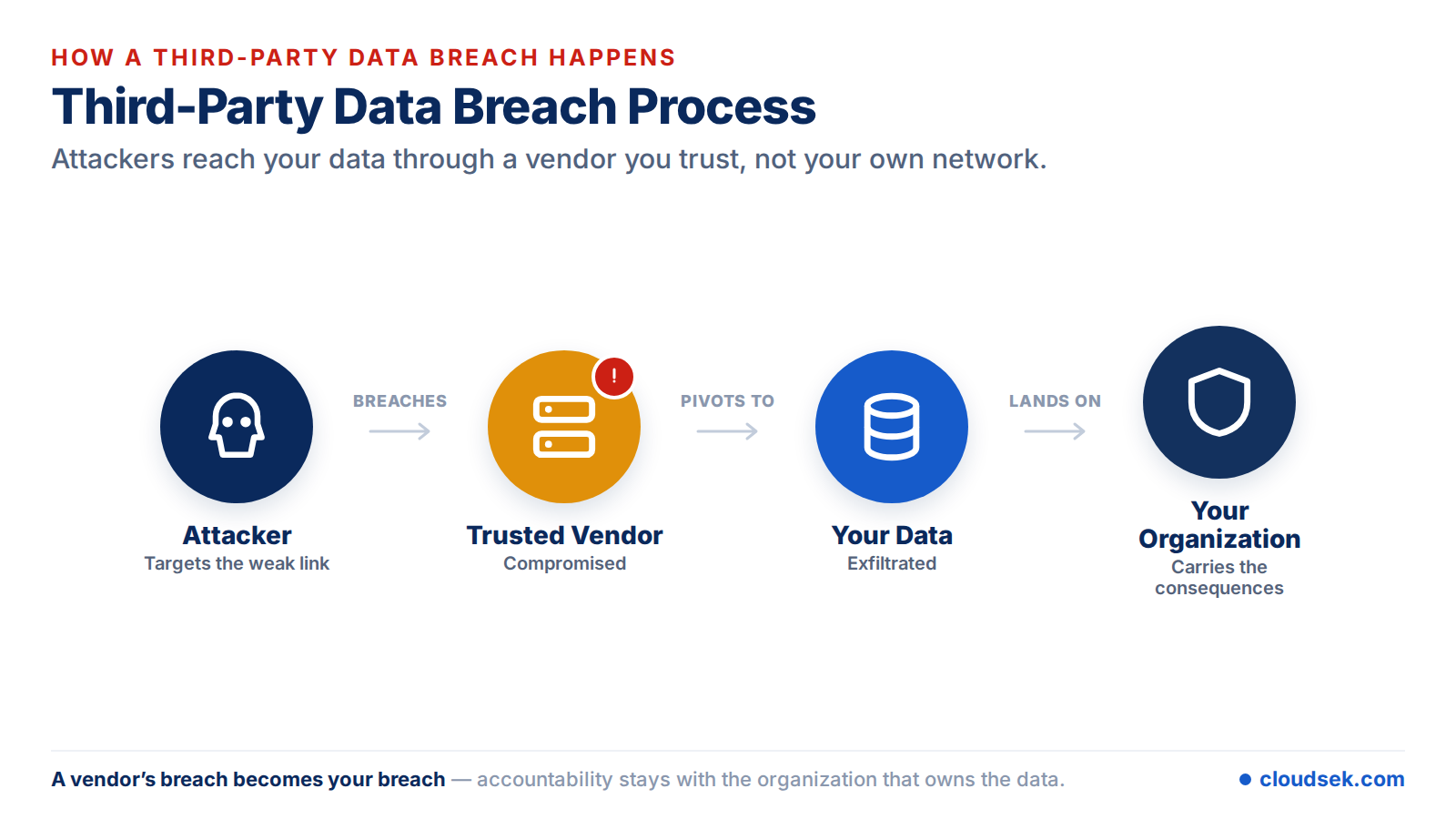
Attackers obtain a vendor's login details, often through infostealer malware or phishing, then sign in to systems that hold client data. Accounts without multi-factor authentication are the simplest to abuse, and a single reused password reaches multiple environments.
A flaw in a widely deployed product hands attackers entry to every organization running it. File transfer tools are a frequent target because they move sensitive data between partners, and ongoing external vulnerability scanning of vendor-facing software shortens the window of exposure. SecurityScorecard's research identifies file transfer software as the leading single vector for vendor-driven breaches.
A vendor granted more access than its task requires widens the blast radius of any compromise. Applying least privilege limits what a breached vendor account can reach inside the organization.
Misconfigured cloud storage, exposed databases, and forgotten internet-facing systems on a vendor's external attack surface leak data without an attacker needing to break in. Discovery of these assets is the first step toward closing them. Attackers scan continuously for these exposures, so a brief configuration lapse becomes an opening.
A vendor's own suppliers introduce risk that the primary organization rarely sees directly. A breach several steps down the chain still reaches the data held at the top of it.
The pattern stays consistent across cases: a vendor is compromised, the attacker pivots toward the data it holds or can reach, the data is exfiltrated, and the organization that owns the data carries the disclosure and the consequences.
High-profile incidents show how a single vendor weakness cascades across many organizations and millions of individuals.
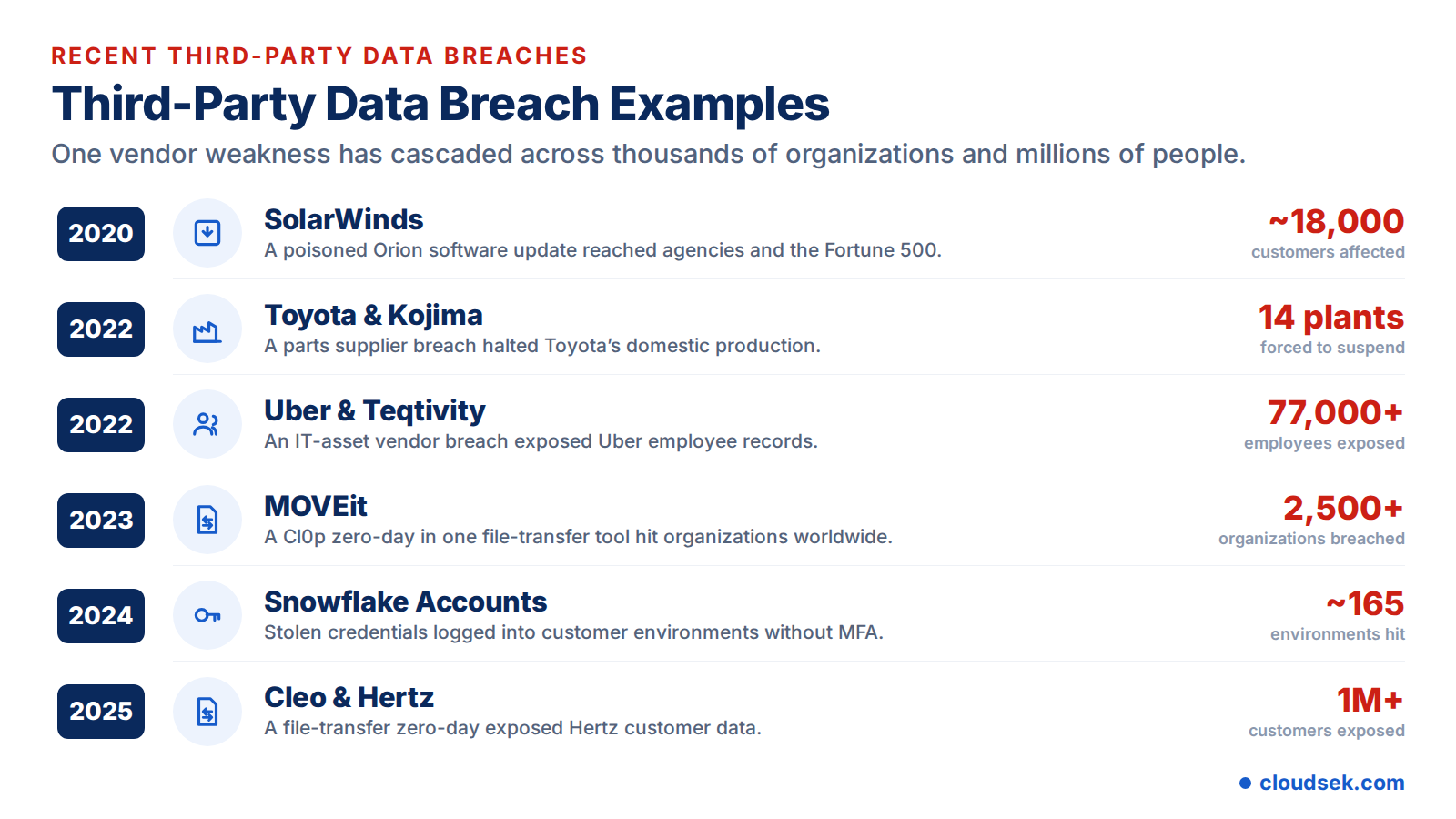
Attackers inserted malicious code into updates of the SolarWinds Orion monitoring platform. Around 18,000 customers received the compromised update, including government agencies and a large share of the Fortune 500, making it a defining supply chain attack. The breach reshaped how regulators and enterprises view software supply chain risk.
The Cl0p ransomware group exploited a zero-day flaw in the MOVEit file transfer tool through SQL injection. The campaign reached more than 2,500 organizations, including British Airways and the BBC, and exposed the data of millions of people through one vendor product. The campaign continued to surface new victims for months after the initial disclosure.
A cyberattack on Kojima Industries, a plastic-parts supplier, forced Toyota to suspend operations at 14 domestic plants. The disruption cut roughly one-third of the automaker's global output, showing that a third-party breach damages operations and data.
Teqtivity, a vendor that helps Uber manage IT assets, was breached and exposed information on more than 77,000 Uber employees. The incident reached Uber through a connected vendor rather than its own network. It shows that employee data, not only customer data, is exposed when a connected vendor is breached.
The group tracked as UNC5537 used credentials stolen by infostealer malware to log into around 165 Snowflake customer environments that lacked multi-factor authentication. Victims included AT&T and Ticketmaster, and the campaign exploited customer credentials rather than any flaw in the platform itself.
Multi-factor authentication on the affected accounts blocks the stolen-credential path that the attackers used.
The Cl0p group exploited a zero-day in the Cleo managed file transfer software used by Hertz. The breach exposed data on more than a million customers, including names, payment card details, and driver's license numbers. It echoed the file transfer pattern behind the earlier MOVEit campaign.
A third-party data breach carries the same categories of damage as a direct breach, and the organization that owns the data absorbs them.
Because the organization that owns the data manages the disclosure, customer notifications, and regulatory response, the cost of a vendor's breach lands largely on the primary organization rather than the vendor.
Responsibility for protecting personal data rests with the organization that collects it, not the vendor that processes it. Under regulations such as the GDPR, the data controller answers to regulators for a breach even when a processor caused it. A data processing agreement sets out how the vendor protects the data and reports incidents, though it does not transfer the controller's accountability to regulators.
Breach notification duties follow the same principle. The GDPR requires notification of a qualifying personal data breach to the supervisory authority within 72 hours of awareness, and many United States state and sector laws set their own timelines. Contracts and cyber insurance shape how cost and liability are shared, which is why vendor agreements define security obligations, breach-notification windows, and indemnification. This article provides general information rather than legal advice, and obligations vary by jurisdiction and contract.
Preventing third-party breaches means managing vendor risk continuously rather than at a single point in time. The controls below reduce both the likelihood and the blast radius of a vendor compromise.
These controls sit inside a wider third-party risk management program that governs how vendors are tiered, assessed, and offboarded over the life of each relationship.
Detection of a third-party breach often comes from external signals, since the compromise sits on a vendor's systems. Early indicators include vendor breach disclosures, company data or credentials surfacing on criminal marketplaces, and anomalous vendor account activity. A clear response sequence limits the damage once a breach is confirmed, and the faster a third-party breach is detected, the smaller the window attackers have to move from the vendor toward the data.
Many third-party breach signals originate outside an organization's own systems, on vendor infrastructure that internal security tools cannot see. Visibility into that external layer is what lets a team act before a vendor weakness becomes a breach.
CloudSEK SVigil addresses this layer directly. It monitors the third-party and supply chain attack surface continuously, surfacing vendor exposures and emerging supply chain risks as they appear rather than at the next scheduled review. Continuous monitoring of this kind narrows the gap between a vendor's security posture change and the organization learning about it.
Signals of this kind give a third-party risk program early warning of the conditions that precede a breach, such as a vendor's deteriorating security posture or exposed data tied to its environment. They supply context for the program and complement the governance process that assesses, contracts with, and offboards vendors rather than replacing it.
A third-party data breach involves unauthorized access to data through a vendor, usually via an attack. A data leak is unintentional exposure, often from a misconfiguration, with no attacker needed. A vendor's data leak can lead to a third-party breach.
Third-party breaches often take longer to detect than internal ones, because the compromise sits on systems the organization does not control or monitor.
Yes, when the policy includes third-party or contingent business interruption coverage. Standard policies do not always cover losses from a vendor's breach, so coverage depends on the specific terms and on whether the organization performed proper vendor due diligence.
Yes. Small businesses are frequently affected by the same widely used platforms that hit large enterprises, such as file transfer and payroll tools.
It depends on the vendor's risk level. High-risk vendors that handle sensitive data warrant assessment at least annually and after any major incident or change, while low-risk vendors need less frequent review. Continuous monitoring covers the gaps between assessments.
Retail and hospitality, technology, and energy and utilities rank among the more affected sectors in SecurityScorecard's 2025 report, while healthcare records a large number of incidents. Any organization that depends on shared vendors or software faces real exposure.
