🚀 أصبحت CloudSek أول شركة للأمن السيبراني من أصل هندي تتلقى استثمارات منها
اقرأ المزيد
.avif)

Botnet attacks are cyber attacks where a group of infected devices is controlled remotely to perform coordinated malicious activities such as DDoS attacks, data theft, or spam distribution.
A botnet consists of compromised devices called “bots.” These devices include computers, servers, and IoT devices such as routers and cameras. Attackers infect these devices with malware and connect them to a central control system.
Control happens through command-and-control (C2) servers. These servers send instructions to all infected devices at once. As a result, attackers can launch large-scale attacks using thousands or even millions of bots.
The main strength of botnet attacks lies in their scale and automation. Instead of attacking from one system, attackers use many devices at the same time. This distributed approach makes attacks harder to detect and more powerful in impact.
Preventing botnet attacks is important because they cause large-scale disruption, spread malware, and expose sensitive data.
Botnets power distributed denial-of-service (DDoS) attacks that overwhelm websites and services. Thousands of infected devices send traffic at once, which causes outages and downtime. Service disruption affects revenue, user experience, and business operations.
Malware spread increases rapidly through botnets. Infected devices scan networks and attempt to compromise other systems. This expansion grows the botnet size and raises the overall attack impact across organizations and users.
Credential theft and data exposure follow once devices are compromised. Attackers capture login details, monitor activity, and access sensitive information. Large botnets scale these actions across many targets, which increases financial loss and security risk.
Botnet attacks follow a multi-stage lifecycle that enables infection, control, expansion, and sustained malicious activity.

Attackers infect devices using malware delivered through phishing emails, malicious downloads, or unpatched vulnerabilities. Once installed, the malware runs silently in the background and takes control of the device.
Infected devices connect to command-and-control servers controlled by attackers. These servers send instructions to all bots. This connection allows attackers to manage the entire botnet remotely.
Infected devices scan networks to find and compromise additional systems. This process increases the number of bots in the network. A larger botnet increases attack strength and reach.
Attackers use the botnet to perform coordinated actions such as DDoS attacks, spam campaigns, credential stuffing, or data theft. All bots act simultaneously, which amplifies the impact of the attack.
Botnet malware maintains long-term control by restarting automatically and hiding from detection. Attackers use techniques to avoid security tools and remain active on devices. This persistence allows continuous use of infected systems for future attacks.
Botnet infections show clear signs on devices, accounts, and networks that indicate unauthorized control and hidden activity.

Unusual network traffic appears as high outbound connections or repeated communication with unknown servers. Devices may send data continuously without user action. This pattern often indicates communication with command-and-control servers.
Slow performance occurs when botnet malware consumes system resources. Devices may lag, freeze, or respond slowly even during normal use. Background malicious processes reduce overall performance.
Frequent crashes, restarts, or abnormal system behavior signal a possible infection. Applications may open or close unexpectedly. These disruptions often result from hidden malicious activity.
Unknown or unauthorized applications may run without user knowledge. These processes often appear in task managers or system logs. Hidden programs indicate malware controlling the device.
Unusual account activity includes logins from unknown locations or unexpected password changes. Devices may send spam messages or perform actions without user input. These signs indicate compromised access linked to botnet control.
Security tools or system protections may be turned off without user action. Antivirus programs, firewalls, or updates may stop working. Attackers disable these controls to maintain access and avoid detection.
Preventing botnet attacks requires layered security measures that block infections and stop communication with attacker-controlled systems.
Regular updates fix security vulnerabilities in operating systems and applications. Attackers often exploit outdated software to infect devices. Keeping systems updated closes these entry points.
Strong passwords prevent unauthorized access to devices and accounts. Multi-factor authentication adds an extra verification step. This combination reduces the risk of devices being compromised.
Antivirus and endpoint protection tools detect and remove malware. These tools scan files, applications, and system activity for threats. Continuous protection helps stop botnet infections early.
IoT devices often use default credentials and weak security settings. Changing default passwords and disabling unnecessary features reduces risk. Secured devices are less likely to be added to botnets.
Blocking known malicious IPs and domains prevents devices from connecting to command-and-control servers. Firewalls and filtering tools enforce these blocks. This step disrupts the attacker's control over infected devices.
Email and download security prevent malware from entering systems. Avoid opening unknown attachments or clicking suspicious links. Use filtering tools to block malicious files and websites.
Advanced security measures strengthen detection and block large-scale botnet activity across networks and devices.
Network monitoring tools track traffic across systems and external connections. These tools identify unusual patterns such as high outbound traffic or unknown connections. Continuous monitoring helps detect botnet communication early.
Firewalls control incoming and outgoing network traffic based on security rules. Intrusion detection systems analyze traffic for suspicious behavior. Together, they block unauthorized connections and detect potential botnet activity.
Threat intelligence provides updated information about known botnet infrastructure. This includes malicious IPs, domains, and attack patterns. Integrating this data improves detection accuracy and reduces false positives.
Rate limiting controls the number of requests a system can handle from a single source. DDoS protection tools filter and absorb large volumes of traffic. These measures reduce the impact of botnet-driven attacks.
DNS filtering blocks access to known malicious domains used by botnets. Sinkholing redirects botnet traffic to controlled servers to stop communication with attackers. These methods break the connection between infected devices and command-and-control systems.
Endpoint and network controls stop botnet infections on managed devices. They do not see the external infrastructure and stolen credentials that attackers use to build and run a botnet. CloudSEK Threat Intelligence covers that external view. It tracks more than 30,000 threat actors, including the operators and command-and-control infrastructure behind major botnet campaigns, along with the exploited CVEs and malware they distribute, so security teams know which threats target their sector before an attack reaches them.
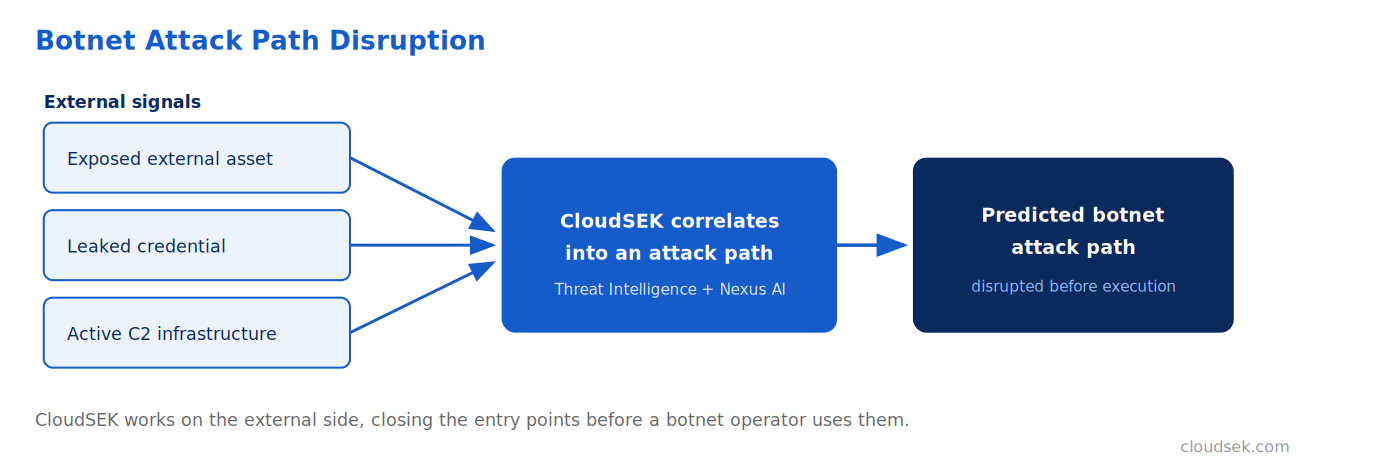
CloudSEK Nexus AI correlates that intelligence with an organization's exposed external assets and leaked credentials into a validated attack path. It shows how a botnet operator would chain an exposed device, a stolen credential, and active C2 infrastructure into a route to a target, before execution. CloudSEK identifies and predicts these attack paths from outside the network, and complements the endpoint, network, and response controls that handle infected devices rather than replacing them.
Best practices strengthen long-term defense against botnet attacks by improving system security, access control, and response readiness.
Regular scanning detects hidden malware on devices. Security tools identify and remove threats before they spread. Frequent scans reduce the risk of devices becoming part of a botnet.
Limiting network access reduces exposure to external threats. Only required services and ports remain open. Restricted access lowers the chances of unauthorized connections.
User awareness reduces the likelihood of malware infections. Training helps users identify suspicious emails, links, and downloads. Better awareness prevents common entry points for botnets.
Continuous monitoring tracks activity across all connected devices. Unusual behavior is detected early. Early detection helps isolate infected devices quickly.
Incident response plans define steps to handle infections and attacks. Teams act quickly when threats are detected. Structured response reduces damage and speeds up recovery.
Remote access services such as RDP or SSH must be secured with strong authentication. Unused services should be disabled to reduce the attack surface. This step prevents attackers from gaining entry and controlling devices remotely.
These Real-world botnet attacks show how large-scale infections cause disruption and damage.
In October 2016, the Mirai botnet launched a massive DDoS attack against Dyn. Attackers used thousands of compromised IoT devices such as cameras and routers to flood Dyn’s servers with traffic. Major platforms, including Twitter, Netflix, and GitHub, were affected. Millions of users experienced outages across the U.S. and Europe. The attack exposed the risks of unsecured IoT devices and caused widespread service disruption.
Between 2011 and 2014, the GameOver Zeus botnet targeted financial institutions and users worldwide. Operated by cybercriminal groups, it used phishing emails and malicious downloads to infect systems. The botnet stole banking credentials and financial data from over 1 million devices. Losses exceeded $100 million globally. The attack demonstrated how botnets can be used for large-scale financial fraud and data theft.
From 2014 to 2021, the Emotet botnet spread through phishing emails and malicious attachments. It infected hundreds of thousands of systems across businesses, governments, and individuals. Emotet acted as a delivery platform for other malware, such as ransomware. Organizations worldwide faced operational disruption and financial loss. A coordinated global law enforcement effort eventually disrupted the botnet, highlighting its scale and impact.
Botnet attacks start through malware infection of devices.
Botnet attacks cannot be fully eliminated, but can be significantly reduced with strong security measures.
IoT devices, outdated systems, and unsecured endpoints are most vulnerable.
The main goal is to use multiple infected devices to perform large-scale malicious activities.
