🚀 CloudSEK featured in the 2026 Frost Radar™!
Read more
.avif)

A Distributed Denial of Service (DDoS) attack overwhelms a website, server, or network with traffic from many sources at once until the system stops serving legitimate users. Nothing is breached, and no data is stolen. Availability itself becomes the target, and the service fails because it runs out of bandwidth, connections, or processing capacity.
CloudSEK experienced this directly in 2023, and the numbers show why distribution is what makes these attacks hard to stop. Across a 72-hour window, the company’s infrastructure absorbed 1.62 billion requests totalling 4TB of data from more than 6.38 million distinct IP addresses. Blocking any single source would have changed nothing, because no single source carried meaningful volume.
A DDoS attack works by flooding a website or server with distributed traffic to make it unavailable. Here’s a clear, step‑by‑step explanation of how a DDoS attack works:
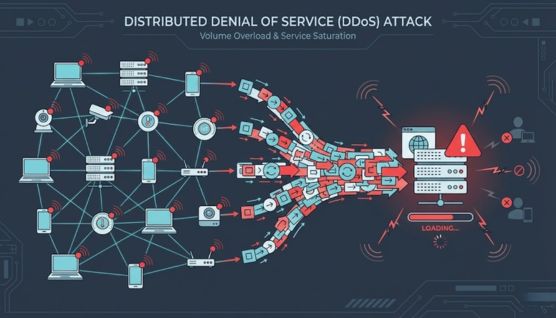
Attackers first build or rent a botnet of compromised devices.
The botnet is instructed to send massive amounts of traffic to the target.
The target system becomes overloaded and unable to respond to legitimate users.
The attack results in downtime or denial of service for legitimate users.
A DoS (Denial of Service) attack uses a single source to flood or disrupt a target system, while a DDoS (Distributed Denial of Service) attack amplifies the impact by coordinating traffic from multiple compromised devices across different locations, making it harder to block and far more damaging. Distribution removes that option entirely and changes what defense has to accomplish.
Motivation shapes duration, intensity, and how a target needs to respond, so identifying the likely driver early affects the containment decision. Here are some main purposes of DDoS Attacks:
Extortion-driven attacks warrant particular attention because they arrive inside a wider criminal economy. DDoS threats appear as one pressure layer in triple extortion campaigns, alongside encryption and data leak threats, a pattern documented under types of ransomware and driven by the same ransomware-as-a-service affiliate structures.
Attack types are classified by which layer of infrastructure runs out of capacity first, and each demands a different mitigation control.
These aim to overwhelm raw bandwidth. Attackers use amplification tricks—like abusing DNS, NTP, or memcached services—to turn small requests into massive floods. The victim’s network gets saturated in gigabits or terabits per second, cutting off legitimate traffic.
Here the target is the connection-handling process. Techniques like SYN floods leave half‑open connections that consume slots on firewalls and servers, while fragmented packets force devices to waste resources reassembling them. Capacity collapses even before bandwidth runs out.
These look like normal user requests but drain backend resources disproportionately. This attack targets specific web applications or pages, forcing the server to do heavy database work until it crashes. Examples include search queries hitting unindexed database columns, login attempts triggering heavy password hashing, or API calls that generate large responses. Because traffic volume stays low, they often bypass network‑level defenses.
Attackers combine several methods at once—hitting bandwidth, protocols, and applications simultaneously. As defenders block one vector, attackers shift to another, prolonging disruption and forcing response teams to fight on multiple fronts.
Understanding the attacker toolkit supports detection, since each technique leaves recognizable traces in traffic and logs.
Commercial attack services are the point at which early warning becomes possible at all. Campaign coordination, target lists, and service advertisements appear on forums and marketplaces before traffic arrives, which places dark web monitoring among the few controls that operate ahead of an attack instead of during one.
Attacks follow a recognizable progression, and knowing the sequence helps defenders identify which stage they are observing.
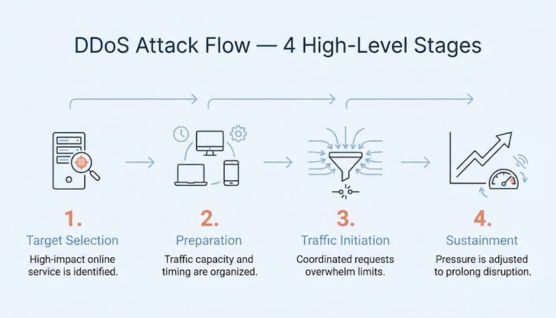
Static defenses are defeated at the adjustment stage more than at any other. CloudSEK’s attackers appended random numbers to request URIs specifically to bypass browser caching, forcing every request through to the origin server. The countermeasure was a URI path rule matching that pattern, applied alongside WAF pattern matching and query-matching rules during the same incident.
Attack scale has risen so quickly that human response is no longer viable for the largest events. Cloudflare’s DDoS threat report for the second quarter of 2025 recorded peaks of 7.3 terabits per second and 4.8 billion packets per second, and more than 6,500 hyper-volumetric attacks in a single quarter, averaging 71 per day.
Attack duration has compressed even as volume has climbed. Most attacks now finish in minutes, which leaves no window for an analyst to receive an alert, assess traffic, and apply a rule manually. Automated mitigation stopped being a convenience at that point and became the only workable model for volumetric defense.
Detection works from deviation against an established baseline, which means the baseline has to exist before the attack does. Five signal categories carry most of the diagnostic value.
Distinguishing an attack from genuine demand is the hard part of detection. A product launch and an application-layer attack both produce a request surge, and the difference shows in request distribution, session behaviour, and source characteristics. Correlating those signals across systems is core SOC practice, and enrichment through a threat intelligence platform adds the campaign context that a traffic graph cannot supply on its own.
Effective protection layers several controls, because no single mechanism covers volumetric, protocol, and application-layer attacks together.
Traffic is absorbed and filtered across distributed infrastructure before it reaches origin systems. Capacity carries the entire argument here, since defending a terabit-scale attack requires more bandwidth than any single organization maintains, and only a provider network operating at that scale can absorb it.
Rate limiting, blackhole routing, anycast distribution, and upstream filtering reduce volume before it reaches application infrastructure. These controls handle volumetric and protocol attacks well and offer limited help against requests that look legitimate.
Web application firewalls, behavioral analysis, CAPTCHA challenges, and request fingerprinting identify malicious patterns among valid-looking requests. CloudSEK’s mitigation relied on exactly this layer, combining WAF pattern matching with URI path and query rules targeting the specific request signature in use.
Detection and mitigation execute without waiting for human intervention. Given that most attacks now resolve within minutes, the speed of automated systems determines whether mitigation arrives during the attack or after it.
Content delivery networks, load distribution, autoscaling, and geographically separated redundancy raise the volume required to cause an outage. Preparation of this kind happens before an incident and cannot be arranged during one.
Traffic mitigation is not what CloudSEK does, and specialized platforms handle scrubbing at scale. What external intelligence contributes is warning and exposure reduction ahead of an attack, which is where CloudSEK XVigil operates, monitoring deep and dark web sources for campaign coordination, target lists, and DDoS-for-hire advertisements naming an organization.
Reducing what an attacker can reach matters alongside early warning. BeVigil maps internet-facing infrastructure and surfaces the unprotected origin servers, exposed endpoints, and misconfigurations that let attackers bypass scrubbing entirely, which is the practical output of external attack surface management. An origin IP reachable outside the CDN removes the benefit of having a CDN.
CloudSEK’s own 2023 incident illustrates the division of labour. Threat research identified the botnet and its origin, WAF and traffic rules handled mitigation, and the two functions worked together across the same 72 hours.
Yes. Launching one is a criminal offence in most jurisdictions under computer misuse and cybercrime law, regardless of whether data is stolen or financial damage results.
Most last minutes. Sustained multi-vector campaigns run for hours or days, depending on attacker resources and how quickly mitigation takes effect.
No. Firewalls filter some malicious traffic and cannot absorb volumetric floods. Effective defense combines a WAF, rate limiting, and cloud-based scrubbing capacity.
Not by itself. DDoS targets availability, not confidentiality. Attackers do sometimes use one as cover while a separate intrusion proceeds, so investigation is warranted.
An extortion attempt where attackers demand payment to stop an active attack or to avoid a threatened one, backed by a short demonstration burst as proof of capability.
Yes. Booter services make attacks cheap to commission, and smaller organizations rarely hold scrubbing capacity, which makes them easier to disrupt than large enterprises.
Legitimate spikes show varied sessions, natural navigation paths, and distributed geography. Attack traffic concentrates on narrow endpoints with repetitive request patterns and abnormal source characteristics.
Defending against DDoS is largely a matter of decisions taken in advance. Scrubbing capacity, architectural redundancy, and automated mitigation must be in place before traffic arrives; an organization that discovers it needs them during an attack has already lost the window in which they would have helped.
Two habits separate prepared organizations from exposed ones. Traffic baselines are established under normal conditions because detection depends on knowing what normal looks like. And the external footprint is mapped so no origin server sits reachable outside the protection layer, since a single exposed IP address undoes the investment in everything upstream of it.
