🚀 أصبحت CloudSek أول شركة للأمن السيبراني من أصل هندي تتلقى استثمارات منها
اقرأ المزيد
.avif)

Cyber warfare is the use of digital attacks by one nation-state, or a group acting on its behalf, to damage, disrupt, or spy on another state in pursuit of a strategic or military objective. It targets the systems a society runs on, such as power grids, financial networks, and defense communications, rather than the battlefield in front of an army.
The trend line tracks geopolitics closely. A 2026 academic review of a decade of attacks on critical infrastructure found major incidents rising from one or two a year to four or five, with the sharpest spikes arriving alongside armed conflict.
Cyber warfare describes state-driven operations that carry the intent traditionally reserved for military force: degrading an adversary's capabilities, coercing a government, or preparing the ground for physical conflict. The actor and the objective define it, not the tool.
That definition matters because the term gets stretched to cover events it does not fit. A criminal ransomware crew extorting a hospital is committing a crime, and a group defacing a website to make a political point is engaging in protest. Neither becomes warfare simply for happening online.
State backing is the dividing line. Cyber warfare involves governments directing or sponsoring the activity, pursuing national interest rather than profit or publicity, and accepting the operation as an instrument of statecraft.
Three categories overlap in technique and diverge sharply in who acts and why. Keeping them apart is the first step toward reading any incident accurately.
The lines do blur in practice. States occasionally recruit criminal groups as proxies, and hacktivist noise sometimes provides cover for state operators working quietly underneath it.
State operations draw on a consistent set of techniques, chosen to match the strategic goal behind them. Here are the most common cyber warfare tactics:
Cyber espionage is the most common and least visible tactic. Operators infiltrate government, defense, and research networks to exfiltrate classified material, intellectual property, and diplomatic communications, often maintaining access quietly for years.
Sabotage aims at the industrial control systems running power, water, and manufacturing. Manipulating this operational technology produces physical consequences, from blacked-out cities to damaged equipment, which sets it apart from purely digital disruption.
Influence operations attack perception rather than infrastructure. Coordinated fake accounts, fabricated leaks, and manipulated media aim to sway elections, deepen social division, and erode trust in institutions.
Distributed denial-of-service attacks and website defacements deliver visible disruption at low cost. Their strategic value lies less in lasting damage than in signalling capability and sowing confusion during a crisis.
Supply-chain attacks corrupt trusted software or hardware to reach targets indirectly. Compromising one widely used vendor grants access to every organization downstream, which turns a single intrusion into thousands.
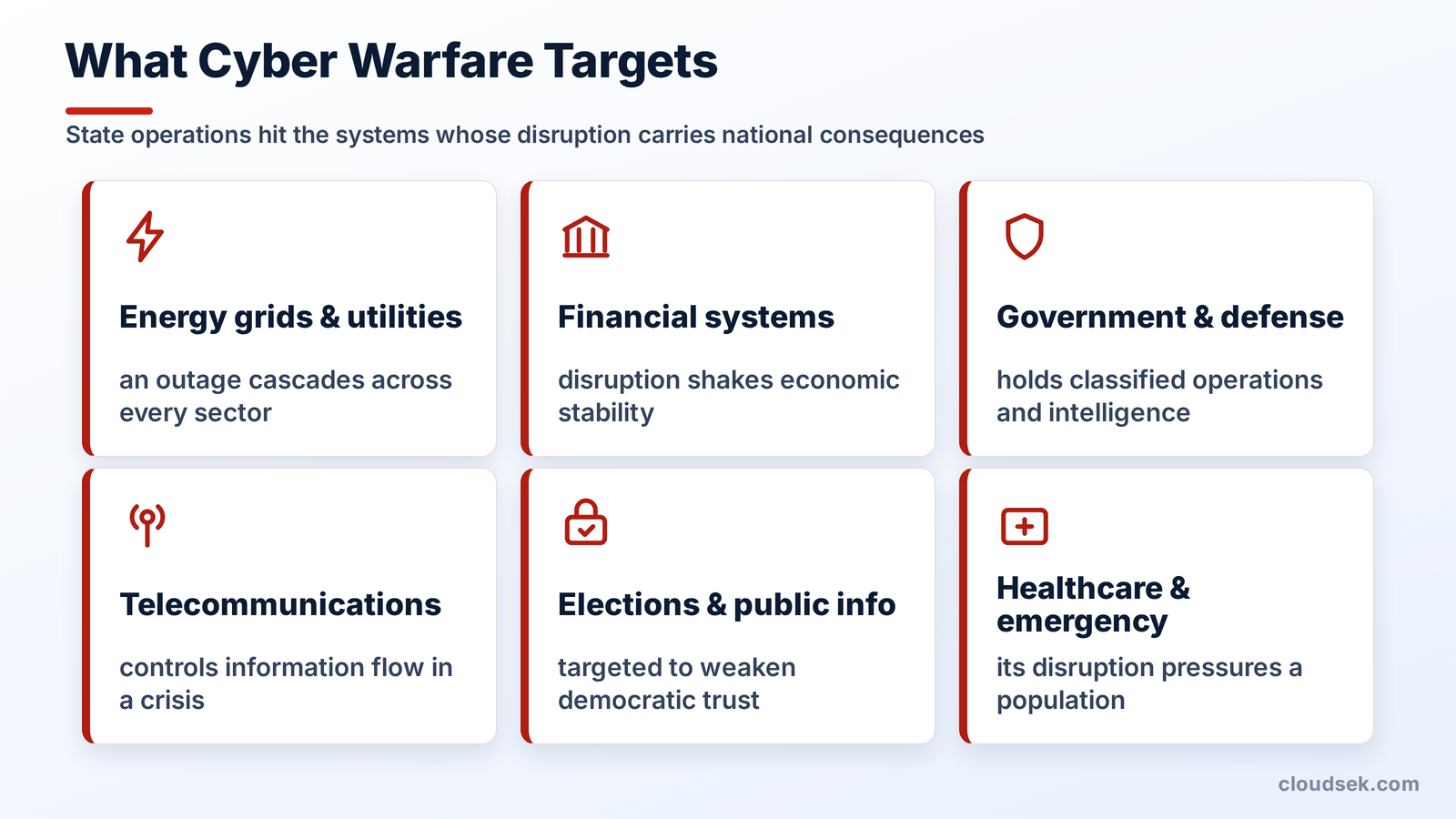
State operations concentrate on systems whose disruption carries national consequences:
Five operations mark the evolution of cyber warfare from proof of concept to routine instrument of conflict.

Stuxnet (2010). A worm widely attributed to a joint US-Israeli effort sabotaged Iran's nuclear enrichment program, manipulating industrial controllers to destroy centrifuges while reporting normal operation. It stands as the first cyberattack known to cause physical destruction, proving that code could achieve what once required a bomb.
Ukraine power grid (2015 and 2016). Russian-linked operators switched off electricity for hundreds of thousands of Ukrainians, the first confirmed cyberattacks to take down a power grid. The 2016 incident used Industroyer, malware built specifically to manipulate grid control systems.
NotPetya (2017). A destructive wiper disguised as ransomware, aimed at Ukraine, spread worldwide and caused an estimated $10 billion in damage across shipping, logistics, and manufacturing. It demonstrated how a state operation escapes its target and inflicts global collateral damage.
SolarWinds (2020). Russian intelligence compromised the Orion software platform and reached roughly 18,000 organizations, including multiple US federal agencies. The espionage ran undetected for months, a textbook supply-chain intrusion.
Viasat (2022). An attack on the KA-SAT satellite network disabled thousands of modems at the very hour Russia invaded Ukraine, disrupting military communications. It showed cyber operations timed as the opening move of a conventional war.
Artificial intelligence has moved cyber warfare into a faster, cheaper, and harder-to-detect phase. It amplifies the existing tactics rather than replacing them, and it does so on three fronts.
Disinformation is where the shift is most visible. In March 2022, a deepfake video of President Zelensky urging Ukrainian troops to surrender ran on a hacked Ukrainian television channel before being debunked, an early demonstration of AI-generated propaganda deployed mid-conflict. Quality has climbed steeply since, and deepfake incidents in early 2025 already outpaced the whole of 2024.
Offensive operations gain scale next. National security assessments now record state actors using generative models to accelerate reconnaissance, write and adapt malware, and mass-produce convincing phishing lures, compressing work that once needed skilled operators into automated pipelines.
The harder problem is speed. AI-generated content is on track to outrun detection tools, which pushes defenders toward permanently reactive verification and widens the attribution gap that already shields state operators.
Not every loud claim signals a serious attack, and mistaking one for the other wastes the attention real threats demand. Hacktivist campaigns trade on visibility, which makes their claimed impact easy to inflate.
CloudSEK's analysis of the May 2025 India-Pakistan surge illustrates the gap precisely. Pakistan-linked groups claimed more than 100 breaches of Indian government and infrastructure sites, yet investigation showed most were recycled data, defacements that left no trace, or DDoS attacks lasting only minutes.
The genuine threat sat elsewhere. While the noise drew headlines, the APT36 espionage group used Crimson RAT malware and Pahalgam-themed phishing lures to target Indian defense networks, the quiet operation that actually mattered. Separating theatrical claims from state-backed espionage is a core skill of modern threat assessment.
Assigning blame for a cyberattack is far harder than detecting one. Operators route activity through compromised machines in third countries, reuse tools associated with other groups, and plant false clues designed to mislead investigators.
Proxies deepen the fog. A state directs a nominally independent hacktivist group or criminal crew, preserving deniability while achieving its aims, which leaves attribution resting on probability rather than proof.
That ambiguity is strategic, not incidental. It lets states operate in a grey zone below the threshold of armed conflict, and it keeps unsettled the central legal question of when a cyberattack counts as an act of war that justifies a military response.
Defense runs on two levels. Nations build military cyber commands, share intelligence through alliances, and issue doctrine on deterrence and response, while the private companies that own most critical infrastructure carry the practical burden of resilience.
The measures that matter most in practice:
National agencies publish continuous guidance for the operators on the front line, and CISA's nation-state threat resources set out concrete steps for organizations facing state-sponsored activity.
Cyber warfare is conducted by nation-states for strategic goals, while cyber terrorism uses digital attacks to cause fear or coerce a population toward an ideological end. The actor and intent separate them, since techniques often overlap.
Yes, a cyberattack causing death or severe physical damage could trigger a military response, though no clear international threshold defines that point. States deliberately operate below it to avoid escalation.
A cyber weapon is malicious code built to damage, disrupt, or gain unauthorized control of an adversary's systems, such as Stuxnet or Industroyer. Unlike conventional arms, it can be copied and repurposed once discovered.
The United States, Russia, China, Israel, North Korea, and Iran are consistently assessed as holding the most advanced offensive cyber programs. Many other states operate capable units of their own.
Yes, private firms are frequent targets, since they own most critical infrastructure and sit throughout defense and technology supply chains. A vendor compromise often serves as the route to a state target.
A cyber cold war describes sustained, deniable digital conflict between rival states that stops short of open warfare. Continuous espionage and infrastructure pre-positioning define the current standoff among major powers.
