🚀 CloudSEK featured in the 2026 Frost Radar™!
Read more
.avif)

Information security management is the organization-wide discipline of protecting information through governance, policies, risk assessment, and controls applied across people, processes, and technology. The discipline determines what information an organization protects, why it warrants protection, and how that protection holds up as the business changes.
Governance rather than tooling distinguishes the practice. Firewalls, encryption, and monitoring platforms enforce decisions, and information security management is the structure that makes those decisions deliberately, records the reasoning, and assigns ownership. Organizations that run it formally gain a defensible answer to the question auditors, regulators, customers, and insurers now ask routinely: not whether controls exist, but whether anyone can demonstrate they were chosen for a reason and reviewed since.
Information security management governs how information is protected across the whole organization, while cybersecurity delivers the technical defenses that protect systems and digital assets. The two are complementary layers rather than competing terms, and conflating them produces programs with tools but no direction.
Example: A printed contract left in a meeting room, a departing employee retaining system access, and a supplier handling customer records all fall inside information security management, and none of them is a cybersecurity problem in the technical sense.
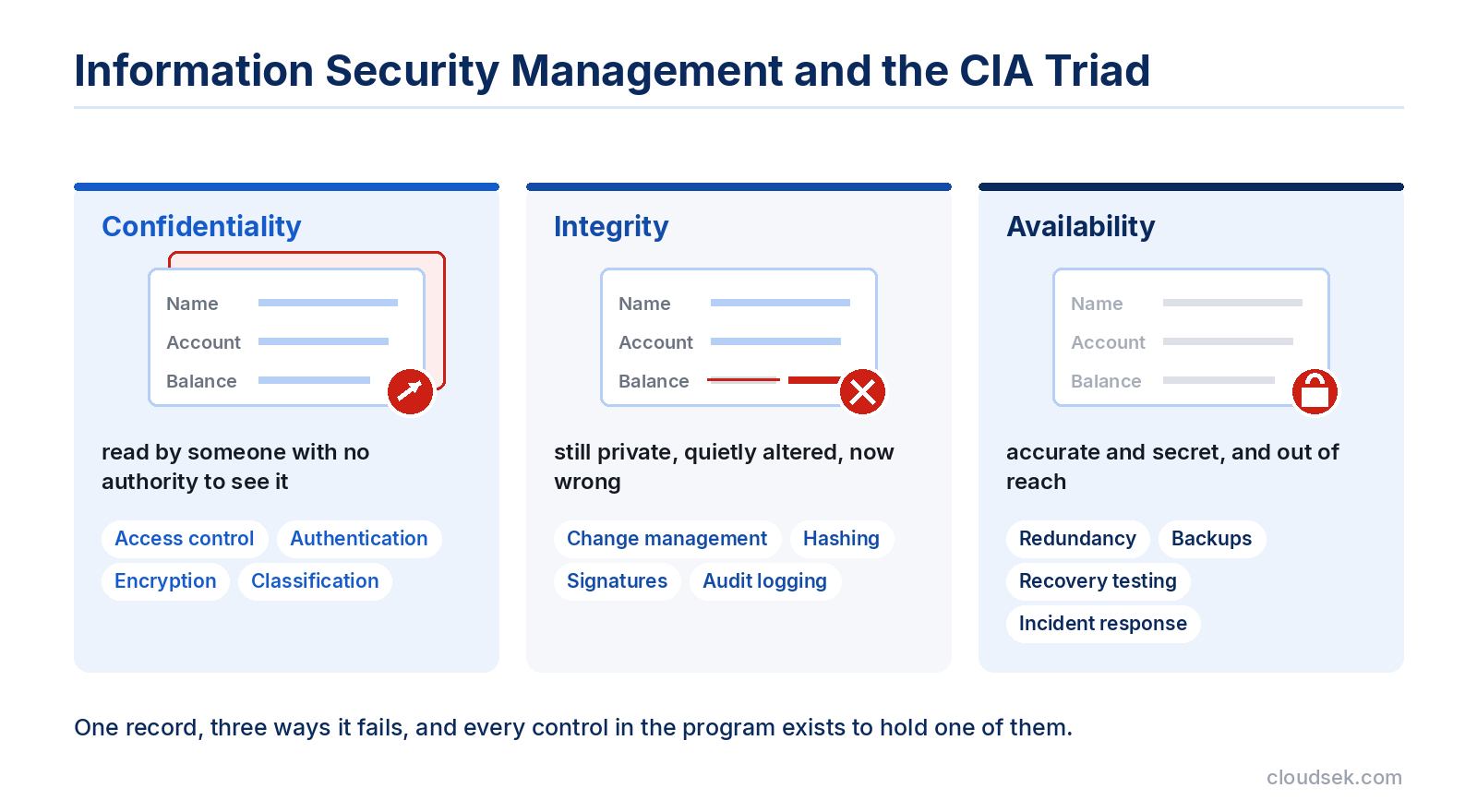
Information security management protects three properties of information: confidentiality, integrity, and availability. Every policy, control, and risk decision within the discipline exists to preserve at least one of them, which makes the CIA triad the model against which control effectiveness is judged.
Confidentiality means information reaches only the people, systems, and processes authorized to see it. Access control, authentication, encryption, and data classification carry most of the load, and human behavior determines whether they hold. Verizon’s 2026 Data Breach Investigations Report found the human element present in 62% of confirmed breaches across a dataset of more than 22,000 incidents, which places awareness and access discipline alongside technical controls rather than beneath them.
Credential and secret exposure is the failure mode that recurs across organizations of every size. Keys committed to repositories, tokens left in build pipelines, and passwords reused across services convert a single oversight into standing unauthorized access, a pattern examined in CloudSEK’s guide to checking whether AI API keys have leaked.
Integrity means information stays accurate and complete, and changes to it happen only through approved routes. Version control, change management, cryptographic hashing, digital signatures, and segregation of duties enforce it, while audit logging makes unauthorized modification detectable after the fact.
Financial reporting, clinical records, and industrial process values depend on this property more heavily than on secrecy. Silent corruption of a dataset that decisions rely on causes damage that no disclosure control prevents, because the information remains confidential throughout and simply becomes wrong.
Availability means authorized users reach the information they need when operations require it. Redundancy, backups, capacity planning, disaster recovery, and tested incident response deliver it, and ransomware has made this property the one most organizations now measure first.
Six interdependent elements make information security management operational. Weakness in any one of them undermines the others, which is why programs built on technology alone plateau quickly.
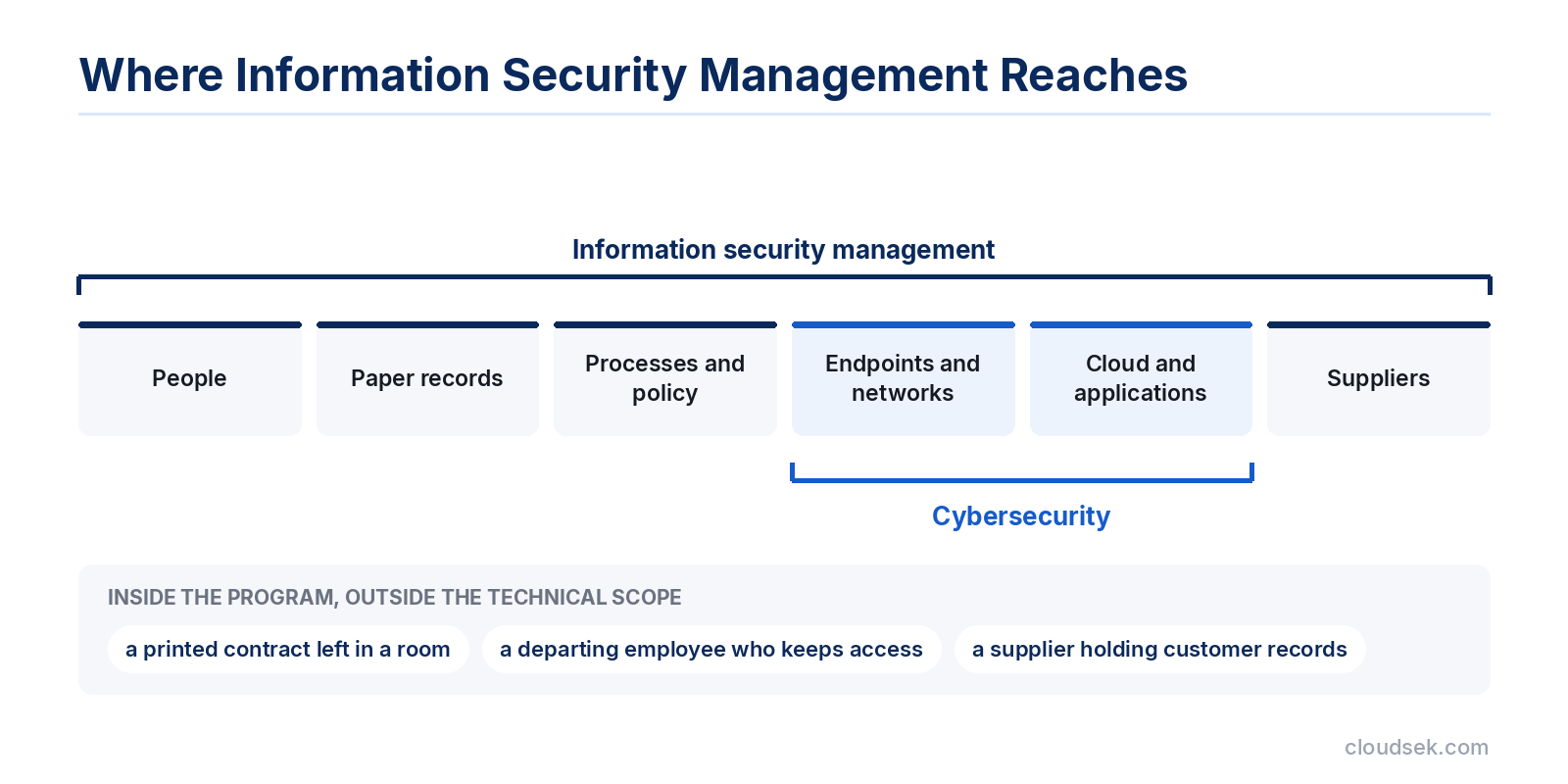
Technology scope reaches further than most programs assume. Organizations running industrial or facility systems carry a second technology estate with different risk tolerances and control constraints, and the distinction between IT and OT environments determines which controls transfer between them and which create operational risk when applied without modification.
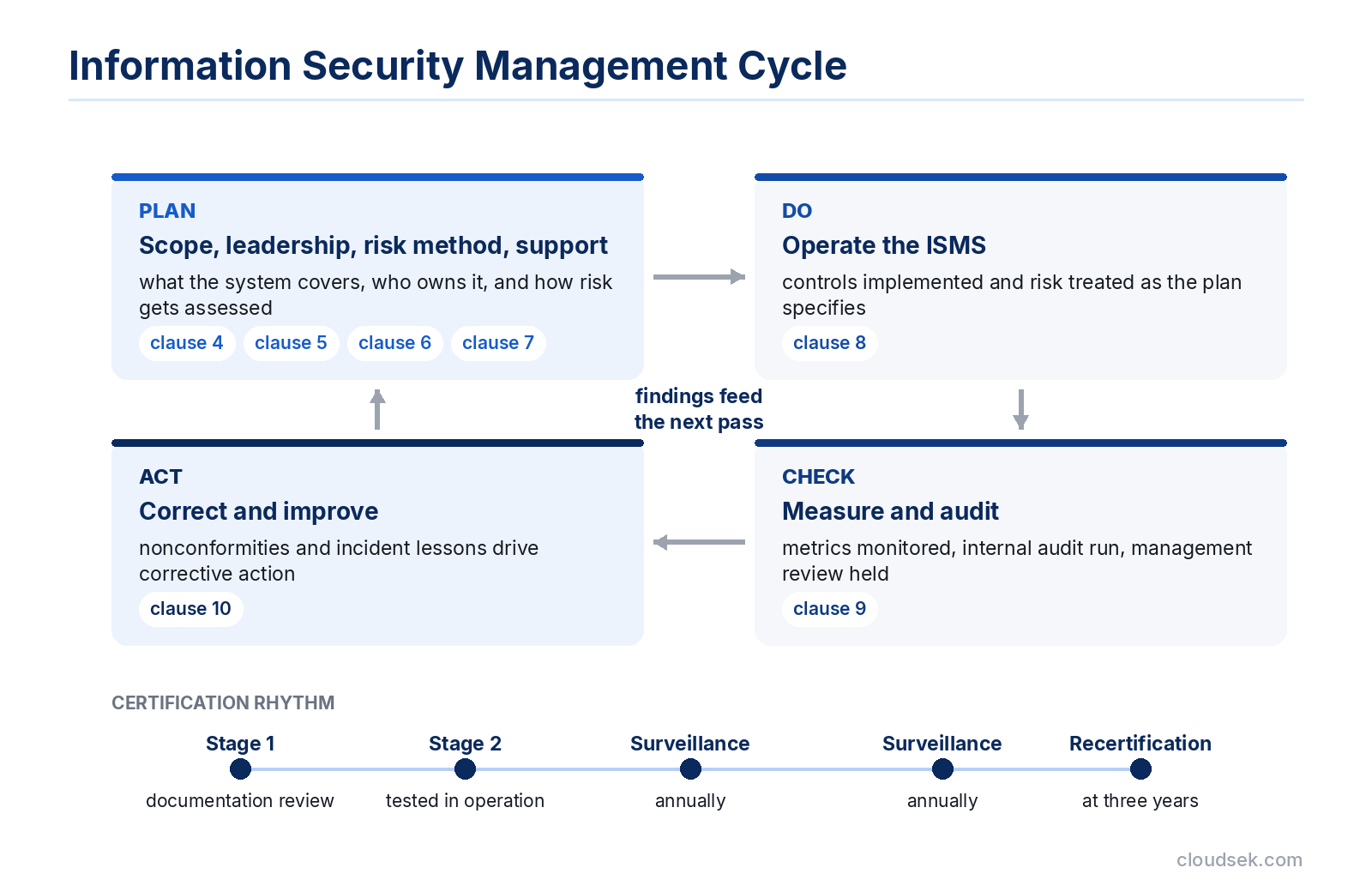
An ISMS works by running information security as a documented, repeating management cycle rather than as a set of standing controls. ISO/IEC 27001 specifies that cycle in clauses 4 through 10, and those clauses, rather than the control list, are what an auditor certifies against. The cycle follows Plan-Do-Check-Act: scope and risk methodology are established, controls are implemented, performance is measured, and findings feed the next round.
Every later decision inside an ISMS inherits its scope, which is why clause 4 requires an organization to state exactly which business units, locations, systems, and information types the system covers, along with the internal and external issues and interested parties shaping its security obligations. A scope drawn too narrowly produces a certificate that impresses nobody, since customers read the scope statement before the certificate.
Responsibility under clause 5 sits with top management explicitly rather than with the security function. Executives approve the information security policy, assign roles and authority, and provide visible commitment, and auditors test this by asking who made a given risk decision rather than by reading the policy document.
Planning under clause 6 fixes how the organization will assess and treat risk before any assessment runs. The methodology specifies how risks are identified, what impact and likelihood scales apply, who owns each risk, and what criteria trigger treatment, which is what makes results comparable between assessment cycles and between different assessors.
Clause 7 covers the support the ISMS needs to function: competent people, awareness across the workforce, defined communication paths, and controlled documentation. Programs that skip this clause tend to produce accurate risk registers nobody outside the security team has read.
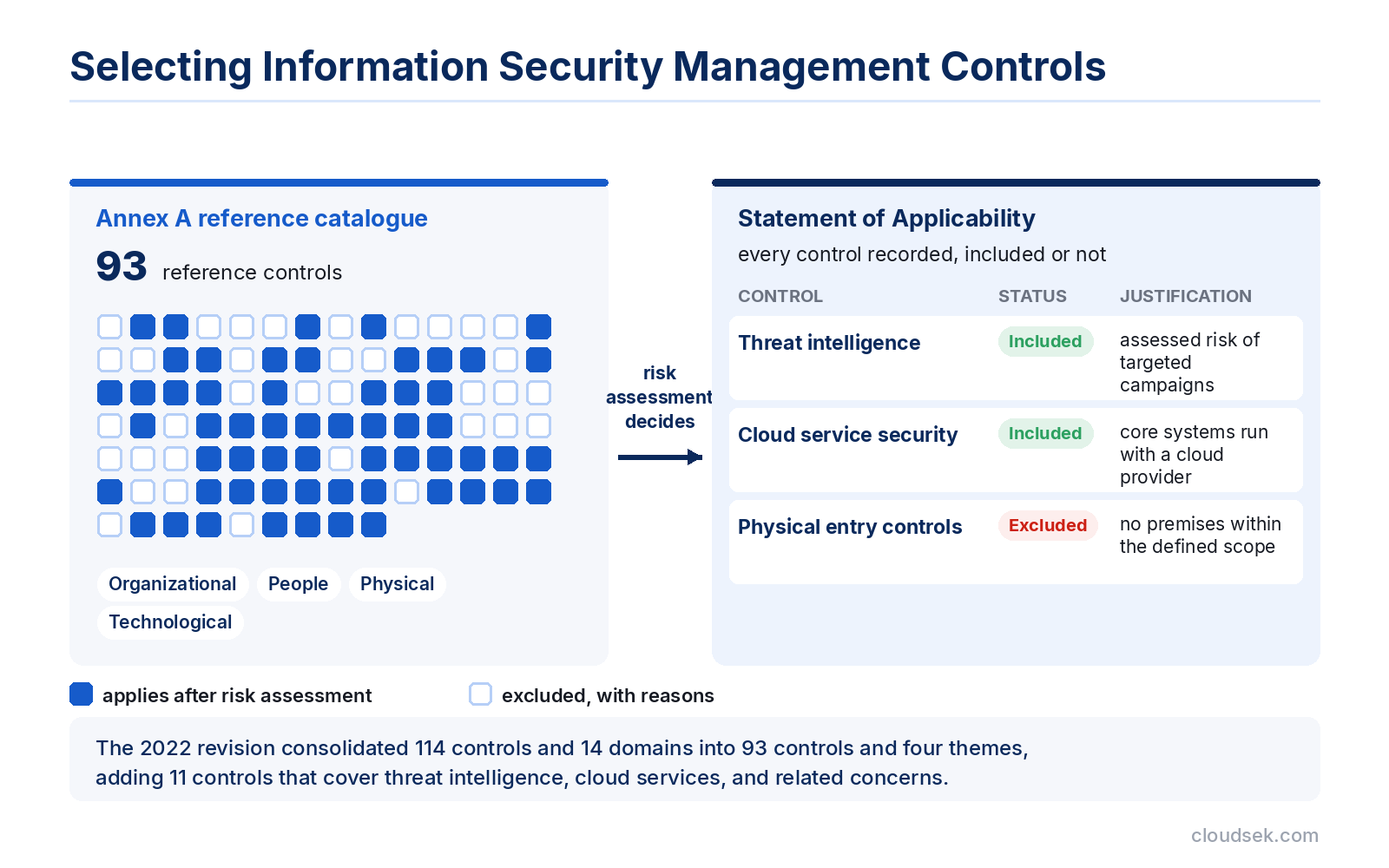
Annex A of ISO/IEC 27001:2022 lists 93 reference controls grouped into four themes: organizational, people, physical, and technological. The 2022 revision consolidated the previous 114 controls and 14 domains, and added 11 controls covering newer concerns including threat intelligence and cloud service security.
Selection is where the standard resists shortcuts, because Annex A functions as a reference catalogue rather than a checklist. Risk assessment determines which controls apply, and the Statement of Applicability records every control, whether it was included or excluded, and the justification for that decision. Auditors examine the Statement of Applicability closely because it reveals whether control selection followed the organization’s own risk findings or simply copied a template.
Performance evaluation under clause 9 is what turns the ISMS from documentation into something measurable. Control performance is monitored against defined metrics, internal audit tests whether the system operates as written, and management review puts results in front of the executives accountable for them on a fixed schedule.
Nonconformities raised in audit, lessons drawn from incidents, and shifts in the business or threat environment all feed corrective action under clause 10, which is the mechanism that keeps an ISMS current between certification dates rather than frozen at the last audit.
Certification audits follow the same rhythm as the management cycle itself. A Stage 1 audit reviews documentation and readiness, a Stage 2 audit tests whether the ISMS operates as documented, and surveillance audits run annually across a three-year certification cycle before full recertification. The ISMS has to run long enough before Stage 2 to generate the records auditors sample, which is why organizations cannot compress implementation into the weeks before an audit date.
Voluntary standards and binding regulations both shape information security management, and the distinction matters for planning. Standards such as ISO/IEC 27001 are adopted by choice and certified by an accredited body, while regulations apply by jurisdiction or industry and carry penalties for noncompliance.
Overlap between these frameworks is substantial and works in an organization’s favor. NIST CSF 2.0 added a Govern function in its 2024 revision that maps closely to the ISO 27001 leadership and planning clauses, and a healthcare provider processing EU card payments satisfies large parts of HIPAA, GDPR, and PCI DSS through the same control set once an ISMS defines it centrally.
Information security management reduces breach cost, sustains operations, and produces the evidence regulators and customers require. IBM’s Cost of a Data Breach Report 2026 places the global average breach cost at a record $4.99 million, up 12% year over year, with mean time to identify and contain rising to 247 days after five consecutive years of improvement.
Five outcomes follow from a functioning program:
Implementation runs into five recurring obstacles, and awareness of them shapes realistic program planning.
Third-party exposure has moved fastest of the five. The 2026 DBIR recorded third-party involvement in 48% of breaches, a 60% year-over-year rise, and CloudSEK’s investigation into the LiteLLM supply chain compromise shows the mechanism: attackers poisoned an upstream dependency and swept credentials from the build pipelines of more than 2,500 organizations in roughly 40 minutes. Vendor questionnaires answered annually describe none of that, which is why supply chain attack prevention now sits inside information security management rather than beside it.
Implementation succeeds or fails on sequence. Working through the following steps in order prevents the common outcome of controls deployed before anyone established what they protect.
Architectural choices reinforce the program. Applying zero trust principles to access decisions removes the implicit trust that flat networks grant, which limits how far a single compromised credential travels before controls intervene.
Maturity describes how consistently an organization structures, operates, and improves its information security management. Five levels mark the progression, and honest placement on the scale matters more than the label.
Most organizations pursuing certification operate between the defined and managed levels, since ISO 27001 requires documented processes and measured performance but does not demand full integration with enterprise risk. Maturity assessment guides investment sequencing and establishes the baseline against which audit readiness gets judged.
Information security management earns its value from ongoing practice rather than one-time implementation. Organizations that treat certification as a finish line often accumulate documented controls describing an environment that has already changed. The gap between what is recorded and what actually exists is precisely what incidents expose.
Programs that hold up share three traits. Scope reflects where information actually lives, including supplier systems and platforms adopted without central approval. Risk decisions are recorded with enough reasoning that a successor understands why a control was selected or declined. Review happens on a schedule that survives competing priorities, because the discipline works through the cycle rather than through any single control within it.
No. ISO 27001 is a voluntary standard, and no jurisdiction requires it by law. Enterprise customers and public sector tenders make certification a contractual condition, which turns a voluntary standard into a commercial requirement in practice.
Accountability sits with executive leadership; in most structures, a CISO or equivalent, with the board or an audit committee retaining oversight. ISO 27001 assigns responsibility to top management explicitly, and delegating it entirely to a security team is a common audit finding.
Most organizations reach certification in six to twelve months from a standing start. Scope size, existing documentation, and the number of controls requiring new implementation drive the variance, and the ISMS must operate long enough to generate audit evidence before Stage 2.
It can, and scope is what makes it practical. A twenty-person company applying the same clauses to a narrow scope produces a proportionate ISMS, since ISO 27001 specifies what to decide rather than how many controls to deploy.
Internal audits run at least annually and cover the full ISMS across a defined cycle. Certified organizations receive annual surveillance audits from their certification body, with full recertification every three years.
No. Data privacy governs how personal information is collected, used, and shared, while information security management protects information of all kinds from unauthorized access, alteration, and loss. The disciplines overlap heavily, and privacy obligations rely on security controls for enforcement.
