🚀 CloudSEK featured in the 2026 Frost Radar™!
Read more
.avif)

Strategic threat intelligence is a high-level analysis of cyber threats that helps organizations understand long-term risks, attacker motives, and business impact for informed decision-making.
This intelligence focuses on the broader threat landscape instead of technical details. It explains why attacks happen, who is behind them, and what they target. A broader view helps organizations understand risk in clear business terms instead of raw technical data.
Clear insights connect cybersecurity with business strategy. These insights translate complex threat information into actionable understanding for leadership. Long-term trend analysis reveals patterns in attacker behavior and supports better planning and risk management.
Reliable strategic threat intelligence originates from multiple high-level sources that provide context and depth. These sources include threat intelligence reports, cybersecurity research publications, government advisories, industry reports, geopolitical analysis, dark web monitoring, open-source intelligence (OSINT), commercial intelligence platforms, internal security data, and global news sources. Combining these sources creates a complete and accurate view of the threat landscape.
Strategic threat intelligence is important because it improves decision-making, strengthens risk awareness, identifies emerging threats, supports long-term planning, prepares organizations for future risks, and builds industry-level awareness.
According to IBM Security research, organizations that effectively leverage threat intelligence can detect and respond to cyber threats up to 50% faster than those without structured intelligence programs.
Here are the key benefits of strategic threat intelligence:
Strategic threat intelligence provides clear insights that leaders use to make informed decisions. It explains risks in business terms instead of technical language. Better understanding helps executives allocate resources and set priorities with confidence.
Accurate intelligence highlights which threats matter most to the organization. It connects cyber risks to financial, operational, and reputational impact. Clear risk awareness helps organizations focus on what truly affects the business.
Continuous analysis reveals new attack patterns and evolving threat actors. This visibility shows how threats change over time. Early awareness helps organizations stay ahead of potential risks.
Long-term insights guide security strategies and future investments. Organizations align their defenses with expected threats instead of reacting to incidents. Strategic planning reduces uncertainty and improves resilience.
Prepared organizations respond more quickly and effectively to threats. Intelligence provides the context needed to anticipate risks before they occur. Better preparation reduces disruption and improves overall security posture.
Strategic intelligence shows how threats impact specific industries and competitors. It reveals targeted attack patterns and sector-wide risks. Industry awareness helps organizations benchmark their security posture and stay competitive.
Strategic threat intelligence stands apart because of its scope, focus, and the way it communicates insights to decision-makers. The following are the key characteristics of strategic threat intelligence:
Strategic threat intelligence concentrates on broad threat patterns instead of technical details. It explains trends, attacker intent, and overall risk direction. This high-level view helps leaders understand threats without needing technical expertise.
Analysis focuses on trends over months or years rather than short-term incidents. It tracks how threats evolve and how attacker behavior changes over time. A long-term view supports planning and future risk preparation.
Insights connect cyber threats directly to business impact, such as financial loss, operational disruption, or reputational damage. This connection makes the information relevant to leadership. Business context ensures decisions align with organizational priorities.
Information is presented in clear, simple language without technical complexity. Reports often include summaries, risk ratings, and key insights. Simple communication ensures leaders can quickly understand and act on the information.
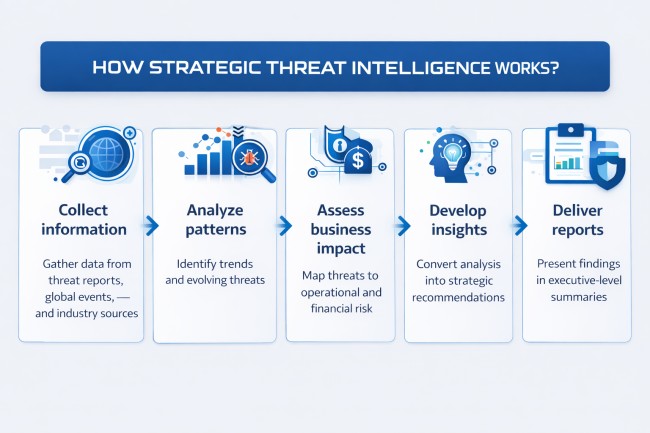
Strategic threat intelligence works by collecting information, analyzing long-term trends, assessing business impact, and delivering clear insights for decision-making.
The process begins with gathering information from multiple reliable sources, such as threat reports, industry analysis, and global events. Analysts review this information to identify patterns and shifts in the threat landscape. Pattern analysis reveals how threats evolve and which risks are becoming more significant over time.
Once patterns are identified, the next step focuses on understanding how these threats affect the organization. This involves mapping threats to business operations, financial impact, and strategic goals. A clear impact assessment helps leadership understand which risks require attention.
The final step turns analysis into simple and structured insights. These insights are shared through reports designed for decision-makers. Clear reporting ensures leaders can act quickly and make informed strategic decisions.
Strategic threat intelligence relies on several essential components that build a complete understanding of the threat landscape.
Threat landscape analysis examines global and industry-specific threats. It identifies trends, common attack types, and target sectors. This analysis provides a clear picture of the overall risk environment.
Adversary profiling studies who the attackers are, what they want, and how capable they are. It focuses on motives such as financial gain, espionage, or disruption. Understanding attackers helps predict their future actions.
Risk assessment frameworks evaluate how threats impact the organization. They measure potential damage to operations, finances, and reputation. Structured assessment helps prioritize risks based on real impact.
The geopolitical context connects cyber threats with global events such as conflicts, regulations, or economic shifts. These factors influence attacker behavior and targeting. Global context explains why certain threats emerge or increase.
Executive reporting presents insights in a clear and simple format. Reports highlight key risks, trends, and recommendations without technical complexity. Clear reporting ensures leaders understand and act on the information.
Organizations struggle with gaps in visibility, unclear priorities, and reactive security decisions when strategic context is missing. Here are the main problems a strategic threat intelligence solves:
Many organizations see isolated security events but miss the bigger picture. This creates confusion about the overall risk direction. Strategic threat intelligence solves this by providing a clear view of long-term threats and trends.
Security decisions often happen without linking them to business goals. This leads to misaligned priorities and wasted resources. Strategic threat intelligence connects cyber risks with business objectives, improving decision alignment.
Large volumes of threat data make it difficult to identify what matters most. Teams may focus on low-impact issues. Strategic threat intelligence highlights high-impact risks, helping organizations focus on what truly matters.
Many organizations respond only after incidents occur. This approach increases damage and recovery time. Strategic threat intelligence shifts the approach from reactive to proactive by identifying future risks early.
Leaders often lack a clear understanding of cyber threats due to technical complexity. This limits effective decision-making. Strategic threat intelligence simplifies information, making it accessible and useful for executives.

Organizations apply strategic threat intelligence in specific scenarios where long-term risk understanding directly influences decisions.
Executive teams rely on clear and concise reports to understand the threat landscape. These reports highlight key risks, trends, and potential business impact. Structured reporting helps leaders make informed strategic decisions.
Budget decisions depend on understanding which threats pose the highest risk. Strategic intelligence shows where to invest in tools, teams, or controls. Informed planning ensures resources are used effectively.
Different industries face different types of threats. Strategic intelligence identifies sector-specific risks and attacker focus areas. Industry analysis helps organizations prepare for targeted attacks.
During mergers and acquisitions, organizations need to assess the cybersecurity posture of the target company. Strategic intelligence reveals potential risks and hidden threats. Accurate evaluation prevents future security issues after integration.
Security policies and frameworks require alignment with real-world threats. Strategic intelligence guides the creation of policies based on current and future risks. Well-informed policies improve overall security governance.
Strategic threat intelligence faces challenges related to data volume, context gaps, resource limitations, and rapidly changing threats.
Large amounts of data create confusion instead of clarity. Organizations collect information from many sources, but not all of it is useful. Too much unfiltered data makes it difficult to identify what truly matters.
Another challenge comes from the lack of a clear business context. Raw threat data often does not explain how risks affect operations or revenue. At the same time, skilled analysts are required to interpret this information, and not every organization has access to such expertise. Limited context and resources reduce the effectiveness of intelligence.
Threats continue to evolve quickly, which makes long-term prediction difficult. Attackers change methods, targets, and strategies over time. Constant change requires continuous analysis to keep intelligence relevant and accurate.
Strategic, tactical, and operational threat intelligence are types of threat intelligence but differ in focus, time horizon, and usage. Strategic intelligence explains long-term risks and business impact. Tactical intelligence focuses on attacker methods and techniques. Operational intelligence tracks active threats and ongoing campaigns. Each type serves a different purpose but works together to strengthen overall security.
Here is the comparison table to understand in a better way:
Effective outcomes depend on how intelligence is collected, analyzed, and delivered across the organization. Here are the strategic threat intelligence best practices an organization must follow:
Strategic threat intelligence must reflect organizational priorities such as revenue, operations, and reputation. This alignment ensures that insights stay relevant to decision-makers. Business alignment improves the value of intelligence.
Reliable insights require data from multiple sources, such as reports, research, and global events. Diverse inputs reduce bias and improve accuracy. Multiple sources create a more complete threat picture.
Reports must present information in a clear and structured way without technical complexity. Simple formats help leaders understand risks quickly. Clear communication improves decision-making speed.
Threat landscapes change over time, so intelligence must stay current. Regular updates ensure that insights reflect the latest trends. Continuous updates maintain relevance and accuracy.
Strategic intelligence must connect with existing risk management processes. This integration ensures that insights influence real decisions and actions. Integration strengthens the overall security strategy.
The goal is to provide high-level insights that guide business and security decisions.
Executives, CISOs, and risk managers benefit the most from strategic insights.
Yes, it supports long-term decisions rather than immediate technical actions.
Strategic intelligence focuses on trends and impact, while technical intelligence focuses on indicators and data.
