🚀 CloudSEK featured in the 2026 Frost Radar™!
Read more
.avif)

Spyware works by staying out of sight. It slips onto a device bundled with free software or hidden inside a fake update, settles into the background, and quietly records passwords, keystrokes, and browsing activity before sending everything to whoever planted it. That hidden behavior is the whole point: spyware is malicious software that secretly monitors a device and steals its data, designed to go unnoticed for as long as possible.
Behind the quiet sits an industrial economy. The European Union Agency for Cybersecurity (ENISA) ranks info-stealers among the most prevalent threats fuelling credential theft and access brokering, with the Lumma stealer assessed as the most widespread strain in circulation through 2025.
Spyware is a broad category of malware defined by intent rather than technique: it gathers information about a person or organization without consent and hands it to a third party. What it takes ranges from passwords and payment details to messages, location, and a full record of everything typed.
Concealment separates spyware from noisier malware. Ransomware announces itself, and adware floods the screen, whereas spyware earns its value by running unnoticed, sometimes for months, while it collects. That patience is what makes it dangerous even when the payload looks modest.
The label covers a wide span, from consumer tracking cookies to government-grade surveillance tools. What unites them is the quiet siphoning of data from a device its owner believes is private.
Spyware follows the same three-phase pattern regardless of its target.
Spyware reaches a device by deception. It rides along with free software, hides inside a cracked application or a fake update, or arrives through a phishing link that runs code the moment it opens.
Once resident, spyware watches. Keyloggers record every keystroke, screen recorders capture activity, and browser-focused variants copy saved passwords, autofill data, and the session cookies that keep a user logged in.
Collected data leaves quietly. Spyware sends it to a command-and-control server the attacker controls, often in small bursts disguised as ordinary traffic, and modern infostealers complete the whole cycle within 48 hours of infection.
Spyware spans several forms, distinguished by what they collect and who deploys them:
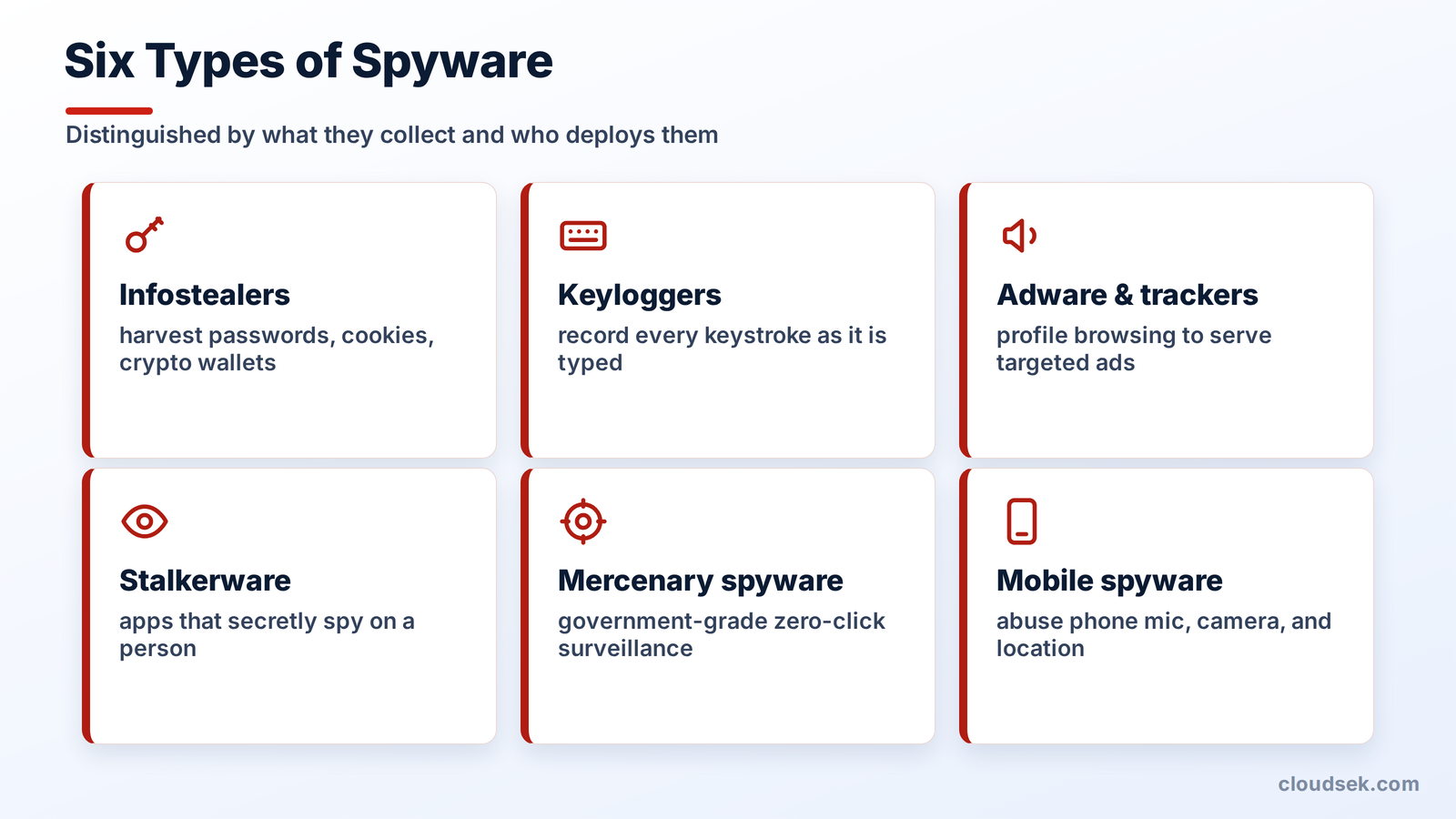
Real spyware families show how far the category stretches, from early nuisance software to state-grade surveillance:
Spyware relies on a handful of dependable delivery routes:
Spyware hides by design, though several symptoms tend to surface:
Infostealers have become the dominant form of spyware, run as a professional business. Malware-as-a-service vendors rent variants like Lumma and RedLine for a monthly fee, letting unskilled operators harvest credentials at scale.
The session cookie is the prize. Once a user clears multi-factor authentication, the browser holds a token proving the check already passed, and an infostealer that copies that token lets an attacker resume the session without facing MFA at all.
That single capability rewires the breach economy. Stolen logs reach dark web markets within hours, initial access brokers filter them for corporate VPN and SSO credentials, and ransomware crews buy the qualifying ones to log straight into target networks. Phishing emails carrying infostealers have climbed sharply year over year, and the 2024 Snowflake breaches, which reached roughly 165 organizations, ran entirely on infostealer-harvested credentials that lacked MFA.
Monitoring for exposed credentials is the counter. Because stealer logs surface publicly and in criminal markets, watching those sources for a company's leaked credentials closes the window between infection and misuse. CloudSEK's research tracks this underground economy, tracing how infostealer logs feed the credential trade that fuels ransomware and account takeover.
Removing spyware follows a clear sequence, and the order matters:
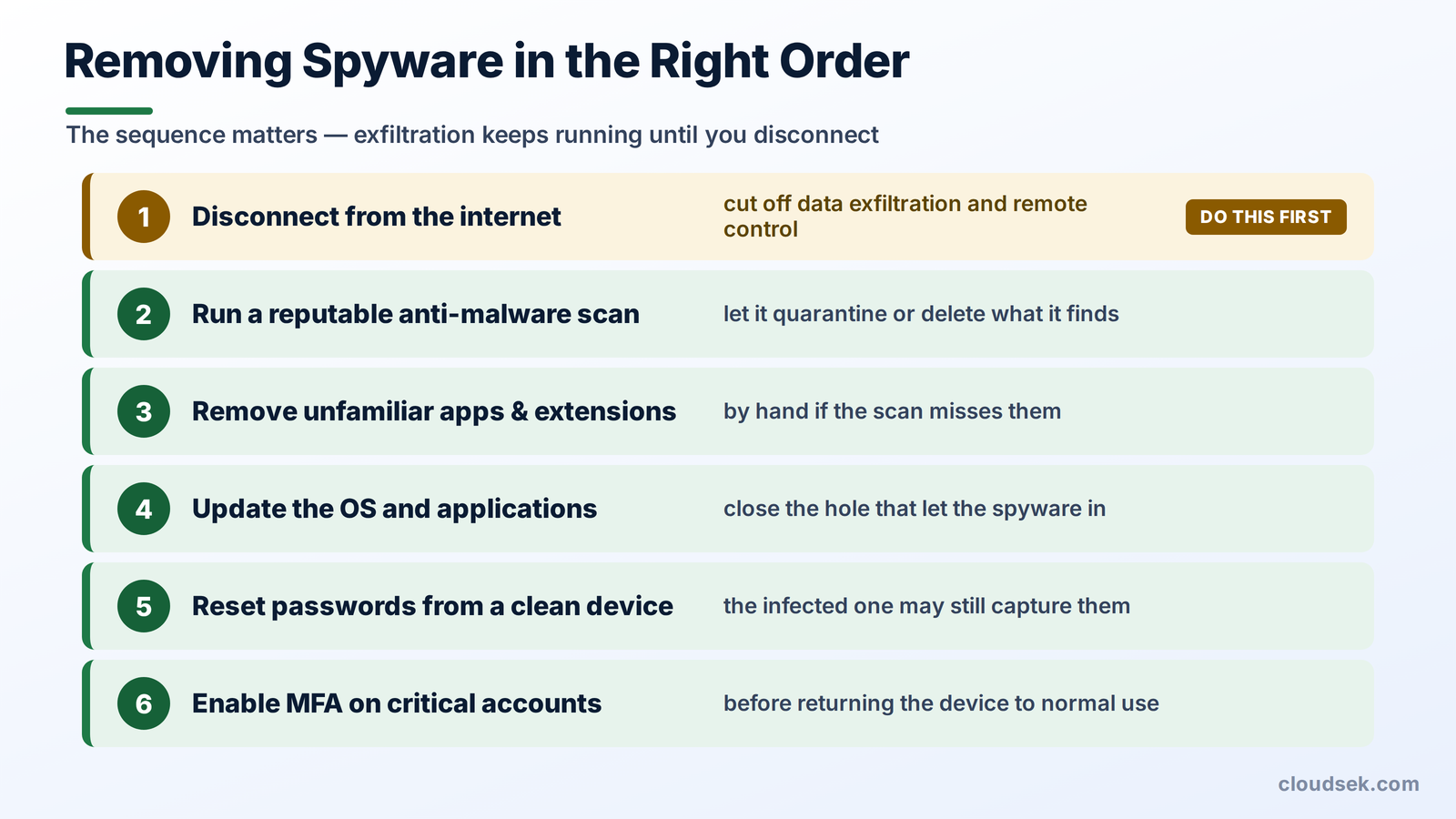
how-to-remove-spyware
Preventing spyware comes down to limiting how it arrives and what it reaches:
No, spyware and viruses are different types of malware. A virus replicates and spreads to other files or systems, while spyware focuses on silently collecting data and does not necessarily self-replicate.
Creating or installing spyware on a device without the owner's consent is illegal in most jurisdictions. Commercial surveillance tools and stalkerware occupy contested legal ground that varies by country.
Spyware secretly steals data, while adware displays unwanted advertisements. Adware crosses into spyware when it tracks and profiles behavior without consent.
Yes, phones are common spyware targets through malicious apps, stalkerware, and mercenary surveillance tools. Both Android and iOS devices are affected.
A factory reset removes most spyware by wiping the device to its original state. Advanced mercenary spyware that embeds in firmware occasionally survives and needs vendor-level intervention.
Antivirus catches most common spyware but not all of it. Advanced and mercenary variants use evasion techniques that routine scanning misses, which is why layered defenses matter.
