What Is Enterprise Security? Domains, Threats, and Controls
Enterprise security is the organization-wide protection of data, systems, identities, networks, and operations through layered controls and governance.
Enterprise security is the organization-wide protection of data, systems, identities, networks, and operations, combining technical controls, operational processes, and governance across every environment a business runs.
CloudSEK's year-long investigation into public Postman workspaces found more than 30,000 of them leaking access tokens, refresh tokens, and third-party API keys, with 5,924 exposures tied to GitHub, 5,552 to Slack, and 4,206 to Salesforce.
None of those exposures involved an intrusion, an unpatched vulnerability, or a failed control. Developers shared a collection, permissions stayed open, and live credentials for healthcare, financial services, and retail systems became publicly readable outside every internal defense the affected organizations had funded.
Why is Enterprise Security Important?
Enterprise security is crucial because modern organisations operate large, distributed, and constantly evolving digital environments where security failures directly impact financial performance, regulatory standing, and executive accountability.
Here are the reasons why enterprise security is essential:
Protection of Sensitive Assets
Enterprises manage customer data, intellectual property, financial records, and regulated information that require continuous protection to prevent financial loss and legal exposure.
Operational Continuity
Cyber incidents cause downtime, service disruption, and productivity loss across business units and geographies, directly affecting revenue and service delivery.
Regulatory and Legal Compliance
Enterprises must comply with regulations such as GDPR, HIPAA, PCI DSS, and industry-specific mandates, where non-compliance results in fines, penalties, and regulatory scrutiny.
Reputation and Customer Trust
Data breaches and service outages reduce customer confidence, damage brand credibility, and create long-term market impact.
Support for Digital Transformation
Cloud adoption, remote work, and third-party integrations expand the attack surface and increase security complexity, making enterprise security essential for safe innovation and growth.
How Does Enterprise Security Work?
Enterprise security works by applying layered controls across every environment, binding people, process, and technology into one operating model, and adjusting protection continuously as risk and exposure change.
Layered Controls Across Hybrid Environments
Controls stack across on-premises systems, cloud platforms, endpoints, applications, identities, and networks so a single failure never exposes the whole organization. Each layer narrows what an attacker reaches after clearing the one before it, which matters most in hybrid estates where ownership of each environment sits with a different team.
People, Process, and Technology as One Operating Model
Mature programs run as an operating model, not a tool inventory. People hold accountability and decision rights, documented processes define escalation and approval paths, and technology enforces the controls while producing the telemetry that shows whether enforcement actually held.
Risk-Driven Security Lifecycle
Enterprise security cycles through five stages, and the cycle repeats continuously without ever closing out on a completion date.
Visibility: inventory assets, users, configurations, and internet-facing exposure across the full estate, including systems no team formally registered.
Protection: apply access management, segmentation, hardening, and encryption in the order that business impact and exploitability dictate.
Detection: monitor telemetry for intrusion, misuse, and behavior that deviates from an established baseline.
Response: contain the incident, remove attacker access, remediate the weakness that allowed entry, and restore affected services.
Improvement: feed incident findings, threat trends, and audit results back into control design and policy.
Centralized Visibility and Policy Enforcement
Correlation across environments converts isolated signals into a picture an analyst can act on, and orchestration removes the manual handoffs that stretch response times. Policy-driven enforcement keeps access rules, data handling, and control baselines identical whether a workload runs on-premises, in a public cloud, or inside a SaaS platform.
Assets Enterprise Security Protects
Enterprise security protects the full range of assets that enable an organisation to operate securely, remain compliant, and maintain continuity across complex and interconnected digital ecosystems.
Data assets: customer records, intellectual property, financial data, employee information, and regulated data held across internal systems, cloud storage, and third-party processors.
IT infrastructure: networks, servers, endpoints, data centers, cloud workloads, and the connections between them.
Applications and digital services: web applications, APIs, enterprise software, SaaS platforms, and internally built systems used by employees, partners, and customers.
Identities and access: employees, contractors, partners, service accounts, and privileged users, each carrying entitlements that determine blast radius when compromised.
Business operations: system availability, service uptime, and continuity of the processes that generate revenue across regions and business units.
External digital footprint: public-facing domains, exposed services, partner integrations, and brand presence that form the external attack surface an attacker maps before acting.
Core Domains of Enterprise Security
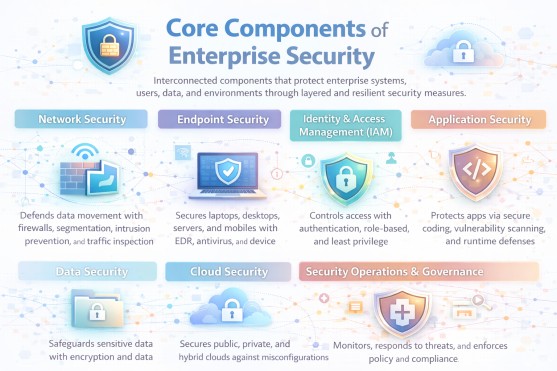
Enterprise security divides into nine key control domains, each owning a distinct risk area while contributing to one shared view of organizational posture.
Network security: firewalls, segmentation, intrusion prevention, and traffic inspection that restrict how data moves and limit lateral movement between systems.
Endpoint security: endpoint detection and response(EDR), device hardening, and continuous monitoring across laptops, servers, and mobile devices.
Identity and access management: authentication, role-based access, least privilege, privileged access controls, and joiner-mover-leaver lifecycle enforcement.
Application security: secure coding standards, dependency scanning, penetration testing, and runtime protection across the software lifecycle.
Data security: classification, encryption, access control, and data loss prevention applied wherever regulated data comes to rest or moves.
Cloud security: configuration baselines, workload protection, entitlement management, and clear ownership under the shared responsibility model.
Third-party and supply chain security: continuous vendor risk monitoring, dependency mapping, and controls that address fourth-party exposure beyond direct contracts.
AI attack surface security: discovery and protection of the AI attack surface formed by models, inference APIs, agents, and unsanctioned AI tools inside the organization.
Security operations and governance: detection engineering, incident response, and the security operations practices that turn control coverage into measurable outcomes.
Enterprise Security vs Traditional IT Security
Enterprise security differs from traditional IT security on scope, orientation, and where trust is placed. Traditional models defended a perimeter that contained the assets, and that containment stopped being accurate once workloads, users, and data moved outside it.
Aspect
Enterprise Security
Traditional IT Security
Scope of Protection
Entire organization, including cloud, SaaS, remote users, and third parties
Individual systems, networks, and on-premises environments
Security Approach
Risk-based and proactive, prioritized by business impact
Perimeter-based and largely reactive
Environment Coverage
Built for hybrid, multi-cloud, and distributed work
Built for static, on-premises estates
Identity Treatment
Identity as the primary control plane, with governance and least privilege
Identity as a supporting control behind the network boundary
Governance and Compliance
Integrated policy, risk management, and regulatory reporting
Limited formal governance, handled separately from operations
Business Alignment
Tied to resilience planning and board-level risk reporting
Operated as a technical function inside IT
Adaptability
Evolves with organizational change and threat movement
Slow to adjust in dynamic environments
Enterprise Security Threats and Business Impact
Attacks against enterprise environments cluster into the following recurring categories, and their financial consequences are measured rather than estimated.
Phishing and social engineering: credential-harvesting messages and social engineering pretexts open most intrusions, and IBM recorded phishing as the initial vector in 16 percent of studied breaches.
Ransomware and advanced persistent threats: encryption and extortion campaigns disrupt operations directly, while advanced persistent threats pursue long-term access and quiet data theft.
Credential theft and identity exploitation: reused and leaked credentials grant authenticated entry that produces no malware signature, then support privilege escalation and lateral movement.
Supply chain compromise: a single poisoned dependency or breached vendor reaches every downstream customer, placing supply chain attacks outside the direct control of the affected organization.
Cloud misconfiguration and API exposure: open storage buckets, permissive entitlements, and unauthenticated APIs remain the most common route into cloud estates.
Insider threats: employees and contractors with legitimate access cause loss through deliberate misuse or ordinary error, and IBM recorded malicious insider breaches as the most expensive category at $4.92 million.
Availability attacks: volumetric denial-of-service campaigns interrupt customer-facing services and pull response capacity away from concurrent intrusions.
Board-level cost drivers now extend past ransomware exposure and the familiar breach categories. IBM recorded shadow AI in 20 percent of studied breaches, with 97 percent of AI-related breaches occurring where access controls were absent and 63 percent at organizations holding no AI governance policy at all.
Enterprise Security Architecture Principles
Enterprise security architecture defines how controls are placed, sequenced, and integrated so protection scales with the organization. Five principles carry most of the design weight.
Zero trust access: verify identity, device posture, and session context on every request, applying zero trust conditions instead of granting trust by network location.
Defense in depth: place independent controls at the network, endpoint, application, identity, and data layers so one failure never becomes a full compromise.
Attack path correlation over alert volume: connect individual findings into attack graphs that show how weaknesses chain, which converts a queue of alerts into a ranked list of attack paths worth breaking.
Integrated controls with shared context: architect tools to exchange intelligence and trigger each other through automation, closing the gaps that appear between disconnected products.
Risk-aligned control placement: weight investment by asset criticality, exploitability, and business impact so the strongest controls sit on the systems an organization cannot afford to lose.
Governance, Risk, and Compliance in Enterprise Security
Governance, risk, and compliance make enterprise security measurable and accountable to people outside the security team. Policy defines expected behavior, risk assessment ranks what matters, and audit evidence demonstrates that controls are performed as documented. Information security management supplies the documented system that holds those three together.
Reference
Type
What It Contributes to an Enterprise Security Program
NIST Cybersecurity Framework 2.0
Voluntary framework
Six functions covering governance, asset identification, protection, detection, response, and recovery, expressed as outcomes leadership can track
ISO/IEC 27001:2022
Certifiable standard
Requirements for an information security management system, with external certification that customers and regulators recognize
CIS Critical Security Controls
Prioritized control set
An implementation-ordered list of technical safeguards suited to teams that need a starting sequence
MITRE ATT&CK
Adversary knowledge base
Tactics and techniques that let detection coverage be measured against observed attacker behavior
GDPR, HIPAA, PCI DSS
Regulatory and contractual
Binding obligations on personal, health, and cardholder data, carrying financial penalties for non-compliance
Governance moved to the center of the reference model in 2024. NIST published Cybersecurity Framework 2.0 on February 26 of that year, adding Govern as a sixth function alongside Identify, Protect, Detect, Respond, and Recover, expanding scope from critical infrastructure to organizations of every size, and strengthening its treatment of supply chain risk across 22 categories and 106 subcategories.
Detection coverage benefits from the same mapping discipline that governance frameworks bring to policy and audit evidence. Mapping controls to the MITRE ATT&CK framework replaces a subjective sense of readiness with a documented view of which attacker techniques the program detects and which it misses.
Enterprise Security Challenges
Enterprise security programs run into the same six challenges regardless of sector, budget, or maturity. Each one degrades visibility, control consistency, or the ability to prioritize accurately.
Expanding attack surface: cloud adoption, remote work, SaaS sprawl, and partner integrations add exposed assets faster than inventory processes record them.
Hybrid environment complexity: holding identical policy across on-premises, cloud, and SaaS estates creates enforcement gaps wherever a control has no equivalent in one environment.
Identity sprawl and privilege creep: accumulated entitlements across human and service accounts widen blast radius long before any attacker arrives.
Tool sprawl without shared context: disconnected products generate alert volume with no ranking by business impact, which buries the findings that matter.
Skills and capacity constraints: limited availability of experienced practitioners slows detection engineering, response, and program improvement.
Third-party dependency risk: a third-party data breach transfers consequences to an organization that had no ability to inspect the failing control.
How to build an Enterprise Security Program?
Program sequence determines how quickly coverage becomes real rather than aspirational. Inventory precedes prioritization, and prioritization precedes any purchase decision.
Inventory assets and exposure. First, build a current record of systems, identities, data stores, cloud accounts, and internet-facing services, including the assets no team registered.
Rank risk by business impact. Second, score each asset on criticality, exploitability, and regulatory weight, then use that ranking to order every control decision that follows.
Establish identity governance. Third, enforce least privilege, remove standing administrative access, and run recurring entitlement reviews across human and service accounts.
Close the highest-exploitability gaps. Fourth, remediate internet-facing vulnerabilities, exposed credentials, and misconfigured cloud services before addressing internal findings.
Build detection against real techniques. Fifth, map detection coverage to documented attacker behavior and measure gaps by technique, not by alert count.
Rehearse response and recovery. Sixth, run tabletop exercises and technical simulations covering ransomware, vendor compromise, and account takeover, then correct the playbook gaps each exercise exposes.
Report outcomes to leadership. Seventh, present coverage, containment times, and residual risk to executives and the board in terms of business consequence.
Secure Your Organization with CloudSEK
Enterprise security programs control what the organization owns and configures, and attackers begin outside that boundary. Leaked credentials, exposed services, lookalike domains, and vendor weaknesses are visible from the public internet well before any of them appear in an internal alert queue.
CloudSEK covers that external half through four monitoring surfaces feeding one correlation layer. BeVigil fingerprints the external attack surface across web applications, APIs, cloud, DNS, SSL, and network assets. XVigil watches surface, deep, and dark web sources for organization-specific exposure and brand abuse. SVigil tracks vendor posture continuously, and AIVigil covers the AI attack surface that most enterprise programs have yet to inventory.
Nexus AI correlates those signals into validated attack paths, showing how a leaked credential, an exposed asset, and a vendor weakness combine into one executable route rather than three unrelated findings. Prioritization by reachable path answers the question every enterprise security program eventually reaches: which exposure gets fixed first, and why that one.
Frequently Asked Questions
What is the difference between enterprise security and cybersecurity?
Cybersecurity names the discipline. Enterprise security applies it organization-wide, adding governance, risk management, and business alignment across every environment the organization operates.
At what size does an organization need enterprise security?
Around 500 employees, or earlier when the organization handles regulated data, operates in several countries, or depends on a large third-party ecosystem.
Is enterprise security the same as information security management?
No. Information security management governs policy, controls, and documentation. Enterprise security covers that governance plus the technical operations that enforce it.
Which metrics measure enterprise security effectiveness?
Mean time to detect, mean time to contain, asset inventory coverage, patch latency on internet-facing systems, and the share of privileged accounts under active review.
Can a small team run an enterprise security program?
Yes, with strict prioritization. Small teams cover scope through automation, consolidated tooling, and external intelligence that ranks exposure by exploitability instead of finding count.
How long does an enterprise security program take to mature?
Between eighteen months and three years for initial maturity, with asset inventory and identity governance consuming most of the first year in large environments.
Cybersecurity risk management is the process of identifying, assessing, and treating cyber risk. Explore its steps, frameworks, quantification, and best practices.
A keylogger secretly records every keystroke to steal passwords and data. Learn its types, how it works, its infostealer evolution, and how to detect and remove it.
Smishing is phishing by text message, using fake SMS to steal data and money. Learn how it works, its scam types, red flags, and how to spot and prevent it.
.avif)