🚀 CloudSEK featured in the 2026 Frost Radar™!
Read more
.avif)

Information technology (IT) manages digital data, software, and enterprise networks, while operational technology (OT) monitors and controls physical equipment such as pumps, turbines, valves, and production lines. IT failures interrupt information. OT failures interrupt physical processes, and the consequences extend to equipment damage, environmental release, and human safety.
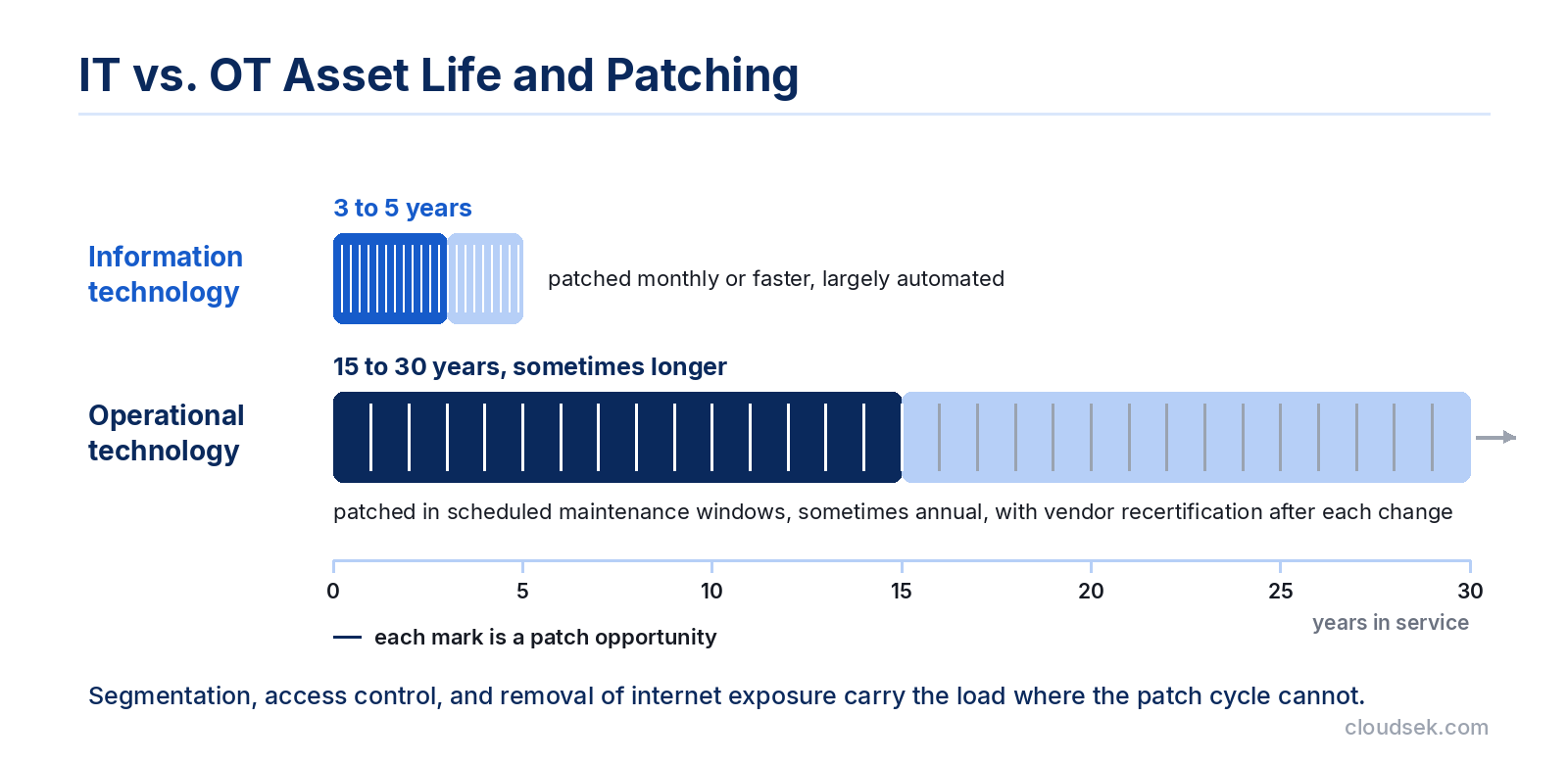
That difference in consequence drives every other distinction between the two domains. An enterprise server gets patched on a monthly cycle and rebooted overnight, whereas a programmable logic controller running a chemical process operates for twenty years without interruption because stopping it costs more than the vulnerability it carries.
Both domains once operated on separate networks with little traffic between them. Industrial connectivity, remote monitoring, and cloud analytics dissolved that separation, and attackers now reach physical processes through the enterprise network that sits above them.
Eight attributes separate IT from OT in practice, covering what each domain manages, how long its assets live, and what a failure costs.
Security priority order and patching cadence carry most of the practical weight. Priority order determines how a security team responds to a live incident, and patching cadence determines which controls remain available once a vulnerability is published.
Information technology covers the systems that create, store, move, and secure business data. Enterprise offices, data centers, and cloud platforms run on IT, and the domain spans servers, databases, applications, identity systems, endpoints, and the networks connecting them.
Design assumptions in IT favor change. Systems get refreshed on 3-5 year cycles, software updates deploy continuously, and virtualization makes a compromised server disposable. When an IT asset behaves unexpectedly, isolating it from the network is a standard first response that carries limited operational cost.
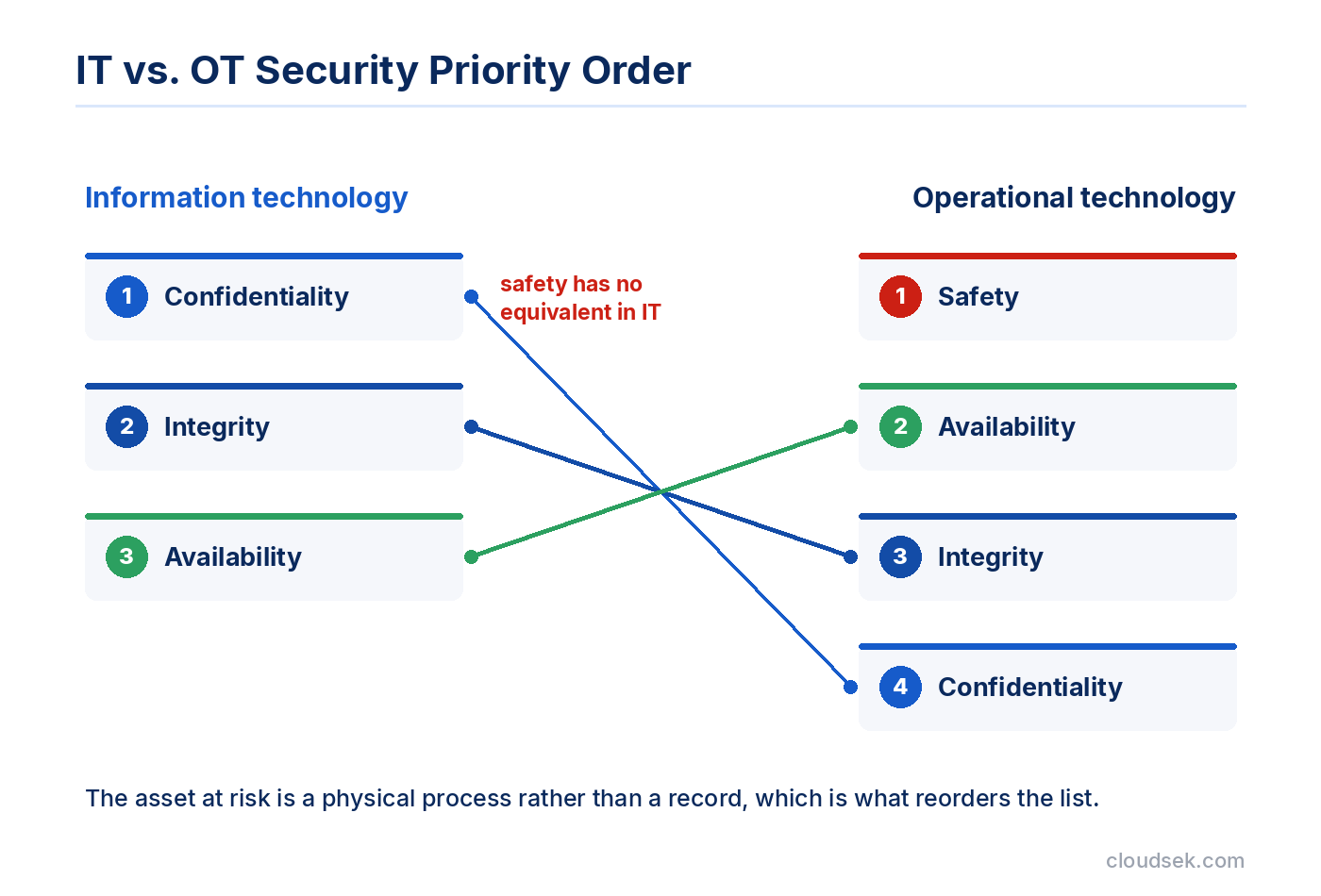
Confidentiality leads the priority order because the asset being protected is information. A breach that exposes customer records causes regulatory, financial, and reputational damage even when every system stays online throughout.
Operational technology controls physical equipment and the industrial processes that equipment performs. Factories, refineries, power stations, water treatment plants, rail networks, and building management systems depend on OT to hold temperatures, pressures, flow rates, and machine states within safe operating ranges.
Six device classes make up most OT environments:
Availability and safety outrank confidentiality throughout this stack. Process data holds little value to an attacker compared with the ability to change a setpoint, and an OT operator treats an unexpected shutdown as more damaging than an information disclosure.
Industrial architecture follows the Purdue Enterprise Reference Architecture, which organizes systems into hierarchical levels and places a controlled boundary between operational and enterprise zones. Understanding where that boundary sits explains how IT and OT actually connect.
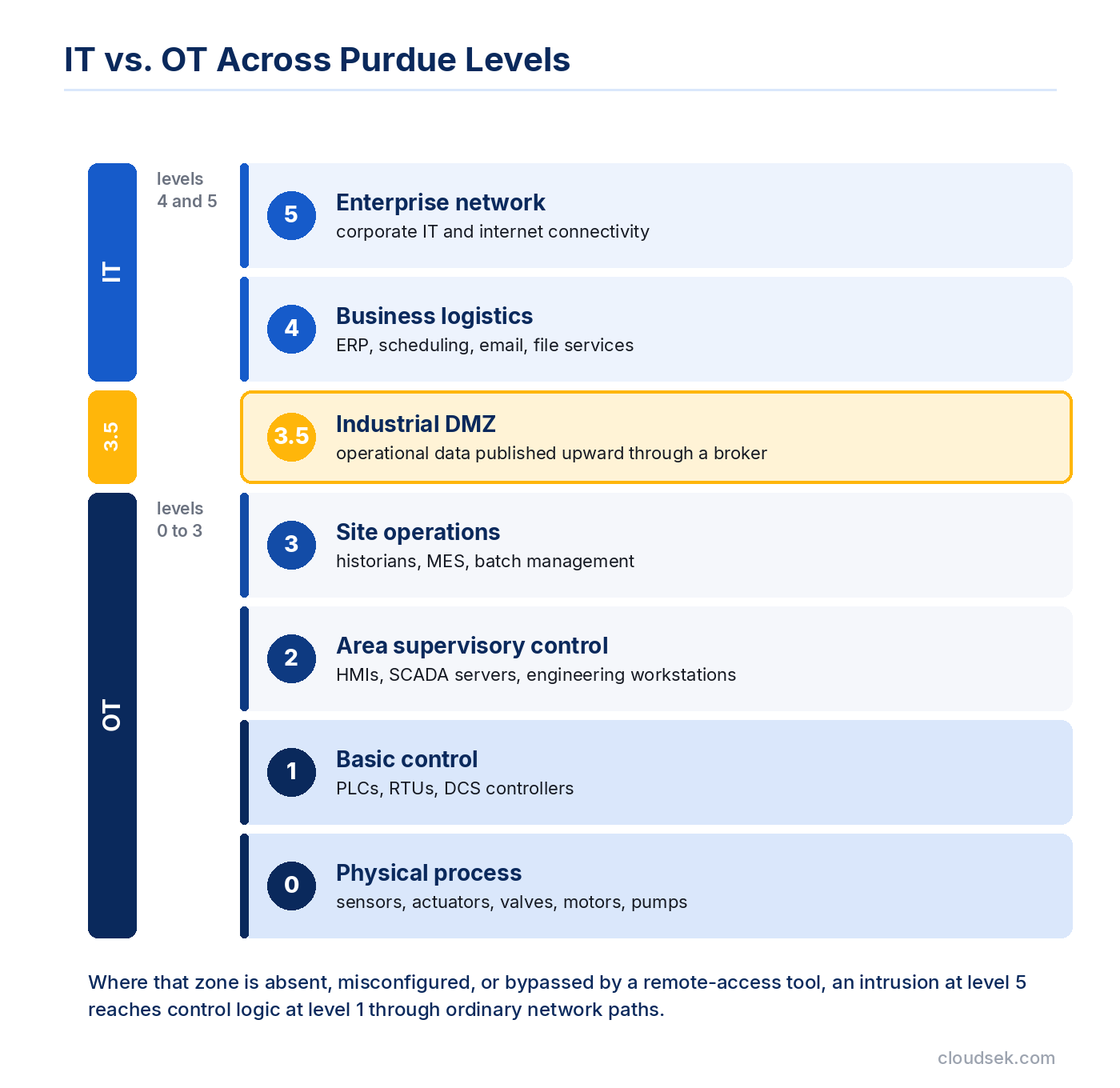
Levels 0 through 3 constitute OT, levels 4 and 5 constitute IT, and level 3.5 is the control that keeps them apart. Where that demilitarized zone is absent, misconfigured, or bypassed by a remote-access tool, an intrusion at level 5 reaches control logic at level 1 through ordinary network paths.
IT security ranks confidentiality first and availability last, and OT security reverses that order because the asset at risk is a physical process rather than a record. NIST Special Publication 800-82, the federal guide to operational technology security, frames OT protection around performance, reliability, and safety requirements that have no equivalent in enterprise environments.
Stuxnet established the stakes in 2010. The worm reached Siemens controllers governing uranium enrichment centrifuges at Natanz, altered their rotational speed, and replayed normal readings to operators while roughly a thousand centrifuges tore themselves apart. No purely information-focused breach produces that outcome, because destroying the equipment required commanding it.
Safety systems became targets seven years later. TRITON, discovered in 2017, was written specifically to manipulate safety instrumented systems, which represent the final barrier between an abnormal process condition and a physical disaster. An attack on that layer removes the protection that every other control assumes is present.
Applying a patch to a controller running a live process requires stopping the process, and plants schedule those windows months in advance. Vendor certification adds further delay, since modifying software on a certified safety or process control system voids validation until the vendor requalifies the configuration.
Compensating controls carry the load as a result. Network segmentation, strict access control, protocol-aware monitoring, and removal of internet exposure substitute for the patch cycle that IT environments rely on, which makes asset visibility more valuable in OT than vulnerability counts.
Modbus, DNP3, S7comm, and BACnet were designed for isolated, trusted networks and carry no native authentication or encryption. A device listening on Modbus TCP port 502 accepts read and write commands from any host that reaches it, which means network reachability is equivalent to control authority.
OPC UA introduced authentication and encryption to close this gap, and adoption remains partial across installed equipment. Legacy protocols continue to run in production because replacing a controller means replacing the process it governs.
IT/OT convergence is the integration of enterprise and industrial systems, where operational data guides business decisions and business systems connect to operational realities. Four main forces drive this shift :
Each of these delivers measurable operational benefit, and each creates a route between the enterprise network and control systems. Third-party access compounds the effect, because integrators and managed service providers install remote-access tooling on OT networks that inherits the trust of the environment it sits in, a pattern examined further in CloudSEK’s guidance on preventing supply chain attacks.
Three routes carry attackers from enterprise networks into industrial control, according to CloudSEK’s assessment of ICS and OT targeting, which mapped both the active threat actors and the size of the exposed attack surface. The routes are not mutually exclusive, and the least sophisticated one carries the highest volume.
Route three produces the longest dwell times and the highest potential impact. CISA, the NSA, and the FBI reported that Volt Typhoon maintained access inside some US critical infrastructure environments for at least five years, using only built-in operating system tools such as netsh, wmic, and ntdsutil so that signature-based detection had nothing to match. Their assessment describes pre-positioning for disruption rather than espionage, with observed capability to reach controls governing energy and water systems.
Financially motivated intrusion follows the same paths toward a different objective. A ransomware operator who encrypts scheduling, historian, and MES systems at level 3 halts production without ever touching a controller, because a plant that cannot track what it is making stops making it. Targeted email remains the common entry point across both motives, which places spear phishing defenses among the more consequential OT controls despite belonging to the IT domain.
Six sectors run substantial estates in both IT and OT Systems, and the division of responsibility follows a consistent pattern across all of them.
Water utilities carry the sharpest version of the problem. Small operators run OT estates comparable to those of far larger organizations while funding security from municipal budgets, which produces the combination of exposed equipment and default credentials that attackers locate first.
Securing a converged environment starts with removing exposure rather than deploying detection, because the highest-volume attacks require no exploitation. Work through the following priorities in order.
Governance carries as much weight as tooling. Clear ownership of the boundary between domains prevents the gap where IT assumes operations secures the plant and operations assumes IT secures the network, and applying zero trust principles to the crossing points enforces verification on the traffic that convergence created.
Separation between IT and OT was once a matter of physical fact, with different networks, different vendors, and different staff. Convergence removed that separation as an accident of architecture and turned it into something organizations now maintain deliberately or lose entirely.
Practical security follows from respecting what makes each domain distinct. IT controls applied without modification to a plant floor interrupt processes they were never scoped to understand, and operational practices applied to enterprise systems leave data exposed. Organizations that keep the boundary explicit, monitored, and owned by a named team hold the benefits of connected operations without inheriting the failure modes of both domains at once.
No. Operational technology is a separate domain with its own assets, protocols, priorities, and lifecycles. Many organizations place both under one executive, and that reporting structure does not merge the technical disciplines.
No. SCADA is one supervisory component within OT, responsible for aggregating data from distributed controllers. Operational technology is the wider category that includes PLCs, DCS platforms, safety systems, sensors, and building automation.
Yes. Most industrial protocols now run over Ethernet and TCP/IP, including Modbus TCP and EtherNet/IP. Shared transport with enterprise networks is precisely what makes segmentation between the domains necessary.
It can run on Windows-based engineering workstations and HMIs where the vendor has certified it. Embedded controllers cannot host an agent at all, and scanning during production risks introducing latency into a timing-sensitive process.
Ownership works best as a joint model with a single accountable executive. Operations understands process safety and tolerances, security understands adversary behavior, and unilateral decisions from either side produce controls that break production or defenses that never get deployed.
No. Industrial IoT describes networked sensors and edge devices that add connectivity and analytics to industrial settings. Traditional OT was built for isolated operation, while IIoT devices assume network connectivity from the outset and communicate directly with cloud platforms.
