🚀 أصبحت CloudSek أول شركة للأمن السيبراني من أصل هندي تتلقى استثمارات منها
اقرأ المزيد


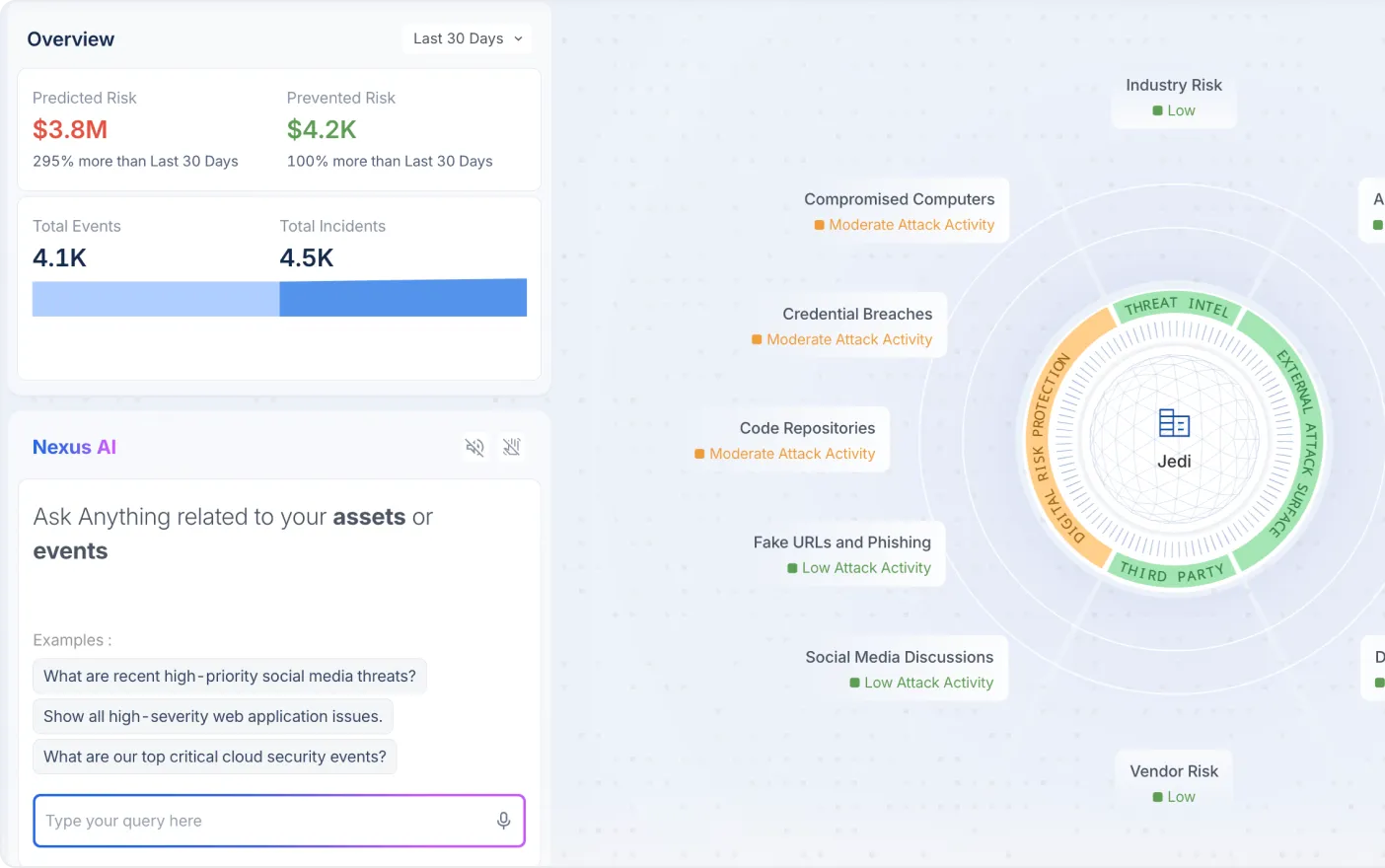
CloudSEK XVigil detects leaked usernames, passwords, API keys, and cloud credentials across cybercrime forums, paste sites, code repositories, and Telegram, so security teams can rotate them before they are used.


















تثق الشركات العالمية وشركات Fortune 500 في CloudSEK لتعزيز وضعها في مجال الأمن السيبراني.
Leaked credential detection is the continuous search of cybercrime forums, dark web marketplaces, paste sites, code repositories, and combo lists for usernames, passwords, and access keys that belong to an organization.
Credential leak monitoring is the same practice run without pause, so each new exposure is caught when it appears and not at the next audit.
CloudSEK XVigil for leaked credential detection
CloudSEK XVigil is a digital risk protection platform that monitors the surface, deep, and dark web for an organization's exposed credentials, verifies each finding, and alerts the security team so the credentials can be rotated.
XVigil reports each of these credential types when it matches an organization's assets.

XVigil checks a seven-year historical credential breach database for employee usernames and passwords that could lead to account takeover.

XVigil scans paste sites and forums for exposed server credentials tied to an organization.

XVigil identifies exposed API keys in repositories, paste sites, and underground sources.

XVigil identifies exposed cloud credentials, so they can be rotated before they give access to cloud environments.

XVigil detects an organization's credentials exposed by vendors, contractors, and service providers.

XVigil uses a data lake of historical breach data to surface credentials that leaked before monitoring began.
Leaked credentials move between sources as they are dumped, compiled, and resold. XVigil scans each of these sources continuously and matches findings to an organization's domains and subdomains.
Cybercrime forums are discussion boards where threat actors share and trade stolen logins. XVigil scans these forums for credentials tied to an organization.
(i) Leaked data and data trade threads
(ii) Posts that name an organization's domains
(iii) Forums that sit behind a login wall

Dark web marketplaces are anonymous storefronts where credentials and access are listed for sale. XVigil monitors thousands of them.
- Listings that name an organization's accounts
- A historical reference of previous listings
- Free and login-gated marketplaces
Combo lists are compiled files of username and password pairs that attackers feed into credential stuffing tools. XVigil scans combo lists continuously for credential matches.
- Pairs that match an organization's email domains
- Newly circulated lists
- Older lists held in historical breach data
Paste sites are text-sharing pages often used to dump credentials. XVigil scans paste sites for exposed logins.
- Credential dumps
- Exposed server credentials
- Configuration snippets that contain passwords
Code repositories such as GitHub and Bitbucket can expose credentials inside code, files, and descriptions. XVigil monitors repositories for an organization's assets.
- Passwords written into code
- Exposed API keys
- Exposed cloud credentials
Telegram channels are encrypted channels that threat actors use to share and sell stolen logins. XVigil scans these channels for credentials tied to an organization.
- Channels that post credential dumps
- Channels that sell access
- Conversations that reference an organization
Credential leak monitoring in XVigil runs as a continuous four-step loop, from asset mapping to rotation.
XVigil's digital fingerprinting maps domains and subdomains, which defines the credentials that belong to the organization.
XVigil scans forums, paste sites, repositories, Telegram, and combo lists continuously, and checks a data lake of historical breach data.
XVigil's verification confirms that a leaked credential is authentic, then raises an actionable alert.
The security team rotates the exposed credentials and reviews access, which closes the initial access vector.
Leaked credentials let an attacker log in instead of breaking in. A valid username and password passes perimeter controls, and the same pair is often tried on other services through credential stuffing. From one working login, the attack path can extend to account takeover, business email compromise, and data theft.
Leaked credential detection shortens the time an exposed login stays usable. XVigil flags the exposure when it appears on a monitored source, which gives the security team the chance to rotate the credential before it becomes the first step of an attack path.
The deciding difference is whether an exposed login is found when it leaks or after it has been used.


When leaked credentials are detected, the first action is to reset or rotate them, and the second is to check whether they were used.
XVigil runs on CloudSEK's proprietary AI and machine learning models, which produce specific, actionable, and timely warnings.
Verified alerts
XVigil confirms that leaked data is authentic before it reaches the security team.
Actionable alerts
Each XVigil alert names the exposed credential and the matched asset, ready for rotation.
High priority alerts so far
Rated by our Customers
Credentials in the historical data lake
Sources monitored
Email domain matched. Recommended: reset the password and end sessions.
Subdomain matched. Recommended: rotate the key.
Email domain matched. Recommended: confirm the password was changed.
Leaked credential detection is the continuous search of cybercrime forums, dark web marketplaces, paste sites, code repositories, and combo lists for usernames, passwords, and access keys that belong to an organization. Leaked credential detection covers employee passwords, server credentials, API keys, and cloud credentials. Security teams use it to rotate an exposed credential before an attacker logs in with it.
Credential leak monitoring works by mapping an organization's assets, scanning the sources where credentials are traded, and matching what is found. In CloudSEK XVigil, digital fingerprinting maps domains and subdomains, and continuous scanning covers cybercrime forums, paste sites, repositories, Telegram channels, and combo lists. Verification confirms that a finding is authentic before an alert is raised.
Leaked credentials are logins that have been exposed outside an organization, while compromised credentials are logins an attacker has obtained and can use. A leak becomes a compromise when the exposed username and password are still valid. Leaked credential detection aims to close that gap by flagging the exposure early enough for the password to be changed.
Credentials get leaked through third-party data breaches, phishing, infostealer malware on employee devices, and secrets committed to public code repositories. Password reuse widens the damage, because a login stolen from one service is tried on others. Once exposed, credentials are compiled into combo lists and traded on forums, marketplaces, and Telegram channels.
Leaked credentials appear on dark web marketplaces, cybercrime forums, paste sites, public code repositories, and encrypted channels such as Telegram. Many are bundled into combo lists that attackers feed into credential stuffing tools. CloudSEK XVigil scans these sources continuously and matches findings to an organization's domains and subdomains.
A company can check if employee credentials have been leaked by searching breach data for its email domains. A free starting point is the CloudSEK Data Exposure Checker, which shows whether an organization's data appears in a known data breach. For ongoing coverage, CloudSEK XVigil monitors forums, paste sites, repositories, and combo lists and alerts the security team when a verified match appears.
A security team should reset the exposed password and end active sessions as soon as leaked credentials are detected. The next steps are to rotate any exposed API keys or cloud credentials, review recent logins on the affected accounts, and enforce multi-factor authentication. The team should then trace how the credential leaked, so the same source does not expose more accounts.
CloudSEK XVigil detects leaked credentials. XVigil is CloudSEK's digital risk protection platform, and it identifies exposed usernames, passwords, API keys, and cloud credentials across the surface, deep, and dark web. A data lake of historical breach data lets XVigil surface both new and previously exposed credentials, and each verified finding arrives as an actionable alert.
Leaked credential detection is narrower than dark web monitoring. Dark web monitoring tracks every kind of exposure on hidden sources, including stolen data, source code, and threat actor conversations. Leaked credential detection focuses on logins and access keys, and it also covers surface sources such as public code repositories. CloudSEK XVigil delivers both from one asset list.
Leaked credential detection does not replace multi-factor authentication. The two work together, and each covers a different point in an attack path. Multi-factor authentication adds a check at login. Leaked credential detection tells the security team which passwords and keys are exposed, so they can be rotated before anyone tries them.